



Autonomous Freight Trucks Market Size is USD 575.7 Million in 2026
Autonomous Freight Trucks Market (By Type: New Energy Trucks, Traditional Fuel Trucks; By Application: Logistics, Port, Other; By Region: North America, Europe, Asia-Pacific, Latin America, Middle East & Africa) Industry Size, Share, Growth, Trends 2026 to 2035.


The autonomous freight trucks market size was estimated at USD 475 million in 2025 and is predicted to increase from USD 575.7 million in 2026 to approximately USD 3,248.78 million by 2035, expanding at A CAGR of 21.2% from 2026 to 2035. As freight companies grapple with heightened demand and a driver shortage, autonomous trucks offer a viable solution to these challenges, potentially boosting the autonomous freight trucks market growth.
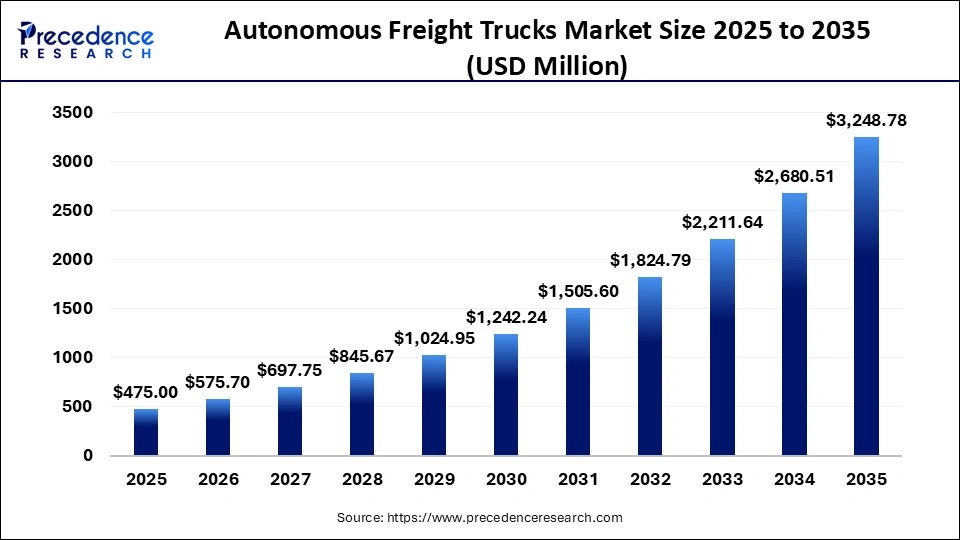
Autonomous Freight Trucks Market Statical Scope
| Reports Attributes | Statistics |
| Market Size in 2025 | USD 475 Million |
| Market Size in 2026 | USD 575.7 Million |
| Market Size by 2035 | USD 3,248.78 Million |
| CAGR 2026 to 2035 | 21.2% |
| Base Year | 2025 |
| Forecast Period | 2026 to 2035 |
Autonomous trucking is characterized by self-driving vehicles that employ sensors, cameras, and advanced software to navigate with minimal or no human intervention. These vehicles are capable of maintaining lane discipline, monitoring traffic, adjusting speed, and performing actions such as braking and lane changes autonomously. Investment in self-driving freight trucks positions fleets to operate safer, more efficiently, and with greater longevity. Notably, several major corporations are committing substantial resources to the development of electric semi-trucks that are self-driving.
Transportation costs have risen substantially in recent years, driven by increasing driver salaries and escalating expenses related to fuel and tolls. These costs are expected to rise further due to the implementation of stricter emissions standards and a transition toward zero-emission vehicles. However, these additional costs may be significantly mitigated by the reduced operational expenses associated with autonomous driving technology.
The persistent shortage of qualified drivers and elevated labor costs are further motivating industry stakeholders to expedite the adoption of autonomous trucking solutions, thereby propelling the sector's growth. Government initiatives, including grants and favorable regulatory frameworks, are also enhancing adoption rates.
Market participants are making considerable investments in AI-powered driving systems, real-time data analytics , and integrated vehicle-to-everything communication technologies to facilitate the operation of trucks with minimal human oversight. Companies such as Amazon Freight are leveraging machine learning to optimize routing and inventory management, adapting to real-time traffic conditions and demand forecasts.
Autonomous trucks are set to transform long-haul transportation by enhancing safety, lowering labor costs, and optimizing fuel efficiency. Research indicates that firms like Waymo and TuSimple have achieved significant fuel savings through the deployment of autonomous vehicle fleets.
Industry leaders, including Tesla, Waymo, TuSimple, and Embark, are at the forefront of innovation in the autonomous trucking sphere. These companies are allocating substantial resources to research and development aimed at improving safety, reliability, and scalability. Strategic partnerships are vital; for example, TuSimple's collaboration with UPS is currently evaluating autonomous freight routes to enhance delivery network efficiencies.
The outlook for autonomous freight trucking is promising, driven by ongoing advancements in artificial intelligence and automation technologies. Future smart trucks can adapt to varied environments, while connected infrastructure can facilitate streamlined logistics operations.
Autonomous Freight Trucks Market Share, By Region, 2025 (%)
| Regions | Shares (%) |
| North America | 32% |
| Europe | 27% |
| Asia Pacific | 26% |
| Latin America | 8% |
| Middle East & Africa | 7% |
Autonomous Freight Trucks Market Share, By Type, 2025 (%)
| Segments | Shares (%) |
| Traditional Fuel Trucks | 72% |
| New Energy Trucks | 28% |
- Traditional Fuel Trucks – It leads autonomous fleet deployment and, with a 72% share, dominates due to existing diesel infrastructure and operational familiarity.
- New Energy Trucks – It is expanding with electrification trends and, with a 28% share, is driven by growing EV adoption and sustainability initiatives.
Autonomous Freight Trucks Market Share, By Application, 2025 (%)
| Segments | Shares (%) |
| Logistics | 64% |
| Port | 21% |
| Other (Mining, Construction, etc.) | 15% |
- Logistics – It drives primary demand for autonomous freight and, with a 64% share, benefits from e-commerce growth and long-haul transportation needs.
- Port – It supports controlled environment operations and, with a 21% share, remains limited to port-specific use cases.
- Other (Mining, Construction, etc.) – It covers niche industrial applications and, with a 15% share, is constrained by specialized and fragmented demand.
Top Companies in the Autonomous Freight Trucks Market
- Volvo
- Daimler
- TuSimple
- Tesla
- Waymo
- Westwell
- PlusAI
- Pony.ai
- Kodiak Robotics
- Suzhou Zhitu Technology
- Inceptio Technology
- BYD
Segments Covered in the Report
By Type
- New Energy Trucks
- Traditional Fuel Trucks
By Application
- Logistics
- Port
- Other
By Region
- North America
- Europe
- Asia Pacific
- Latin America
- Middle East & Africa
Research Methodology
Related Databooks
April 2026
April 2026
June 2026
June 2026


 sales@precedenceresearch.com
 +1 804-441-9344
 Download Databook
 Schedule a Meeting