



Hydrogen Powered eVTOL Aircraft Market Size is USD 101.73 Million in 2026
Hydrogen Powered eVTOL Aircraft Market (By Type: <100 km, 100–1000 km; By Application: Passenger Transportation, Logistics Transportation; By Region: North America, Europe, Asia-Pacific, Latin America, Middle East & Africa) Industry Size, Share, Growth, Trends 2026 to 2035.


The hydrogen-powered eVTOL aircraft market size was estimated at USD 86.07 million in 2025 and is predicted to increase from USD 101.73 million in 2026 to approximately USD 458.17 million by 2035, expanding at A CAGR of 18.2% from 2026 to 2035. Growing demand for zero-emission aviation energy and superior energy density as compared to batteries is driving the hydrogen-powered eVTOL aircraft market.
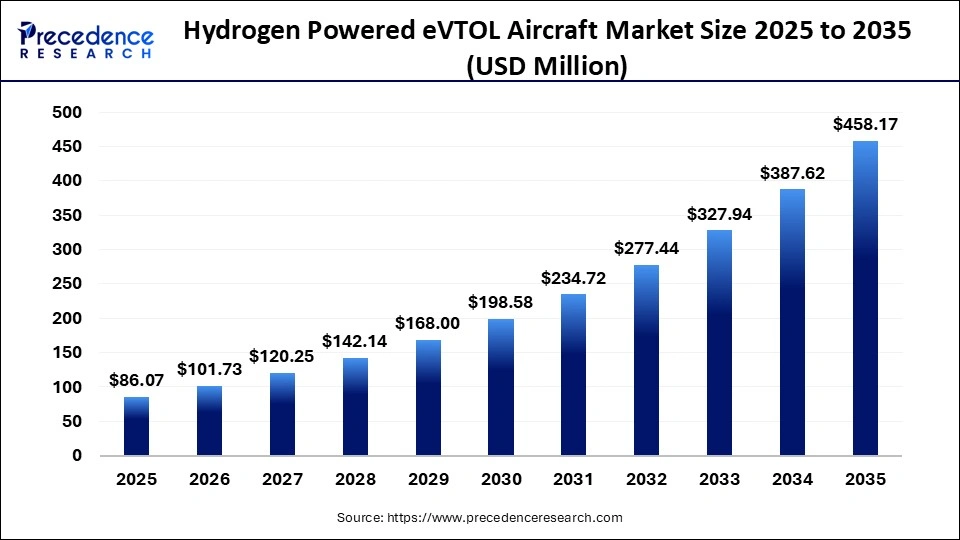
Hydrogen Powered eVTOL Aircraft Market Statical Scope
| Reports Attributes | Statistics |
| Market Size in 2025 | USD 86.07 Million |
| Market Size in 2026 | USD 101.73 Million |
| Market Size by 2035 | USD 458.17 Million |
| CAGR 2026 to 2035 | 18.2% |
| Base Year | 2025 |
| Forecast Period | 2026 to 2035 |
Hydrogen-powered eVTOL aircraft are set to transform urban and regional air mobility by offering a zero-emission alternative to traditional rotorcraft and short-haul airliners. This market research report explores the combination of advancements in electric propulsion and improvements in hydrogen fuel cell efficiency. By utilizing high-energy-density storage and rapid refueling cycles, operators can extend the range of these aircraft while minimizing downtime. This supports new use cases, including on-demand air taxi services, emergency response missions, and last-mile logistics.
Switching from battery power systems to hydrogen fuel cells can significantly enhance range, lower maintenance costs associated with battery cycling, and improve operational efficiency due to quicker turnaround times. Many countries are developing national hydrogen strategies to maximize the use of hydrogen technologies in sectors like aviation. For example, various regions have begun investing in the infrastructure necessary for hydrogen production, storage, and distribution.
This infrastructure is crucial for the large-scale deployment of hydrogen aircraft. Government support for this sector can not only foster innovation but also encourage private sector investment in hydrogen technologies, thereby accelerating market development.
In addition to having a broad range of potential applications, eVTOLs offer environmental benefits due to their reliance on electric power. Recent advancements in hydrogen fuel cell technology are a major factor driving the development of hydrogen-powered eVTOLs. Breakthroughs in power density and durability have made fuel cell stacks suitable for the demanding power requirements of vertical take-off and landing.
The growth of robust regulatory support and government-led green aviation initiatives significantly boosts the hydrogen eVTOL aircraft market. Governments around the world are implementing ambitious decarbonization targets for the aviation industry, creating a favorable policy environment for zero-emission technologies. Hydrogen-powered eVTOL aircraft represent a transformative shift in the future of flight. With advantages such as superior endurance, rapid refueling, and eco-friendly operation, they surpass traditional lithium-battery and fossil-fuel systems.
Hydrogen Powered eVTOL Aircraft Market Share, By Region, 2025 (%)
| Regions | Shares (%) |
| North America | 36% |
| Europe | 27% |
| Asia Pacific | 24% |
| Latin America | 7% |
| Middle East & Africa | 6% |
Hydrogen Powered eVTOL Aircraft Market Share, By Type, 2025 (%)
| Segments | Shares (%) |
| <100 km | 62% |
| 100–1000 km | 38% |
- <100 km – It leads early deployment use cases and, with a 62% share, dominates due to focus on short-range urban air mobility operations.
- 100–1000 km – It supports longer regional travel and, with a 38% share, lags due to current technological and infrastructure limitations.
Hydrogen Powered eVTOL Aircraft Market Share, By Application, 2025 (%)
| Segments | Shares (%) |
| Passenger Transportation | 68% |
| Logistics Transportation | 32% |
- Passenger Transportation – It drives primary demand in urban air mobility and, with a 68% share, benefits from strong focus on passenger transit solutions.
- Logistics Transportation – It is expanding in cargo delivery use cases and, with a 32% share, is driven by faster growth in logistics applications.
Top Companies in the Hydrogen Powered eVTOL Aircraft Market
- Siriusjet
- Airbus
- Airspace Experience Technologies
- Aurora Flight Sciences
- NEX Aero
- AMSL Aero
- Embraer
- Joby
- Alaka'i Technologies
- Neva Aerospace
Segments Covered in the Report
By Type
- <100km
- 100-1000km
By Application
- Passenger Transportation
- Logistics Transportation
By Region
- North America
- Europe
- Asia Pacific
- Latin America
- Middle East & Africa
Research Methodology
Related Databooks
April 2026
April 2026
April 2026
April 2026


 sales@precedenceresearch.com
 +1 804-441-9344
 Download Databook
 Schedule a Meeting