



Marine Digital Twin Market Size is USD 822.38 Million in 2026
Marine Digital Twin Market (By Type: Cloud Digital Twin, Edge Digital Twin, Hybrid Digital Twin; By Application: Marine Environment, Marine Infrastructure, Marine Transportation, Others; By Region: North America, LAMEA, Europe, Asia-Pacific) Industry Size, Share, Growth, Trends 2026 to 2035.

The marine digital twin market size was estimated at USD 765 million in 2025 and is predicted to increase from USD 822.38 million in 2026 to approximately USD 1,576.69 million by 2035, expanding at A CAGR of 7.50% from 2026 to 2035. Growth of the market is mainly driven by the need for real-time monitoring, predictive maintenance, and enhanced vessel efficiency.
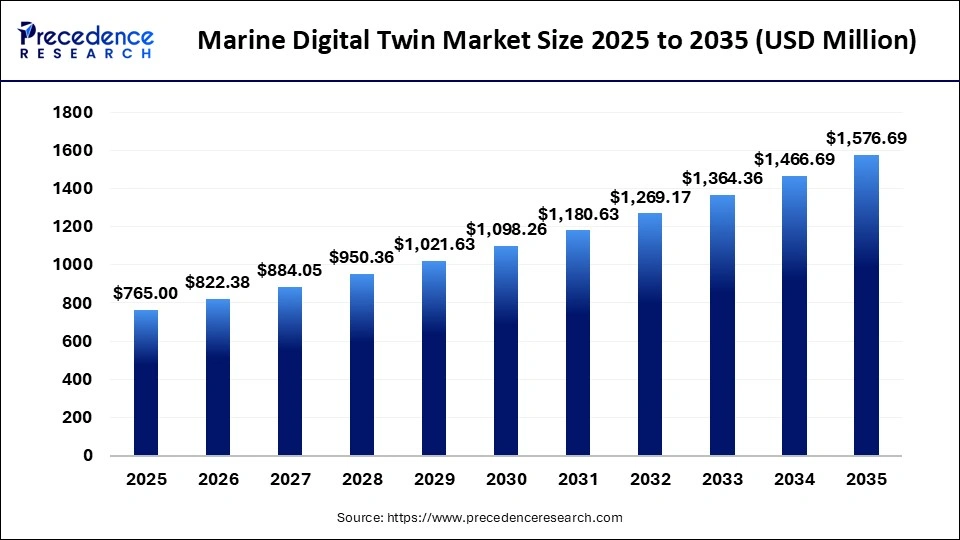
Marine Digital Twin Market Statical Scope
| Reports Attributes | Statistics |
| Market Size in 2025 | USD 765 Million |
| Market Size in 2026 | USD 822.38 Million |
| Market Size by 2035 | USD 1,576.69 Million |
| CAGR 2026 to 2035 | 7.50% |
| Base Year | 2025 |
| Forecast Period | 2026 to 2035 |
A digital twin is a precise replication of a physical entity, designed to evolve into a comprehensive framework that simulates a dynamic real-world environment. Digital twins are connected to physical entities through a network of live data-generating sensors and software components. To understand the oceans, accurate monitoring and suitable testing environments are necessary for conducting hypothesis-driven simulations. Marine digital twins can play a vital role in advancing knowledge toward a sustainable blue economy.
Digital twinning enables global high-resolution ocean forecast models to integrate real-time data with risk reduction and management strategies. This enhances early warning systems, improves the effectiveness of national and local mitigation and adaptation strategies, and builds resilience in vulnerable communities. Growth in this area is supported by the widespread deployment of digital twin solutions across shipyards, vessel fleets, ports, and offshore facilities, as organizations strive to improve asset lifecycle management, reduce unplanned downtime, and strengthen operational control.
In the marine sector, digital twins are increasingly utilized to optimize fuel consumption and monitor emissions, which supports compliance with strict environmental regulations and enhances sustainability in commercial shipping operations. Smart port initiatives leverage digital twins for traffic flow management, optimizing berth allocation, and improving cargo handling efficiency, ultimately boosting overall port operational effectiveness. Shipbuilders and marine equipment manufacturers are using digital twins during design, construction, and testing phases to simulate performance, shorten development cycles, and reduce engineering costs.
AI systems can seamlessly integrate within digital twin environments, adding valuable layers of significance that can greatly increase the return on investment (ROI) for vessels and fleets. Anomaly detection is another key strength of maritime AI; utilizing digital twin data, AI systems can identify operational deviations in real-time ranging from unexpected engine performance and unusual fuel consumption to deviations from standard operating procedures and misalignment with maritime regulations.
Global government initiatives for marine digital twins are rapidly advancing, focusing on smart ports, sustainable shipping, and ocean monitoring to meet net-zero targets by 2050. For example, the DITTO program aims to support ocean protection, governance, and a sustainable blue economy through the use of Digital Twins of the Ocean (DTOs). It seeks to develop a common understanding of DTOs, establish best practices, and create a digital framework to empower ocean professionals worldwide.
Marine Digital Twin Market Share, By Region, 2025 (%)
| Regions | Shares (%) |
| North America | 45% |
| Europe | 30% |
| Asia Pacific | 15% |
| Latin America | 5% |
| Middle East & Africa | 5% |
- North America - North America leads the market with 45% of the share, driven by advanced healthcare infrastructure, significant research funding, and the strong presence of leading pharmaceutical companies and research institutions, particularly in CAR T-cell therapy development.
- LAMEA - The LAMEA region (Latin America, the Middle East, and Africa) holds 30% of the market, a smaller share due to limited healthcare infrastructure and fewer resources for advanced cancer treatments, though interest is growing in some countries.
- Europe - Europe holds 15% of the market, with strong healthcare systems and research efforts, although it lags behind North America due to slower regulatory approvals and market adoption of novel therapies like CAR T-cell treatments.
- Asia-Pacific - Asia-Pacific, holding 5% of the market, is gaining momentum due to rising investments in healthcare infrastructure, an increasing focus on biotech innovations, and an expanding population that is driving demand for advanced therapies like CAR T-cell treatments.
- Middle East & Africa - Does not dominate with 5%, though the region is starting to explore digital twin applications, particularly in resource management and infrastructure development.
Marine Digital Twin Market Share, By Type, 2025 (%)
| Segments | Shares (%) |
| Cloud Digital Twin | 50% |
| Edge Digital Twin | 30% |
| Hybrid Digital Twin | 20% |
- Cloud Digital Twin - Dominates with 50% due to its ability to provide scalable, flexible, and centralized management of digital twins, making it the most widely adopted type for large, complex systems.
- Edge Digital Twin - Gaining momentum with 30% as the need for real-time data processing and decision-making closer to the source drives growth, especially in industries requiring low latency.
- Hybrid Digital Twin - Does not dominate with 20%, but it is used for scenarios that require a balance of cloud and edge computing capabilities for optimized performance and flexibility.
Marine Digital Twin Market Share, By Application, 2025 (%)
| Segments | Shares (%) |
| Marine Environment | 35% |
| Marine Infrastructure | 30% |
| Marine Transportation | 25% |
| Others | 10% |
- Marine Environment - Dominates with 35% due to the growing focus on environmental sustainability, conservation efforts, and the management of marine ecosystems, where digital twins are essential for data collection and analysis.
- Marine Infrastructure- Does not dominate with 30%, but marine infrastructure applications such as ports and offshore platforms are becoming increasingly reliant on digital twin technology for maintenance and optimization.
- Marine Transportation- Does not dominate with 25%, though digital twins in marine transportation are gaining traction for optimizing logistics, route planning, and fleet management.
- Others - Does not dominate with 10%, representing smaller or niche applications of digital twin technology in the marine industry.
Top Companies of Marine Digital Twin Market
- EDITO
- Fujitsu
- MetaTwin Space
- ARCFISH
- Sercel
- Ocean Infinity
- UASNL
- Esri
- Arup
- Digital Twin Marine
- Marine Digital
- SailPlan
- Eiwaa Group
Segments Covered in the Report
By Type
- Cloud Digital Twin
- Edge Digital Twin
- Hybrid Digital Twin
By Application
- Marine Environment
- Marine Infrastructure
- Marine Transportation
- Others
By Region
- North America
- Europe
- Asia Pacific
- Latin America
- Middle East & Africa
| Type | 2025 | 2026 | 2027 | 2028 | 2029 | 2030 | 2031 | 2032 | 2033 | 2034 | 2035 |
|---|---|---|---|---|---|---|---|---|---|---|---|
| Cloud Digital Twin | 388.20 | 409.48 | 450.62 | 496.89 | 507.23 | 545.27 | 618.28 | 649.20 | 672.57 | 745.28 | 777.38 |
| Edge Digital Twin | 226.29 | 248.50 | 249.99 | 270.35 | 301.32 | 319.47 | 357.53 | 370.38 | 391.97 | 459.35 | 469.80 |
| Hybrid Digital Twin | 153.31 | 157.44 | 173.92 | 190.70 | 197.27 | 222.13 | 231.87 | 251.61 | 267.95 | 309.64 | 315.21 |
| Application | 2025 | 2026 | 2027 | 2028 | 2029 | 2030 | 2031 | 2032 | 2033 | 2034 | 2035 |
|---|---|---|---|---|---|---|---|---|---|---|---|
| Marine Environment | 259.25 | 294.93 | 298.09 | 334.71 | 336.55 | 369.07 | 415.66 | 454.05 | 479.98 | 511.56 | 546.86 |
| Marine Infrastructure | 219.32 | 241.38 | 261.55 | 294.15 | 309.65 | 312.05 | 357.63 | 376.35 | 401.00 | 448.08 | 487.64 |
| Marine Transportation | 196.59 | 200.42 | 218.96 | 239.95 | 262.88 | 270.62 | 293.51 | 306.76 | 328.85 | 375.61 | 410.21 |
| Others | 76.33 | 84.71 | 89.36 | 93.20 | 103.27 | 114.89 | 117.94 | 132.87 | 125.71 | 150.29 | 158.08 |
| Region | 2025 | 2026 | 2027 | 2028 | 2029 | 2030 | 2031 | 2032 | 2033 | 2034 | 2035 |
|---|---|---|---|---|---|---|---|---|---|---|---|
| North America | 341.16 | 371.09 | 374.10 | 424.84 | 464.66 | 516.13 | 523.02 | 557.28 | 604.72 | 678.13 | 716.51 |
| Europe | 225.85 | 250.51 | 265.99 | 293.39 | 300.03 | 326.24 | 350.02 | 364.03 | 412.94 | 443.45 | 473.08 |
| Asia-Pacific | 113.94 | 118.12 | 130.93 | 141.09 | 149.56 | 163.94 | 179.24 | 201.15 | 205.73 | 221.70 | 235.98 |
| Latin America | 36.05 | 41.09 | 44.28 | 51.03 | 50.79 | 55.41 | 58.97 | 61.23 | 70.56 | 74.99 | 80.71 |
| Middle East & Africa | 37.21 | 42.85 | 42.34 | 48.35 | 54.44 | 53.28 | 58.03 | 63.65 | 67.19 | 69.92 | 79.00 |
Research Methodology
Related Databooks
March 2026
March 2026
March 2026
March 2026



 +1 804-441-9344
 Download Databook
 Schedule a Meeting