



E-textiles Market Size, Key Companies, Company Production Capacity, Manufacturing Efficiency, Capacity Utilization, Raw Material Consumption, Cost Structure, Export Trends, Company Expansion Strategies, and Competitive Landscape
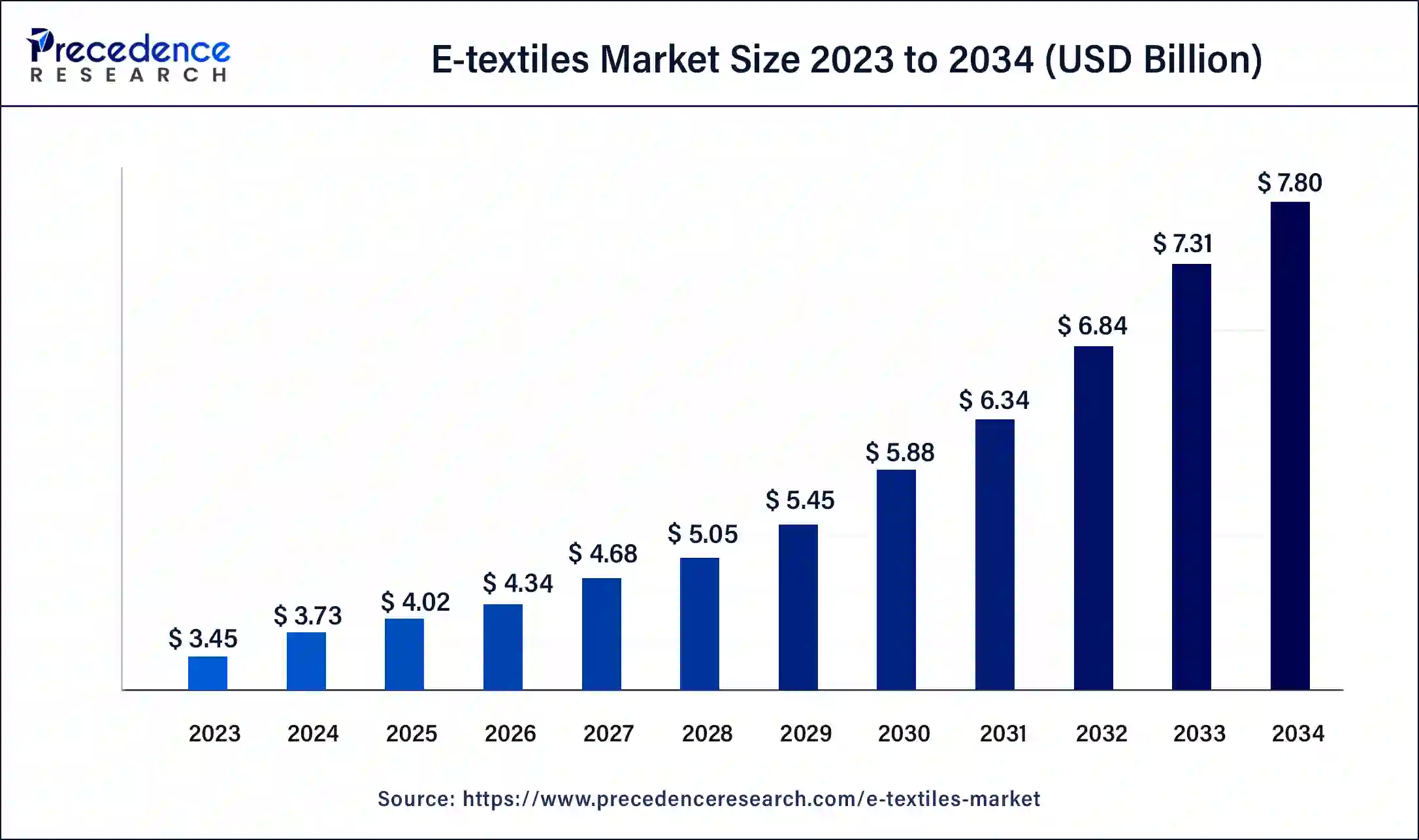
The global E-textiles Market was valued at USD 4.34 billion in 2026 and is projected to reach USD 8.15 billion by 2035, expanding at a CAGR of 7.32% from 2026 to 2035.
Source: https://www.precedenceresearch.com/e-textiles-market
 Get a Sample
 Table Of Content


E-textiles Market Size and Forecast 2026 to 2035
The global e-textiles market size accounted for USD 4.34 billion in 2026 and is anticipated to reach around USD 8.15 billion by 2035, growing at a CAGR of 7.32% from 2026 to 2035 The e-textiles market is driven by rising demand from defence, healthcare, industrial applications and smart fitness apparel.
E-textiles Market Key Takeaways
- North America dominated the market in 2025.
- By function, the sensing segment dominated the market in 2025.
- By function, the energy harvesting segment is anticipated to grow significantly in the market during the forecast period.
- By application , the military segment led the global market in 2025.
- By application, the medical segment is estimated to grow rapidly in the market during the fastest period.
Market Outlook
- Industry growth overview - The e- textile market is expected to expand steadily as wearable technologies, digital healthcare, and sports performance monitoring are gaining wider acceptance.
- Global expansion - The e-textile market is expanding across North America, Europe, and the Asia Pacific due to defence modernization and advanced textile manufacturing.
- Sustainability trends - Manufacturers are increasingly developing recyclable fibres, energy efficient electronic components, and environmentally responsible production methods to reduce waste and meet sustainable goals.
- Startup ecosystem - The startups in the e-textile market are introducing flexible sensors and smart medical garments. The increasing research partnerships and increasing investor interest in wearable electronics are driving the growth of the market.
- Major Investors - The major investments in the e-textile market are from government innovation programs, healthcare companies, defence organization and electronics manufacturers.
Market Overview
The e-textiles market includes fabrics and garments integrated with electronic components such as conductive fibres, sensors, microcontrollers and communication modules. These smart textiles can monitor health conditions, track physical activity and collect real time data. These e textiles are used in industries such as automotive, healthcare, sports and fitness, industrial safety, and defence. The ongoing advances in conductive fibres, flexible sensors and miniature electronic components are improving product reliability and expanding commercial applications. Although high production costs and technical challenges remain, continuous innovation and increasing investment in wearable technologies are expected to strengthen market growth.
AI in the Market
AI is furthering changes within the e-textile industry in terms of innovation, efficiency, and personalization. It can analyze consumer preferences to generate novel textiles, prints, and color schemes while providing smart material selection for applications in medicine and sportswear. AI-powered machine vision aids in waste reduction and improves product quality. It furthermore supports sustainable manufacturing through energy and resource management. Predictive analytics can further demand forecasting, inventory planning, and logistics productivity. Other customer experiences provided through AI include virtual try-ons, chatbots, and product recommendations; analyzing sensor data for health monitoring, power management, and smart clothing innovations.
E-textiles Market Growth Factors
The e-textiles fabrics are embedded with advanced electronic and innovative technologies that provides various functionalities to the users. The rising popularity of the nanotechnologies has and compact electronics has encouraged the development of the e-textiles all over the globe. The e-textiles or e-clothes provides various functions like monitoring the users' movements, tracking the users location, analyzing body temperature, and tracking heart rate and blood pressure. The various technologies such as wireless connectivity, miniaturization of electronics, and internet connectivity has augmented the demand for the e-textiles across various applications such as sports, military, medical, and fashion industries. The potential of the e-textiles market growth is high due to the proliferation of technological advancements and innovations in the intelligent wearable clothing. The rising adoption of the digital technologies in almost every sector is expected to augment the development of the e-textiles industry across the globe. The fashion and the medical equipment manufacturers are estimated to be the most influential segments during the forecast period.
The implementation of the various advanced technologies such as artificial intelligence (AI) and internet of things (IoT) is expected to provide several growth avenues to the market players. Furthermore, technologies such as Bluetooth Low Energy, cloud-computing, and edge computing are used extensively in the e-textiles which can help to track the user's temperature, heart rate, and blood pressure. These technologies can supply the data in real-time and can also help the manufacturers to gain more insights regarding the comfort and discomfort faced by the wearer. These insights will help the manufacturers to design more user-friendly e-textiles and contribute significantly towards the development of the global e-textiles market. However the lack of proper regulations and standards may hinder the market growth. The e-textiles uses electronics that needs to ensure the wearers' safety on priority. The production of the e-textiles may have potential health and environmental risks. The activities such as dyeing, bleaching, printing, and mercerizing in the textile industry discharges toxic elements that can contaminate, air, water, and soil. Therefore, lack of regulations and standards may restrict the growth of the global e-textiles market.
- With the rising adoption of nanotechnology and electronics, the development of smart textiles increasingly equipped with functional sensors and interfaces continues to grow.
- Growing demand for wearable technologies in healthcare, sports, military, and fashion accelerates the market expansion.
- Wireless communication, the IoT, and modern electronics miniaturization are bringing in the enrichment of features, including health monitoring and location tracking.
- Fashion and medical sectors are coming up as imposing adopters, nurturing innovations and applications for e-textiles.
- Increased regard for personalization and user comfort, and the notion that real-time data insight will feed the demand for improvements in design and usability constitute the grounds for such developments.
Market Scope
| Report Coverage | Details |
| Market Size by 2035 | USD 8.15 Billion |
| Market Size in 2026 | USD 4.34 Billion |
| Market Size in 2025 | USD 4.02 Billion |
| Market Growth Rate from 2026 to 2035 | CAGR of 7.32% |
| Largest Market | North Amrica |
| Base Year | 2025 |
| Forecast Period | 2026 to 2035 |
| Segments Covered | Technology, Application, and Region |
| Regions Covered | North America, Europe, Asia-Pacific, Latin America, and Middle East & Africa |
Market Dynamics
Driver
Rising Demand for Wearable Healthcare Devices
The growing use of wearable healthcare devices is a major factor driving the e-textiles market. Smart garments integrated with textile sensors enable continuous monitoring of heart rate, body temperature and respiration outside the hospitals settings, which can help in avoiding readmissions. Hospitals, fitness companies, and home healthcare providers are increasingly adopting these e textile solutions to improve patient care. As healthcare is shifting towards remote monitoring the demand for comfortable and washable e textile products are continues to rise.
Restraint
High Manufacturing and Development Costs
The high cost of developing and manufacturing an e-textiles products remains a significant challenge for market growth. The integration of microelectronic, sensor and conductive fibers in the textiles require specialized materials, advanced production processes, which require advanced setup and adds the costs in manufacturing. Maintaining flexibility, durability and comfort while meeting safety standards further increases expenses. These higher costs limit large scale adoption and affect price sensitive markets where affordability is an important barrier.
Opportunity
Expansion of Smart Industrial and Protective Clothing
The increasing adoption of smart protective clothing across industrial sectors presents a strong opportunity for the e-textiles market. industries such as construction, mining, oil and gas and manufacturing require garments that provide improvement in workplace safety of workers. The ongoing advancement in flexible sensors and durable conductive fabrics are supporting the market expansion. The rising workplace safety regulations further encourage the adoption and innovation in the e textile market.
Segments Insights
Function Insights
Based on the function, the sensing segment dominated the global e-textiles market in 2025, in terms of revenue and is estimated to sustain its dominance during the forecast period. The sensing technologies are extensively used in the healthcare, aerospace, military, and sports & fitness sectors across the globe. These sectors has increased needs for analyzing and monitoring the health conditions of the wearer, which boosted the demand for the sensing functions in the e-textiles market in the past few years.
On the other hand, energy harvesting is estimated to be the most opportunistic segment during the forecast period. The is attributed to the rising emphasis of the manufacturers on utilizing photovoltaic cells, super capacitors, and stretchable fibers in the e-textiles manufacturing to generate energy when needed. The e-textiles are capable of generating energy using motions, body temperature, and sunlight and can produce electric energy. These factors are expected to drive the growth of the sensing segment in the forthcoming years.
Application Insights
Based on the application, the military segment accounted largest revenue share in 2025. The e-textiles for the military applications are made using stretchable and waterproof and has features like ballistics protection and advanced insulation features. These e-textiles can monitor health conditions, track location through the GPS, and has motion trackers in it, which serves the requirements of the military operations. These features led to the extensive use of e-textiles in the military application.
On the other hand, the medical is expected to be the fastest-growing segment during the forecast period. The rising adoption of digital and compact electronic technologies, rising prevalence of chronic diseases among the population and growing geriatric population are the major factors that drives the demand for the e-textiles in the healthcare or the medical application.
Regional Insights
U.S. E-textiles Market Size in the 2026 to 2035
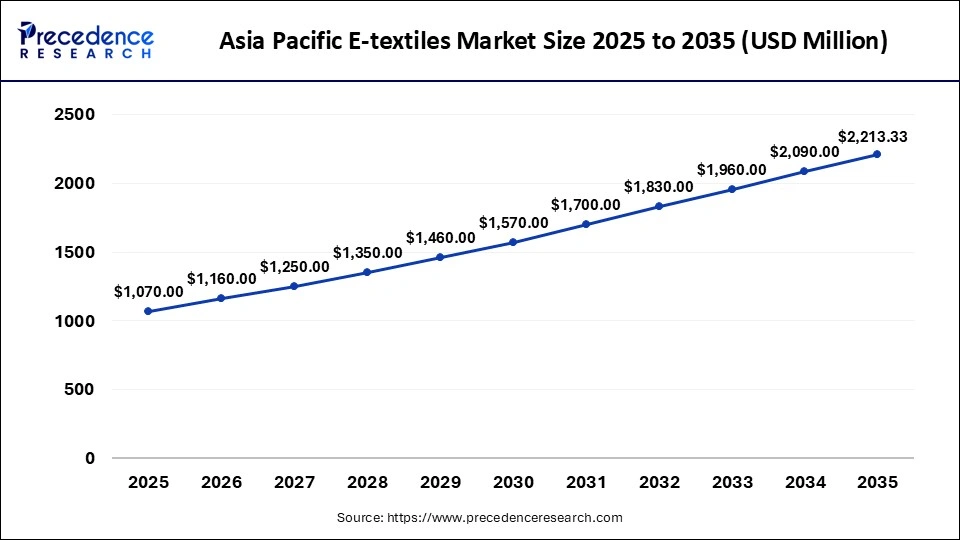
The U.S. e-textiles market size reached USD 1070.00 million in 2025 and is expected to be worth around USD 2213.33 billion by 2035, at a CAGR of 7.54% from 2026 To 2035.
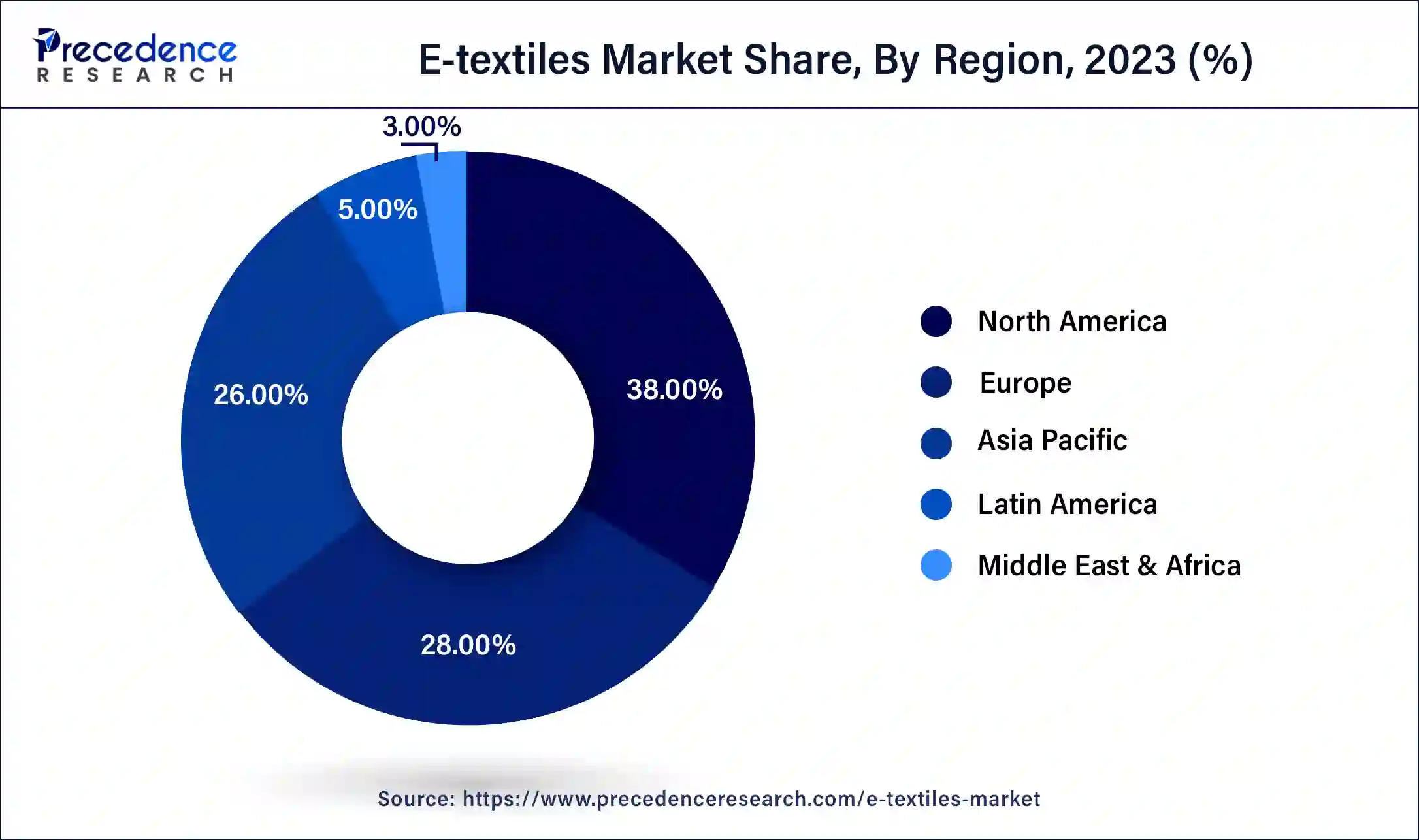
Based on region, North America accounted for around 38% of the market share in 2023. The increased demand for the e-textiles across the military, healthcare, and sports & fitness sectors in US is the most prominent driver of the market. The higher adoption rate of the advanced technologies in the US is a major factor that drives the growth of the e-textiles market in North America.
On the other hand, Asia Pacific is estimated to be the most opportunistic market during the forecast period. The rising expenditure of the government in the military, aerospace, and healthcare industries by the government of countries like China and India are presenting immense growth opportunities to the market players. India and China are increasing investing in advancing and boosting the military sector to improve their military powers. Hence, this would propel the demand for the e-textiles in the Asia Pacific region in the upcoming years.
U.S. E-textiles Market Trends
The United States represents the largest share of the e-textiles market in North America. The growth is driven by advanced research, strong defence spending, and well-established wearable technology ecosystems. The presence of leading innovators in the country, such as Nike, Inc. and Sensoria Inc., also supports the market expansion. Growing consumer interest in connected wearables and investment in domestic advanced manufacturing continue to strengthen market expansion in medical applications.
China E-textiles Market Trends
China accounts for the largest share of the e-textiles market in the Asia Pacific in 2025. The growth is driven by its extensive production capacity and large domestic consumer market. The Chinese companies are increasingly producing conductive fibres, flexible sensors and intelligent clothing for sports, healthcare and industrial applications. The government in the country supports advanced manufacturing and digital innovation in smart wearable technologies that further contribute to the market growth.
Which Factors Made Europe a Significantly Growing Region in the Market?
Europe is expected to grow at a considerable CAGR in the e-textiles market in the coming period. The growth is supported by sustainability goals and advanced textile engineering. The countries such as Germany, France and the United Kingdom are integrating smart textiles into healthcare, protective clothing and sportswear. The region has strict product quality standards that support demand for reliable, high performance smart textile products across the region. The rising collaboration between research institutions and manufacturers further supports the market growth through product innovation.
Germany Market Trends
Germany leads the European e-textiles market in 2025 due to its engineering expertise and globally competitive textile machinery industry. The country focuses on industrial workwear, automotive textiles and medical monitoring garments. The growing investment in Industry 4.0 and smart manufacturing is also creating new opportunities for innovative wearable solutions across various industries. The country's robust medical device manufacturing and workplace health monitoring support the market growth.
What are the Advancements in the Market in Latin America?
Latin America held a considerable share of the e-textiles market in 2025, as healthcare modernization, sports participation, and industry safety awareness increased across the region. The adoption of e-textiles remains lower in Latin America compared to North America and Europe. The growing investment in manufacturing capabilities and stronger partnerships with international technology providers are supporting product availability across the region.
Brazil Market Trends
Brazil accounts for the largest share of the Latin American e-textiles market in 2025, due to its strong textile industry, expanding healthcare sector, and growing interest in wearable fitness products. The rising investment in innovation and digital healthcare supports the commercial adoption of e-textiles. The research organizations are continuously exploring smart fabrics for medical monitoring, sports performance, and protective clothing, which further contributes to the market expansion.
What are the Key Trends in the Market in the Middle East and Africa Region?
The Middle East & Africa held a notable share of the e-textiles market in 2025, driven by investments in healthcare, worker safety, and smart infrastructure projects. The region has abundant gas and oil industries, which demand protective clothing when working in refineries. The demand for intelligent protective clothing is also increasing from construction, defence and medical environments. Although demand is high in the region, production capacity is limited, and imports and technology partnerships with international providers continue to support product availability.
Saudi Arabia Market Trends
Saudi Arabia represents the leading market within the Middle East and Africa e-textiles market in 2025, supported by increasing focus on economic diversification, healthcare modernization, and industrial development under Vision 2030. The demand for e-textiles is increasing for smart medical garments, military uniforms, and protective workwear used in construction and energy industries. The government in the country is promoting and investing in advanced manufacturing technologies, which further supports the market expansion in Saudi Arabia.
Value Chain Analysis
- Feedstock Procurement: This particular stage encompasses the stage of sourcing and procuring raw materials to be used for e-textile production, which include traditional textile fibers, uniquely conductive elements, or electronic components.
Key Players: Toray Industries, Inc., KPR Mill Ltd.
- Chemical Synthesis and Processing: This stage implies the transformations of raw materials into usable materials via certain chemical treatments and processing schemes, including the preparation of conductive inks or the treatment of fibers to achieve their electronic functionalities.
Key Players: Huntsman Corporation, Dow Inc.
- Compound Formulation and Blending: This means designing and mixing materials to attain functionalities of the e-textile, such as making conductive polymers or designing certain blends of fibers for desired properties.
Key Players: Schoeller Textil AG, Gentherm
- Quality Testing and Certification: The stage involves rigorous testing of materials and products to make sure that they satisfy the requirements of performance and safety, including durability tests, conductivity tests, and certifications in compliance with certain standards of industries.
Key Players: SGS Group, Intertek Group Plc
- Packaging and Labeling: This implies designing packaging and labeling suitable for e-textile products such that they will provide the right protection and branding, along with statutory labeling requirements.
Key Players: Mondi plc, Amcor plc
Competitive Landscape
The e-textiles market is moderately fragmented with the presence of several local textile manufacturers, electronic companies, and wearable technology specialists. The leading companies in the market include DuPont, Schoeller Textil AG, Textronics Inc., AiQ Smart Clothing, Sensoria Health, Wearable X and Adidas AG. Companies are also spending on the development of lightweight conductive fabrics, washable electronic components, flexible sensors and energy-efficient smart garments for defence, sports, healthcare and industrial applications. Moreover, they are also focusing on maintaining competitive pricing. These market players are striving to gain higher market share by adopting strategies, such as investments, partnerships, and acquisitions & mergers. The various developmental strategies foster market growth and offer lucrative growth opportunities to the market players.
In July 2021, DuPont announced the acquisition of Laird Performance Materials, a prominent supplier of electromagnetic shielding and provider of thermal management solutions. This would strengthen the position of DuPont in the global e-textiles market.
For sustained growth in the e-textiles market, companies should prioritize improving washability, durability, and performance while lowering production costs. Companies should invest in sustainable materials and collaborations with healthcare providers and technology firms to accelerate commercial adoption and maintain competitiveness.
Top Companies in the E-textiles Market and Their Offerings
- DuPont de Nemours, Inc. - offers the DuPont Intexar line of stretchable electronic inks used for biometric monitoring garments.
- Schoeller Textil AG - offers Schoeller E-Softshell, a fabric integrating heatable conductive yarns for customized thermal apparel.
- Toray Industries Inc - offers high performance fibres, conductive textiles and functional materials for wearable electronics, healthcare and sportswear.
- Interactive Wear AG - It designs and manufactures intelligent textile systems integrated with electronics for healthcare, sports performance monitoring and industrial applications.
Key Companies & Market Share Insights
The market is moderately fragmented with the presence of several local companies. These market players are striving to gain higher market share by adopting strategies, such as investments, partnerships, and acquisitions & mergers. Companies are also spending on the development of improved products. Moreover, they are also focusing on maintaining competitive pricing.
In July 2021, DuPont announced the acquisition of Laird Performance Material, a prominent supplier of electromagnetic shielding and provider of thermal management solutions. This would strengthen the position of DuPont in the global e-textiles market.
The various developmental strategies like acquisition, partnerships, and collaborations fosters market growth and offers lucrative growth opportunities to the market players.
E-textiles Market Companies
- Alphabet
- DuPont
- Jabil
- Sensoria
- AIQ Smart Clothing
- Adidas
- Interactive Wear
- Hexoskin
- Gentherm
- Outlast Technologies
Recent Developments
- In February 2026, Mafatlal Industrial Limited (MIL), a textile institution, announced its entry into the e commerce space with the launch of Mafatlal MedFits, a dedicated digital platform for medical apparel.
- In September 2025, Polytecks, a Cambridge-based spin-out, is developing advanced wearable e-textile technology for faster and more precise heart condition detection. (Source: https://www.eurekamagazine.co.uk)
- In July 2025, IPC-8911, the first international standard focusing on conductive e-textile yarns, is set to redefine the definition, testing, and trustworthiness of these yarns in e-textile innovation. (Source: https://www.electronicsforyou.biz)
Segments Covered in the Report
By Technology
- Thermostatic
- Energy Harvesting
- Sensing
- Luminescent
- Others
By Application
- Military
- Fashion
- Automotive
- Medical
- Sports & Fitness
- Others
By Geography
- North America
- U.S.
- Canada
- Europe
- U.K.
- Germany
- France
- Asia Pacific
- China
- India
- Japan
- South Korea
- Rest of the World
For inquiries regarding discounts, bulk purchases, or customization requests, please contact us at sales@precedenceresearch.com
Frequently Asked Questions





Ask For Sample
No cookie-cutter, only authentic analysis – take the 1st step to become a Precedence Research client
 Get a Sample




 sales@precedenceresearch.com
 Schedule a Meeting
