



Electronic Adhesives Market Size, Share and Trends 2026 to 2035
Electronic Adhesives Market (By Resin Type: Epoxy, Acrylics, Polyurethane, Silicone, Others; By Form: Liquid, Paste, Solid; By Application: Conformal Coatings, Surface Mounting, Encapsulation, Wire Tacking, Others; By End-user: Consumer Electronics, IT Hardware, Automotive, Medical, Aerospace & Defense, Others) - Global Industry Analysis, Size, Trends, Leading Companies, Regional Outlook, and Forecast 2026 to 2035
Source: https://www.precedenceresearch.com/electronic-adhesives-market
 Get a Sample
 Table Of Content


What is the Electronic Adhesives Market Size?
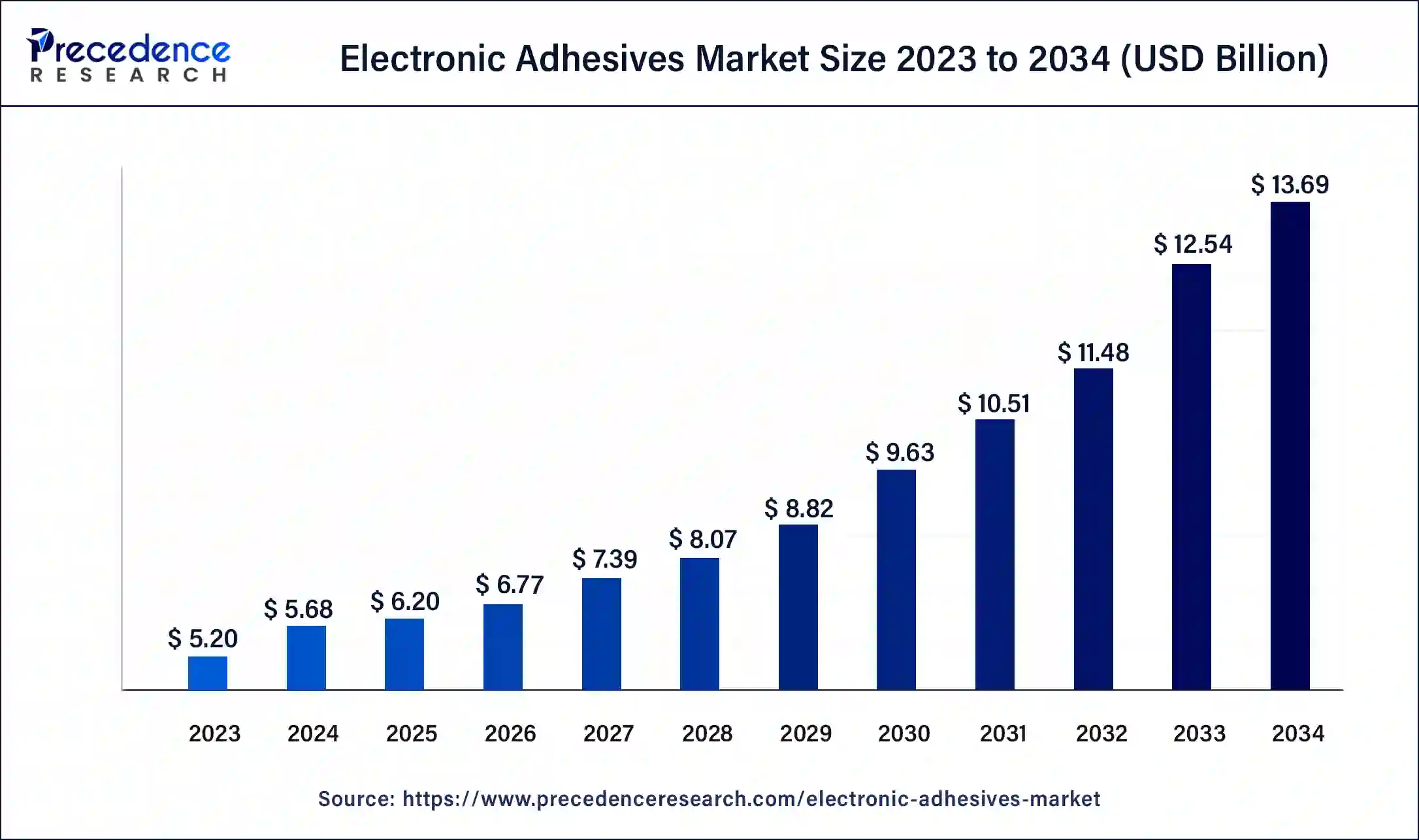
The global electronic adhesives market size accounted at USD 6.20 billion in 2025, and is expected to reach around USD 14.78 billion by 2035, expanding at a CAGR of 9.08% from 2026 to 2035.
Electronic Adhesives Market Key Takeaways
- In terms of revenue, the electronic adhesives market is valued at USD 6.20 billion in 2025.
- It is projected to reach USD 14.78 billion by 2035.
- The electronic adhesives market is expected to grow at a CAGR of 9.08% from 2026 to 2035.
- Asia Pacific dominated the electronic adhesives market in 2025 and accounted for a 32% revenue share.
- North America is the fastest-growing region in the global market.
- By resin type, the epoxy segment has accounted market share of around 37% in 2025.
- Based on application type, the surface mounting segment dominated the market in 2025.
- Based on end user, the consumer electronics segment dominated the market in 2025 and will continue doing so throughout the forecast period.
Market Overview
Electronic devices have become an extremely important part of our lives. In almost every household, at least one electronic device is used. These devices have several small parts that need to be bonded together to ensure that they are safe to operate. Adhesives used for bonding electronic parts are called electronic adhesives. They help in proper bonding and heat dissipation in the device and are manufactured to possess qualities of high-temperature resistance and conductivity. Electronic adhesives also offer thermal and electrical conductivity to the device.
Electronic adhesives with good thermal conductivity help in dispensing heat and prevent the device from overheating. Heat sinks collect the excess heat of the device. When heat is dispensed properly, a device works at optimal temperature and gets a long life. Electrical conductivity in the electronic adhesives ensures that there is a free flow of electric energy in the device.
Electric adhesives are made of silver or nickel to increase electrical conductivity. Silver-based adhesives have the best electrical conductivity but come at exorbitant prices. Graphite also shows excellent electrical conductivity, and hence, graphite-based electronic adhesives offer an economical solution.
Some devices also come in contact with water or moisture, and hence, it becomes important that the bonds created are waterproof and moisture-proof. Poor moisture resistance can lead to current leakage, corrosion, or short circuits. A good moisture resistance protects the device from all these hazards and increases its life. Additionally, the adhesives also have a good resistance against chemical exposure. Some devices tend to heat up during usage. Hence, adhesives also need to have a high heat resistance.
Electronic Adhesives Market Growth Factors
- A rise in the manufacturing of electric devices has benefited the electronic adhesives market.
- Miniaturization of devices is happening at a rapid pace, creating an increase in demand for better quality adhesives.
- Increased manufacturing of electric vehicles is directly related to the growth of the electronic adhesives market.
- Electric adhesives offer better bond strength and durability to devices.
- Electronic adhesives offer high quality at a low budget.
Market Scope
| Report Coverage | Details |
| Growth Rate from 2026 to 2035 | CAGR of 9.08% |
| Market Size in 2025 | USD 6.20 Billion |
| Market Size in 2026 | USD 6.77 Billion |
| Market Size by 2035 | USD 14.78 Billion |
| Largest Market | Asia Pacific |
| Base Year | 2025 |
| Forecast Period | 2026 to 2035 |
| Segments Covered | By Resin Type, By Form, By Application, and By End-user Industry |
| Regions Covered | North America, Europe, Asia-Pacific, Latin America, and Middle East & Africa |
Market Dynamics
Drivers
Increased production and usage of electronic devices
Increased production and usage of electronic devices will positively impact the electronic adhesives market. With a rise in consumerism and developed technology, people prefer high-quality mobile phones, laptops, headphones, and other electronic devices. These devices need their body parts to be bonded properly using high-quality adhesives. The devices are getting smaller and smaller every day. Who knew that a computer could ever fit into our pockets? Compact devices are also being added with many functions.
The electronic adhesives market offers high bond strength while bonding components that are extremely sensitive. This also needs to be done while ensuring that the performance of the device is not hampered. For instance, in a mobile phone or a laptop, certain parts, like a USB portal, are open to the atmosphere and face moisture and humidity. Despite that, it does not lower the performance. This is because of the high quality of electronic adhesives used in these devices. We also find that sometimes, despite the phone getting heated, we don't see the adhesives melting. This is because the adhesives have a high heat tolerance.
Restraint
Concerns associated with the quality of adhesives
Poor quality electronic adhesives can hinder the growth of the electronic adhesives market. They can lead to substandard devices. Raw materials of certain adhesives, like metal-based adhesives, have fluctuating costs. Hence, it also becomes difficult to extract profits. These adhesives, when applied to sensitive parts, require extreme care and precision. Irrespective of the quality of the adhesive, if it is not applied properly, the device might not perform at the best level.
Opportunity
Application in automotive industry
The electronic adhesives market will witness new opportunities in several different fields of electronics. Electronics are highly used in automobiles. With a rise in the production of electric vehicles, the sales of electronic adhesives will keep increasing. Televisions and laptops are increasing visual quality.
As the electronic adhesives market produces better products, such devices will be built better, with higher video quality and other features. Compact devices like smartwatches will also boom in sales. Electronic adhesives will also boost government projects like improving public transport, better facilities at railway stations or airports, and even space research projects.
Segment Insights
Resin Type Insights
The epoxy segment dominated the market share in 2025, and it is expected to continue growing in the forecast period. Epoxy adhesives have a wide range of applications, like die attachment and solderless interconnections. They have a high resistance to heat and can withstand high mechanical stress.
The adhesion provided by epoxy glues is of a high quality, and the bonds are strong. It is compatible with several materials and shows less shrinkage after drying. It does not require solvents before applying, and the viscosity can be controlled as well.
The acrylic segment is projected to witness the fastest growth during the forecast period. They have several benefits that make them a favorable option. Acrylic adhesives are versatile, and their resistance to environmental factors makes them an excellent option. They have a strong adhesive composition, and the bonds that form are strong.
Apart from their use in electronic goods, the electronic adhesives market also caters to the hardware industries like furniture, load-bearing joints, and other industrial equipment. They are used as substitutes for rivets used in other industries. The binding time is less in acrylic adhesives. Metallic parts in electronic appliances can be joined easily with each other. Acrylic adhesives work well for polar substrates, and hence, they can also be used for glass, neoprene, polycarbonate, etc.
Application Type Insights
The surface mounting segment dominated the market share in 2025. As devices are undergoing miniaturization, proper adhesion is required, and surface mounting is in increasing demand in this case. Surface mounting technology offers a lot of advantages at a low price and high efficiency. The setup time for surface mounting technology is shorter, and hence, more appliances can be produced. The surface mounting technology offers better functionality.
Because of the vibrations and shaking of a device, there is a possibility that the joints might weaken. Weak joints will cause damage to the instrument or the device. Surface mount technology provides stability to the joints and ensures that the instrument will tolerate the harshest conditions and vibrations. More compact devices can be produced using surface mount technology because it ensures that one needs fewer circuit boards, and there won't be any compromise with the quality. All these benefits are offered at a low budget, and this makes these adhesives a popular choice.
End-user Insights
The consumer electronics segment dominated the electronic adhesives market in 2025 and will continue doing so throughout the forecast period. An increased demand for smartphones, wearables, and smart devices is boosting the sales of adhesives, as they offer strong bonds in compact devices. Almost everywhere around us, we see that the usage of electronic goods has become very common. Consumers want their products to be of high quality and reliable. Electric vehicles are making huge markets, and it is important to have high-quality adhesives while bonding the joints in the vehicle.
Electronic adhesives provide high tolerance to moisture and vibration. Electronic adhesives can show binding properties in a variety of substrates like metal, plastic, glass, etc. They take less time to dry, and hence, the production of consumer electronic goods can happen at a fast pace.
Regional Insights
What is the Asia Pacific Electronic Adhesives Market Size?
The Asia Pacific electronic adhesives market size was estimated at USD 1.98 billion in 2025 and is predicted to be worth around USD 4.73 billion by 2035, at a CAGR of 9.10% from 2026 to 2035.
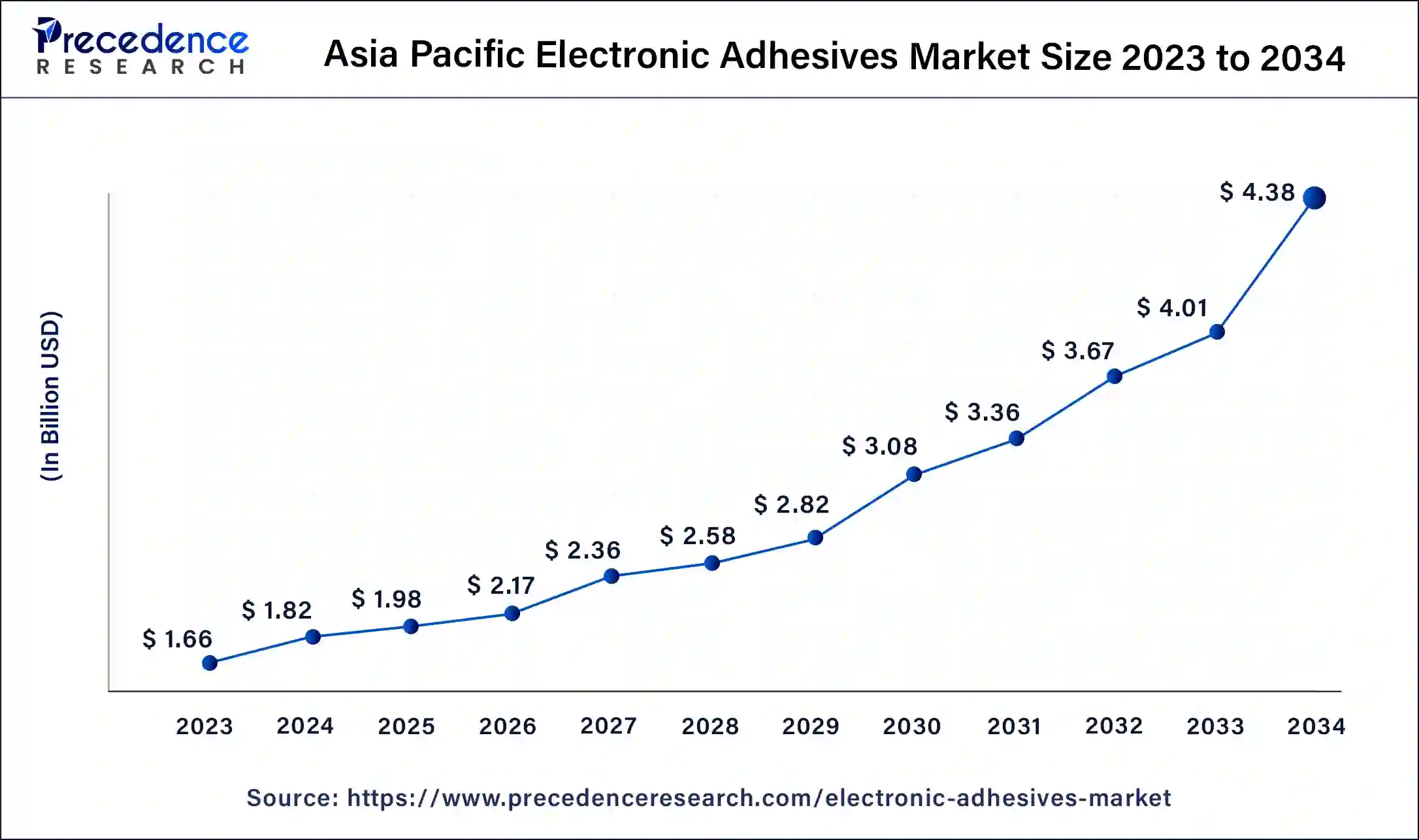
Asia Pacific dominated the electronic adhesives market in 2025. This is because China, Japan, and Taiwan have a rising demand for electronic products. China is home to some of the best producers of electronic adhesives, like Shanghai Hansi, Briture, Shenzhen Jinhua, DeepMaterial, and many more. These companies are leading in the production of electronic adhesives to be used in diverse technical fields, which include aerospace, automotive, construction, and insulation. They ensure that high-quality glues are delivered, which can be used in a wide range of electronic goods, including LED strips, etc. Taiwan, too, is a holder of a large share of electronic adhesives manufacturers, with prominent key players like Dymax, Hitachi Chemical Co, 3M Company, Dow Chemicals Company, etc.
China
China leads the way in the electronic adhesives market in Asia Pacific due to its manufacturing prowess in electronics, especially around smartphones, semiconductors, and consumer electronics. Government initiatives such as "Made in China 2025" also encourage advanced manufacturing, and drive the use of self-sufficient supply chains where China is insulated from import source risks. Furthermore, the rapid adoption of 5G technology and the growth in the electric vehicle (EV) market are additional drivers of the high-performance adhesive market. MNC major manufacturers are establishing new or expanding existing production bases in China, which is maturing the market and developing innovative solutions.
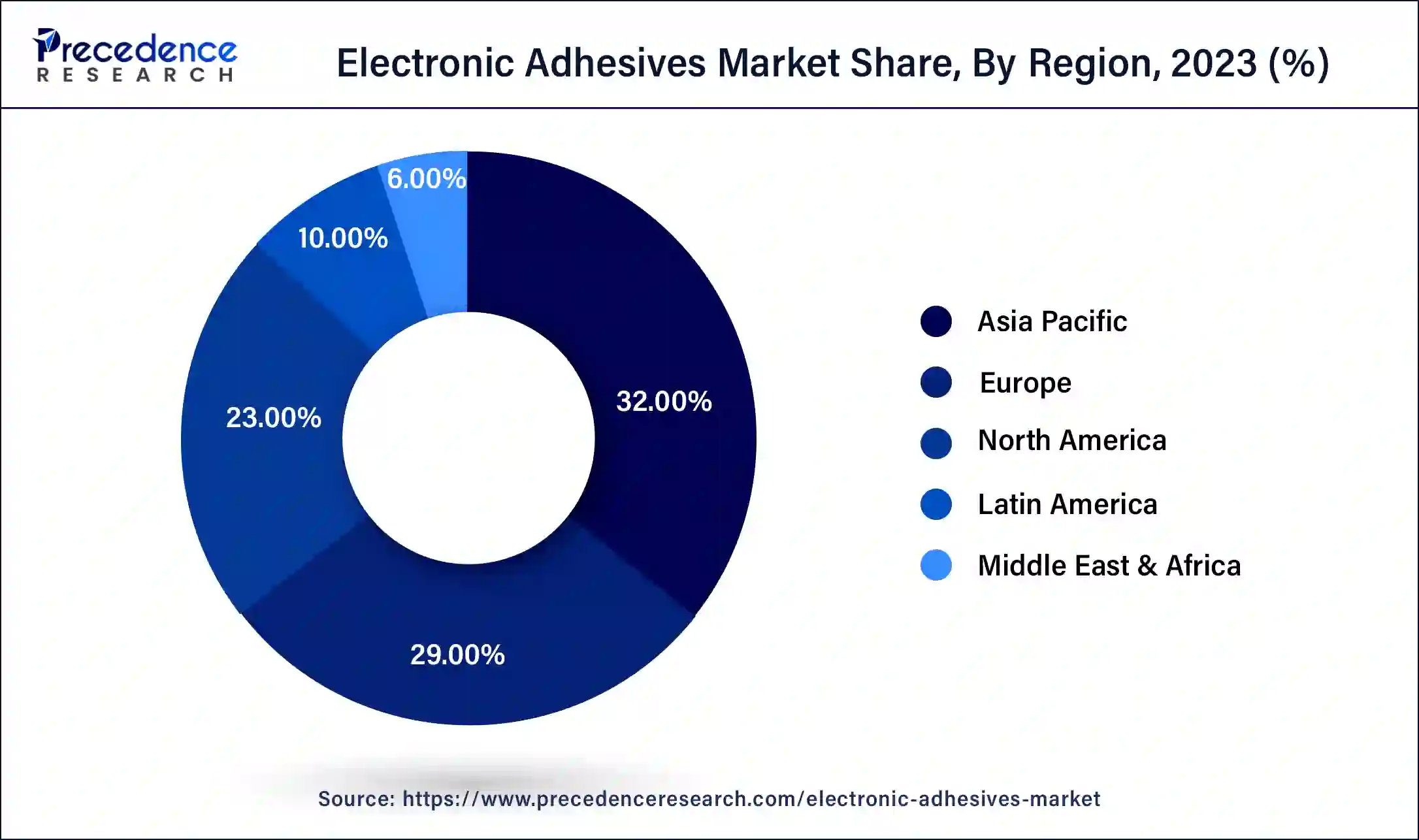
North America is the fastest-growing region in the electronic adhesives market. It contributed a large revenue share, and in particular, the U.S. has contributed largely to the revenue share in North America. There is a rising need for electronic goods. Advancements in technology are happening at a rapid pace because of research and development. There is constant innovation in the electronics industry, and the electric vehicle market is on a boom. There is a high demand for smart devices, and this will take the electronic adhesives market in a positive direction.
North America
In North America, the United States is the dominant country in the electronic adhesives market due to its R&D environment, established technology sectors in electronics and aerospace industries, and an increase in the use of high-reliability components. The growth in electric vehicles, wearable devices, and dental/medical electronics will expand the use of thermally conductive and UV curable adhesives. The development of leading-edge companies, innovation hubs, and clusters (e.g., Silicon Valley) is supporting innovation and product development, while regulatory pressures are accelerating the rate of transition to environmentally sustainable formulations.
How Europe Grows in the Electronic Adhesives Industry
Europe is focused on green growth in terms of electronic adhesive solutions. A robust automotive and industrial industry base, combined with innovation in green electronic adhesive solutions and green growth initiatives, is driving growth in electronic adhesive solutions in various electronic manufacturing sectors. Rising adoption of electric vehicles, wearable devices, and high-performance electronic components is further fueling the need for reliable and high-performance adhesives across the region.
Latin America: Industrial Growth in the Electronic Adhesives Market
Latin America is witnessing moderate growth in the market owing to the improvement in manufacturing capabilities and the rising demand for electronics. Increasing adoption of smartphones, wearable devices, and electric vehicles is fueling the need for high-performance adhesives that offer strong bonding, thermal management, and protection against environmental factors. Additionally, expanding electronics manufacturing capabilities and investments in infrastructure across the region are supporting broader market growth.
Middle East & Africa: Infrastructure-driven growth in the Electronic Adhesives industry
The Middle East and Africa market is growing steadily with rising investments in industrial infrastructure and electronic assembly. Expanding construction, automotive, and energy sectors are fuelling demand for robust adhesive solutions used in electronic devices. Additionally, growing investments in electronics manufacturing infrastructure and supportive government initiatives are further expanding market opportunities across the region.
Electronic Adhesives Market Companies
- Arkema - Offers specialty adhesives under the Bostik brand, including hot melt, UV, and structural adhesives for electronic devices and electric vehicles.
- 3M - Offers a range of electronic adhesives, including conductive, structural, and pressure-sensitive adhesives.
- Ashland - Offers adhesive additives, binders, and modifiers used in heat-activated, pressure-sensitive, and energy-curable electronic adhesives.
- Avery Dennison Corporation - Develops pressure-sensitive adhesives, tapes, and label materials for electronic devices, automobiles, and industrial applications.
- BASF SE - Manufactures epoxy-based and polyurethane-based adhesives offering high durability, heat stability, and performance for electronic devices.
- Beardow Adams - Manufactures hot melt adhesives for electronic devices, packaging, and industrial applications.
- CHEMENCE - A company specialising in cyanoacrylate-based adhesives and sealants for high-speed electronic bonding applications.
- Covestro AG - Manufactures polyurethane resins and polycarbonate resins used as raw materials in high-performance coatings, sealants, and electronic adhesives.
Other Major Key Players
- Dow
- Fuller Company
- Henkel AG & Co. KGaA
- Huntsman International LLC
- Illinois Tool Works Inc. (ITW)
- MAPEI S.P.A.
- Permabond LLC
- Pidilite Industries Ltd.
- Sika AG
Recent Developments
- In February 2025, LG Chem announced a collaboration with HL Mando, a leading Korean automotive parts maker, to co-develop adhesives for automotive electronic components. LG Chem has the technology to enhance the thermal conductivity and stability of existing thermal gap fillers for better reliability. Kim Dong-choon,?President of LG Chem's Advanced Materials Company, stated, “We are committed to developing customized solutions and eco-friendly technologies regarding adhesive spanning from automotive bodies to various electronic components” (Source: indianchemicalnews.com )
- In May 2025, Ellsworth Adhesives announced a collaboration with 3M to meet demand for 3M Scotch-Weld One-Part Epoxy Adhesives 6101 and 6102. These adhesives are intended to support electronic design and improve manufacturing efficiency. The company also provides support with specifications, validation testing, and related services. (Source: designworldonline.com )
- In November 2024, Bostik launched Born2Bond™ Ultra K85, from 60% bio-based raw materials instant adhesive for consumer electronics. The product provides greater protection to products exposed to variable environmental conditions, such as consumer electronics, outdoor lighting, children's water toys, electric toothbrushes, medical devices, and automotive parts. (Source: ascouncil.org )
- In May 2023, Arkema acquired Polytec PT, a German company that specializes in manufacturing adhesives for batteries and electronic products. The company has sales worth 15 Euros and has its main production site in Karlsbad, Germany. Arkema assures us that it will strengthen the company further by serving the best in the ever-growing batteries and electronics market.
- In February 2024, Intertronics, a company specializing in adhesive manufacturing, launched a structural adhesive selection guide. It will help the manufacturers find the right optimal adhesive for their application in order to get a strong and highly effective bond. In this guide, one can find a detailed overview of the chemistries of five structural adhesives: Epoxy, polyurethane, cyanoacrylate, UV curing, and methyl methacrylate (MMA). The guide has been designed in a way that will benefit a wide range of industries, including automotive, aerospace, electronics, construction, etc.
Segments Covered in the Report
By Resin Type
- Epoxy
- Acrylics
- Polyurethane
- Silicone
- Others
By Form
- Liquid
- Paste
- Solid
By Application
- Conformal Coatings
- Surface Mounting
- Encapsulation
- Wire Tacking
- Others
By End-user
- Consumer Electronics
- IT Hardware
- Automotive
- Medical
- Aerospace & Defense
- Others
By Geography
- North America
- Europe
- Asia-Pacific
- Latin America
- Middle East and Africa
For inquiries regarding discounts, bulk purchases, or customization requests, please contact us at sales@precedenceresearch.com
Frequently Asked Questions
Tags





Ask For Sample
No cookie-cutter, only authentic analysis – take the 1st step to become a Precedence Research client
 Get a Sample




 sales@precedenceresearch.com
 Schedule a Meeting
