



Entertainment Robots Market Size, Key Companies, Company Market Share, User Adoption, Technology Deployment, Revenue Growth, Competitive Positioning, and Demand Forecast
Entertainment Robots Market (By Product: Robot Toys, Educational Robots, Robotic Companion Pets; By End-User: Media, Education, Retail, Others) - Global Industry Analysis, Size, Trends, Leading Companies, Regional Outlook, and Forecast 2025 to 2034
Source: https://www.precedenceresearch.com/entertainment-robots-market
 Get a Sample
 Table Of Content


What is the Entertainment Robots Market Size?
The global entertainment robots market size is accounted at USD 4.72 billion in 2025 and predicted to increase from USD 5.73 billion in 2026 to approximately USD 26.94 billion by 2034, expanding at a CAGR of 21.35% from 2025 to 2034. Factors such as rising fascination with robotics amongst consumers, technological innovations, and growing demand for interactive entertainment solutions are expected to drive the growth of the market throughout the forecast period.

Entertainment Robots Market Key Takeaways
- Asia Pacific dominated the global market with the largest market share of 46% in 2024.
- North America is observed to expand at a rapid pace during the forecast period.
- By product, the robot toys segment accounted for the biggests market share in 2024.
- By product, the educational robots segment is expected to witness remarkable growth during the forecast period.
- By end-user, the retail segment held the largest share of the market in 2024.
- By end-user, the educational segment is expected to grow significantly during the forecast period.
Artificial Intelligence: The Next Growth Catalyst in Entertainment Robots
In the ever-evolving landscape of technology, the integration of artificial intelligence has paved the way for a new paradigm of entertainment robots. The integration of machine learning (ML) and artificial intelligence (AI) technologies can offer a personalized, interactive, and immersive experience. AI-powered entertainment robots can effectively recognize facial expressions, voice commands, and gestures, which results in more natural interactions. By harnessing the power of AI, entertainment robots are capable of understanding musical cues, engaging with audiences, generating expressive performances, and adapting the audience's behavior.
Strategic Overview of the Global Entertainment Robots Industry
Robots are rapidly revolutionizing the entertainment industry, from enhancing live performances to creating immersive experiences. Entertainment robots are designed to amuse and entertain humans. Entertainment robots can perform various tasks, including dancing, singing, playing games, and others. These robots are widely adopted in various entertainment segments, including theme parks, cinemas, game centers, and private households. The entertainment robots market is expected to grow rapidly in the coming years due to the rising consumer demand for unique entertainment.
Entertainment Robots Market Growth Factors
- The rising demand for personalized and immersive entertainment experiences is anticipated to drive the growth of the market during the forecast period. Consumers are increasingly seeking personalized options that significantly increase the adoption of entertainment robots to deliver the concept of joy.
- The increasing adoption of entertainment robots for leisure purposes among users of all ages supports market growth.
- The increasing integration of augmented reality (AR) and virtual reality (VR) technologies in entertainment robots to deliver more immersive and realistic experiences bolsters the market's expansion.
- The increasing demand from the healthcare industry is anticipated to drive the growth of the entertainment robots market. Entertainment robots are widely adopted in the healthcare industry for serving numerous purposes, such as entertaining patients, especially children and the elderly, and providing companionship.
- The rising disposable incomes are expected to spur the acceptance of entertainment robots. As disposable incomes continue to rise globally, consumers are becoming financially empowered to opt for entertainment robots to have interactive and immersive entertaining experiences.
Market Outlook
- Market Growth Overview: The Entertainment Robots market is expected to grow significantly between 2025 and 2034, driven by advancements in technology, rising demand for companion robots, and commercial applications.
- Sustainability Trends: Sustainability trends involve energy efficiency in operations, circular economy and waste management, and sustainable materials and manufacturing.
- Major Investors: Major investors in the market include Softbank Group, Sony Corporation, The Walt Disney Company, and Lego Group.
- Startup Economy: The startup economy is focused on niche innovations, acquisitions by major players, and expansion into specialized applications.
Market Scope
| Report Coverage | Details |
| Market Size by 2034 | USD 26.94 Billion |
| Market Size by 2025 | USD 4.72 Billion |
| Market Size by 2026 | USD 5.73 Billion |
| Market Growth Rate from 2025 to 2034 | CAGR of 21.35% |
| Dominated Region | Asia Pacific |
| Fastest Growing Market | North America |
| Base Year | 2024 |
| Forecast Period | 2025 to 2034 |
| Segments Covered | Product, End-User, and Regions |
| Regions Covered | North America, Europe, Asia-Pacific, Latin America and Middle East & Africa |
Market Dynamics
Drivers
Increasing Deployment of Entertainment Robots in Theme Parks
The rising deployment of entertainment robots in theme parks is anticipated to boost the growth of the entertainment robots market during the forecast period. Embracing entertainment robots in amusement parks, theme parks, and entertainment venues can create unforgettable memories for children and adults. From outstanding performers to engaging greeters and knowledgeable guides, entertainment robots give a remarkable touch of wonder and excitement to visitor's experience. These robots are specifically designed to provide visitors with enjoyment, amusement, and entertainment in several interactive activities, such as singing, dancing, and playing musical instruments. Such factors are fuelling the market's growth significantly.
Restraint
Technical Complexity in Integration
Technical complexities that occurred during the integration of entertainment robots hamper the market's growth. Some robots may have limited functionality or fail to meet consumer expectations. In addition, the high cost of these robots may slow their adoption in amusement and theme parks due to budget constraints, particularly in middle- and lower-income countries.
Opportunity
Growing Consumer Demand for Personalized Experience
The growing consumer demand for personalized experience is projected to offer lucrative opportunities in the entertainment robots market. Entertainment robots are continuously evolving through ongoing technological advancement, creating more unique, personalized, and immersive entertainment experiences among people of all ages. From enthralling toys to lovable companions and stunning entertainers, these entertainment robots are increasingly gaining popularity and sparking imaginations. The adoption of these robots provides a glimpse into a world where technology and magic merge effortlessly to create unforgettable experiences for users. Therefore, as robots continue to evolve and become more sophisticated, robots hold the potential to shape the future of entertainment.
Product Insights
The robot toys segment held the largest share of the entertainment robots market in 2024. Robot toys are mechanical or electronic toys that represent a combination of fun and technology. These toys can move, make sounds, and are capable of performing various actions, such as walking, dancing, and interacting with people. With rapid technological innovation, these toys have transformed from basic remote-controlled devices to AI-driven, offering interactive and immersive entertaining experiences. Moreover, rising parents' desire for intellectually stimulating play for their children is expected to accelerate the adoption of robot toys during the forecast period.
On the other hand, the educational robots segment is expected to witness remarkable growth during the forecast period. There is an increasing adoption of educational robots to bridge the gap between theoretical knowledge and practical application. Over the years, the educational industry landscape has undergone a remarkable transformation, with a rising focus on interactive and experiential learning. Educational robots can improve learning and enhance problem-solving skills. Several educational institutions are increasingly adopting these robots to promote Science, Technology, Engineering, and Mathematics (STEM) fields and also make coding and robotics approachable for students.
End-user Insights
The retail segment led the entertainment robots market with the largest share in 2024. In the retail industry, entertainment robots can enhance the shopping experience, promote products in unique ways, and provide interactive services to the customer. The adoption of these robots can lead to increased sales and positive brand perception. Their visual appeal can spark interest in robotics and technology among the general public.
On the other hand, the educational segment is expected to grow significantly during the forecast period. The growth of this segment can be attributed to the increasing adoption of entertainment robots in educational institutions to provide students with a fun and interactive experience. These robots enable students to gain knowledge regarding programming and robotics, as well as improve their critical thinking and innovative problem-solving skills.
Regional Insights
Asia Pacific Entertainment Robots Market Size and Growth 2025 to 2034
The Asia Pacific entertainment robots market size is evaluated at USD 2.17 billion in 2025 and is projected to be worth around USD 12.53 billion by 2034, growing at a CAGR of 2148% from 2025 to 2034.
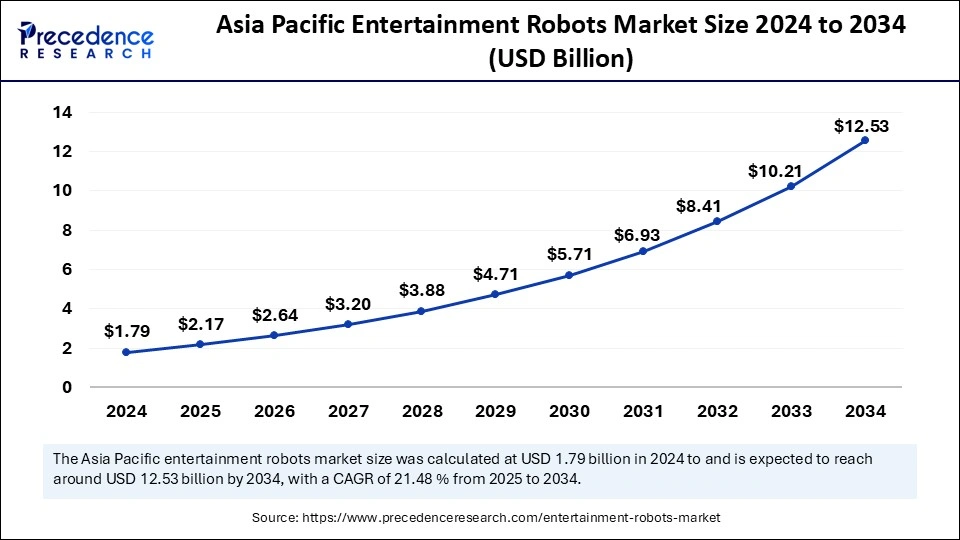
Asia Pacific dominated the entertainment robots market with the largest share in 2024. The growth of the market in the region is driven by the strong presence of key players, high consumer demand for interactive and immersive entertaining experiences, and increased disposable income. The region is likely to sustain its position in the market during the upcoming period due to the surging use of robots among the elderly and children for educational, therapeutic, and caregiving purposes, increasing investment in technology-driven products, a supportive government framework, and increasing integration of artificial intelligence (AI) and machine learning (ML) technologies. The increasing adoption of entertainment robots in emerging markets, such as Japan, China, and South Korea, is anticipated to drive regional growth.
Asia Pacific: China Entertainment Robots Market Trends
China's market is experiencing rapid growth, largely driven by strong government support and heavy investment in robotics technology. The development of affordable humanoid robots is due to advanced AI integration and robust domestic manufacturing. These robots are increasingly deployed in commercial settings like theme parks and museums for public engagement.
North America is projected to witness the fastest growth in the coming years. In North America, entertainment robots are widely deployed in live performances, theme parks, and robotics in movies. These robots are captivating people's imaginations and bringing joy to millions. Factors such as the presence of key market players, rapid technological innovation, rising consumer demand for entertainment robots for leisure purposes, and governmental support for the development of innovative robots further support market growth. The popularity of humanoid robots is also increasing in the region. These robots can perform various tasks, such as singing, dancing, and playing musical instruments, providing a unique, personalized, and immersive entertainment experience. With increasing disposable incomes, people in the region are increasingly seeking out high-tech toys, immersive experiences, and cutting-edge robots that deliver an outstanding entertainment experience.
North America: U.S. Entertainment Robots Trends
The U.S. entertainment robot market is experiencing strong growth, driven by the integration of AI and machine learning for more lifelike, interactive experiences. The use of robots as "edutainment" tools to teach STEM skills to children. Demand is also rising for personalized companion robots that provide emotional support and entertainment for both children and adults.
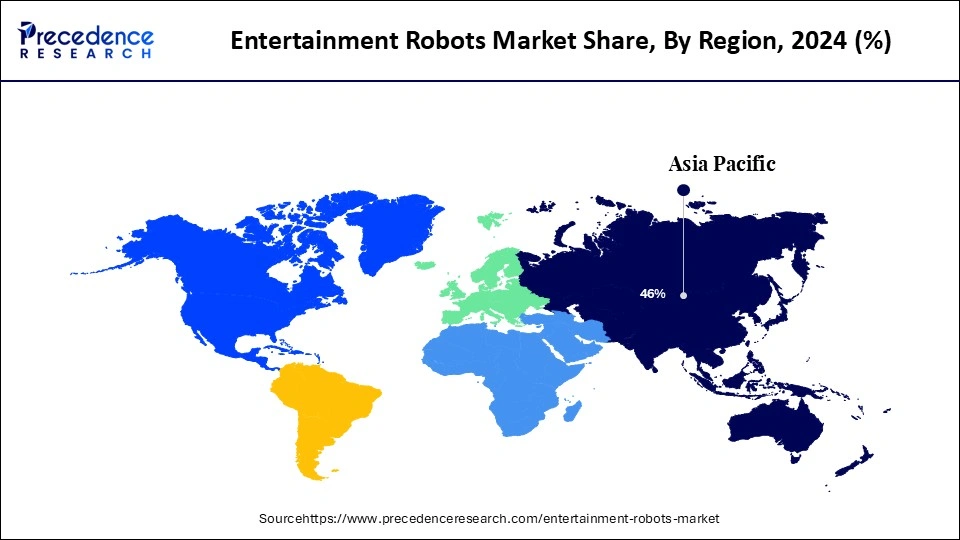
Europe is anticipated to grow at a notable rate. The growth of the entertainment robots market in Europe can be attributed to the increasing demand for entertainment robots for leisure purposes, rising investment in humanoid robots, increasing disposable income, increasing popularity of augmented reality (AR) and virtual reality (VR) technologies, and rising applications of entertainment robots in educational institutions like STEM learning. In the healthcare industry, entertainment robots are being widely used for engagement and therapeutic assistance. These robots are equipped with sophisticated features like cognitive computing, robot vision, and voice recognition, delivering patients a more personalized and interactive experience.
Europe: Germany Entertainment Robots Market Trends
Germany's entertainment robots market growth is expanding through the integration of advanced AI for more lifelike and interactive experiences, and an expansion into commercial applications like museums and theme parks. Germany's advanced robotics sector and emphasis on high-quality, safe products are key market drivers.
Entertainment Robots Market-Value Chain Analysis
- Raw Material & Component Sourcing
This foundational stage involves procuring essential electronic components, sensors, motors, batteries, and materials (plastics, composites, metals) required for robot production.
Key Players: Broadcom Inc., NVIDIA Corporation, Intel Corporation, Amphenol Corporation, specialty motor and sensor suppliers. - Research & Development (R&D) and Design (Software & Hardware)
In this stage, significant investment goes into developing the robotics hardware, AI algorithms, software for interaction, and creative design for user engagement.
Key Players: Sony Corporation, Hasbro Inc., UBTECH Robotics Corp., Makeblock Co., Ltd., Boston Dynamics (for advanced robotics R&D). - Manufacturing and Assembly
This involves the physical production of the robots on a large scale, including injection molding of plastic parts, assembly of electronic components, and integration of complex mechanical and software systems.
Key Players: UBTECH Robotics Corp., Makeblock Co., Ltd., Sphero, Inc., various contract manufacturing service providers in Asia. - Distribution and Sales
The finished robots are distributed to consumers and commercial clients through a variety of channels, including online retailers (Amazon, specialty tech sites), brick-and-mortar stores (Best Buy, electronics stores), and direct sales teams for commercial applications.
Key Players: Amazon.com, Inc., Best Buy Co., Inc., various regional distributors, an direct-to-consumer online platforms of manufacturers. - After-Sales Service, Support, and Content Updates
This critical stage involves providing customer support, repairs, software updates, and new content to enhance user experience and ensure product longevity.
Key Players: Sony Corporation (Aibo subscription services), UBTECH Robotics Corp., Makeblock Co., Ltd., and in-house customer support teams of manufacturers.
Top Companies in the Entertainment Robots Market & Their Offerings:
- Softbank Robotics: Softbank Robotics, through its "Robot Integrator" strategy, leverages its vast experience and AI expertise to aid businesses in integrating robotics, including for entertainment purposes.
- Mattel, Inc.: Mattel develops and manufactures a broad range of toy robots optimized for engaging and imaginative play for children, which drives market demand in the domestic segment.
- Lego: Lego significantly contributes to the entertainment robot market through its Lego Mindstorms and Lego Boost lines, which focus on educational robotics and STEM learning.
- WowWee Group Limited: WowWee is a manufacturer of interactive entertainment robots and toys, known for creating innovative products like the "MINTiD Dog-E".
- Sony Corporation: Sony plays a major role with its AI-infused Aibo robot dog, which provides advanced interactive and personalized companion experiences for families and tech enthusiasts.
- Hasbro, Inc.: Hasbro contributes to the entertainment robots market by offering a wide range of interactive robot toys in its product portfolio, driving demand in both domestic and commercial applications.
- Sphero: Sphero is a leader in edtech programmable robots, offering devices like Sphero BOLT and RVR+ that help students learn STEM concepts through play.
- Florida Robotics: Information about Florida Robotics as a direct contributor to the entertainment robot market is limited. However, robotics in entertainment is growing in areas like theme parks and events, with robots serving as crowd attractions and performers.
- Bluefrog Robotics: Bluefrog Robotics is known for its Buddy robot, an innovative social robot that provides interactive entertainment and companionship.
- Robobuilder: Robobuilder is a manufacturer of robotic kits designed for users to assemble and program their own robots for educational and entertainment purposes.
Entertainment Robots Market Companies
- Softbank Robotics
- Mattel, Inc.
- Lego
- WowWee Group Limited
- Sony Corporation
- Hasbro, Inc.
- Sphero
- Florida Robotics
- Bluefrog Robotics
- Robobuilder
Recent Developments
- In March 2025, Nvidia announced its collaboration with Disney Research and Google DeepMind to develop Newton, a powerful physics engine that will help simulate robotic movements in real-world settings. Newton will play a crucial role in bringing Disney's advanced entertainment robots to life.
- In January 2025, Researchers present a study in PeerJ Computer Science, showcasing how humanoid robots can collaborate seamlessly with human musicians during live musical performances. This innovative work highlights the evolving role of robotics in entertainment and creativity. The study introduced a human-robot musical band featuring Polaris, a mid-sized humanoid robot as a drummer, and Oscar, a Robotis-OP3 humanoid robot as a keyboardist. These robots performed alongside human musicians, achieving natural synchronization and collaboration through advanced robotic systems. The project leverages cutting-edge technologies, including human-robot interaction, and the Robot Operating System (ROS), to ensure fluid communication and timing between the robots and their human counterparts.
- In January 2023, WowWee, a company that develops, designs, and distributes innovative robotic toys, launched Mintid Dog-E. The Dog-E has multiple features, such as an audio sensor, touch sensor, and persistence of vision built into it.
Segments Covered in the Report
By Product
- Robot Toys
- Educational Robots
- Robotic Companion Pets
By End-User
- Media
- Education
- Retail
- Others
By Region
- North America
- Latin America
- Europe
- Asia-pacific
- Middle and East Africa
For inquiries regarding discounts, bulk purchases, or customization requests, please contact us at sales@precedenceresearch.com
Frequently Asked Questions





Ask For Sample
No cookie-cutter, only authentic analysis – take the 1st step to become a Precedence Research client
 Get a Sample




 sales@precedenceresearch.com
 Schedule a Meeting
