



Factoring Services Market Size, Key Companies, Company Product Portfolio, Digital Transformation, Technology Investment, Adoption Rates, Customer Acquisition, Company Market Share, and Market Outlook
Factoring Services Market (By Category: Domestic Factoring, International Factoring; By Type: Recourse Factoring, Non-recourse Factoring; By Application: Small and Medium Enterprise (SMEs), Large Enterprise) - Global Industry Analysis, Size, Trends, Leading Companies, Regional Outlook, and Forecast 2026 to 2035
Source: https://www.precedenceresearch.com/factoring-services-market
 Get a Sample
 Table Of Content


What is the Factoring Services Market Size?
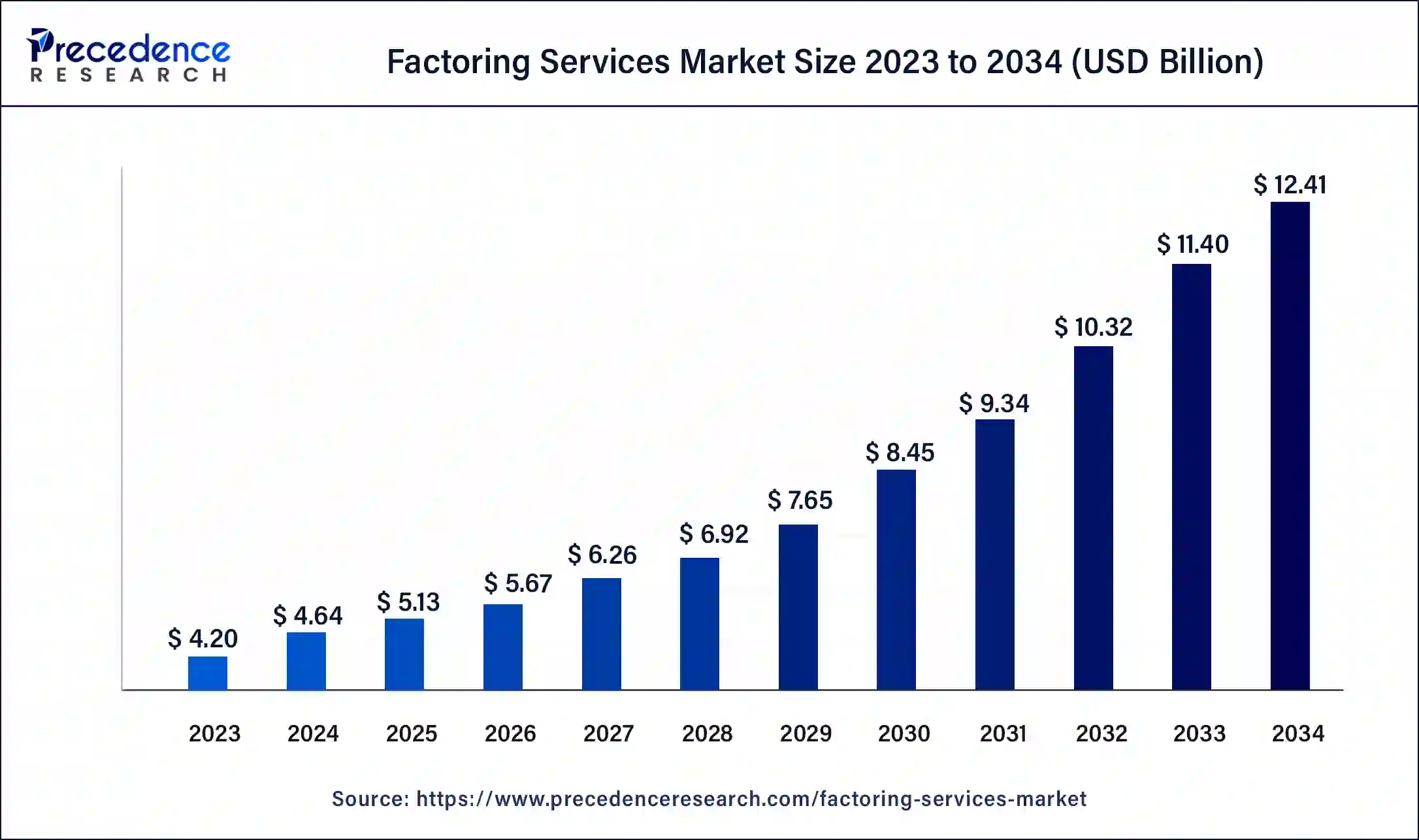
The global factoring services market size is accounted at USD 5.13 billion in 2025 and predicted to increase from USD 5.67 billion in 2026 to approximately USD 13.47 billion by 2035, expanding at a CAGR of 10.13% from 2026 to 2035. The market growth is supported by development strategies, demand for liquidity, and the emergence of a digital factoring platform.
Market Highlights
- In terms of revenue, the market is valued at $5.13 billion in 2025.
- It is projected to reach $13.47 billion by 2035.
- The market is expected to grow at a CAGR of 10.13% from 2026 to 2035.
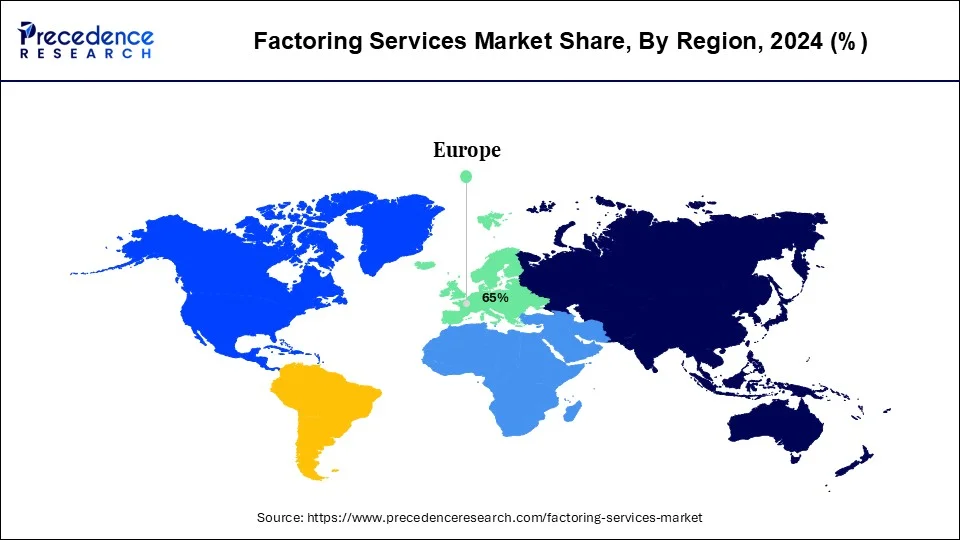
- Europe led the global market with the highest market share of 60% in 2025.
- Asia-Pacific is predicted to expand at the fastest CAGR during the forecast period.
- By category, the domestic factoring segment held the largest market share of 70% in 2025.
- By category, the international factoring segment is anticipated to grow at a remarkable CAGR during the projected period.
- By type, the recourse factoring segment held the largest share of the market in 2025.
- By type, the non-recourse factoring segment is expected to grow with the highest CAGR during the forecast period.
- By application, the small and medium enterprises segment held a significant share of the market in 2025.
- By vertical, the large enterprises segment dominated the market in 2025.
Market Overview
The factoring services market enables businesses to transform accounts receivable into cash by selling unpaid invoices. The market expansion is driven by demand for liquidity, especially in small and medium enterprises, and it is experiencing digital transformation through fintech platforms and AI tools. Major domestic and global companies use factoring to improve cash flow, lowering delays, and strengthening supply chains' resilience, supported by substantial investment. Future growth is expected through technological advancement, digital payments, and fixed finance, ensuring continued importance and extensive industry adoption. Additionally, factoring services offer benefits such as predictable cash flow and greater financial flexibility, making them vital in emerging economies.
How is AI contributing to the Factoring Services Industry?
AI changes the concept of factoring by increasing its speed and accuracy. It robots the invoice processing on the basis of OCR and NLP. It minimizes the number of errors that are made manually. Machine learning improves credit risk analysis based on real-time data. Fraud patterns are detected fast using AI and its anomaly detection method. Cash flow forecasting is enhanced by predictive analytics.
Chatbots make customer care more effective. All the capabilities make the operations easier, minimize risks, and allow faster financing decisions among factoring service providers internationally.
Factoring Services Market Growth Factors
- The factoring is a financial service in which a company sells its bill receivables at a discount rate to a third party in order to raise funds. It's not the same as invoice discounting. The invoice discounting is the process of having an invoice discounted at a given rate in order to obtain funds, although factoring is a larger notion. Factoring is the process of selling all account receivables to a third party.
- Factoring guarantees a predictable cash flow pattern. The credit department is virtually eliminated with continuous factoring. Because of the distinct advantage of flexibility that factoring provides to the borrowing firm, receivable financing is gaining popularity as a beneficial form of financing short-term finance requirements of business organizations. The seller's bills receivables may continue to be funded in a semi-automated manner. If the company's revenues grow or shrink, the financing can be adjusted accordingly.
- The increase in open account trade and the quick expansion of businesses in Asia, led by China, the increase in cross-border factoring, and the rapid growth and development of factoring services in the developing regions are some of the factors contributing to the growth of the factoring services market during the forecast period.
- The growth of the factoring services market can be attributed to rising public knowledge of financial technology advancements, such as government and factoring organization advocacy and initiatives, cryptocurrency, increased use of digital platforms, and an increase in cross-border transactions.
- Furthermore, the use of crypto-solutions has increased the accuracy of transactions and secured both parties' important and confidential information preventing financial fraud. However, the factoring services market growth is being hampered by an increase in data breaches and data privacy violations. In addition, the increased implementation of machine learning, natural language processing (NLP), and artificial intelligence (AI) is expected to generate profitable growth prospects for the factoring services market in the near future.
Factoring Services Market Outlook
- Industry Growth Overview
It is projected that the global factoring services market continue to grow in the coming years. More businesses are learning to use receivables financing as a living and working capital management method due to the tightening credit conditions. Market development is especially gaining momentum in Europe, Asia-Pacific and North America, where cross-border trade and cross-border supply chain financing activities. They are on the increase, as a result of the emergence of digital factoring platforms and embedded finance ecosystems. - Trends of Digital Transformation
Factoring is being redefined by technology-based innovation. The combination of AI, blockchain, and cloud-based solutions is enhancing the transparency, the speed of transactions, and the evaluation of credit risks. In the same vein, banks such as HSBC, Deutsche Bank, and BNP Paribas are making significant investments in the digital trade finance infrastructure to enable real-time receivables monitoring and automatic risk scoring. This is an indication of a transition towards completely digitised and data-driven factoring ecosystems. - Global Expansion
The major participants in the factoring industry are diversifying their territorial presence to capture the emerging markets that have a high concentration of SME and increasing volumes of trade. The Asia-Pacific and Latin America have risen and become areas of strategic investment. Due to the efforts of the governments to increase access of MSMEs to finance. Standard Chartered and ICICI Bank, which have developed digital factoring offerings in Southeast Asia and India, which building cross-border offers on Latin American and European routes to attract trade-related factoring business. - Major Investors
The factoring industry is attracting more attention from both private equity and institutional investors. As a result of the solid cash-flow model, scalable digital infrastructure, and compatibility with the financial inclusion trends. This capital infusion likely further consolidate and spurs technological change, and encourages new collaborations between the current banks and nimble fintech startups. - Fintech Ecosystem
The fintech industry of the world that provides factoring services is currently developing quickly. New companies are working on artificial intelligence to evaluate credit, on blockchains to provide trade financing, and on automated invoice factoring. PrimeRevenue, Demica, FundThrough, and MarketFinance are some of the emerging companies that are disrupting the funding process in SMEs by providing quicker, more open, and accessible funding options. Additionally, the Finastra trade finance offerings are opening new opportunities for embedded factoring and digital supply chain finance globally.
Market Scope
| Report Coverage | Details |
| Market Size by 2035 | USD 13.47 Billion |
| Market Size in 2025 | USD 5.13 Billion |
| Market Size in 2026 | USD 5.67 Billion |
| Market Growth Rate from 2026 to 2035 | CAGR of 10.13% |
| Largest Market | Europe |
| Base Year | 2025 |
| Forecast Period | 2026 to 2035 |
| Segments Covered | Category, Type, Component, Application, and Regions |
| Regions Covered | North America, Europe, Asia-Pacific, Latin America, and Middle East & Africa |
Market Dynamics
Driver
Expanding Demand for Working Capital Optimization
The factoring services are implemented in various sectors because companies face cash flow issues due to delayed payments and longer receivables, which drives the need for improved working capital management across all applications. This capital strategy provides immediate cash from invoices, enabling reinvestment and stable coverage of operational costs without dependence on bank loans. The integration of digital platforms and automated credit checks speeds transactions and reduces risk, encouraging the use of factoring services through flexible funding. The quick access to capital is the main growth catalyst due to firms seeking financial stability, liquidity, and smooth operations, which are major users.
Restraint
High Service and Financing Costs
A major restraint in the market is its high cost structure, driven by fees based on invoice volume, debtor risk, and service complexity. The financing costs of factoring services are especially high for narrow-margin companies. The lack of standardised pricing models and reliance on a debtor's creditworthiness add uncertainty and reduce transparency, thereby increasing costs. The high cost limits the broader adoption of factoring among smaller businesses, especially during periods of low revenue and low-value contractual commitments.
Opportunity
Expansion of Digital and Embedded Finance
The main opportunity for factoring growth lies in the rise of digital finance and embedded solutions through fintech platforms, AI credit analytics, and automated invoice financing, which are transforming delivery. Businesses are faster onboarding, driving demand for tech-enabled factoring by integrating real-time risk assessment and continuous digital transactions. The implementation of E-invoicing and digital payments enhances transparency and reduces fraud, enabling providers to serve underserved markets and customize financing. Additionally, API-based services integrate with ERP systems, improving access and efficiency by enabling data-driven decision-making.
Segments Insights
Category Insights
What Made Domestic Factoring Segment Dominatas the Factoring Services Market?
The domestic factoring segment led the market while holding the largest share in 2025, because small and medium enterprises preferred domestic factoring for its ease, supported by robust legal frameworks and digital platforms that speed up verification and domestic funding. Domestic factoring involves transactions between the seller and the debtor in the same country, making it a mutual form of invoice financing. It helps local businesses and companies meet short-term liquidity needs by converting domestic accounts receivable into cash. Its ability to simplify credit evaluation, reduce currency risks, and streamline processes makes domestic factoring a crucial tool for strengthening working capital.
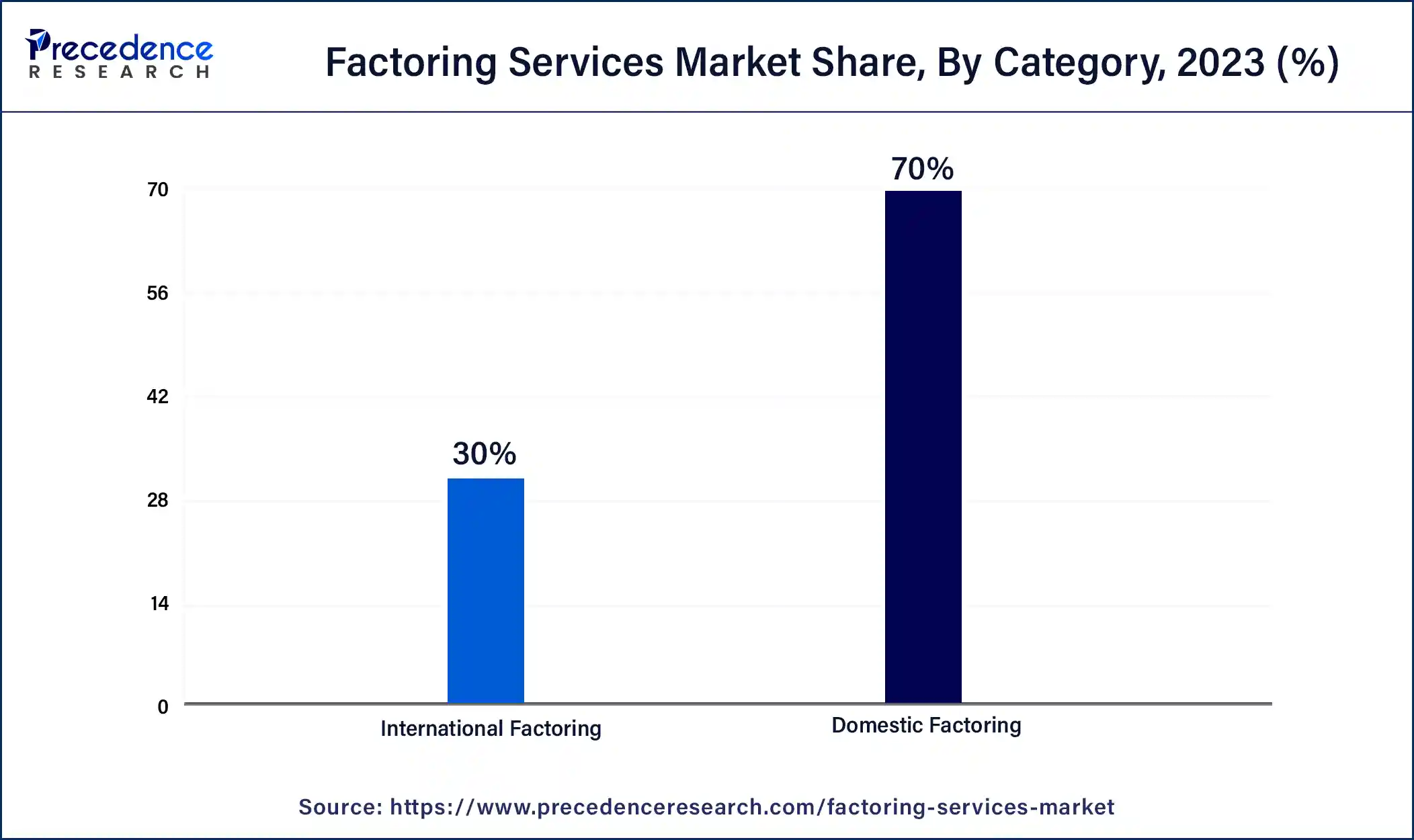
The international factoring segment is projected to grow at the fastest rate in the coming years, supported by rising focus on cross-border trade, where exporters sell foreign receivables to factoring firms. International factoring enhances competitiveness with flexible credit terms and manages cross-border regulations, reducing exporters' operational loads in global trade finance and reducing risks. The expansion of business drives the adoption of international factoring, which offers exporters immediate liquidity and transfers collection risk from currency fluctuations, payment delays, and foreign buyer credit issues to the provider.
Type Insights
How did the Recourse Factoring Segment hold the Largest Share in the Factoring Services Market?
The recourse factoring segment dominated the factoring services market in 2025, due to lower risk premiums and fees, where the selling professional assumes credit risk for unpaid invoices. Recourse factoring suits companies with reliable customers, providing quick access to capital and helping manage cash flow, especially during liquidity issues and debtor defaults. For companies with uncertain debtor payments, recourse factoring is ideal due to its cost savings and liquidity advantages, which align with financial institutions' preference for low-risk cases and less exposure.
The non-recourse segment is experiencing the fastest growth in the market during the forecast period, because it helps businesses by taking on credit risk for unpaid invoices resulting from debtor insolvency, making non-recourse factoring available to firms seeking improved financial risk management. In sectors with unpredictable payments, it is essential to mitigate bad-debt risks to improve cash flow forecasting and planning. The non-recourse model offers security benefits but comes with stricter eligibility requirements, demanding detailed credit evaluations supported by advanced analytics.
Application Insights
Why did the Small and Medium Enterprises (SMEs) Segment Hold the Highest Market Share in 2025?
The small and medium enterprises (SMEs) segment held the highest share of the factoring services market in 2025, because factoring's flexibility and speed are ideal for SMEs, fueling industry growth. An invoice financing service helps small and medium enterprises maintain liquidity for daily operations, expansion, and working capital, without incurring long-term debt. These segments increasingly use digital platforms to achieve faster approvals and easier onboarding, so removing unpredictable cash flows and late payments.
The large enterprises segment is expected to witness rapid growtg over the forecast period, due to the rising use of factoring, mainly to boost cash flow, manage balance sheets, and finance supply chains. Large enterprises often have large accounts receivable and use factoring to maintain liquidity through structured agreements and automated systems that support high-volume, global transactions. The factoring services are growing in corporate finance strategies, improving financial ratios and working capital, offering off-balance-sheet advantages and flexibility in large enterprises.
Regional Insights
Why did Europe Dominate the Factoring Services Market?
Europe dominated the market by capturing the largest share in 2025, driven by invoice financing from established banks and mature credit systems. Supportive regulations and trade policies promote both cross-border and domestic factoring activities across Europe. Manufacturing, logistics, and trade companies with long payment cycles use factoring services to boost working capital. Aligning with digital platforms such as fintech, automated risk tools, and instant invoicing is transforming the SMEs sector. Overall, Europe's industry is advanced and growing, boosted by innovation and acceptance of non-bank finance.
What is the Europe Factoring Services Market Size?
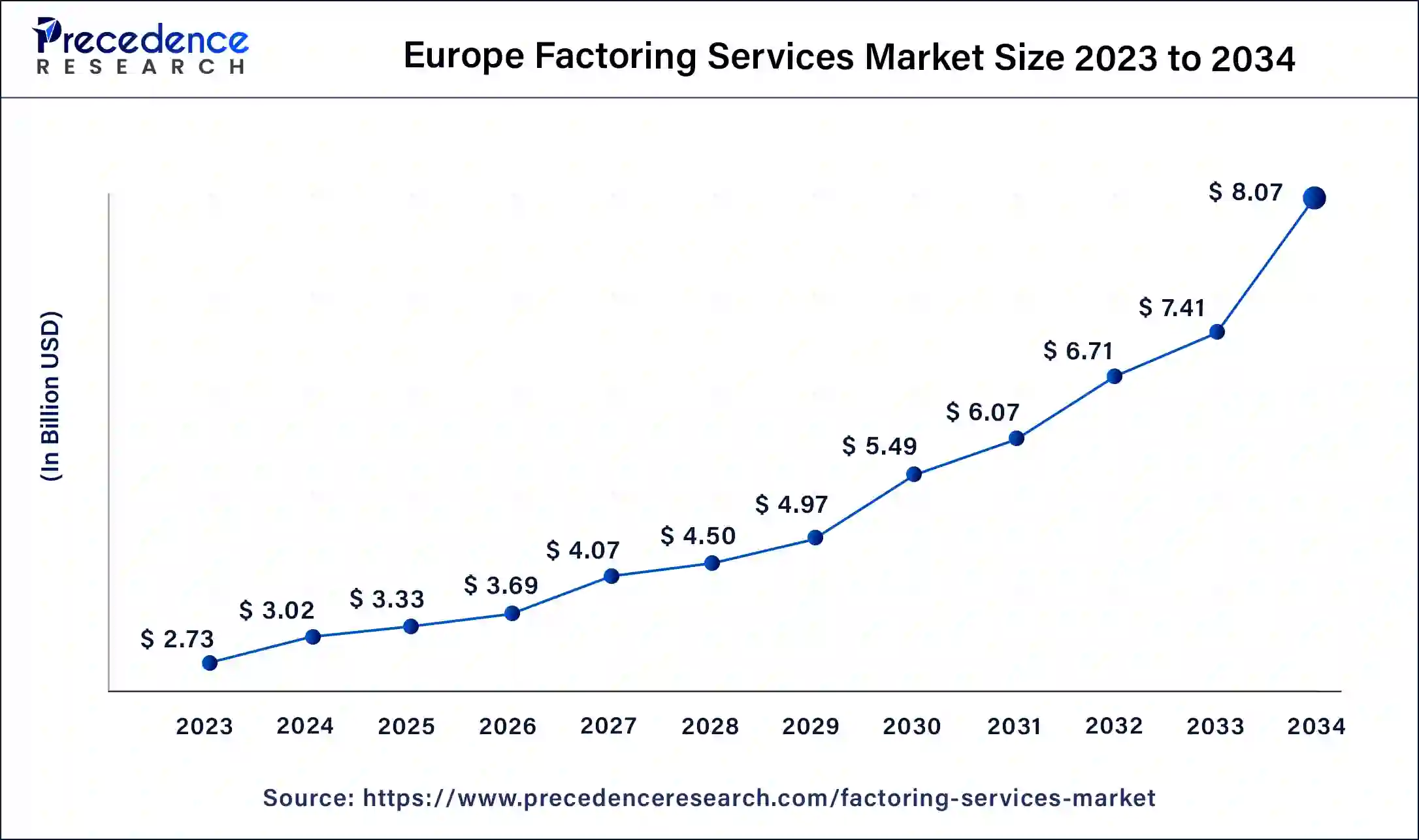
The Europe factoring services market was valued at USD 3.33 billion in 2025 and is expected to be worth around USD 8.84 billion by 2035, at a CAGR of 10.26% from 2026 to 2035.
Germany Factoring Services Market Growth Trends
Germany's market maintains its leadership, supported by a strong banking network, a sophisticated industrial sector, and rising use of invoice financing. Germany's robust credit systems and legal frameworks boost factoring in manufacturing, automotive, and export companies. Domestic-scale small and medium enterprises in Germany remain a key hub for factoring growth and financial innovation.
How is the Asia Pacific expected to grow at the fastest CAGR in the market during the forecast period?
Asia Pacific experiences the fastest growth during the forecast period, due to rising industrial diversification, export-driven economies, and increased demand for working capital. Asia Pacific is becoming a key region for the adoption of factoring services by small and medium businesses. The region is increasing in e-commerce, manufacturing, and cross-border trade, which is boosting invoice financing needs. Additionally, digital innovations and expanding trade networks enable strong demand for factoring services.
The India factoring services market is experiencing expansion due to an increase in open account trading prospects within the country. Furthermore, the demand for cash flow management and the requirement for alternative financing options for SMEs in India drive the expansion of the market. Additionally, the adoption and evolution of blockchain technology is anticipated to create profitable opportunities for the market to experience growth in the coming years.
- IFFSPL is among the seven NBFC-Factors registered with the Reserve Bank of India and functions as a Category III Authorized Dealer, focusing on receivable financing and factoring. In the past five years, IFFSPL has positioned itself as the leader in Indian export factoring, capturing approximately 54% market share in export factoring conducted via FCI in CY 2023.
The growth of the factoring services market in United States is due to the increasing demand for alternative funding options for Micro, Small & Medium Enterprises. Multiple finance firms are offering adaptable factoring solutions to freelancers and small to medium-sized enterprises to help alleviate financial strain from late payments. Additionally, the adoption of cloud-based and AI-driven models in factoring services is increasing to enhance service efficiency. Banks in the area are becoming more customer-friendly by offering accessible websites where clients can view their account balances, submit loan applications, and manage invoices. These advancements are anticipated to propel market expansion throughout the projected timeframe.
What are the Driving Factors of the Factoring Services Industry in North America?
North America is expected to grow at a significant rate during the forecast period. Factoring services have high demand in North America. Companies are based on organized financial models. The market is developed and fintech-based. Rational decision-making is enhanced by AI-inspired credit tools.
There is an upsurge in demand for the non-recourse factoring solution. Competition goes up among fintech providers. Niche services become popular. The market is an indicator of changing demands for flexible financing and risk management in various industries.
U.S. Factoring Services Market Trends
U.S. generates demand by niche factoring solutions. Companies demand easy access to liquidity. Increase in freight and healthcare factoring. Spot factoring assists with on-demand financing requirements. The firms are competing against alternative lending models. Technology improves the services of receivables management. The market indicates a change to custom solutions to sector-specific cash flow problems.
What Drives the Latin America Factoring Services Market?
The Latin America market is developing due to rising demand for liquidity among small and medium enterprises with delayed payments and cash flow issues. Latin America increased trade in agriculture, manufacturing, and retail, supported by greater awareness of invoice financing and improved financial infrastructure. To address economic uncertainty, local enterprises are moving towards digital platforms to enhance transparency and efficiency across Latin America.
Brazil Factoring Services Market Growth Trends
The market in Brazil is expanding due to rising demand for working capital, especially among small and medium businesses. Digital platforms across Brazil enhance transaction efficiency and access to factoring services, improving liquidity and supporting operations amid economic instability. Overall, factoring remains vital for liquidity and economic activity in Brazil.
Why is the Factoring Services Market Within the Middle East & Africa Growing?
The Middle East and Africa's market is growing, influenced by demand for non-bank funding and economic diversification. Governments and financial institutions are focusing on expanding trade finance and working capital access, which is fueling demand for factoring services across MEA. The region is witnessing steady growth, driven by a limited number of companies that use factoring for cash flow, especially in construction, trade, and logistics.
Saudi Arabia Factoring Services Market Growth Trends
Saudi Arabia's market is growing due to financial reforms encouraging non-bank financing. Government efforts to improve financial infrastructure, promote digital banking, and upgrade regulations support growth across Saudi Arabia. Major domestic companies use factoring to manage cash flow and to finance invoices. The emerging fintech integration in Saudi Arabia has strong potential to transform working capital financing.
Key Companies & Market Share Insights
The market is moderately fragmented with the presence of several local companies. These market players are striving to gain higher market share by adopting different marketing strategies, such as new product launch, investments, partnerships, and mergers & acquisitions. The companies are also spending on the development of improved products. Moreover, they are also focusing on competitive pricing.
- In December 2019, the China Construction Bank (CCB) launched the platform for factoring services and trading.
The various developmental strategies such as business expansion, investments, new product launches, acquisition, partnerships,joint venture, and mergers fosters market growth and offers lucrative growth opportunities to the market players.
Recent Collaboration
- In March 2026, India Factoring and MonetaGo announced a strategic alliance in which India Factoring will implement MonetaGo's Secure Financing system. This system is designed to detect invoice financing fraud and authenticate trade documents, thereby reinforcing the integrity of receivables finance.
- In March 2026, M1NXT, an International Trade Financing Services (ITFS) platform authorized by the IFSCA, announced its partnership with YES BANK. This collaboration aims to provide cross-border factoring solutions, starting with services for exporters in India.
Future Outlook and Strategic Recommendation
Long Term Industry Outlook
The factoring services market is expected to experience long term growth, driven by rising demand for working capital financing among SMEs, expansion of cross-border trade, and the rapid digitalization of financial services. As businesses seek quick access to liquidity without increasing debt burdens, invoice factoring is becoming a preferred alternative to traditional bank lending. The incorporation of AI, automation, open banking and e-invoicing is revolutionizing factoring into a data-driven financing solution with lower operational costs and enhanced risk assessment.
Emerging Business Models
AI and machine learning automate invoice verification, credit scoring, fraud detection, and pricing, reducing approval times from days to hours while enhancing operational efficiency. Factoring services are increasingly embedded into ERP systems, accounting software, B2B marketplaces, and procurement platforms, enabling businesses to access financing directly within their operational workflows. Digital marketplaces connect businesses with multiple banks, institutional investors, and fintech lenders, rising competition, enhancing funding availability, and enabling competitive pricing. Blockchain technology is improving invoice authenticity, lowering duplicate financing risks, enabling smart contracts, and enhancing transparency in domestic and international factoring transactions.
Strategic Recommendations for Stakeholders
Industries should invest in AI-powered underwriting, fraud analytics, and automated onboarding to decrease operational costs and improve consumer experience. Expand embedded finance capabilities by combining with accounting, ERP, and e-commerce platforms. Key players should formulate financing products tailored to sectors with long receivable cycles. Strengthen cybersecurity and regulatory compliance as digital transactions continue to increase. Collaborate with fintech firms to modernize factoring operations and expand SME outreach. Utilize open banking and alternative data sources to improve credit assessment for underserved businesses.
Value Chain Analysis
- Client Acquisition & Credit Assessment
The value chain begins with identifying and onboarding clientstypically small and medium-sized enterprises (SMEs), exporters, and supplierswho seek liquidity through the sale of accounts receivable. This stage involves due diligence, creditworthiness evaluation, and KYC/AML verification.
Key Players: HSBC Holdings plc, BNP Paribas, Standard Chartered Bank, Citigroup Inc., Deutsche Bank AG - Invoice Submission & Verification
Once clients are onboarded, invoices and trade documents are submitted to the factoring company for validation. The process includes verifying buyer authenticity, invoice legitimacy, and transaction compliance through automated document management and risk analytics platforms.
Key Players: UniCredit S.p.A., Crédit Agricole Group, Santander Bank, Wells Fargo & Company, China Construction Bank Corporation - Financing & Fund Disbursement
After verification, a pre-agreed percentage of the invoice value (typically 70–90%) is advanced to the seller, providing immediate liquidity. This phase is driven by financial structuring, risk pricing, and dynamic funding systems integrated with digital banking platforms.
Key Players: Barclays plc, ING Group, ICICI Bank Limited, Absa Bank Limited, Mitsubishi UFJ Financial Group, Inc. - Receivables Management & Collection
Factoring firms assume responsibility for managing the debtor ledger, monitoring payment cycles, and collecting outstanding dues from buyers. Modern platforms employ predictive analytics, digital reminders, and automated reconciliation tools to enhance efficiency.
Key Players: Taulia Inc., PrimeRevenue Inc., Demica Ltd., TradeIX (Marco Polo Network), Finastra - Risk Management & Credit Insurance
This stage focuses on mitigating default risks through credit insurance, reserve funds, and integration with global credit bureaus. Factoring companies also partner with insurers and regulatory bodies to ensure compliance and safeguard against cross-border payment risks.
Key Players: Euler Hermes (Allianz Trade), Coface, Atradius, FCI (Factors Chain International), Aon plc - Settlement & Client Reporting
Upon buyer payment, the remaining invoice amount (minus service fees) is transferred to the client. Transparent reporting, performance analytics, and ERP integration ensure clients have real-time visibility into receivables, financing costs, and payment histories.
Key Players: SAP, Oracle Financial Services, FIS, Fiserv, Intuit, Sage Group - Technology Integration & Platform Innovation
The final stage of the value chain revolves around digital transformation automation, blockchain, and AI-powered factoring platforms that streamline onboarding, risk scoring, and transaction processing to enable scalable and transparent financing ecosystems.
Key Players: TradeIX, Taulia, PrimeRevenue, Finastra, Marco Polo Network, TietoEVRY
Top Vendors in the Factoring Services Market & Their Offerings
- Mitsubishi UFJ Financial Group, Inc. (Japan): MUFG offers factoring and trade finance services through its global network, supporting exporters and manufacturers with liquidity solutions, credit protection, and efficient receivables management.
- China Construction Bank Corporation (China): As one of the largest state-owned commercial banks, CCB provides domestic and international factoring services that support China's exporters, manufacturers, and supply chain enterprises.
- Wells Fargo & Company (USA): Wells Fargo's factoring services focus on accounts receivable management, invoice financing, and credit protection for manufacturers, wholesalers, and service providers across North America.
- Barclays plc (UK): Barclays provides innovative factoring and invoice discounting solutions that enable businesses to unlock working capital and manage cash flow efficiently, particularly within the UK and European SME sectors.
- ING Group (Netherlands): ING Commercial Finance offers international factoring and receivables management services through its digital trade platforms, enabling companies to optimize liquidity and reduce credit exposure.
- Taulia Inc. (USA): A global fintech leader in supply chain finance, Taulia offers digital factoring and dynamic discounting solutions powered by AI and automation, helping enterprises accelerate payments and strengthen supplier relationships.
- PrimeRevenue Inc. (USA): Specializing in working capital optimisation, PrimeRevenue delivers cloud-based factoring and supply chain finance platforms that help large corporations improve liquidity and strengthen global supplier networks.
- Demica Ltd. (UK): A prominent fintech company focused on trade finance digitization, Demica offers receivables financing, factoring, and securitization technology for banks and large corporates worldwide.
- TradeIX (Ireland): Through its Marco Polo Network, TradeIX enables blockchain-based factoring and supply chain finance solutions, offering transparent, secure, and efficient trade finance infrastructure.
- Ameri Express Company (USA): Amex offers business financing and B2B payment solutions, including factoring-like cash flow management tools for SMEs seeking faster invoice settlement and improved working capital efficiency.
- ICICI Bank Limited (India): ICICI Bank provides factoring and bill discounting services to exporters and domestic businesses, facilitating seamless cash flow and credit protection through its trade finance solutions.
- Absa Bank Limited (South Africa): Absa's factoring and invoice discounting services support African enterprises by enhancing liquidity and providing flexible working capital solutions tailored to regional market dynamics.
Recent Developments
- In March 2026, BSE Index Services launched the BSE SmallCap 500 Index and four factor-based indices. BSE SmallCap 500 Quality 50, BSE SmallCap 500 Momentum 50, BSE SmallCap 500 Low Volatility 50, and BSE SmallCap 500 Enhanced Value 50, targeting India's small-cap investment factors, reconstituted quarterly.
(https://www.business-standard.com ) - In February 2026, Egypt's Financial Regulatory Authority unveiled a digital factoring system via its portal, collaborating with e-finance to mitigate double financing risks and enhance sector oversight. Phase one enables factoring firms to electronically check invoices against prior funding through direct connections with the Ministry of Finance and the Egyptian Tax Authority for data accuracy. (https://www.dailynewsegypt.com )
- In July 2025, Nice Deer received approval from the FRA to create Egypt's first fully digital NBFI, focusing on factoring services for deferred medical insurance claims. This milestone allows real-time financing for medical providers, addressing liquidity shortages from delayed claim settlements in the healthcare sector. (https://www.zawya.com)
- In October 2024, smeGo secured a €25 million investment from a leading European financial institution. This funding will allow us to expand our invoice factoring services and offer even lower rates to clients, thereby enhancing access to financing for small and medium-sized enterprises (SMEs) across the Baltic region. Since its inception in 2016, smeGo has provided tailored financing solutions to over 4,000 SMEs, boasting a credit portfolio of €240 million and a total of €2 billion financed.
Segments Covered in the Report
By Category
- Domestic Factoring
- International Factoring
By Type
- Recourse Factoring
- Non-recourse Factoring
By Application
- Small and Medium Enterprise (SMEs)
- Large Enterprise
By Geography
- North America
- U.S.
- Canada
- Europe
- U.K.
- Germany
- France
- Asia-Pacific
- China
- India
- Japan
- South Korea
- Rest of the World
For inquiries regarding discounts, bulk purchases, or customization requests, please contact us at sales@precedenceresearch.com
Frequently Asked Questions
Tags





Ask For Sample
No cookie-cutter, only authentic analysis – take the 1st step to become a Precedence Research client
 Get a Sample




 sales@precedenceresearch.com
 Schedule a Meeting
