



Household Appliances Market Size, Key Companies, Company Market Share, Sales Volume, Consumer Demand, Pricing Trends, Distribution Performance, Competitive Positioning, and Growth Forecast
Household Appliances Market (By Product: Major Appliances, Small Appliances; By Distribution Channel: Supermarkets and Hypermarkets, Specialty Stores, E-Commerce, Others) - Global Industry Analysis, Size, Trends, Leading Companies, Regional Outlook, and Forecast 2026 to 2035
Source: https://www.precedenceresearch.com/household-appliances-market
 Get a Sample
 Table Of Content


What is the Household Appliances Market Size?
The global household appliances market size is calculated at USD 705.21 billion in 2025 and is predicted to increase from USD 745.40 billion in 2026 to approximately USD 1,221.81 billion by 2035, expanding at a CAGR of 5.65% from 2026 to 2035.
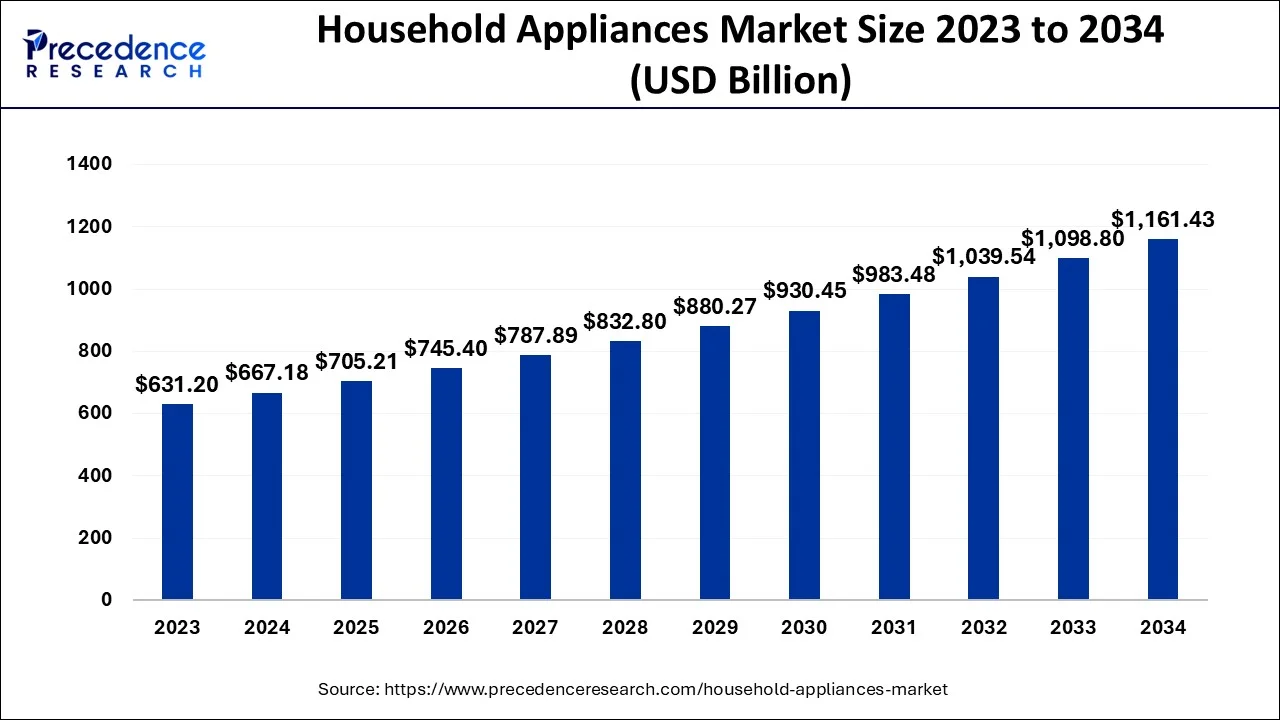
Market Highlights
- Asia Pacific dominated the global household appliances market in 2025.
- North America is expected to expand at the fastest CAGR during the forecast period.
- By product, the major appliances segment carries the largest revenue share in the household appliances market.
- By product, the small appliances segment is expected to significantly boost during the anticipated timeframe.
- By distribution channel, the specialty store segment accounted for more than 47.60% of revenue share in 2025.
- By distribution channel, the e-commerce segment is predicted to grow at a significant CAGR during the forecast period.
How is AI Influencing the Household Appliances Industry?
Smart homes are characterized by numerous interconnected devices, normally controlled by a central hub like the Samsung Smart Things Hub. AI-powered hubs, along with platforms, help integrate and automate multiple appliances, enabling homeowners to control multiple devices from a centralized platform.
Meanwhile, predictive maintenance enables the identification of specific faulty elements, meaning that only the defective part needs to be replaced rather than the entire machine. Thus, this approach not only saves resources but also makes the process more environmentally friendly.
Household Appliances Market Growth Factors
The global household appliances market is anticipated to witness a significant growth rate owing to the changing consumer lifestyle and evolving and growing economic pressure. The rising adoption of technologically advanced appliances is boosting the growth of the market. The proliferation of digital technologies has led to the development of energy-efficient and advanced appliances that offers enhanced performance at less energy consumption. The rising disposable income, improving living standards, and the need for comfort are the major factors that are driving the growth of the household appliances market. The demand for various advanced household appliances is rising owing to the rising consumer expenditure on home improvement products. The easy availability of numerous brands and products at supermarkets and other retail formats has significantly contributed to the growth of the market.
The growing penetration of various distribution channels such as specialty stores, brand outlets, e-commerce, and supermarkets is significantly contributing to the growth of the global household appliances market. The sedentary lifestyle of consumers and busy and hectic schedules has significantly propelled the demand for the household appliances like dishwashers, washing machines, and mixer grinders. Employed people have less time to indulge in household chores regularly and hence they prefer automatic appliances to reduce manual efforts and save time. The integration of various novel technologies in the household appliances like artificial intelligence, AR/VR, the internet of things, and robotics is expected to boost the growth of the global household appliances market significantly in the upcoming future. The regular new product launches and introduction of the latest advanced and innovative features in household appliances trigger the consumers and boost the sales of household appliances.
Market Scope
| Report Coverage | Details |
| Market Size in 2025 | USD 705.21 Billion |
| Market Size in 2026 | USD 745.40 Billion |
| Market Size by 2035 | USD 1,221.81 Billion |
| Growth Rate from 2026 to 2035 | CAGR of 5.65% |
| Base Year | 2025 |
| Forecast Period | 2026 to 2035 |
| Segments Covered |
Product, Distribution Channel, and region |
| Regions Covered |
North America, Europe, Asia-Pacific, Latin America, Middle East & Africa |
Segments Insights
Product Insights
Based on the product the global household appliances market was dominated by the major appliances segment in 2025. The major appliances segment is further categorized into freezers, refrigerators, washing machines, dishwashers, air conditioners, ovens, and others. The refrigerators segment was the dominating segment in the global household appliances market. Refrigerators offer a safe, convenient, and easy solution for preserving food and food products. The easy availability of refrigerators, rising disposable income, rising affordability due to easy financing options, and the growing number of nuclear families across the globe are some of the major factors that have led to the growth of the refrigerators segment. The easy availability of energy-efficient and a wider variety of refrigerators as peruse such as single-door, double-door, and French-door refrigerators are contributing to the growth of the refrigerators segment significantly. The rising investments in research and development by the major market players to develop eco-friendly refrigerators are expected to offer numerous growth opportunities in the near future.
On the other hand, small appliances are expected to be the fastest-growing segment during the forecast period. The small appliances segment is further bifurcated into food processors, grills &roasters, tea/coffee makers, vacuum cleaners, and others. The growing demand for small appliances for various daily routine tasks like cleaning, making breakfast, juices, and tea and coffee is a major factor that drives the growth of this segment. The easy availability of small appliances at affordable costs and ring standards of living are some of the major drivers of the small appliances segment. The rising technological advancements and rising energy efficiency of small appliances are expected to have a significant impact on the growth of the demand for small appliances during the forecast period.
Distribution Channel Insights
Based on the distribution channel, the specialty store segment dominated the global household appliances market in 2025. The huge presence of various multi-branded and mono-branded consumer electronic stores across developed and developing regions and the higher popularity of these stores among consumers has led to the dominance of this segment in the market. The availability of a wide range of products and brands along with the special discounts and guidance provided by the salesperson in the stores makes the buying process and installation process easier for the consumers and hence the growth of this segment has propelled significantly in the past few decades.
On the other hand, e-commerce is expected to be the most opportunistic segment during the forecast period. The rising adoption of smartphones, growing penetration of the internet, rising investments by the manufacturers in the digital distribution channels, huge discounts, easy return and replacement policies of the e-commerce platforms, and fast home delivery are the most prominent factors that drive the growth of the e-commerce segment in the global household appliances market. According to the International Telecommunication Union, around 64% of the global population had access to the internet. This population is expected to grow significantly during the forecast period. Therefore, the market is expected to grow significantly in the upcoming years.
Regional Insights
Asia Pacific was the leading household appliances market in 2025. Asia Pacific has a huge consumer base due to the presence of a huge population. The strong economic growth, rising urban population, rising government investments in the electrification of rural areas, rising number of nuclear families, and rising standard of living are the prominent drivers of the Asia Pacific household appliances market. The rising consumer awareness regarding the availability of technologically advanced appliances and growing demand for energy-efficient appliances is expected to further fuel the growth of the market. Asia Pacific is the home to the world's leading producers of household appliances and the availability of cheap factors of production facilitates the production of cheap and efficient household appliances in the region.
China Market Trends
China is a manufacturing powerhouse in the world, with a transition to high-end, AI-based intelligent appliances. Buying online is predominant, and e-commerce and fast delivery formats are rapidly gaining popularity. Trade-in initiatives supported by the government promote the upgrade to energy-saving products, whereas multifunctional and interconnected appliances become popular among tech-friendly consumers.
North America is a mature market for household appliances. The high disposable income, presence of strong digital and electrical infrastructure, high living standards, and higher demand for technologically advanced appliances in the region have fostered the growth of the household appliances market in North America. The busy and hectic lifestyle of the consumers and the presence of a huge number of nuclear families is augmenting the demand for innovative and advanced household appliances. The rising technological advancements and adoption of the latest technologies in household appliances is expected to foster market growth in North America during the forecast period.
U.S. Market Trends
The household appliances sector in the U.S. is propelled by the replacement of old appliances and the rise in demand for smart and AI-powered appliances that are energy efficient. Small appliances that are health-oriented are on the increase. The standards, such as ENERGY STAR, are vital aspects of sustainability, and design trends include seamless integration, warm minimalism, and enhanced in-built technologies in modern kitchens.
Digitalization and Automation in the Household Appliances Industry in Europe
Europe's market shows significant growth during the forecast period. With growing energy prices and also strict EU regulations on carbon emissions, there is a major shift toward energy-efficient appliances. Smart, connected appliances, e.g., inverters, smart grids, allow optimized energy usage and even lower utility bills. Appliances are becoming more intelligent, utilizing AI to learn user habits, provide predictive maintenance, and offer personalized functionality.
Germany Market Trends
The market of Germany is focused on sustainability, reparability, and adherence to the strict EU standards such as ESPR. There is a high demand for energy-saving and durable appliances. There is a dominance of premium IoT-enabled appliances, which provide smart home connectivity and predictive maintenance. The health-related small appliances have a high growth rate, and online channels are a significant platform in terms of sales.
Urbanization and Changing Lifestyle Fueling the Household Appliances Market in Latin America
Latin America's market shows notable growth during the forecast period. It is driven by rapid urbanization, which contributes to smaller living spaces, driving high need for compact, multi-functional, and even "smart" kitchen appliances, such as microwaves, air fryers, and smart refrigerators that improve space.
Brazil Market Trends
The Brazilian market is motivated by the need for long-lasting, energy-saving, and cost-effective appliances. The growth is geared towards key appliances such as refrigerators and washing machines. Premium features like Frost Free and smart systems are being gradually embraced by consumers. The increase in online retailing channels enhances access and provides competitive pricing.
Consumer Buying Behavior and Preferences in the Household Appliances Market in MEA
MEA's market shows rapid growth during the forecast period. It is driven by a high preference for IoT-driven appliances such as AI-powered washing machines, smart fridges that enables for remote monitoring and improved convenience. Consumers are increasingly looking for appliances that support health, like air purifiers, water filters, and even cooking appliances that provide healthier cooking options.
UAE Market Trends
High demand for luxury, built-in appliances, and advanced cooling systems that would fit extreme climates characterizes the UAE market. Connected appliances are popular and used due to convenience. In addition to the high-end market, a value-based market is expanding, specializing in high-quality, high-functionality appliances at a competitive price.
Value Chain Analysis for the Household Appliances Market
- Product Conceptualization and Design: It is a well-structured, multidisciplinary process that translates consumer insights into aesthetic, functional, and marketable products.
Key Players: Samsung Electronics, LG Electronics, Haier Group Corporation - Raw Material Procurement: This process includes managing a global supplier network and even balancing supply chain risks, like price volatility and transportation delays.
Key Players: LG Electronics & Samsung Electronics, Whirlpool of India Ltd & Godrej Appliances, Haier India & Voltas
Household Appliances Market Companies
- AB Electrolux
- Qingdao Haier Co., Ltd.
- Hitachi, Ltd.
- LG Electronics Inc.
- Midea Group Co., Ltd.
- Panasonic Corporation
- Robert Bosch GmbH
- Samsung Electronics Co., Ltd.
- Sharp Corporation
- Whirlpool Corporation
Key Market Developments
- In April 2026, Hafele launched a new Appliances Studio in Vyttila, Kochi, enhancing its presence in Kerala. The studio offers high-performance appliance solutions for homeowners, architects, and designers, providing an immersive customer experience. (Source: https://hospibuz.com )
- In March 2026, Thomson entered the Indian refrigerator market with eight entry-level models, expanding its home appliance range and rebalancing its portfolio beyond televisions to drive growth in India. (Source: https://retail.economictimes.indiatimes.com )
Segments Covered in the Report
By Product
- Major Appliances
- Freezers
- Refrigerators
- Washing Machines
- Dishwashers
- Air Conditioners
- Ovens
- Others
- Small Appliances
- Food Processors
- Grills & Roasters
- Tea/Coffee Makers
- Vacuum Cleaners
- Others
By Distribution Channel
- Supermarkets and Hypermarkets
- Specialty Stores
- E-Commerce
- Others
By Region
- North America
- Europe
- Asia-Pacific
- Latin America
- Middle East & Africa (MEA)
For inquiries regarding discounts, bulk purchases, or customization requests, please contact us at sales@precedenceresearch.com
Frequently Asked Questions
Tags





Ask For Sample
No cookie-cutter, only authentic analysis – take the 1st step to become a Precedence Research client
 Get a Sample




 sales@precedenceresearch.com
 Schedule a Meeting
