



Smart Home Appliances Market Size, Key Companies, Company Product Portfolio, Manufacturing Output, Sales Performance, Cost Structure, Distribution Channels, Company Market Share, and Competitive Landscape
Smart Home Appliances Market (By Product: Smart Washing Machines, Smart Air Purifiers, Smart TV, Others; By Distribution Channel: Online, Offline) - Global Industry Analysis, Size, Trends, Leading Companies, Regional Outlook, and Forecast 2025 to 2034
Source: https://www.precedenceresearch.com/smart-home-appliances-market
 Get a Sample
 Table Of Content


What is the Smart Home Appliances Market Size?
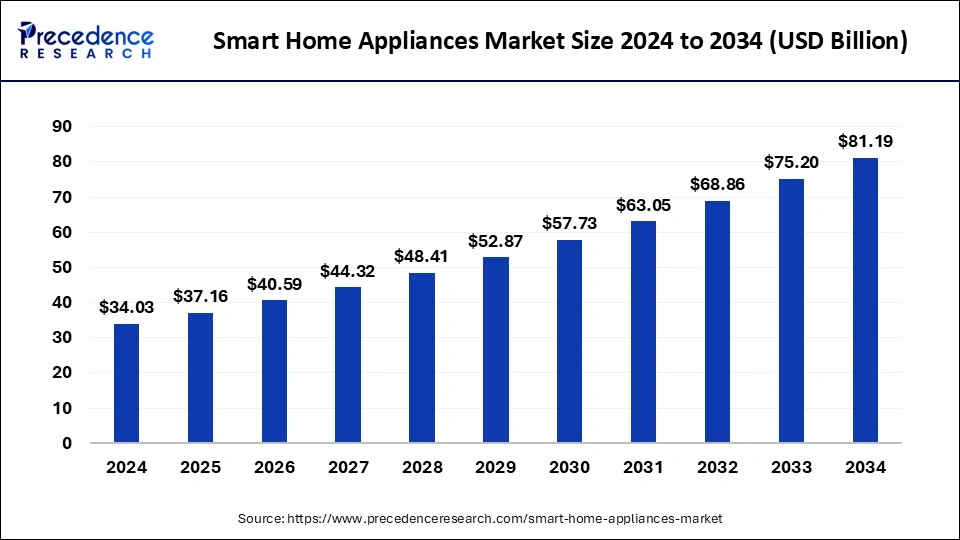
The global smart home appliances market size is estimated at USD 37.16 billion in 2025 and is predicted to increase from USD 40.59 billion in 2026 to approximately USD 81.19 billion by 2034, expanding at a CAGR of 9.08% from 2025 to 2034. The smart home appliances market is driven by the rising interest in energy-saving appliances.
Smart Home Appliances Market Key Takeaways
- Asia Pacific had dominated in the market with the largest revenue share of 42% in 2024.
- North America is expected to grow at a solid CAGR of 7.72% during the forecast period.
- By product, the smart washing machines segment has recorded more than 37% of revenue share in 2024.
- By product, the smart air purifiers segment is observed to be the fastest growing in the smart home appliances market during the forecast period.
- By distribution channel, the offline segment has generated more than 65% of revenue share in 2024.
- By distribution channel, the online segment is observed to be the fastest-growing in the smart home appliances market during the forecast period.
What are Smart Home Appliances?
The consumer electronics segment that manufactures cutting-edge features, including sensors, automated control systems, and networking capabilities like Wi-Fi and Bluetooth, is known as the "smart home appliances market." These appliances are intended to improve overall performance, energy efficiency, and convenience by integrating with smart home ecosystems.
By enabling remote control and monitoring through smartphone apps or voice assistants, smart appliances provide convenience to their customers. They can save time and effort by automating temperature control, operation scheduling, and alerting users to maintenance requirements. Popular smart home platforms (including Google Home, Amazon Alexa, and Apple HomeKit) are frequently compatible with these appliances, allowing easy integration and control with other linked devices. This connectivity improves the user experience and overall home automation.
Smart Home Appliances Market Outlook
- Industry Growth Overview: The smart home appliances market segments are projected to experience rapid growth through 2025-2030 as consumers embrace connected, energy-efficient, and automated home solutions. Demand for smart appliances increased in response to changing urban lifestyles, increasing adoption of smart speakers, and other technologies that utilize artificial intelligence and the Internet of Things in home settings. Strong growth is expected in the Asia-Pacific region and North America.
- Sustainability Trends: Sustainability is creating significant change in the smart home appliances market segment, with expanded demand for energy-saving blended systems, low-power sensors, and eco-certified appliances. Leading brands increased research and development investment in recyclable materials and for more efficient and smart energy-use optimization of appliances.
- Global Expansion: Key industry players expanded into markets in Asia-Pacific, the Middle East, and Eastern Europe to capture the increasing adoption of the technology in the smart home space and a favorable regulatory environment. Companies are also investing in local manufacturing and service operations. For example, global appliance brands have increased their operations in Southeast Asia to capture growing demand for connected kitchen and climate-control appliances.
- Major Investors: The smart home appliance surging growth, recurring revenue from service associated with apps, and strong ESG alignment drew private equity and strategic investors into the space. Firms developing AI-enabled appliances, home security and automation, and energy and water-efficient appliances attracted investor interest from prominent groups such as SoftBank, Temasek, and BlackRock.
- Startup Ecosystem: The startup ecosystem expanded rapidly, particularly in the following product categories: AI home automation, cleaning devices using robotics, and energy management systems. Startups such as SwitchBot (Japan) and Atomberg (India) have garnered considerable VC funding and attention for producing innovative, cost-effective, and sustainable products or solutions that replace traditional home appliances.
What are the Growth Factors in the Smart Home Appliances Market?
- Customers are growing more drawn to smart home technology's freedom and convenience.
- Developments in artificial intelligence (AI) and the Internet of Things (IoT) are facilitating the creation of increasingly complex and user-friendly smart appliances.
- Customers are more inclined to purchase smart products as their discretionary income rises. Voice instructions for smart appliance control are made simpler with these devices. This drives the growth of the smart home appliances market.
- Customers may lessen their influence on the environment and save energy by using smart appliances.
Market Scope
| Report Coverage | Details |
| Market Size by 2034 | USD 81.19 Billion |
| Market Size in 2026 | USD 40.59 Billion |
| Market Size in 2025 | USD 37.16 Billion |
| Growth Rate from 2025 to 2034 | CAGR of 9.08% |
| Largest Market | Asia Pacific |
| Base Year | 2024 |
| Forecast Period | 2025 to 2034 |
| Segments Covered | Product, Distribution Channel, and Regions |
| Regions Covered | North America, Europe, Asia-Pacific, Latin America, and Middle East & Africa |
Market Dynamics
Drivers
Increasing adoption of home automation systems
Smart home appliances are made to maximize energy use by modifying usage habits in response to human behavior and real-time data. Smart washers can optimize water usage based on load size, smart thermostats can alter occupancy patterns, and smart refrigerators can modify cooling settings during off-peak hours. Because they use less energy overall, these efficiencies minimize energy bills and promote environmental sustainability.
Home automation is becoming increasingly popular as people age and need help with everyday chores and accessibility. For older or differently abled people, smart home appliances with features like voice control and automated routines improve independence and quality of life. This drives the growth of the smart home appliances market.
Advancements in Artificial Intelligence (AI)
AI is a fundamental component of smart homes' networked Internet of Things (IoT) ecosystem. Artificial intelligence (AI) algorithms facilitate smooth communication and coordination between many appliances by managing and analyzing data from sensors and devices. Because of their connectivity, appliances may function intelligently together in situations like this. For instance, a home security system powered by artificial intelligence (AI) can instantly change the lighting and notify the owner of any risks it detects.
Restraint
High initial cost
Installing and configuring smart home gadgets can incur additional fees in addition to the purchase price. Professional installation could be necessary for some devices, raising the total cost. To incorporate these appliances into their current smart home ecosystem, consumers might also need more hubs or accessories, raising the initial cost even more.
It is still common for consumers to be ignorant of the features and advantages of smart home products. Another critical factor is preferences; some users value price and basic features more than the sophisticated features that smart appliances can offer. This limits the growth for the smart home appliances market.
Opportunities
Integration with IoT
Energy conservation can be facilitated by IoT-enabled appliances, which optimize energy usage by utilizing real-time data and user behavior. By decreasing energy waste, this capability helps consumers' utility bills and promotes environmental sustainability efforts. IoT has many advantages, but there are privacy and data security risks. Strong security measures must be put in place by developers and manufacturers to safeguard user information and stop illegal access to linked devices. This opens an opportunity for the smart home appliances market.
New product launches
New product launches meet the growing consumer demand for innovative and advanced technology in their homes, offering convenience, efficiency, and enhanced user experiences. Launching new products allows companies to differentiate themselves from competitors, showcasing unique features and cutting-edge technologies that attract tech-savvy consumers. As the adoption of smart home technology increases, new product launches cater to early adopters and tech enthusiasts, driving market growth and expanding the customer base. Many consumers look to upgrade their existing home systems with the latest smart appliances, creating a continuous demand for the newest products on the market.
Segment Insights
Product Insights
The smart washing machines segment dominated in the smart home appliances market in 2024. Smartphone apps help owners of contemporary smart washing machines remotely operate and monitor them, thanks to their Wi-Fi and Bluetooth capabilities. Voice control and automation are also made possible by these machines' smooth integration with other smart home ecosystems and devices, including Google Assistant, Apple HomeKit, and Amazon Alexa.
Urban populations are more tech-savvy than ever and want connected, efficient, and convenient smart appliances. The need for smart washing machines is fueled by the growing number of smart homes adopted in urban areas. Advanced cleaning technologies such as steam cleaning, allergen removal, and high-temperature washes are prominent in smart washing machines, catering to the growing consumer demand for health and hygiene.
There is a strong market demand for smart washing machines due to their practical benefits, with consumers willing to invest in appliances that offer time-saving and efficiency-enhancing features. Leading appliance brands have focused heavily on developing and marketing smart washing machines, increasing their availability and consumer awareness, and driving segment growth.
The smart air purifiers segment is observed to be the fastest growing in the smart home appliances market during the forecast period. Artificial Intelligence (AI) and Internet of Things (IoT) technology are now features of smart air purifiers. Due to these developments, the devices can now automatically alter their operation to provide adequate air purification based on real-time air quality monitoring. Smart sensors that identify allergies, pollutants, and other airborne particles are a feature of modern air purifiers. Connecting to household Wi-Fi networks makes it possible for smartphones and smart home ecosystems like Apple HomeKit, Google Assistant, and Amazon Alexa to be used for remote control and monitoring.
Distribution Channel Insights
The offline segment dominated in the smart home appliances market in 2024. Consumers appreciate being able to view, feel, and operate smart home gadgets before making a purchase. This tactile feeling guarantees the functionality and quality of the product. Instead of waiting for their goods to arrive from online retailers, shoppers may take their products home right away. Brick-and-mortar establishments frequently have established reputations that foster customer confidence. Many consumers would rather purchase pricey goods, such as smart home appliances, from reputable merchants.
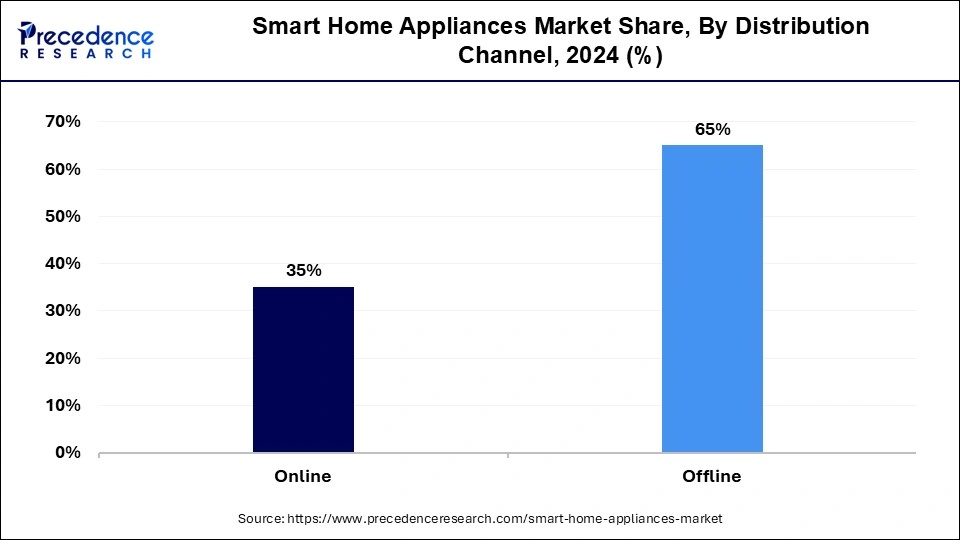
The online segment is observed to be the fastest growing in the smart home appliances market during the forecast period. Increased access to online shopping platforms has been made possible by the global expansion in internet usage. The number of individuals who can now use the Internet has significantly increased, especially in developing countries. This has increased the potential client base for online sales of smart home products. Customers can now buy smart home equipment online more quickly because of the significant infrastructure investments made by major e-commerce platforms like Amazon, Alibaba, and local businesses. These marketplaces provide a large selection of goods, affordable prices, and practical delivery choices.
Regional Insights
Asia Pacific Smart Home Appliances Market Size and Growth 2025 to 2034
The Asia Pacific smart home appliances market size is exhibited at USD 15.61 billion in 2025 and is projected to be worth around USD 34.50 billion by 2034, poised to grow at a CAGR of 9.21% from 2025 to 2034.
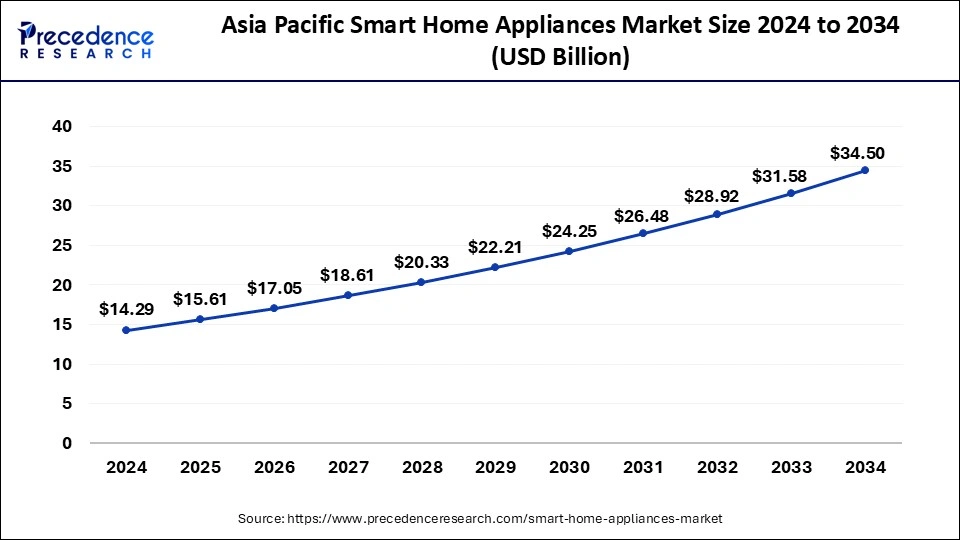
Asia Pacific dominated in the smart home appliances market in 2024. The middle class has expanded due to rapid economic expansion, especially in China, India, and Southeast Asia. For the sake of protection and convenience, this group is becoming increasingly prepared to spend money on smart home technologies. These nations are becoming increasingly urbanized, which has increased demand for space-saving, intelligent, and practical household appliances. Governments offer tax breaks and subsidies to producers and users of smart home products. Additionally, they provide grants and money to research institutes and startups concentrating on innovative technology developments.
China Market Trends
China's Smart Home Appliances Market is anticipated to grow significantly with the rise of rapid technology development of the Internet of Things and the growing trend of urbanisation. There is more money in buyers' pockets, and they are purchasing smart appliances, such as fridges and freezers, washing machines, air conditioners, TVs, robotic vacuum cleaners, kitchen gadgets, etc. The government's initiatives in this area, such as those on digital infrastructure development and smart city projects, will also provide a significant boost to the market.
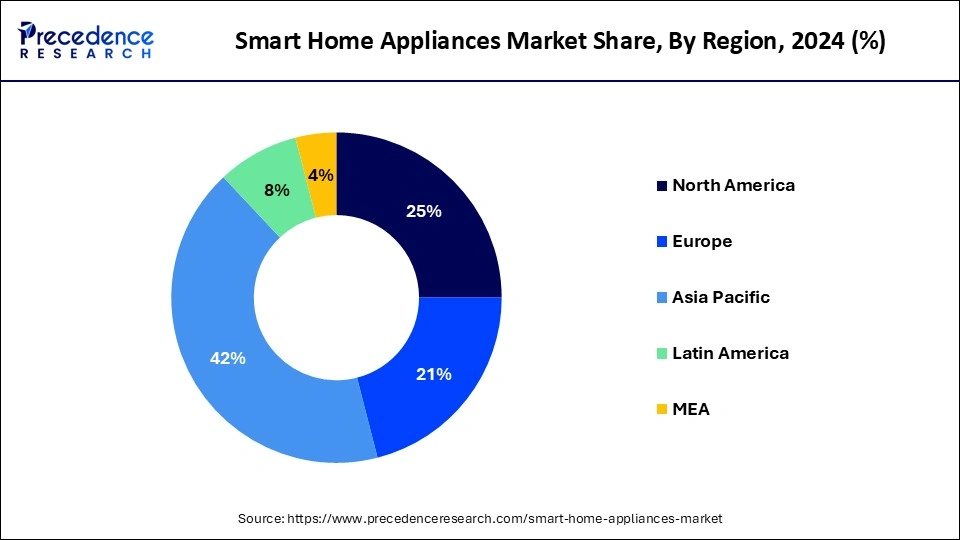
North America is expected to grow at the fastest rate in the smart home appliances market during the forecast period. Customers are more prepared to spend money on high-end smart home appliances with cutting-edge features and benefits in North America due to the region's generally better standard of living and disposable income levels. The demand for smart home appliances with time-saving features and remote-control capabilities is driven by changes in lifestyle, such as the rise in dual-income homes and the need for convenience.
North America: U.S. Smart Home Appliances Market Trends
The U.S. market is seeing strong growth as consumers increasingly invest in energy efficient, connected devices. There's a rising trend of integrating AI and IoT into everyday appliances, refrigerators can suggest recipes, washing machines adapt to usage, and devices learn user behavior. Interoperability is improving, with appliances working seamlessly across smart home ecosystems like Alexa, Google Home, and Matter compatible platforms.
What Made Europe grow at a Steady Rate in the Smart Home Appliances Market?
Europe's growth was steady due to an emphasis on energy-efficient homes and investment in sustainable technologies. Regulations to drive choice toward appliances that use less energy supported by this consumer choice. There was a strong enthusiasm to buy smart security systems and kitchen appliances with connected applications. The region also presented an opportunity for companies to make products that are environmentally friendly and last longer. Additionally, increasing interest in smart heating products, especially in the West, created more choice and led to greater demand for modern appliances in the home.
Germany Smart Home Appliances Market Trends
Germany was the largest market in Europe for smart home appliances because people placed trust in quality and energy-efficient appliances, as well as early adoption of digital systems for the home. Government initiatives to promote low-energy homes have added encouragement and demand for smart appliances in heating, lighting, and kitchen consumer goods. German companies have also invested in smart sensors and artificial intelligence features in kitchen appliances, which further supported the growth of the smart home appliances market.
Why did Latin America Show Rapid Growth in the Smart Home Appliances Market?
Latin America experienced rapid growth in the smart home appliances market because of urbanization, and more households improved their access to online capabilities. Many families showed increased interest in lower-priced smart appliances, particularly in categories like smart televisions, lighting systems, and security devices. In addition, brands benefited from e-commerce expansion, reaching more buyers; increasing opportunities came from firms that produced low-cost models.
Brazil Smart Home Appliances Market Trends
Brazil was the leading country in this region due to the size of its population and increased interest in smart televisions, smart security devices, and cooking appliances that save energy. The rise of household incomes for the middle class improved the adoption, while many established brands have increased the number of retailers for smart devices. E-commerce opportunities allowed many households to expose themselves to a level of affordability for smart devices. Government programs to promote efficient energy use have also promoted a movement back into modern appliances.
Why did the Middle East & Africa Experience Significant Growth in the Smart Home Appliances Market?
The Middle East & Africa experienced significant growth as smart security systems and climate-control devices became popular in urban households. Rising incomes in Gulf states increased demand for high-end appliances, while African countries saw increased interest as internet access improved. Companies found an opportunity to provide smart cooling, lighting, and energy-saving products. Growth in modern home and apartment construction also helped spur the adoption of connected appliances in the region
The UAE Smart Home Appliances Market Trends
The United Arab Emirates was the most advanced country in the region due to income levels, rapid smart city development, and a strong love for luxury home technology. Smart cooling systems, security devices, and premium kitchen appliances were typical in modern apartments and villas. Support from government digital initiatives further contributed to the uptake of technologies. Retailers represented a wide variety of international brands, which encouraged homeowners to upgrade.
Supply Chain Analysis
- Product Conceptualisation and Design: Smart home appliance manufacturers are more likely to take great care while developing their products to fit the characteristics of IoT connectivity, AI, energy saving, and easy-to-use applications.
- Key Players: Samsung Electronics, LG Electronics, Haier Smart Home, Whirlpool Corporation, and Midea Group
- Raw Material Procurement: The ingredients brought in from the world of global manufacturers for collaboration include electronic components, semiconductors, sensors, plastics, metals, connectivity modules, and more. To ensure production stability and product reliability, efficient procurement methods, diversification of suppliers, and a system for quality control are indispensable.
- Key Players: TSMC, Samsung Electronics, Intel Corporation, Foxconn, and Murata Manufacturing
- Branding and Packaging: Packaging decisions are usually made based on the idea that it is going to be useful to the product; this can be during shipping and storage, and it will deliver information about the product, at least clearly and competitively, so that it becomes associated with the brand.
- Key Players: Samsung Electronics, LG Electronics, Bosch, Panasonic Corporation, and Electrolux
Competitive Landscape
Leaders in the smart home appliances industry are turning to artificial intelligence, connectivity, and collaborations for products: Samsung Electronics, LG Electronics, Haier Smart Home, Whirlpool Corporation, and Electrolux. At AWE 2026 in Shanghai, in March next year, Haier Smart Home showcased its latest smart home devices, emphasising smart living rooms that are aware of the needs of the moment. The key drivers of AI in the smart house devices business include Predictive upkeep, energy optimisation, and customised automation.
As there is growing use of appliances that utilise IoT, cloud connectivity, and voice control, they are becoming more convenient and user-friendly. Technology continues to be a major focus area for manufacturers, with manufacturing moving towards the usage of next-generation smart technologies to develop next-generation seamless and connected home solutions. (Source: https://www.haier.com)
Smart Home Appliances Market Companies
- Whirlpool Corporation
- LG Electronics
- Haier Group
- Samsung Electronics Co. Ltd
- Panasonic Corporation
- BSH Hausgeräte GmbH
- Electrolux AB
- Xiaomi Corporation
- Koninklijke Philips N.V
- GE Appliances
Recent Developments
- In September 2025, LG Electronics unveiled an upgraded version of its ThinQ AI Platform, aiming to provide more sophisticated, longer-lasting, and easier-to-use smart home devices. The platform allows for predictive maintenance, feature upgrades, and customised recommendations for energy savings, which are made via the LG ThinQ app. (Source: https://www.lg.com)
- In June 2025, Xiaomi officially introduced the Mi Home smart climate control device, Mijia Air Conditioner Pro Eco Inverter. It is equipped with electronic temperature controls and features energy saving and remote control through the Mi Home app. (Source: https://www.mi.com)
- In April 2024, Chinese electronics brand Xiaomi initiated the Redmi Pad SE tablet and Redmi Buds 5A wireless earbuds in India. Alongside the latest devices, Xiaomi has also begun smart home appliances such as the Robot Vacuum Cleaner S10 and Xiaomi Handheld Garment Steamer.
Segments covered in the report
By Product
- Smart Washing Machines
- Smart Air Purifiers
- Smart TV
- Others
By Distribution Channel
- Online
- Offline
By Geography
- North America
- Asia Pacific
- Europe
- Latin America
- Middle East & Africa
For inquiries regarding discounts, bulk purchases, or customization requests, please contact us at sales@precedenceresearch.com
Frequently Asked Questions





Ask For Sample
No cookie-cutter, only authentic analysis – take the 1st step to become a Precedence Research client
 Get a Sample




 sales@precedenceresearch.com
 Schedule a Meeting
