






 Request Consultation
AI-powered translation services combine AI, machine learning, and NLP to deliver high-speed, context-aware, and scalable translations, enhancing global communication for businesses.
What are AI-Enabled Translation Services?
AI-enabled translation services leverage cutting-edge technologies like artificial intelligence, particularly neural machine learning, machine learning, and natural language processing, to automatically translate text or speech from one language to another seamlessly without human intervention. These services analyze text, syntax, and sentence structure to produce fluent, naturally toned translations. AI translation models also learn from user feedback, refining themselves over time to better understand language patterns. In contrast, traditional translation systems are time-consuming and not as fast-paced.
The core technology behind this is Neural Machine Translation, which acts as the system’s brain and uses deep learning models to simulate human language interpretation. It learns patterns from large datasets such as books, websites, and other authentic sources to deliver highly precise and fluent translations without human input. Key benefits include cost-effectiveness, scalability, consistency, and speed. Consequently, industries are increasingly using AI-enabled translation for customer support, documentation, product descriptions, and instant video subtitles to reach global audiences efficiently.
Will AI Translation Services Replace Human Translators?
One of the most pressing questions for professionals and researchers today is how AI will impact human roles, especially given its unprecedented growth, expansion, and ability to perform tasks previously reliant on human intelligence, logic, and problem-solving. However, this concept of uniqueness gets shattered when AI arrives. Now, its progress is concerning, and many leaders are warning us to stop the AI innovations.
However, every innovation has two sides, and its impact depends on how we perceive and manage it. It is impossible for AI to completely replace humans or function independently. Instead, AI works alongside humans, transforming roles such as editors and specialists. While AI provides fast, cost-effective, and precise translation of high-volume content, it lacks the emotional depth, cultural awareness, and specialized knowledge required for creative or high-level interactions.
Despite rapid advancements, neural machine translation covers only a fraction of the world’s 7,000-plus languages, highlighting the need for humans in the loop. AI often misses humor, slang, or idioms, which can lead to misinterpretation or backlash. Therefore, human translators remain essential for creative marketing, culturally nuanced content, and messages that resonate emotionally across diverse audiences, ensuring quality and effectiveness even in the era of AI-enabled translation services.
What is the AI Enabled Translation Services Market Size in 2026?
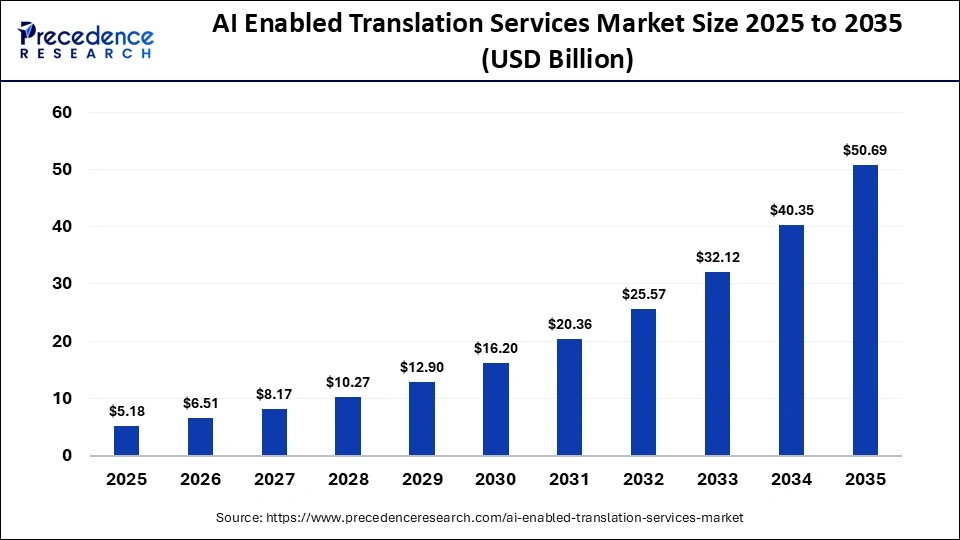
The global AI enabled translation services market size was calculated at USD 5.18 billion in 2025 and is predicted to increase from USD 5.18 billion in 2026 to approximately USD 50.69 billion by 2035, expanding at a CAGR of 25.62% from 2026 to 2035.
Top Industries Benefiting from AI-Powered Translation Services
- E-commerce and Retail: The AI translation is highly crucial for enabling cross-border commerce that allows companies to launch in new markets easily. It automates product descriptions, localized search engine optimization, translation of user reviews, and customized support in local languages. AI supports the translation of thousands of items at scale and increases conversion rates by developing localized storefronts.
- Healthcare and Life Science: AI assists in overcoming language barriers in the healthcare sector and often uses human-in-the-loop oversight to ensure precision and avoid mismanagement. AI-enabled translation services support the translation of medical records, documents, and product manuals for medical devices and offer multilingual customer services to patients. It enhances efficiency in clinical documents and supports patient safety by ensuring understandable communication in their local language.
- Legal Services and Law Firms: Legal services often operate on a global scale and require robust support for language translation as well as the ability to manage large volumes of documents. AI-enabled translation can review foreign-language documents, translate legal contracts into native languages, and help navigate multinational laws and regulatory requirements. By automating these processes, AI drastically reduces turnaround time for searching, analyzing, and processing extensive datasets across multiple languages, improving efficiency and accuracy in legal operations.
- Travel and Hospitality: This sector's growth heavily depends on constant information delivery to the customer, irrespective of their native languages. Instant language translations are highly anticipated in this sector, which is fulfilled by the AI-enabled translation services that boost rates by delivering a personalized user experience in the traveler’s native language.
- Gaming and Entertainment: The gaming industry relies heavily on localized content, including text, dialogue, and user interfaces, to create an immersive experience for players across different regions. AI-enabled translation services provide in-game text translation, dialogue interpretation, video subtitling, and localized marketing content, enabling games to reach global audiences efficiently. By streamlining localization, AI helps game developers and publishers maximize ROI while delivering a seamless, culturally relevant experience for international gamers.
- Financial Services and Banks: The finance industry requires precise understanding of every concept to avoid costly penalties from regulatory bodies for violations. As a result, many banks and financial firms are leveraging AI-enabled translation services to handle, analyze, and communicate information securely across borders. AI assists with compliance filings, customer statements, and regulatory reporting, ensuring consistency, accuracy, and adherence to international regulations while streamlining communication in a highly regulated global environment.
Benefits of AI-Enabled Translation Services Over Traditional Ones
AI-enabled translation services backed by neural machine translation and LLMs offer significant advantages as compared to conventional ways of human-guided language translation in terms of speed, costs, and consistency. Human translators are still preferred for high-stage and legal or creative content translation for high precision, while AI is highly beneficial for high-volume and rapid turnaround tasks. AI offers benefits like,
- Unmatched speed and efficiency for language translation
- High cost-effectiveness
- Highly scalable for evolving global needs for data translation
- Excellent consistency and precision with training
- Seamless integration with various preexisting systems
Artificial Intelligence translators further reduce the requirement for manual translation of each word, which leads to high-cost savings for large projects. Nearly 96% of companies are currently leveraging AI translation services and reporting positive ROI with lower investments that lead to huge savings as it automates high-volume and low-stakes content. AI translation tools can easily integrate with e-commerce platforms like Shopify and CMS environments like WordPress that enable automated workflows. When content is updated in its native language, AI automatically supports re-translation with the help of translation memory triggers to ensure consistency across each document and keeps multilingual sites in sync without extensive need for manual intervention.
Technologies Supporting AI-Enabled Translation Services
- Natural Language ProcessingNatural Language Processing (NLP) is a widely used AI technology that powers AI-enabled language translation, allowing machines to understand context, tone, sentiment, humor, idioms, and cultural nuances. By going beyond simple word-to-word translation, NLP enables machines to provide accurate, context-aware, and highly functional interpretations of text, making translations more natural, meaningful, and effective across different languages and cultures.
- Neural Machine TranslationThis technology is the backbone of AI-enabled translation services. Neural machine translation leverages neural networks to process complete sentences or whole paragraphs at once, instead of word-to-word translation, which is time-consuming and expensive as well for large projects. This approach is possible by using encoder-decoder architecture that offer high-quality outcomes, more context-aware, and natural-sounding translation.
- Large Language ModelsLarge language models are specifically leveraged by advanced AI translation tools, which are trained on huge datasets with clarity to understand language patterns with deeper meaning, context, and cultural references that enable them to improve natural flow over time and result in consistent translated data.
- Machine Learning and Deep LearningThese are highly popular models of AI. These algorithms allow translation systems to learn from huge datasets of bilingual texts and detect complex patterns hidden in a huge dataset, aiming to refine their output as technologies evolve and precise data translation demand increases. Also, supervised learning is used by models to train labelled datasets, while unsupervised learning enables models to learn from complex and unstructured datasets while identifying hidden patterns in language pairs.
Expert Opinion
According to industry experts from Precedence Research, AI-enabled translation services are rapidly transforming how companies operate in a globalized economy. By leveraging technologies like neural machine translation, natural language processing, and deep learning, AI can translate high volumes of text and speech across multiple languages with speed, accuracy, and consistency that traditional human translation cannot match. This allows businesses in sectors such as legal, healthcare, e-commerce, media, and customer support to expand into new markets faster, streamline regulatory compliance, and improve cross-border communication
While AI enhances efficiency and reduces operational costs, human expertise remains critical to ensure cultural relevance, emotional nuance, and contextual accuracy, especially for marketing, creative content, and high-stakes communications. Companies that successfully integrate AI translation with human oversight gain a competitive advantage, achieving faster turnaround times, better scalability, and improved customer experiences.
In essence, AI-enabled translation services are not a replacement for human translators but a strategic tool that augments human capabilities, redefining roles in the translation workflow from manual translation to content editing, analysis, and quality assurance. Businesses adopting this hybrid model are well-positioned to maximize productivity and global reach in today’s interconnected markets.
Wrapping Up
In conclusion, AI-enabled translation services have become indispensable for leading industries seeking to translate data efficiently and expand globally, particularly in sectors like legal, healthcare, travel, e-commerce, and media/entertainment. AI is transforming traditional word-for-word translation methods, replacing them with advanced technologies capable of translating entire documents at high speed and scale. However, AI cannot fully replace humans, as it cannot grasp emotional context, cultural nuances, and the subtleties of writing.
Therefore, the most effective approach combines AI’s speed and efficiency with human creativity and emotional insight. Machine learning and deep learning technologies allow AI to handle complex language structures, reducing the need for constant human editing, yet humans remain essential to ensure accuracy, cultural relevance, and context-sensitive interpretation.
AI is not a threat to the translation industry; rather, it opens new opportunities, enabling professionals to shift from active translation to roles such as data analysis and editing, ensuring consistency, cultural appropriateness, and maximizing the value of global content. This collaboration between humans and AI is redefining the future of translation services.
About the Authors

Aditi Shivarkar
Aditi, Vice President at Precedence Research, brings over 15 years of expertise at the intersection of technology, innovation, and strategic market intelligence. A visionary leader, she excels in transforming complex data into actionable insights that empower businesses to thrive in dynamic markets. Her leadership combines analytical precision with forward-thinking strategy, driving measurable growth, competitive advantage, and lasting impact across industries.



Aman Singh
Aman Singh with over 13 years of progressive expertise at the intersection of technology, innovation, and strategic market intelligence, Aman Singh stands as a leading authority in global research and consulting. Renowned for his ability to decode complex technological transformations, he provides forward-looking insights that drive strategic decision-making. At Precedence Research, Aman leads a global team of analysts, fostering a culture of research excellence, analytical precision, and visionary thinking.

Piyush Pawar
Piyush Pawar brings over a decade of experience as Senior Manager, Sales & Business Growth, acting as the essential liaison between clients and our research authors. He translates sophisticated insights into practical strategies, ensuring client objectives are met with precision. Piyush’s expertise in market dynamics, relationship management, and strategic execution enables organizations to leverage intelligence effectively, achieving operational excellence, innovation, and sustained growth.