






 Request Consultation
AI in accounting automates bookkeeping, enhances fraud detection, streamlines audits, and enables predictive financial analytics. Discover the key applications, expert insights, and global trends reshaping finance today.
What is AI in Accounting?
Artificial Intelligence in accounting basically refers to the term where accounting processes are performed by using cutting-edge technologies like AI/ML models, NLP, and robotic process automation. It enhances routine tasks with automation, analyzing large datasets that result in robust financial security. AI in accounting serves as a tool that streamlines invoice processing, expense management, audit preparation, and fraud detection. This shift allows manual accounting into strategic advisory roles.
Key applications of AI in accounting include automating routine tasks like invoicing and reconciliation, intelligent trend analysis and forecasting, improving efficiency, enhancing fraud detection, and ensuring compliance with stringent security regulations, which are critical for sensitive sectors like finance. However, challenges such as data security concerns, lack of skilled professionals, resistance to AI adoption due to limited knowledge, and keeping up with evolving regulatory requirements still need careful attention.
Where AI can be Used in Accounting?
- Automated Data Entry Bookkeeping: AI can read invoices, receipts, and bank statements accurately, reducing manual errors and saving significant time in routine bookkeeping tasks.
- Fraud Detection: By analyzing transactional patterns in real time, AI can quickly identify anomalies and potential risks, helping organizations prevent fraudulent activities.
- Expense Handling: AI can automatically categorize expenses and detect policy violations, making expense handling faster, more accurate, and compliant with company rules.
- Audit and Regulatory Compliance: AI streamlines audits by analyzing complete datasets instead of relying on samples, identifying inconsistencies, and preparing reports efficiently.
- Tax Follow-ups: AI handles tax follow-ups with higher accuracy than manual processes, navigating complex regulations and accelerating compliance.
By leveraging AI across these areas, accounting teams can increase efficiency, reduce errors, and focus on strategic decision-making, transforming the way finance functions operate.
Expert Opinion: The Role of AI in Accounting
According to Precedence Research, AI is transforming accounting by automating repetitive tasks, enhancing accuracy, and providing deeper insights for decision-making. The integration of AI allows finance professionals to shift from manual data entry and routine bookkeeping to higher-value activities such as financial analysis, forecasting, and strategic planning. Real-time monitoring, powered by AI algorithms, ensures more accurate reporting and reduces human error, while keeping accountants in the loop to validate results and interpret complex data.
AI applications in accounting extend beyond automation; they include predictive analytics for trend forecasting, intelligent expense management, fraud detection through anomaly identification, and compliance monitoring. Natural Language Processing (NLP) and machine learning models also enable the extraction and analysis of large volumes of financial documents, creating faster and more precise reports. Additionally, AI-powered chatbots and virtual assistants help firms improve client engagement and support by providing real-time answers to financial queries.
Despite these advantages, Precedence Research emphasizes that human expertise remains critical. AI enhances efficiency and insight but cannot fully replace professional judgment and domain knowledge. The key to successful adoption lies in combining AI capabilities with skilled accounting professionals, enabling firms to improve accuracy, deliver strategic value, and stay competitive in an increasingly AI-driven financial landscape.
How Will AI in Accounting Be a Revolutionary Shift in the Finance Area Globally?
AI has made a significant impact on the finance and accounting fields. The major reason behind the adoption of AI in accounting is the vast data generation due to the integration of technologies like IoT devices and big data. AI enhances productivity and output quality, along with greater transparency and auditability. AI offers a huge range of opportunities in finance while bypassing conventional ways to expand businesses. AI assists in forecasting precise financial statements by using machine learning technology. Professionals can predict future trends based on historical trends as major drivers.
AI can process documents in real time with the help of NLP and computer vision to create reports with precise insights and enable enterprises to be proactive and change their course if necessary. As invoice processing is one of the most time-consuming and labor-intensive parts of accounting, AI-powered invoicing can support zero-error processing and enhance vendor relationships. AI-based processes like purchasing and procurement resolve a lot of paperwork and predict future cash flow. Additionally, AI-powered chatbots can solve users’ queries easily by understanding the context behind a question instead of relying on a scripted reply, making them highly engaging and supportive throughout the cycle.
What are the Benefits of AI in Accounting?
- AI is highly efficient in handling repetitive tasks 24/7 without needing to take rest as humans do, resulting in maximum time saving and enhanced capacity. AI automatically processes invoices, matches transactions, and offers bank reconciliations that reduce manual errors by up to 70-80% approx.
- AI-driven tools can close books in hours rather than extended weeks, that allow faster financial reporting. OCR technology, while combining with ML models, can read, precisely interpret, and extract data instantly.
- AI can detect unusual patterns or duplicate entries that humans may miss. AI can learn from past data and categorize transactions easily while keeping financial records precise.
- AI analyzes historical data to forecast future trends like cash flow issues, seasonal fluctuations, or revenue projections by using real-time data analysis, unlike traditional financial insights and forecasting that are usually based on human analysis and skills in accounting.
- By automating repetitive manual work, the extra expenses required to maintain manual labor have been resolved by using AI/ML automation and reduce the need for temporary staffing during busy schedules.
- The major benefit of AI in accounting is the increasing shift of accountants into strategic advisory roles so that they can offer real insights from human intelligence and bypass mundane tasks to offer better guidelines to consumers at any given time frame.
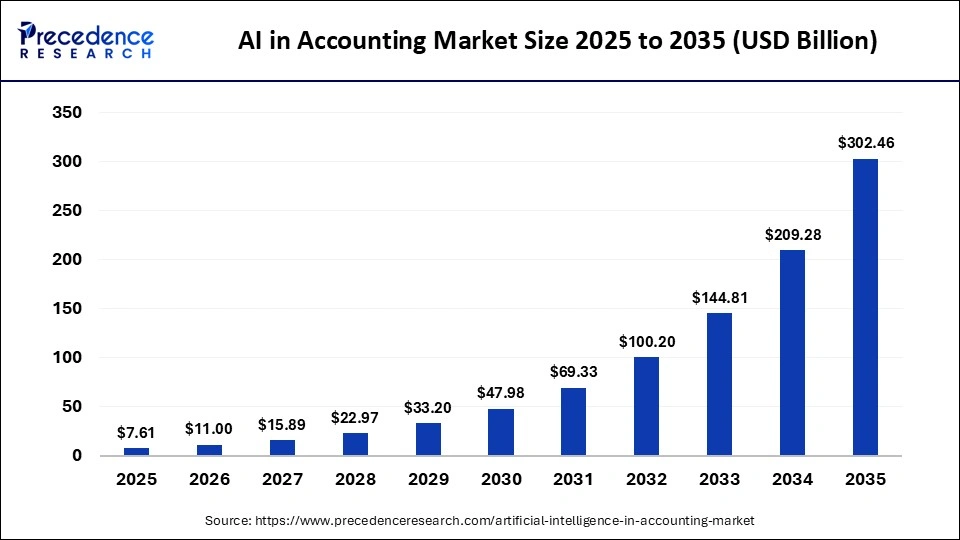
What is the AI in Accounting Market Size in 2026?
The global AI in accounting market size accounted for USD 7.61 billion in 2025 and is predicted to increase from USD 11.00 billion in 2026 to approximately USD 302.46 billion by 2035, expanding at a CAGR of 44.52% from 2026 to 2035.
What are the Key Applications of AI in Accounting?
Many financial institutions and small-scale firms are leveraging AI in their workflow to offer better services and stay competitive. Here are some of the use cases for tax firms that are using Generative AI:
- Tax Research FirmsAI-driven algorithms are revolutionizing tax research by quickly retrieving data from human-edited, tax-specific content. These tools provide authoritative answers from trusted sources with real-time insights, helping firms make faster and more informed decisions.
- Accounting or Bookkeeping AutomationAI-powered software is increasingly used to automate tasks such as expense categorization, account reconciliation, and financial report generation. This automation saves time, reduces manual errors, and allows finance professionals to focus on higher-value activities.
- Document SummarizationMany firms use AI to summarize larger documents into key points from contacts, invoices, and receipts, and easily detect anomalies for further investigation. This speeds up the review process and enhances the reliability of financial audits with compliance checks.
- Tax Return Process AI is transforming the tax return process by extracting and analyzing data from multiple financial documents, reducing the time and effort required for accurate filings. Generative AI models are particularly effective in identifying applicable deductions and generating precise tax returns.
What are the Pitfalls of AI in Accounting and How to Resolve Them?
With the rapid adoption of AI in accounting, firms face several challenges that must be addressed to fully leverage AI’s potential for higher ROI. According to sources, nearly 79% of tax, accounting, and audit professionals expect AI to transform their firm’s future by boosting returns and enhancing client trust. Yet, only a small fraction have defined strategies to integrate AI, highlighting uncertainty among leaders on how to adopt AI within existing infrastructures amid its rapid expansion. Over time, technological maturity is expected to resolve many of these uncertainties.
Major challenges include data privacy and security, high implementation costs, training staff to effectively use AI tools, ensuring regulatory compliance, and managing client expectations. A 2025 report on generative AI in professional services identified data security as a top concern, as clients are increasingly cautious about sharing financial information. Firms must prioritize privacy and cybersecurity, using multilayered strategies to maintain trust and avoid legal issues.
Ultimately, AI adoption in accounting is inevitable. Success requires clear goals, starting with small, strategic plans, investing in skilled people, and prioritizing client needs. By tackling these challenges intelligently, firms can turn potential obstacles into opportunities for transformative growth in the AI era.
Can AI Replace an Accountant’s Role?
The answer is no. While AI brings speed, precision, and efficiency to accounting tasks, it cannot replace the insights, judgment, and real-world expertise that human accountants provide. AI can handle repetitive tasks, but accountants must remain in the loop to ensure accuracy and effectiveness.
The future of AI in accounting is collaborative, not threatening. Firms are increasingly using AI for tasks such as data summarization, organization, analysis, fraud detection through predictive analytics, real-time monitoring, expense and payroll processing, reporting, forecasting, and workflow automation. However, professionals with accounting expertise and the ability to work alongside AI tools cannot be replaced by technology alone.
The key for accountants is to stay updated with AI skills while deepening domain knowledge, leveraging AI as a tool to enhance their value rather than viewing it as a threat. By combining human judgment with AI capabilities, finance professionals can achieve greater efficiency, accuracy, and strategic insight, shaping the future of the accounting profession.
In Summary
The integration of AI into the finance sector, specifically in accounting, is rapidly evolving and transforming the industry, as AI has become an indispensable part of modern accounting. It has helped accounting move from traditional, human-dependent analysis to fast, real-time monitoring, providing greater accuracy and strategic value. Keeping humans in the loop, rather than completely replacing their role, is a significant advantage and demonstrates a balance between technology and human insight.
Unquestionably, AI has expanded the capabilities of accounting professionals by assisting with mechanical tasks, freeing them to focus on core activities and provide deeper insights to clients. This enables accountants to remain relevant and competitive in the AI-driven financial landscape.
About the Authors

Aditi Shivarkar
Aditi, Vice President at Precedence Research, brings over 15 years of expertise at the intersection of technology, innovation, and strategic market intelligence. A visionary leader, she excels in transforming complex data into actionable insights that empower businesses to thrive in dynamic markets. Her leadership combines analytical precision with forward-thinking strategy, driving measurable growth, competitive advantage, and lasting impact across industries.



Aman Singh
Aman Singh with over 13 years of progressive expertise at the intersection of technology, innovation, and strategic market intelligence, Aman Singh stands as a leading authority in global research and consulting. Renowned for his ability to decode complex technological transformations, he provides forward-looking insights that drive strategic decision-making. At Precedence Research, Aman leads a global team of analysts, fostering a culture of research excellence, analytical precision, and visionary thinking.

Piyush Pawar
Piyush Pawar brings over a decade of experience as Senior Manager, Sales & Business Growth, acting as the essential liaison between clients and our research authors. He translates sophisticated insights into practical strategies, ensuring client objectives are met with precision. Piyush’s expertise in market dynamics, relationship management, and strategic execution enables organizations to leverage intelligence effectively, achieving operational excellence, innovation, and sustained growth.