



AI in Accounting Market Trends, Companies, Revenue / Sales Performance, Subscriber Growth, Pricing Strategies, Cloud Adoption, Infrastructure Expansion, Competitive Landscape, and Industry Outlook
AI in Accounting Market (By Component: Software, Services; By Deployment Mode: On Premises, Cloud, Hybrid; By Organization Size: SMEs, Large Enterprises; By Application: Fraud and Risk Management, Reporting and compliance, Invoice classification, Automated Bookkeeping, Forecasting and budgeting, others; By End Use Industry: BFSI, Retail and E-commerce, Manufacturing, Healthcare, Government and public sector, Others) - Global Industry Analysis, Size, Trends, Leading Companies, Regional Outlook, and Forecast 2026 to 2035
Source: https://www.precedenceresearch.com/ai-in-accounting-market
 Get a Sample
 Table Of Content


What is the AI in Accounting Market Size in 2026?
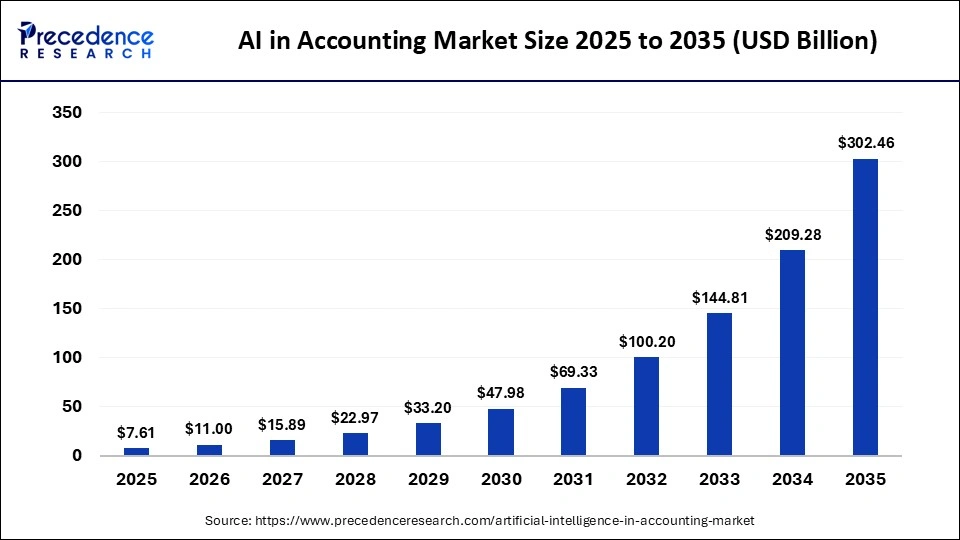
The global AI in accounting market size was calculated at USD 7.61 billion in 2025 and is predicted to increase from USD 11.00 billion in 2026 to approximately USD 302.46 billion by 2035, expanding at a CAGR of 44.52% from 2026 to 2035.The market is rapidly expanding due to the increasing demand for higher ROI, reduced manual labor for error-free accounting processes, and compliance with stringent regulations to avoid fraudulent activities in the finance sector.
Key Takeaways
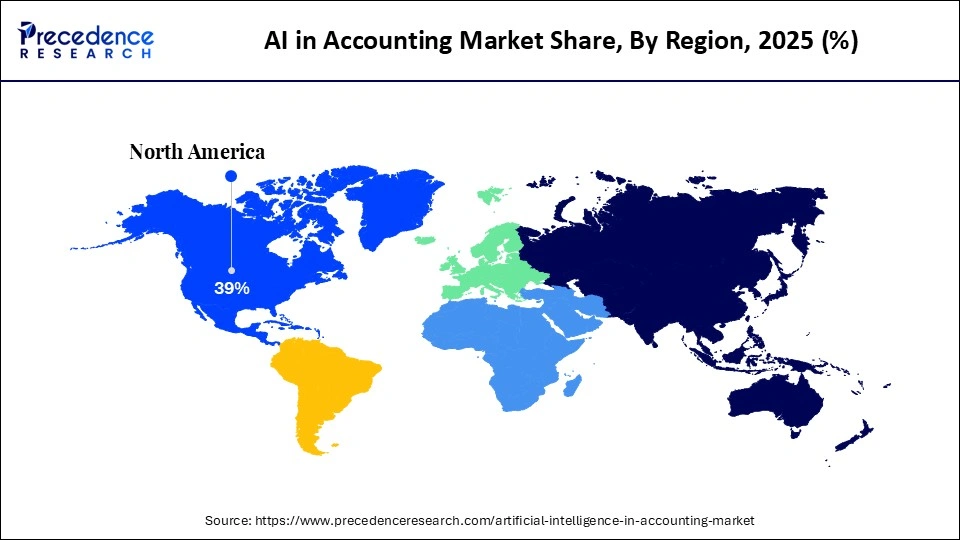
- North America dominated the global market with the largest market share of 39% in 2025.
- The Asia Pacific is projected to grow at the fastest CAGR during the foreseeable period of 2026 to 2035.
- By component, the software segment contributed the biggest market share of 75% in 2025.
- By component, the services segment is projected to grow at the fastest CAGR during the foreseeable period.
- By deployment mode, the cloud solutions segment held the largest market share in 2025.
- By deployment, the on-premises segment is projected to grow at a significant rate during the foreseeable period.
- By enterprise size, the large enterprise segment held the major market share of 76% in 2025.
- By enterprise size, the SMEs segment is projected to grow at the fastest CAGR during the foreseeable period.
- By application, the fraud and risk management segment captured more than 35% of the market share in 2025.
- By application, the automated bookkeeping segment is projected to grow at the fastest CAGR during the foreseeable period.
- By end use industry, the BFSI segment held the largest market share in 2025.
- By end use industry, the retail and e-commerce segment is projected to grow at a significant CAGR during the foreseeable period.
Market Overview
The AI in accounting market deals with the automation of routine financial tasks like bookkeeping, invoice processing, and expense tracking with the help of artificial intelligence and machine learning models, along with other automation tools. This automation is crucial in the era of AI and the rapid expansion of the financial sector, which needs 24/7 services with high precision. It reduces human errors while offering real-time insights for accurate forecasting, which enables a shift into strategic advisory roles rather than manual data entry for professionals working in the accounting sector. The market is significantly growing due to the increasing adoption of AI into accounting by SMEs to stay competitive and strengthen their high-value strategic decision-making and advisory services across the globe.
AI in Accounting Market Trends
- The emergence of agentic AI and automated accounting systems is transforming financial operations by enabling autonomous digital assistants that can learn, adapt to new scenarios, and make data-driven financial decisions using real-time information.
- Generative AI is increasingly being adopted in the accounting sector to summarize complex financial reports, draft emails, conduct tax research, and respond to personalized client queries, with nearly 71% of tax professionals reporting daily use of GenAI tools in their work.
- Continuous accounting is gaining traction across organizations, replacing traditional monthly or quarterly closing cycles by enabling real-time financial reporting, improved cash flow visibility, and faster data-driven decision-making.
- AI-enabled audit and compliance solutions are being widely adopted by major firms, leveraging advanced analytics to examine entire transaction datasets instead of relying on conventional sampling methods.
- Accounting professionals are increasingly using AI-generated insights to provide strategic financial guidance to clients, reflecting a growing shift from routine accounting tasks toward higher-value advisory roles.
Market Scope
| Report Coverage | Details |
| Market Size in 2025 | USD 7.61 Billion |
| Market Size in 2026 | USD 11.00 Billion |
| Market Size by 2035 | USD 302.46 Billion |
| Market Growth Rate from 2026 to 2035 | CAGR of 44.52% |
| Dominating Region | North America |
| Fastest Growing Region | Asia Pacific |
| Base Year | 2025 |
| Forecast Period | 2026 to 2035 |
| Segments Covered | Component, Deployment Mode, Organization Size, Application, End Use Industry, and region |
| Regions Covered | North America, Europe, Asia-Pacific, Latin America, and Middle East & Africa |
Segmental Insights
Component Insights
AI in Accounting Market Share, By Component, 2025 (%)
| Component | 2025 |
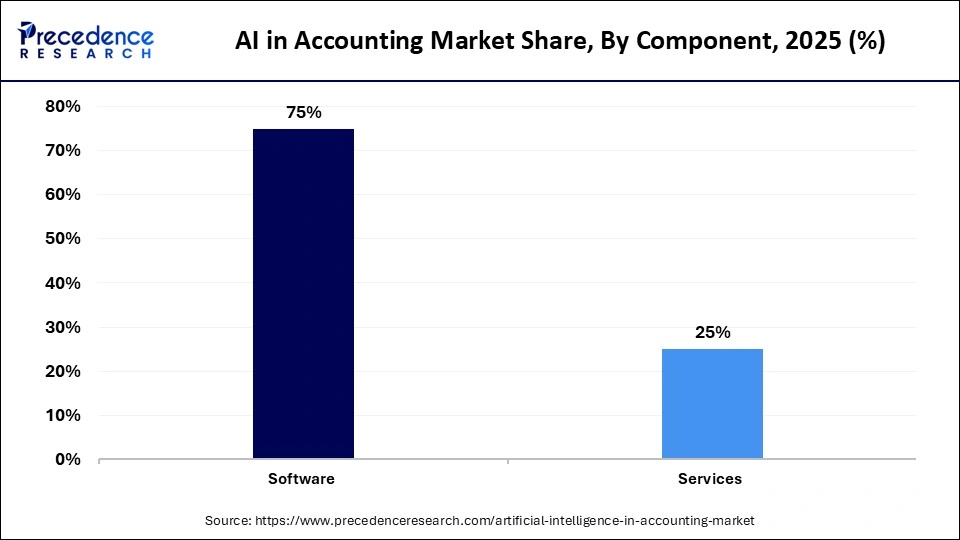
| Software | 75% |
| Services | 25% |
Why Did the Software Segment Dominate the AI in Accounting Market?
The software segment dominated the market, holding the largest share of 75% in 2025. This is mainly due to the increasing adoption of cloud-based platforms that support automation for high-volume and repetitive tasks like expense management, invoicing, and reconciliation. AI-driven software like OCR engines handles huge volumes of manual entries, reduces human errors, and offers better security, which is a crucial factor in modern financial management. AI software can provide features like cashflow forecasting and fraud detection with real-time data analysis that assists strategic decision-making.
The services segment is projected to grow at the fastest CAGR during the foreseeable period due to the increasing need for expert advice to implement AI in the accounting process, especially among SMEs. Professional services bridge the gap between raw AI solutions and fully functional and compliant financial processes. The lack of in-house expertise is another key driver of the segment's growth. Due to the growing complexity of accounting processes and ERP systems, the need for managed and professional services is rising to integrate AI systems seamlessly.
Deployment Mode Insights
How Does the Cloud Solutions Segment Lead the AI in Accounting Market?
The cloud solutions segment led the market with the largest share in 2025 and is expected to sustain its position in the coming years. This is due to its role as a foundational infrastructure enabling accessibility, scalability, and real-time data processing. Cloud-based platforms allow organizations to automate repetitive accounting tasks, enhance regulatory compliance, and deliver advanced analytics across geographically dispersed operations. Additionally, cloud solutions facilitate the rapid integration of AI, machine learning, and robotic process automation (RPA) to streamline routine accounting processes such as expense categorization and bank reconciliation.
The on-premise segment is projected to grow at the fastest CAGR during the foreseeable period, as it provides enhanced data security, greater customization, and stronger compliance with strict regulatory requirements. Since the financial sector handles highly confidential and sensitive data, many organizations prefer on-premise deployment to maintain greater control over their systems and information. Additionally, on-premise solutions enable firms to balance scalability with robust data privacy and security measures.
Enterprise Size Insights
Why Did the Large Enterprises Segment Lead the AI in Accounting Market?
The large enterprise segment led the market while holding the highest share of 76% in 2025. This is primarily due to their high-volume data processing needs and demand for efficiency in complex financial operations. AI is increasingly being adopted by large enterprises to reduce operational costs, enhance precision, and ensure stringent regulatory compliance. Large enterprises require real-time financial insights and predictive analytics for instant decision-making, which is offered by the AI system across all departments of finance, including accounting.
The SMEs segment is projected to grow at the fastest CAGR during the foreseeable period due to the need to streamline financial operations while managing increasing complexity without substantial investment to build separate infrastructure. AI-driven solutions enable SMEs to automate routine tasks, reduce errors, and efficiently manage expenses. Additionally, features like live dashboards, accurate cash flow tracking, and real-time monitoring provide SMEs with actionable insights and a high return on investment.
Application Insights
Why Does the Fraud and Risk Management Segment Hold the Highest Market Share?
The fraud and risk management segment held the largest share of 35% in 2025, driven by the urgent need to combat financial fraud, comply with stringent safety regulations, and achieve high ROI through automation. Financial institutions face rising threats such as synthetic identity and payment fraud, which AI systems can address by providing real-time monitoring, instant threat detection, and enabling immediate corrective actions. This capability makes AI a critical tool for safeguarding financial operations and ensuring regulatory compliance.
The automated bookkeeping segment is projected to grow at the fastest CAGR during the foreseeable period due to the drastic efficiency offered by AI in routine tasks like invoice processing, expense management, and others, with minimal human backup. AI-driven bookkeeping reduces costs required for manual labor with less error-prone work that significantly increases ROI for companies that are adopting AI for bookkeeping.
End Use Industry Insights
What Made BFSI the Dominant Segment in the AI in Accounting Market?
The BFSI segment dominated the market with the largest share in 2025 due to its crucial role in handling confidential data, the urgent need to comply with data-intensive regulations, increasing demand for high ROI with less manual labor, and automating complex financial decisions with robust data security. The sector generates a vast amount of data, which is a crucial aspect of AI/ML models to work efficiently and detect fraudulent activities in real time. With strict regulatory scrutiny and potential reputational risks, BFSI institutions increasingly rely on AI systems to ensure compliance and safeguard their operations.
The retail and e-commerce segment is projected to grow at the fastest CAGR during the foreseeable period due to the growing need to manage large volumes of data, optimize thin profit margins, and deliver personalized consumer experiences. AI-driven systems can automate invoice processing, bank statements, verification, and expense handling without external support from humans. This frees up accountants' time and lets them work on core strategies to build and expand businesses.
Regional Analysis
North America AI in Accounting Market Size and Growth 2026 to 2035
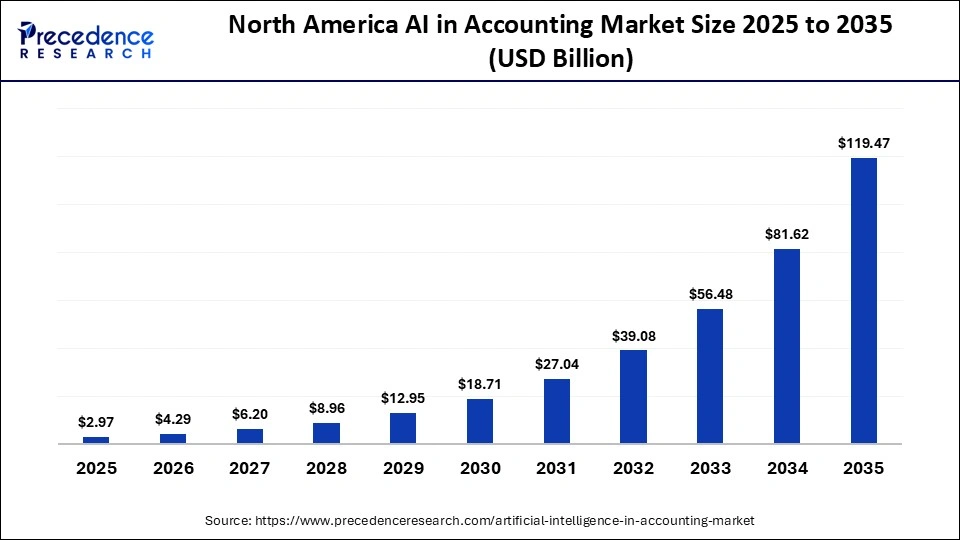
The North America AI in accounting market market size is estimated at USD 2.97 billion in 2025 and is projected to reach approximately USD 119.47 billion by 2035, with a 44.69% CAGR from 2026 to 2035.
What Made North America a Leader in the AI in Accounting Market?
North America led the AI in accounting market by holding the largest share of 39% in 2025. This is mainly due to a combination of factors like technological maturity, high adoption rates of AI in the finance sector, complex regulatory requirements, and the presence of a large number of industry players with strategic collaboration in the region. Nearly 68% of U.S. accounting firms have implemented AI for tasks such as bookkeeping and compliance, reflecting widespread adoption. Additionally, with 86% of finance leaders in the region exploring AI solutions, the potential for further growth and integration remains strong.
Additionally, stringent regulatory mandates from the IRS and SEC have expanded the market by promoting the adoption of automated compliance tools and driving significant investments in AI solutions for accounting. North America's robust IT infrastructure further facilitates the seamless integration of advanced technologies such as **AI/ML, robotic process automation (RPA), and Generative AI** into financial workflows, enhancing efficiency and accuracy across the sector.
U.S. AI in Accounting Market Size and Growth 2026 to 2035
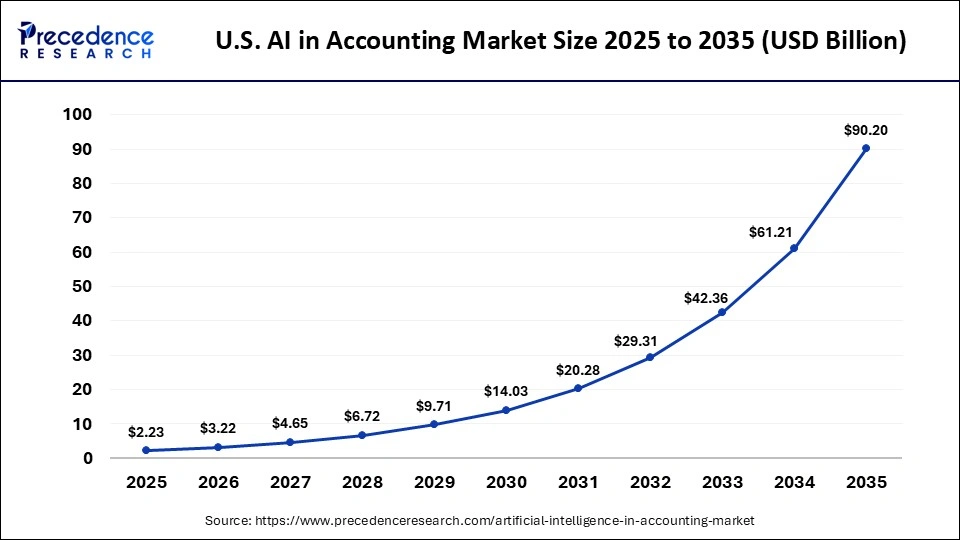
The U.S. AI in accounting market market size is calculated at USD 2.23 billion in 2025 and is expected to reach nearly USD 90.20 billion in 2035, accelerating at a strong CAGR of 44.77% between 2026 and 2035.
U.S. AI in Accounting Market Analysis
The U.S. is at the forefront of AI adoption in the finance sector, with many firms leveraging AI for accounting and financial planning. According to recent reports from KPMG LLP, nearly 62% of U.S. companies are using AI to some extent, with 58% piloting generative AI and 52% applying AI for financial reporting. Impressively, 92% of enterprises reported that their AI initiatives in finance have exceeded the ROI they initially projected, highlighting the strong impact of AI integration in the sector.
Why is Asia Pacific Rapidly Growing in the AI in Accounting Market?
Asia Pacific is projected to grow at the fastest CAGR during the foreseeable period of 2026 to 2035, driven by rapid digital transformation, increasing adoption of cloud-based AI tools, and the accelerated uptake of generative AI. Cloud-based software-as-a-service (SaaS) solutions are gaining traction in the region, enabling seamless AI integration with greater scalability in the finance sector. Additionally, a large pool of SMEs across leading countries in Asia Pacific is increasingly leveraging AI for automated bookkeeping and transaction management, boosting market growth.
Governments around the region are strictly enforcing regulations on invoicing and digital tax paying, encouraging finance firms to adopt AI tools for various tasks like fraud detection, compliance, and audit automation. According to the survey done by BCG in July 2025, employees in Asia Pacific are rapidly adopting generative AI tools in their daily workflow more than other peer regions, and this report was concluded from surveying 45000 employees in the region
China AI in Accounting Market Analysis
China is witnessing rapid growth in AI adoption across key sectors, including accounting, driven by state-led industrial policies, the need to automate repetitive financial tasks, and the cost-effective development of local AI models. The Chinese government acts as a primary catalyst, with initiatives like the “Accounting Informatization Development Plan” encouraging firms to integrate AI tools into corporate governance and accounting processes. Additionally, domestic players such as DeepSeek have developed efficient and affordable AI models like DeepSeek R1, while Chinese firms increasingly leverage open-source AI to accelerate local innovation and reduce reliance on Western AI technologies.
What Drives the AI in Accounting Market in Europe?
Europe is expected to grow at a considerable CAGR in the upcoming period. The surging adoption of AI-enabled accounting solutions in large enterprises to reduce the risks of fraudulent activities and numerous government initiatives aimed at integrating advanced technologies in the financial sector drives the market expansion. Moreover, the rapid investment by AI services providers to deliver accounting services to the public sector entities has boosted the industrial growth.
France Market Analysis
The increasing use of advanced AI-based accounting solutions in the e-commerce sector for managing invoices, along with the rise in the number of AI-based startups, has fostered the market growth.
What are the Trends of the AI in Accounting Market in Latin America?
Latin America is expected to grow at a notable CAGR in the foreseeable future. The rapid deployment of cloud-based software in the government offices across Brazil and Argentina to enhance tax collection capabilities, along with the surge in the number of P2P lending platforms, has contributed to the market expansion. In addition, the manufacturing companies are widely integrating AI-enabled accounting platforms to enhance budgeting and assess risk management, which in turn accelerates the industrial growth.
Argentina Market Analysis
The growing emphasis of the small and medium companies to adopt on-premises accounting solutions to protect against cyberattacks, coupled with the presence of various accounting service providers, has fostered the market expansion.
What are the Driving Factors of the AI in Accounting Market in Middle and East Africa?
The Middle East and Africa region is considered to be a significantly growing area, due to the surging focus of the government on deploying AI-based solutions in the BFSI sector and the rising cases of hacking activities in the financial institutions, leading to the adoption of AI-based accounting solutions. Moreover, collaborations among telecom companies and e-commerce brands to deploy high-speed Wi-Fi modules for managing accounting activities further contribute to the market growth.
UAE Market Trends
The growing demand for high-quality accounting solutions from the healthcare sector to manage financial risks, as well as the surging interest of public companies to use AI-based accounting solutions to forecast their revenues, has driven the industrial expansion.
Competitive Landscape
The AI in accounting market is highly fragmented due to the presence of several tech giants, including Oracle, SAP, and Microsoft, along with the proliferation of numerous startups such as Brex, Candis, Rillet, and Vic.ai. These companies are adopting various tactics, such as collaborations and product launches, to strengthen their position in this expanding sector. The recent collaboration of Microsoft with EY demonstrated positive influence on the market by facilitating the deployment of AI solutions to automate accounting operations.
The problems related to data privacy and inaccuracy have lowered the adoption rate of AI-based accounting tools. The leading companies have started integrating Big Data analytics and blockchain in their accounting platforms to overcome the issues of data accuracy and privacy concerns, which is expected to reshape the industry in the future.
AI in Accounting Market Companies
- Intuit Inc. (QuickBooks)
- Xero Limited
- Sage Group plc
- Oracle Corporation (NetSuite/ERP)
- Microsoft Corporation (Dynamics 365)
- SAP SE
- Deloitte
- PwC (PricewaterhouseCoopers)
- EY (Ernst & Young)
- KPMG
- Vic.ai (AP Automation)
- AppZen Inc. (Audit & Expense)
- MindBridge Analytics (Risk & Anomaly Detection)
- Botkeeper (Automated Bookkeeping)
- Docyt (GenAI Financial Workflow)
- Trullion (Lease & Revenue Accounting)
- BlackLine, Inc. (Financial Closure)
Recent Developments
- In February 2026, Goldman Sachs partnered with AI startup Anthropic to develop autonomous agents automating roles in trade accounting and client onboarding, with embedded Anthropic engineers co-developing the solutions over the past six months, according to CIO Marco Argenti.(Source: https://www.cnbc.com)
- In March 2026, Mastercard advances its agentic AI strategy by offering a virtual C-suite that will bring an executive-level intelligence to small businesses. By using this AI-driven suite, businesses can automate their entire commerce lifecycle and will be able to take data-driven decisions with high data security. (Source: https://www.mastercard.com)
Segments Covered in the Report
By Component
- Software
- Services
By Deployment Mode
- On Premises
- Cloud
- Hybrid
By Organization Size
- SMEs
- Large Enterprises
By Application
- Fraud and Risk Management
- Reporting and compliance
- Invoice classification
- Automated Bookkeeping
- Forecasting and budgeting
- others
By End Use Industry
- BFSI
- Retail and E-commerce
- Manufacturing
- Healthcare
- Government and public sector
- Others
By Region
- North America
- Latin America
- Europe
- Asia-pacific
- Middle and East Africa
For inquiries regarding discounts, bulk purchases, or customization requests, please contact us at sales@precedenceresearch.com
Frequently Asked Questions
Tags





Ask For Sample
No cookie-cutter, only authentic analysis – take the 1st step to become a Precedence Research client
 Get a Sample




 sales@precedenceresearch.com
 Schedule a Meeting
