






 Request Consultation
Discover why aluminium is essential across industries—lightweight, recyclable, and driving innovation in automotive, construction, and packaging.
What is Aluminium and Where is it Mainly Being Used?
Aluminium is a widely used metal, from beverage cans to aeroplane parts. It does not occur naturally, and the production process is complex. There are three stages in aluminium production –
- Mining Bauxite – Bauxite is composed of aluminium oxide with other minerals. Bauxite is refined into alumina, which is converted into aluminium. Australia is the largest bauxite producer in the world.
- Alumina Production – Bauxite is refined into alumina through Bayer's process. In this process, digestion is the first step - bauxite is mixed with sodium hydroxide and heated under pressure. The sodium hydroxide dissolves only aluminium oxide, and minerals are left as impurities. In filtration, impurities are filtered and separated. The aluminium oxide is converted into sodium aluminate. This sodium aluminate solution is precipitated to form crystallised aluminium hydroxide.
- Aluminium Production – In the Hall - Heroult process, the alumina is dissolved in molten cryolite and subjected to electrolysis. This process separates aluminium from oxygen, resulting in pure molten aluminium that can be cast into various sizes and shapes. China is the largest producer of aluminium, followed by India.
What is the Aluminum Market Market Size?
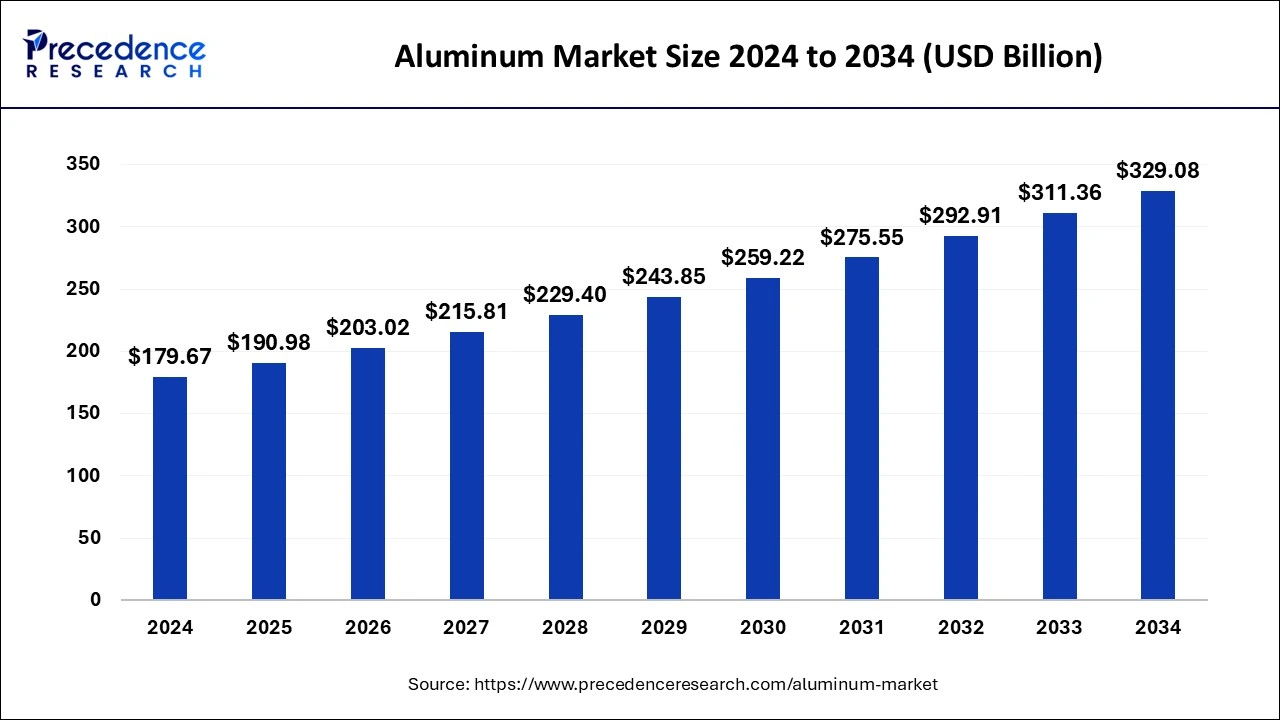
The global aluminum market size surpassed USD 190.98 billion in 2025 and is estimated to increase from USD 203.02 billion in 2026 to approximately USD 347.29 billion by 2035, growing at a CAGR of 6.16% between 2026 and 2035.
What are the Unique Properties of Aluminium?
The following are the unique characteristics of Aluminium:
- One of the biggest strengths of aluminium is its low density. It weighs one-third as much as steel, which makes it ideal for industries where weight reduction matters. It is suitable for use in automotive and aerospace industries, as light materials directly show better fuel efficiency and reduced emissions.
- Aluminium is a corrosion-resistant metal. When exposed to air, aluminium forms a thin oxide layer, protecting it from rusting and environmental damage. This makes it reliable for use in outdoor structures and marine applications.
- Aluminium is highly malleable and ductile. It ranked as the second most malleable metal. It can be rolled in thin sheets and rolled in wires without losing its structural integrity. This adaptability of aluminium allows engineers to widely use it without compromising performance.
- The aluminium possesses high electrical and thermal conductivity. While it is not as conductive as copper, it allows a more cost-effective and lightweight alternative. It is widely used in power transmission, motor windings, and heat exchanges.
Challenges and Limitations for Aluminium:
Despite its advantages, aluminium has a certain set of challenges, including:
- One of the most challenging aspects in the aluminium manufacturing industry is the high energy production requirement. Aluminium is extracted from ore, refined, and smelted, which requires energy. The energy expenditure impacts the overall production cost.
- Aluminium production significantly impacts the environment due to carbon emissions and waste material generation. The governments and regulatory bodies across the world are imposing strict regulations to reduce environmental impact and promote the adoption of sustainable practices.
- The global uncertainties, previously the pandemic and now the war situations, affect the supply chain of raw materials to the aluminium industries. The disruption of the supply chain delays the raw material availability for production, which leads to an increase in cost.
- The integration of advanced technologies such as automation, artificial intelligence, and Internet of Things and Industry 4.0 technologies into existing manufacturing processes can be complex and requires huge initial investments.
- Additionally, aluminium is strong, but it is not as strong compared to steel. This limits its use and may not be suitable for applications where extreme load-bearing is required. The strength can be increased by alloying, which requires specialised techniques and engineering that further increase the cost.
Understanding the limitations and challenges in the aluminium industry is important for making an informed decision about its use.
Aluminium and Sustainability
What Role does Aluminium Play to Support and Establish Sustainability Practices?
Aluminium is light-weight, strong, durable, and can be infinitely recycled without losing its properties. Recycling of aluminium requires only about 5% of the energy needed for its production from ore. This makes the aluminium a sustainable material choice. Recycling of aluminium significantly reduces environmental impact by reducing energy consumption, lowering greenhouse gas emissions, and minimising the need for mining.
Aluminium is lightweight, which requires less energy to transport the metal from one place to another. Its structure can weigh less than steel while providing comparable strength. Aluminium is durable and resistant to corrosion. These reasons make aluminium the choice for a sustainable material.
Nearly 75% of all aluminium ever produced is still in use today. This highlights its durability and long-term value, which perfectly aligns with sustainability goals.
Application of Aluminium Across Industries
Which Industries Majorly Use Aluminium and Why?
Aluminium is a highly versatile, lightweight, and corrosion-resistant metal used widely in industries:
| Industries | Applications |
| Construction Industry |
|
| Transportation and Automotive Industry |
|
| Packaging Industry |
|
| Electrical Applications |
|
Aluminium plays a crucial role in various industrial settings. It is used in machinery, electrical systems, packaging lines, and chemical processing equipment. Aluminium is corrosion-resistant, which makes it suitable for handling chemicals, while its conductivity supports electrical and thermal systems. Aluminium alloys, in which aluminium combines with other elements like silicon or magnesium, enhance their strength and increase their usage in areas where high strength and heavy load bearing are required.
Real World Updates for the Aluminium Industry
Several innovative approaches have been made by key players in the aluminium industry recently:
- The European aluminium and packaging industry collaborated to address the issue of the low recycling rate of small aluminium packaging formats. This initiative was launched by the European Aluminium Foil Association (EAFA) in partnership with Flexible Packaging Europe (FPE) on January 1, 2026. The 16 companies come together to reduce the environmental impact and boost recycling rates for small aluminium packaging.
- The National Aluminium Company Limited (NALCO) launched a new IA91 Grade aluminium alloy ingot in February 2026. It is a high-performance, silicon-based casting alloy designed to deliver a balance of castability, mechanical strength, and corrosion resistance. This alloy can be used in automotive, electrical, and power equipment, industrial sectors, and foundries.
- Manaksia Aluminium announced the launch of High Security Registration Plate (HSRP) aluminium sheets with a target capacity of 200 tons per month by FY27. The company aims to focus on both domestic and export markets, which can increase the company's revenue by 17%.
- On December 4, 2025, the East Coast Canning company collaborated with Swedish packaging innovator Meadow to launch a resealable aluminium can in Australia and New Zealand. This new approach of KASUL can be integrated directly into the production line of can manufacturers and owners. The sustainability of aluminium helps in taking this step of the KAPSUL format.
Emerging Trends and Technology in the Aluminium Sector
Aluminium is a versatile and lightweight material, widely used in various industries. The future of aluminium looks promising as emerging trends and technologies are reshaping the application of aluminium.
- Advanced Alloys – Aluminium alloys are developed to increase strength, durability, and performance for a wide range of applications. These alloys are used in industries such as automotive, aerospace, defence, and advanced manufacturing. The development of nanostructured alloys and composite materials is further pushing boundaries of aluminium's mechanical and thermal properties.
- Surface Treatment Technologies – Surface treatment is another area where aluminium is continuously improving. Processes such as nanocoating, anodizing processes, and plasma treatments help improve durability and resistance to corrosion. These technologies are enhancing the performance and appearance of aluminium, making products more durable and aesthetic.
- Sustainable Solutions – Sustainability is becoming a priority across the aluminium industry. There is a clear shift towards environmentally friendly aluminium products and processes. The emerging trends in sustainable aluminium production involve the use of recycled aluminium and lower carbon production techniques. The aim is to reduce the environmental impact of aluminium and make it a more sustainable option for the future.
- Digitalization and Automation – the integration of automation and digitalization in the aluminium industry enables increased productivity, enhanced process control, and reduced costs. The automated production lines, data-driven quality control, and predictive maintenance improve overall operational efficiency.
- Additive Manufacturing – Additive manufacturing, commonly known as 3D printing, is changing how aluminium parts are designed and produced. This approach allows manufacturers to produce complex structures and reduce material waste. 3D printing is opening new ways to use aluminium in aerospace, automotive, and consumer products by making it lighter, stronger, and more optimized.
As industries continue to prioritise sustainability and efficiency, aluminium is expected to be a cornerstone in modern industrial use.
Final Thoughts
Aluminium is a lightweight, strong, corrosion-resistant, and durable material. It is used in the automotive, aerospace, construction, and packaging industries. Aluminium is 100% recyclable, which makes it a sustainable material. The future of aluminium is promising, with emerging trends and technologies opening new opportunities. Advanced alloy, sustainable solution, additive manufacturing, surface treatment technologies, and digitalization are reshaping the future of aluminium. As the aluminium industry continues to grow and environmental concerns become more serious, the importance of aluminium can continue to increase.
About the Authors

Aditi Shivarkar
Aditi, Vice President at Precedence Research, brings over 15 years of expertise at the intersection of technology, innovation, and strategic market intelligence. A visionary leader, she excels in transforming complex data into actionable insights that empower businesses to thrive in dynamic markets. Her leadership combines analytical precision with forward-thinking strategy, driving measurable growth, competitive advantage, and lasting impact across industries.



Aman Singh
Aman Singh with over 13 years of progressive expertise at the intersection of technology, innovation, and strategic market intelligence, Aman Singh stands as a leading authority in global research and consulting. Renowned for his ability to decode complex technological transformations, he provides forward-looking insights that drive strategic decision-making. At Precedence Research, Aman leads a global team of analysts, fostering a culture of research excellence, analytical precision, and visionary thinking.

Piyush Pawar
Piyush Pawar brings over a decade of experience as Senior Manager, Sales & Business Growth, acting as the essential liaison between clients and our research authors. He translates sophisticated insights into practical strategies, ensuring client objectives are met with precision. Piyush’s expertise in market dynamics, relationship management, and strategic execution enables organizations to leverage intelligence effectively, achieving operational excellence, innovation, and sustained growth.