






 Request Consultation
Benefits administration software is transforming HR operations by automating employee benefits and reducing manual workload. This blog highlights deployment models, pricing strategies, and industry adoption trends. It also covers key innovations and how organizations improve efficiency and employee experience.
What is Benefits Administration Software?
Benefits administration software is a digital platform designed to help HR teams manage several employee benefits programs, such as health insurance, wellness initiatives, retirement plans, and gratuity. This software simplifies compliance tasks, centralizes enrollment, and provides employees with self-service access to select their profitable schemes. It automates various tasks, including enrollment updates, eligibility verification, and data synchronization to ensure that information remains accurate in the databases. In addition, this software facilitates the ongoing management of renewals, claims, and eligibility changes every year, which helps in reducing the administrative workload and improving operational efficiency in organizations.
How is the Deployment of Benefits Administration Software Done?
The benefits administration software is deployed in several ways, including cloud, on-premises, and hybrid.
- Cloud: Cloud-based benefit administration software is a web-based solution that helps several organizations to manage, track, and automate employee benefits programs in real-time. It delivers employees with self-service portals and automated compliance features by eliminating paper-based processes, which allows 24/7 access from remote locations.
- On-Premises: On-premises benefit administration software is an advanced HR software installed and hosted on any organization’s IT infrastructure. This deployment mode delivers companies with total control over sensitive employee data, high security for compliance, and customization options. It is mainly deployed by financial institutions, large enterprises, or healthcare providers.
- Hybrid: Hybrid-based benefit administration software combines the security and control of on-premises software with the accessibility of cloud-based technology. It offers a pay-as-you-go structure for certain services by keeping critical infrastructure in IT organizations.
What is the Benefits Administration Software Market Size in 2026?
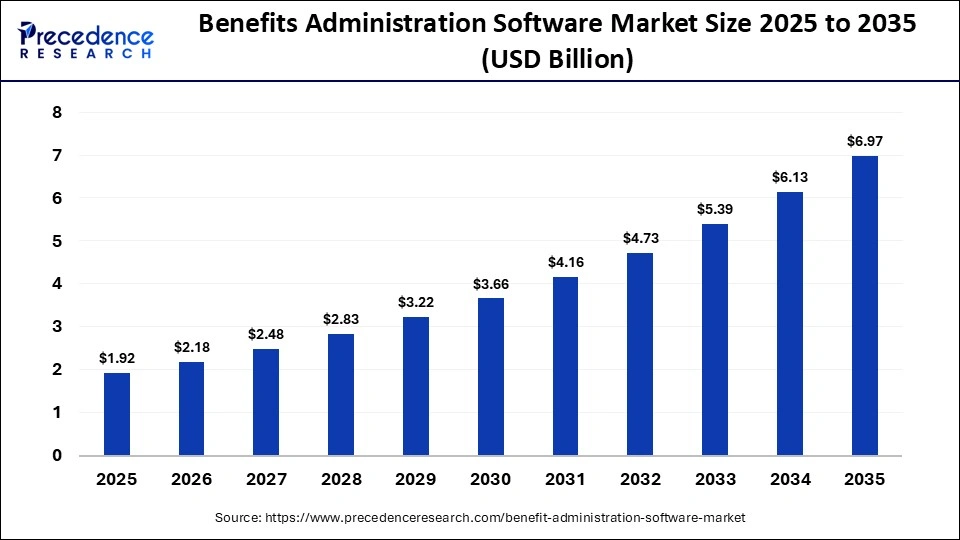
The global benefits administration software market size was valued at USD 1.92 billion in 2025 and is expected to grow from USD 2.18 billion in 2026 to approximately USD 6.97 billion by 2035, registering a CAGR of 13.76% from 2026 to 2035. The growth is driven by the rising adoption of advanced software by corporate organizations to streamline complex tasks, ensure regulatory compliance, and improve employee experience and benefits management efficiency.
Get a Free Sample Report with Key Market Trends: https://www.precedenceresearch.com/sample/8234
Which Types of Organizations are Adopting Benefits Administration Software?
Several types of organizations are adopting benefits administration software, such as private sector organizations, public sector organizations, and nonprofit organizations.
- Private Sector Organizations: Benefits administration software is rapidly adopted in private sector organizations to automate the enrollment, management, and compliance of employee benefits, including health insurance, retirement plans, and wellness programs. This software platform enhances HR tasks by reducing manual paperwork and lowering data entry errors, which enables employees to adopt self-service and deliver data insights for managing costs and improving efficiency and accuracy in organizations.
- Public Sector Organizations: In public sector enterprises, benefits administration software delivers unified systems for caseworkers to review applications and automates eligibility determination for public assistance programs. It also provides real-time insights into employee enrollment trends, which allows organizations to lessen budget constraints and take data-driven decisions.
- Nonprofit Organizations: Benefits administration software in nonprofit organizations helps in streamlining HR tasks, automating employee enrollment, lowering paper-based processes, and maintaining compliance with various regulations to avoid fines. It also provides self-service tools for employees to manage benefits and enhance retention by enabling non-profit organizations to manage costs and focus on prominent resources.
Industry Leaders and Their Game-Changing Innovations
| Companies | Breakthrough |
 |
In November 2025, ADP unveiled the ADP Embedded Payroll. ADP Embedded Payroll is a management software platform designed for small organizations in the U.S. |
 |
In October 2025, Alight, Inc announced the commercialization of Alight Worklife. Alight Worklife is an AI-integrated software platform designed for delivering employee benefits enrolment in organizations. |
 |
In May 2024, Dayforce launched Dayforce Partner Exchange. Dayforce Partner Exchange is a new range of software designed to accelerate HR innovation. |
 |
In March 2026, BambooHR launched the BambooHR Services. This comprehensive range of software services is designed to navigate complex HR responsibilities with superior confidence, clarity, and control. |
 |
In March 2026, Oracle launched Fusion Agentic Applications. The new Workforce Operations Agentic Application is designed to help HR leaders in reducing manual data gathering, accelerating scheduling request approvals, and lowering payroll issues. |
 |
In March 2026, SAP launched SmartRecruiters. SmartRecruiters is an advanced employee hiring platform designed to simplify the sourcing capabilities of HR. |
 |
In July 2025, Paylocity launched Paylocity for Finance. Paylocity for Finance is an integrated spend management solution that helps finance teams automate operations, gain real-time visibility and control, and provide a seamless, intuitive employee experience through the HCM platform. |
 |
In March 2026, UKG launched the workforce operating platform. This platform is designed for enterprises to simplify complex HR, payroll, and regulatory requirements. |
 |
In February 2026, Zenefits launched the all-in-one human resource (HR) solution. This HR solution is designed for small businesses across the world. |
 |
In March 2026, Paycom Software, Inc., launched career and succession planning. Career and Succession Planning is an automated software designed to identify successors for company-wide roles, assess bench strength, and ensure talent acquisition and development. |
What are the Pricing Models of the Benefits Administration Software?
Numerous pricing models of benefits administration software include subscription-based, per employee per month pricing, license-based, and usage-based pricing.
- Subscription-Based: Subscription-based (SaaS) benefits administration software delivers lower upfront costs, predictable operating expenses, and automatic updates. This pricing model enhances efficiency through cloud-based automated enrollment to reduce manual errors and enhance data security. It provides high flexibility to scale, improve employee self-service access, and streamline regulatory compliance.
- Per Employee Per Month Pricing: Per Employee Per Month pricing for benefit administration software offers superior scalability, cost-efficiency, and improved flexibility to allow organizations to align software expenses with workforce size. This pricing model lowers upfront licensing fees by delivering low-cost services for growing organizations.
- License-Based: License-based benefit administration software is provided through SaaS (Software as a Service) to offer several benefits for HR teams and organizations by automating complex tasks and improving data accuracy. Through a license-based platform, the enterprises can enhance operational efficiency and upscale employee satisfaction, along with maintaining compliance regulations.
- Usage-Based Pricing: Usage-based pricing (UBP) helps in aligning costs directly with various consumers to offer significant advantages, such as enhanced cost transparency, low entry barriers, and automated scaling with customer growth. This model allows for moving away from per-seat or fixed-fee subscriptions, allowing employers to pay only for the services that are being used by them, which in turn reduces spending on inactive employees.
Who are the Major End-Users of the Benefits Administration Software?
The benefits administration software is adopted by several industries, such as IT and telecom, BFSI, healthcare, retail and e-commerce, manufacturing, government and education, and professional services.
- IT and Telecom: Benefit administration software is widely used in the IT and telecom sectors to centralize, automate, and streamline complex employee benefits, such as health insurance and wellness programs, through a cloud-based platform.
- BFSI: In the BFSI sector, the benefit administration software is prominent for navigating high employee turnover, managing distributed teams in multiple branches, and ensuring regulatory compliance with stringent frameworks.
- Healthcare: Benefits administration software in the healthcare sector streamlines healthcare professionals' benefits through self-service portals. This software lowers HR-based administrative tasks, ensures compliance with HIPAA/ACA regulations to centralize employee data, and enhances communication with insurance providers for accurate billing.
- Retail and E-Commerce: Benefit administration software is prominent in the retail and e-commerce sectors for managing diverse, large, and high-turnover workforces efficiently. This software is designed to centralize employee benefits into a digital, self-service platform to reduce administrative burdens on HR teams by improving engagement.
- Manufacturing: Benefit administration software is widely adopted in the manufacturing sector to streamline high-volume HR tasks by automating employee benefits enrollment, payroll deductions, and regulatory compliance, such as ACA or COBRA. This software provides a self-service portal for shop-floor workers to deliver benefits, lessen administrative burdens, ensure accurate data, and improve employee engagement.
- Government and Education: Benefit administration software is deployed in the government and education to automate complex HR processes by enhancing enrollment, ensuring regulatory compliance, and delivering self-service portals. It reduces paperwork for large and diverse workforces to enhance accuracy in managing insurance, retirement, and public sector benefits of government employees.
- Professional Services: Benefit administration software is applied in the professional services sector to automate time-consuming management of employee benefits, ensuring regulatory compliance, and improving employee experience. It helps to generate real-time insights on benefits utilization and costs, which enables professional firms to optimize benefit spending and identify upcoming trends.
Expert Opinion
According to our industry experts, benefits administration software (BAS) is transforming how organizations manage employee benefits, enabling HR teams to streamline operations, reduce administrative overhead, and maintain compliance with complex regulatory frameworks. By digitizing processes such as enrollment, claims management, and reporting, companies can achieve greater accuracy, efficiency, and cost savings, while minimizing errors associated with manual systems. The software also empowers employees with self-service portals, improving engagement, satisfaction, and retention.
For enterprises, investing in BAS is not just an operational decision; it is a strategic move to attract and retain top talent, enhance workforce productivity, and gain insights through advanced analytics. Moreover, as organizations scale or enter global markets, BAS offers flexibility to manage diverse benefits programs, integrate with payroll systems, and adapt to local regulations, making it a key driver of long-term business growth and competitiveness in the HR technology landscape.
Wrapping Up
It can be concluded that the benefits administration software industry is likely to gain immense traction in the coming years. The ongoing trend of automating HR related tasks and delivering employee benefits through a single platform is managed by benefits administration software. This software is deployed in several modes in various industries according to their capacity. It is available in various pricing models for different types of organizations. The top companies are launching a wide range of software to cater to the needs of the end-users.
About the Authors

Aditi Shivarkar
Aditi, Vice President at Precedence Research, brings over 15 years of expertise at the intersection of technology, innovation, and strategic market intelligence. A visionary leader, she excels in transforming complex data into actionable insights that empower businesses to thrive in dynamic markets. Her leadership combines analytical precision with forward-thinking strategy, driving measurable growth, competitive advantage, and lasting impact across industries.



Aman Singh
Aman Singh with over 13 years of progressive expertise at the intersection of technology, innovation, and strategic market intelligence, Aman Singh stands as a leading authority in global research and consulting. Renowned for his ability to decode complex technological transformations, he provides forward-looking insights that drive strategic decision-making. At Precedence Research, Aman leads a global team of analysts, fostering a culture of research excellence, analytical precision, and visionary thinking.

Piyush Pawar
Piyush Pawar brings over a decade of experience as Senior Manager, Sales & Business Growth, acting as the essential liaison between clients and our research authors. He translates sophisticated insights into practical strategies, ensuring client objectives are met with precision. Piyush’s expertise in market dynamics, relationship management, and strategic execution enables organizations to leverage intelligence effectively, achieving operational excellence, innovation, and sustained growth.