






 Request Consultation
Learn how Dental Service Organizations support clinics, reduce workload, and improve patient care with advanced technology and streamlined operations.
A dental service organisation (DSO) is a company that helps dental clinics by providing non-clinical support through partnerships with practices. DSO mainly handles business operations such as HR, IT, marketing, payroll, accounting, supply procurement, and regulatory compliance functions. This helps dentists focus more on patients and deliver excellent patient care. The dental care demand is expanding, which encourages the implementation of DSO in dental practices. DSO offers advantages such as financial stability, support, and access to technology. DSO can be implemented in an existing system or can help to launch a new practice.
In the US, DSOs have grown from about 100 in 2010 to over 2000 in 2023. This highlights the rapid growth and expansion of DSOs. Professional dentists can sell their practice to a DSO to focus solely on patient care. According to the American Dental Education Association (ADEA), newly graduated students want to work in DSOs as they are able to reduce the clerical work of dentists.
What is the Dental Services Organization Market Size?
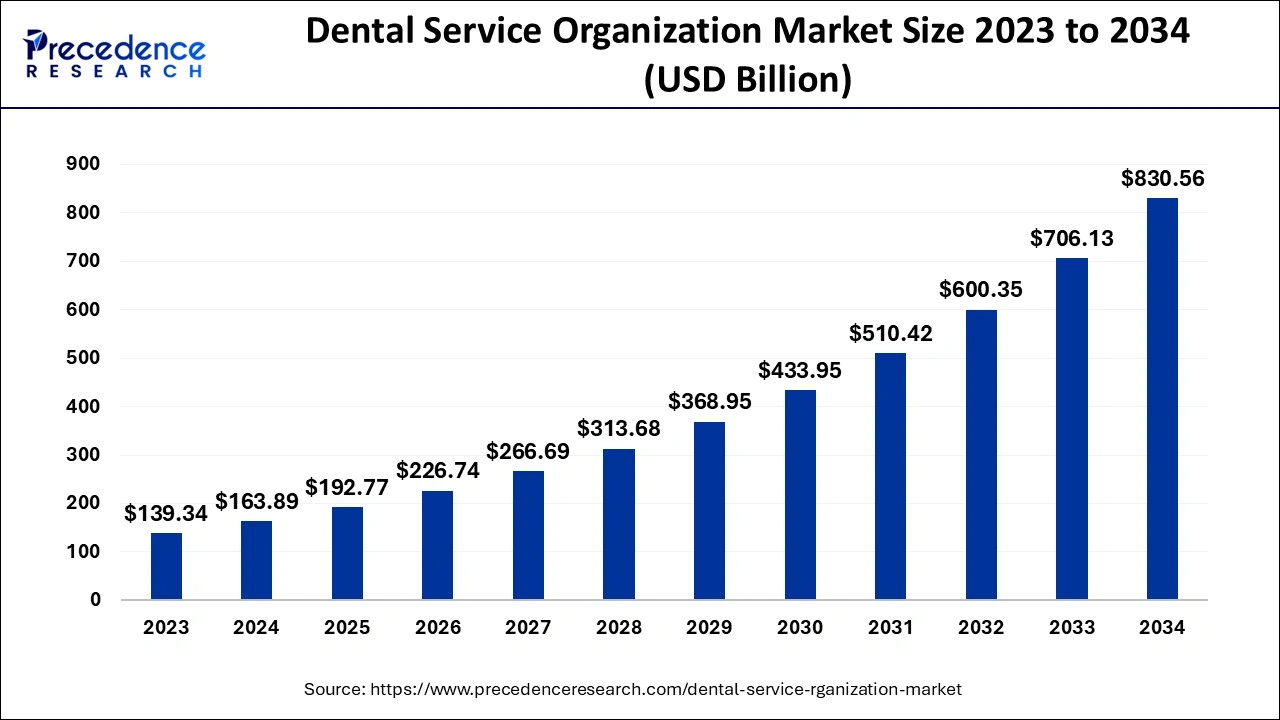
The global dental services organization market size surpassed USD 192.77 billion in 2025 and is estimated to increase from USD 226.74 billion in 2026 to approximately USD 942.56 billion by 2035, rugistuiring a CAGR of 17.2% between 2026 and 2035.
How DO Dental Services Organization (DSOs) Work
A dental Service Organization (DSO) works quietly in the background, handling business administrative tasks that keep a dental clinic running day to day. Instead of the dentist managing appointments, staff, billing, marketing and supplies alone, DSO helps clinics to take these responsibilities. The DSO provides infrastructure, systems, tools, and trained teams to help practices grow, improve operations, and successfully operate the business aspects of dentistry. The dentist manages all clinical decisions, such as treatment planning, maintaining control over patient care, and clinical protocols, while DSO handles the non-clinical operations, such as business responsibilities. This setup helps to reduce stress for dental professionals and improve the overall patient experience, as clinics become more organised, better equipped, and able to deliver consistent, high quality care without the administration delays and burden.
Benefits of Partnering with a Dental Service Organization
Partnering with a Dental Service Organization makes things a lot easier for dental practitioners who are managing both patients and business administrative activities. Instead of handling everything alone, they get support with operations like marketing, payroll, appointment scheduling, vendor contacts, and compliance. This helps to reduce business workload and allows dentists to focus more on treating patients and improving clinical skills.
Dental practices benefit from enhanced efficiency and cost savings with the implementation of centralised systems to provide a standard of care within multiple locations. Over time, dentist can expand their practice without feeling overwhelmed as financial and administrative challenges are handled by experienced teams of DSO. With the backing of a DSO, expanding, upgrading equipment, or improving the system becomes much easier and less risky. Implementing DSO in dental practice creates balanced and manageable ways to run a dental clinic.
Applications
Detanl services today go beyond basic checkups and fillings. Modern dental care surrounds a wide range of treatments designed to address both functional and aesthetic needs.
- Preventive services – Preventive care helps to maintain good oral health. It includes regular cleanings, oral examinations, and routine X-rays, which help maintain healthy teeth and gums while preventing major issues. Early identification of dental problems helps to minimize treatment and cost.
- Restorative Treatments – Restorative dentistry focuses on repairing damaged teeth and restoring their function. Treatments such as dental fillings, crowns, bridges, dental implants, dentures, and root canals to restore the oral functions and aesthetics.
- Cosmetic Dentistry – cosmetic treatment aims at improving the appearance of patients' teeth, gums, and smile. The treatments, such as teeth whitening, porcelain veneers, dental bonding, Invisalign and dental implants, can significantly improve confidence and self-image. DSO helps to leverage cosmetic services to meet patient demands.
- Paediatric Dentistry – children require specialized dental care to ensure proper growth and development of teeth. Paediatric dentists provide restorative dentistry and oral hygiene instruction, and specialised techniques include behaviour guidance.
Use of Artificial Intelligence in Dental Service Organization
Artificial intelligence is becoming a powerful tool in dentistry. Integration of AI in dentistry helps in improving precision and efficiency, streamlining administrative workflow, and enhancing overall patient experience. AI is used in reading dental scans and X-rays. An AI algorithm can analyse dental radiographs, identify abnormalities, and assist in making accurate diagnosis decisions. This helps in the early detection of problems to help give better treatment for patients.
AI is also used to assist dentists in treatment planning. It can create a personalized treatment plan for patients based on patient data and historical treatment outcomes. This helps dentists in making tailored treatment plans and making more informed decisions. AI tools are used to streamline administrative tasks and optimizing workflows in dental practices. AI can automate routine processes and manage administrative activities such as appointment scheduling, billing and patient data management to improve operational efficiencies.
Recent Updates on Dental Services Organization
The dental industry has been going through a noticeable shift, and is driven by technological advancement. Over the past years, DSOs have started adopting tools like 3D printing, tele dentistry, and AI-based diagnostic systems. These changes are helping dentists work more precisely and plan treatment more efficiently.
- 3D Printing – This technology allows the creation of dentures, crowns, bridges, and aligners in the dental office. The 3D printing enables custom-fit production with significant speed and precision. The integration of artificial intelligence in the 3D printing workflows enhances the customisation process. This synergy between AI and 3D printing improves patient outcomes and streamlines workflow processes, which leads to increased efficiency in dental practices.
- Tele dentistry – with advancing digital platforms, the remote dental consultation is now possible. Tele dentistry includes consultation via video calls, transmission of dental images for evaluation and remote monitoring using connected devices. The tele dentistry offers advantages such as cost-effectiveness, remote consultation, accessibility- individuals in rural areas can access dental care anywhere, and convenience – consultation scheduling at their own time, reducing the need for long commutes.
DSOs are using centralised systems to emphasise patient-centric models to give convenient and personalised care. It focuses on making dental care more patient-friendly and improving patient engagement by providing flexible appointment scheduling, clearer treatment plans, and better communication channels.
Recent Developments in Dental Care
Heartland Dental, the nation's largest dental support organization launched the Orahh Care Dental Community. This new community aims to create a space where doctors can connect, learn from each other, and improve patient outcomes. It focuses on making dental care more accessible while also supporting dentists with better tools and guidance. The aim is to improve patient experience and build a strong and more connected dental care system.
An international leader of cloud-based technology called - RipeGlobal has expanded their portfolio in dental education by launching an AI-powered dental training platform in the United States. RipeGlobal brought simulation-based clinical training for Dental Support organizations, group practices, and private practices. The company aims to upskill, increase confidence, and improve patient outcomes.
Pearl is the global leader in dental AI solutions and has launched Calibrate, the first AI-powered clinical calibration and training tool for providers and educators. The clinical institutions and universities received a grant from the American Dental Education Association (ADEA) to use this AI tool in their research. The Calibrate offers advantages such as standardizing clinical performance across teams, minimising risk and enhancing patient care, improving x-ray capture quality, and supporting dental education and accreditation.
Planet DDS launched its launchpad programme to support emerging dental and orthodontic groups by providing access to advanced cloud-based solutions, including Denticon, Cloud 9, Apteryx, and Legwork and expert guidance. The aim of Plant DDS is to support new dental and orthodontic groups to scale and grow. These features include artificial intelligence powered clinical recommendations, automated tools to ease administrative stress and accounts receivable features.
Limitations of Dental Service Organization
A dental service organization can have its disadvantages, especially for dentists used to managing all tasks on their own. Because after the integration of DSO, dentists may lose control over the day-to-day operations, like scheduling. There can also be a change in how patient care is managed. Sometimes these changes do not align with the dentist’s personal approach, which can lead to frustration and dissatisfaction over time. Sometimes, DSO culture may not align with the dentist’s practice culture, which can create discomfort or tension within the clinics. Staff turnover may happen when a practice is sold to a DSO, which leads to instability and affects workflow.
Future Aspects of Integrating Dental Service Organization in Dentistry Practice
The dental service organization is reshaping the future of dental practice models with continuous advancement in technology and patient care. Innovations are expected to further improve diagnosis, treatment precision, and overall patient experience. The DSO models are very popular in the United States for clinics aimed at offering affordable care to patients. The DSO model provides non-clinical business management making dental practitioners to focus on delivering quality patient care. DSO models provide operational efficiencies and cost-effective care at scale, helping in wider access to dental services. The digital integration, advanced materials and improved technologies will continue to enhance the efficiency and effectiveness of dental services. As awareness grows and access improves, dental care becomes an integral part of routine.
Final Words
As the demand for dental care continues to rise, the market for dental care practices is expected to grow even further. DSOs are likely to expand and gain more attention in dental clinic practices. The dental service organization is showing a 20X increase in the last few years. DSO services bring both opportunities and challenges. They offer support, structure, and opportunity for growth, but they also come with adjustments. The adoption of DSO in dental practice depends on the dentist and the practice owner. If the model aligns with your goals, your work and culture, then DSO will be very helpful in clinical practices.
About the Authors
Aditi Shivarkar
Aditi, Vice President at Precedence Research, brings over 15 years of expertise at the intersection of technology, innovation, and strategic market intelligence. A visionary leader, she excels in transforming complex data into actionable insights that empower businesses to thrive in dynamic markets. Her leadership combines analytical precision with forward-thinking strategy, driving measurable growth, competitive advantage, and lasting impact across industries.



Aman Singh
Aman Singh with over 13 years of progressive expertise at the intersection of technology, innovation, and strategic market intelligence, Aman Singh stands as a leading authority in global research and consulting. Renowned for his ability to decode complex technological transformations, he provides forward-looking insights that drive strategic decision-making. At Precedence Research, Aman leads a global team of analysts, fostering a culture of research excellence, analytical precision, and visionary thinking.

Piyush Pawar
Piyush Pawar brings over a decade of experience as Senior Manager, Sales & Business Growth, acting as the essential liaison between clients and our research authors. He translates sophisticated insights into practical strategies, ensuring client objectives are met with precision. Piyush’s expertise in market dynamics, relationship management, and strategic execution enables organizations to leverage intelligence effectively, achieving operational excellence, innovation, and sustained growth.