






 Request Consultation
Digitalization, AI, and ESG are reshaping the E&C industry. Smarter supply chains, visualization, and data centers boost productivity and resilience, enabling faster, safer, low-carbon infrastructure and stronger governance.
The engineering and construction (E&C) industry is a foundational pillar of global economic development, enabling the creation of infrastructure, industrial expansion, and urbanization. Despite its cultural importance, the sector has historically been characterized by low productivity growth, fragmented value chains, and slow technology adoption. In recent years, however, the industry has entered a phase of structural transformation driven by digitalization, sustainability imperatives, evolving project delivery models, and changing labor dynamics. This research article examines the current state of the E&C industry, analyzes key drivers of change, evaluates persistent challenges, and explores future pathways for resilience and growth. The study adopts an industry-agnostic analytical framework, integrating technological, economic, and organizational perspectives.
Introduction
The engineering and building sector has been strategically important in influencing economic competitiveness, social well-being, and environmental performance. It covers a wide range of operations, such as civil infrastructure, industrial facilities, commercial buildings, and residential development. With the global economy relying on urbanization, climate change, and technological upheaval, the E&C industry is being pressured to deliver projects quickly, risk-free, more sustainably, and at reduced costs. The paper will expound on how the industry is transforming towards a more integrated technology-facilitated ecosystem that is not traditional and labor-intensive.
What is the Artificial Intelligence (AI) in Construction Market Size?
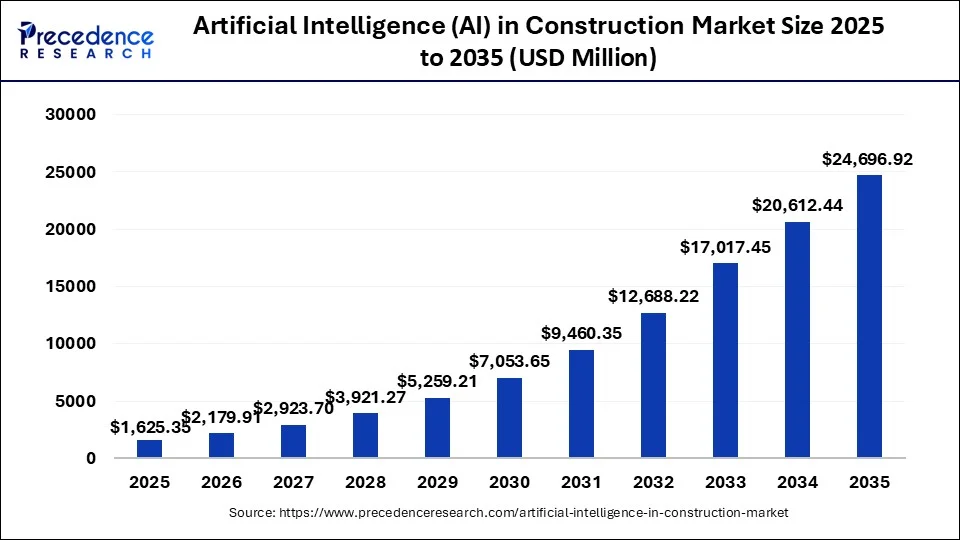
The global artificial intelligence (AI) in construction market size is calculated at USD 1,625.35 million in 2025 and is predicted to increase from USD 2,179.91 million in 2026 to approximately USD 24,696.92 million by 2035, expanding at a CAGR of 31.27% from 2026 to 2035.
What are the Emerging Benefits of Artificial Intelligence (AI) in Construction?
The artificial intelligence (AI) in construction market is rapidly growing, driven by advancements in machine learning, robotics, and data analytics. AI applications in construction include project management, design optimization, predictive maintenance, safety monitoring, and autonomous machinery. Increased efficiency, reduced costs, and enhanced safety are key benefits. Major players include IBM, Autodesk, and Trimble. The market faces challenges like high initial costs and a need for skilled labor. However, with ongoing innovation and increased adoption, it is poised for significant expansion in the coming years.
Supply Chain Management in E&C
Supply chain management in the construction industry is a critical strategic function that governs the flow of materials, equipment, information, and financial resources from suppliers to project sites, ultimately determining project efficiency, cost control, and delivery timelines. Unlike manufacturing supply chains, construction supply chains are highly fragmented, project-specific, and temporary in nature, involving multiple tiers of suppliers, contractors, subcontractors, and logistics providers operating under tight schedules and uncertain conditions. Effective construction supply chain management requires early-stage integration of procurement planning with design and engineering decisions, ensuring material specifications, lead times, and availability are aligned with project requirements.
Coordination challenges are intensified by fluctuating material prices, regulatory compliance needs, and dependence on geographically dispersed suppliers, making risk management and supplier reliability essential components of supply chain strategy. Digital tools, such as integrated procurement platforms, real-time inventory tracking, and data-driven demand forecasting, are increasingly being adopted to enhance visibility, reduce delays, and minimize waste across construction projects. Additionally, sustainable supply chain practices, including responsible sourcing, local supplier engagement, and lifecycle-based material selection, are gaining importance as environmental and social accountability become central to construction governance. Ultimately, a well-structured construction supply chain enables improved collaboration among stakeholders, optimized resource utilization, reduced project uncertainty, and enhanced overall project performance, positioning supply chain management as a core driver of competitiveness and resilience in the construction industry.
The Minds that Build Tomorrow: Large Generative Models in E&C
The large generative models (LGMs) are among the most radical technological changes of the modern industrial age, not as tools but as scalable, adaptive intellectual infrastructure, capable of reasoning, creating, and optimizing. Raised on large, heterogeneous datasets and honed in state-of-the-art learning machinery, these models can produce text, designs, simulations, code, and strategic insights with a degree of context sensitivity never seen. They are not automation, but augmentation, which is useful for the industry to boost human decision-making, expedite innovation, and change the concept, implementation, and control of complex systems.
In every industry, LGMs are transforming knowledge work by enabling the synthesis of disparate data into intelligible, actionable information. They assist in the rapid design process, simulate performance results, and suggest optimized design solutions in the context of engineering and manufacturing, considering constraints related to cost, materials, safety, and sustainability. Through learning more about past data on projects and current contributions, these models can predict design conflicts, recommend alternative engineering directions, and significantly reduce the amount of rework, thus shrinking development schedules and enhancing quality. The generative ability enables engineers to shift to exploratory and scenario-driven thinking as opposed to the linear resolution of problems.
LGMs can be used as cognitive coordinators in operations and supply chain management, capable of synthesizing signals generated by procurement systems, logistics networks, market dynamics, and geopolitical variables. They facilitate proactive planning through the creation of future scenarios, detect vulnerabilities, and advise mitigation measures before the disruption becomes a reality. Instead of responding to shortages or delays, organizations can proactively restructure sourcing policies, inventory management, and supplier interactions, creating resilience in highly unstable industrial ecosystems.
The influence of LGMs on strategic decision-making is also transformative. These models serve as intelligent advisors in sectors like construction, energy, finance, and healthcare, assisting with the interpretation of complex regulatory landscapes, financial models, and risk frameworks. They can help leadership groups estimate trade-offs, predict long-term consequences, and aid in harmonizing work-related choices with overall organizational goals. Generative models enhance the quality and speed of executive decision-making by decreasing cognitive overload and increasing clarity.
The productivity of the workforce and the development of capabilities will also have tremendous benefits. LGMs are considered knowledge companions accessible on demand and can assist professionals with contextual advice, documents, and training material, as well as solve problems. They democratize knowledge by accessing higher-order knowledge at organizational levels, thereby decreasing the reliance on limited specialists and facilitating learning at scale. Such a change reinvents talent models, where more creativity, judgment, and systems thinking are valued as opposed to routine execution.
| LGMs | Developers | Training parameters | Release year |
| GPT4 | Open AI | 1000 | 2023 |
| Gemini pro | Google DeepMind | 17 | 2023 |
| Llama 2 | Meta | 2000 | 2023 |
| PaLM | 540 | 2022 | |
| Claude | Anthropic | 12 | 2023 |
| SDXL | Stability AI | 2.6 | 2023 |
The collaboration of humans and artificial intelligence (AI) is redefining creativity and innovation, as previously considered to be in exclusively human spheres. In general, generative models encourage thinking differently, cross-domain knowledge generation, and disruptive thinking. They serve as engines of originality in product development, marketing, architecture, and research to assist teams in exploring design space that would be cumbersome to do manually. Notably, this does not substitute human imagination, but enhances it in a way that industries can be more innovative and faster at it.
When Ideas Take Shape: The Power of Visualization in E&C
Visualization in engineering is far more than a supporting tool; it is a cognitive bridge that transforms abstract ideas, complex data, and mathematical models into clear, interpretable, and actionable insights. At its core, engineering visualization enables professionals to see what cannot be built, to understand systems before they exist, and to communicate complexity with precision and elegance. From early conceptual sketches to advanced digital simulations, visualization plays a decisive role across the entire engineering lifecycle.
In the design and planning phase, visualization allows engineers to convert technical specifications into tangible representations that can be evaluated, refined, and validated. Three-dimensional models, parametric designs, and virtual prototypes enable stakeholders to explore geometry, spatial relationships, and functional behavior long before physical construction or manufacturing begins. This early visibility reduces ambiguity, enhances design accuracy, and significantly lowers the risk of costly changes at later stages. Visualization, thus, becomes a preventive instrument, safeguarding both time and resources.
As engineering systems grow in scale and complexity, data visualization emerges as a critical analytical capability. Engineering projects generate vast volumes of data from sensors, simulations, testing, and operational monitoring. Through dashboards, heat maps, digital twins, and interactive models, visualization transforms raw data into meaningful patterns, trends, and correlations. Engineers can identify anomalies, optimize performance, and predict failures with greater confidence, enabling proactive decision-making rather than reactive problem-solving.
In multidisciplinary and large-scale projects, visualization also serves as a powerful medium of collaboration and communication. Engineering concepts that are difficult to articulate through equations or technical language alone can be clearly conveyed through visual narratives. Visualization aligns architects, engineers, contractors, clients, and regulators around a shared understanding of objectives and constraints, reducing misinterpretation and enhancing coordination across diverse teams.
Advanced visualization technologies are further expanding the possibilities of engineering. Immersive environments such as virtual reality and augmented reality allow engineers to interact with designs at full scale, inspect hidden components, and simulate real-world operating conditions. These tools enhance safety planning, training, and maintenance by enabling experiential learning without physical risk. Engineers can walk through structures before they are built, identify hazards, and optimize workflows with unprecedented clarity.
Beyond functionality, visualization supports innovation by encouraging exploration and creativity. By making design spaces visible, engineers can experiment with alternative configurations, materials, and systems, comparing outcomes in real time. This visual feedback accelerates iteration and fosters a deeper intuitive understanding of complex systems, bridging the gap between analytical rigor and creative insight.
In essence, visualization in engineering is not merely about seeing better; it is about thinking better. It sharpens perception, strengthens communication, and elevates decision-making across the engineering landscape. As digital technologies continue to evolve, visualization will remain a cornerstone of engineering excellence, shaping how ideas are conceived, tested, and ultimately brought to life.
Media Richness in Computer-Mediated Communication within the Supply Engineering Industry
The media richness theory refers to the ability of various communication media to transmit information, reduce ambiguity, and facilitate understanding between the parties. Computer-mediated communication (CMC) has emerged as the foundation of collaboration among dispersed teams, suppliers, contractors, and logistics partners in the supply engineering industry, where coordination, accuracy, and speed of decision-making matter. The concept of media richness, here, refers to a factor that distinguishes the extent to which tricky technical, logistical, and relational information can be managed using digital products.
Media Richness Framework for Effective Organizational Communication
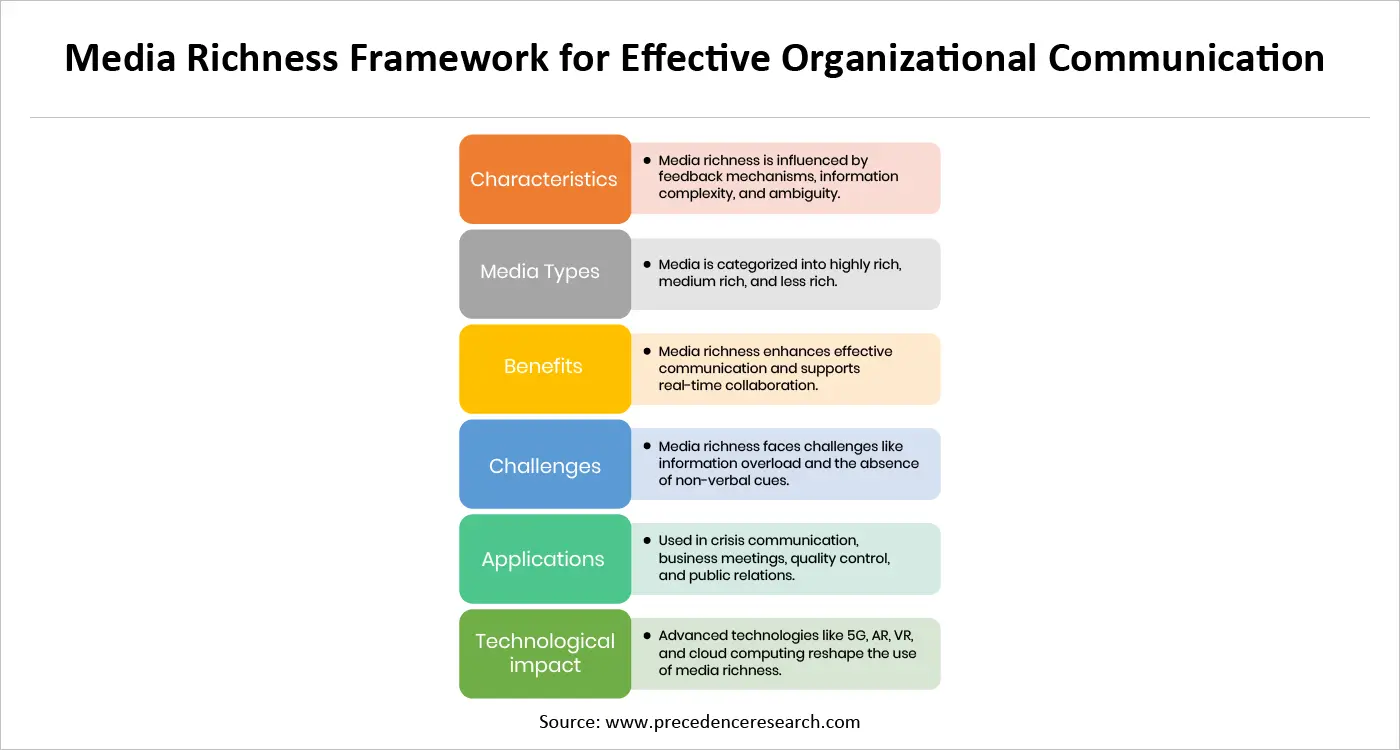
Supply engineering encompasses the regular operations of complex data, including technical specifications, purchase schedules, quality control, risk evaluation, and order alterations. Lean communication media, like emails or text-based procurement systems, are effective in routine and standardized transactions, including purchase confirmations and the inventory update process. Nonetheless, such media are not very rich because they do not provide immediate feedback, non-verbal messages, and context. Lean media may not be sufficient and may result in misunderstanding, wastage of time, or expensive mistakes when there is uncertainty or ambiguity, as in supplier negotiations, design clarifications, or in disruption management.
More sophisticated computer-enabled communication instruments, such as video conferencing, connection platforms, and digital collaboration workspaces, significantly promote coordination in supply engineering. Video-based meetings enable individuals to read facial recognition, tones, and other visual signs to enhance trust and relational alignment between supply partners and engineering teams. Screen sharing, real-time models, and interactive dashboards make media wealthy by allowing participants to collaboratively analyze drawings, bills of materials, logistics flows, and risk scenarios, building a common cognitive frame despite physical distance.
The complex CMC systems incorporate several layers of richness in the supply engineering processes. Messaging digital platforms that include document management, workflow, and visual analytics enable information to be shared both deeply and at speed. These systems are useful in achieving both synchronous and asynchronous communication, allowing time zone-dispersed teams to work effectively without disruption of context. The capability to append drawings, simulations, inspection images, and performance information enhances the clarity of the message and minimizes the possibilities of rework.
Media richness is also a strategic factor in handling uncertainty and disruptions in supply chains. When a shortage of material is detected, a delay in delivering goods, or a variation in quality, a more enhanced form of communication can be used to quickly sense-make and solve the problem collectively. Live chats with visual-powered interactive discussions and real-time updates can help engineering and supply teams align priorities, conduct alternative evaluations, and implement corrective measures with confidence. Under these circumstances, organizational response is directly dependent on the quality and speed of the medium used.
Optimal communication in supply engineering, however, does not mean that the richest media should always be used. Communication strategy requires that media richness should be equal to task complexity. Wasting rich media on simple tasks may eliminate efficiency, and wasting lean media on complicated problems may enhance risk. The strategy of mature supply engineering organizations is to use a layered communication strategy providing a range of CMC tools, based on the transactional, operational, and strategic requirements.
To sum up, the richness of media used in CMC is a vital facilitator of performance in the supply engineering market. The alignment of communication media with the complexity of information and uncertainty enables organizations to enhance clarity, trust, coordination, and resilience throughout supply networks. As digital collaboration is becoming a major core in the operations of the engineering profession, the intelligent orchestration of media richness will continue to serve as a critical factor influencing supply chain effectiveness and competitive advantage.
Powering the Invisible Backbone: Data Centers and Energy Infrastructure in E&C
The E&C industry is entering a new phase of expansion driven by the accelerating demand for data centers and resilient energy infrastructure. As economies become increasingly digital and electrified, the physical systems that support data processing, storage, and power transmission are emerging as strategic national assets. This shift is redefining project priorities, capital allocation, and technical complexity within the E&C sector, positioning data centers and energy infrastructure as central engines of its next growth wave.
The rapid proliferation of cloud computing, AI, and digital services has elevated data centers from back-end facilities to mission-critical infrastructure. These assets demand highly specialized engineering capabilities, combining structural design with advanced electrical, mechanical, and thermal systems. Construction timelines are compressed, reliability standards are uncompromising, and operational continuity is paramount. As a result, E&C firms are required to adopt industrialized construction methods, modular design approaches, and precision execution to meet the stringent performance requirements of hyperscale and edge data center projects.
Parallel to this digital expansion is a global transformation of energy infrastructure. The electrification of transportation, decentralization of power generation, and the integration of renewable energy sources are reshaping how energy systems are designed and built. E&C projects increasingly focus on grid modernization, energy storage, transmission networks, and hybrid power systems that can support variable demand and intermittent generation. These projects are complex, capital-intensive, and deeply intertwined with regulatory, environmental, and geopolitical considerations, demanding a high degree of engineering sophistication and risk management.
The convergence of data centers and energy infrastructure further amplifies the opportunity for the E&C industry. Data centers are among the most energy-intensive building types, requiring a secure, redundant, and increasingly low-carbon power supply. This interdependence is driving the integration of project models that align data center construction with on-site generation, energy storage, and grid connectivity. Engineering solutions now extend beyond buildings to encompass entire energy ecosystems, elevating the strategic role of E&C firms from builders to infrastructure partners.
This next wave of growth is also accelerating technological and organizational transformation within the E&C sector. Digital engineering, advanced project controls, and data-driven asset management are becoming essential in managing the scale and complexity of these infrastructure projects. Firms are investing in cross-disciplinary capabilities, blending civil, electrical, and systems engineering with digital and sustainability expertise. The ability to deliver speed, certainty, and resilience is emerging as a defining competitive differentiator.
External Economic Geopolitical Policy and Technological Drivers Are Accelerating Growth Across Data Centers and Energy Infrastructure
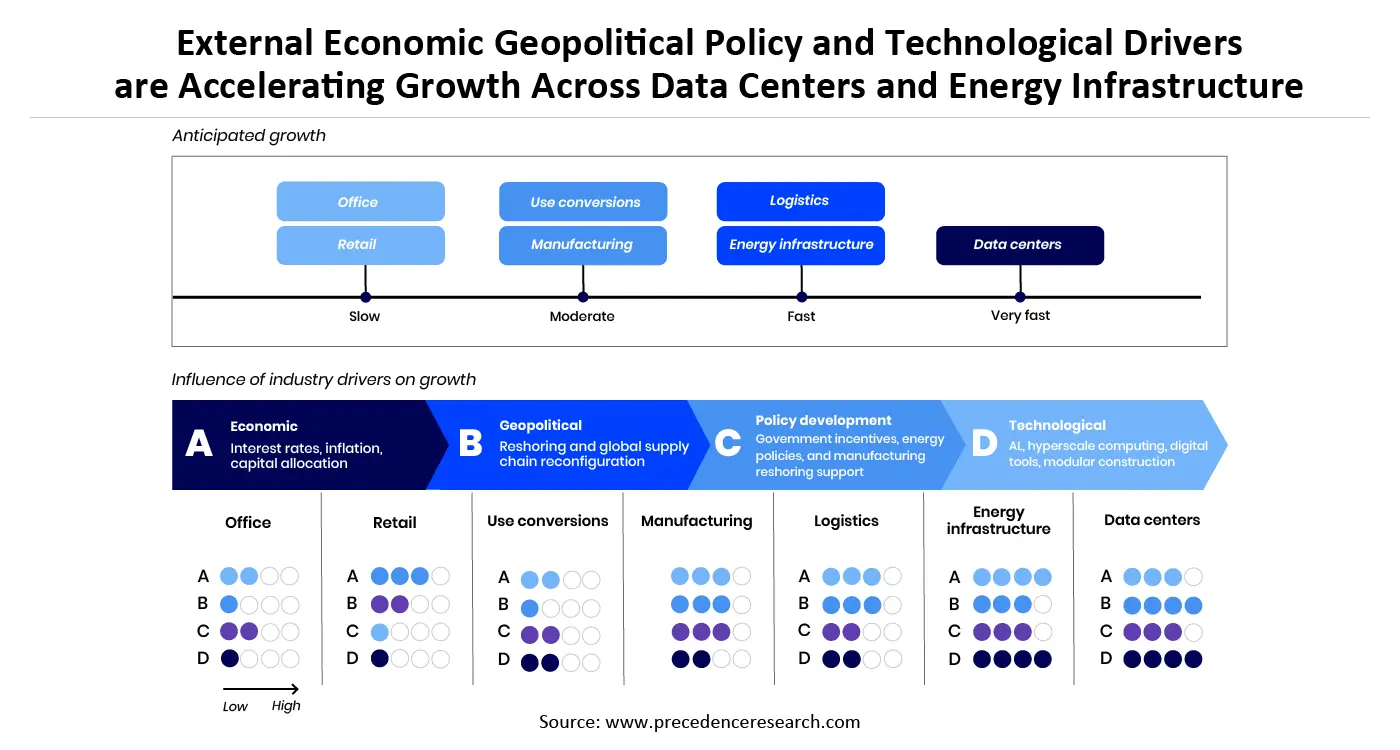
The above image illustrates the anticipated influence of industry drivers on the growth of various sectors. Prominent industry drivers include economic, geopolitical, policy development, and technology. Data centers and energy infrastructure are expected to result in robust growth.
Sustainability and ESG Integration in E&C
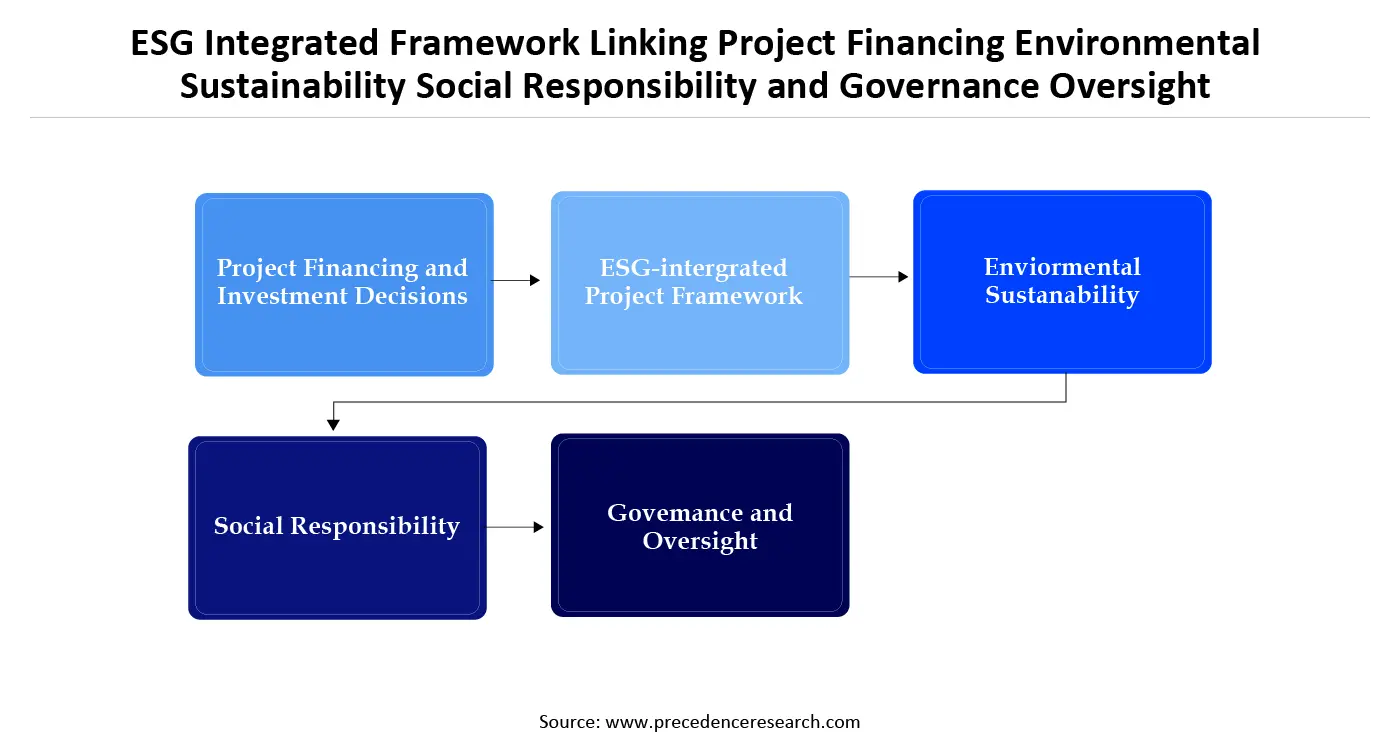
The concepts of sustainability and the incorporation of environmental, social, and governance (ESG) principles have ceased to be viewed as peripheral issues to value creation determinants in the E&C sector. Infrastructure and construction projects are now assessed by project stakeholders, such as investors, regulators, clients, and communities, not just in terms of cost, quality, and timelines, but also in terms of their environmental impact, social responsibility, and transparency of their governance. This leads to the fact that ESG performance is becoming a factor in project financing, design approach, and contractor selection standards.
In terms of environmental concerns, engineering firms are directly integrating carbon reduction strategies into project planning and design. These are lifecycle assessments of materials, energy-efficient structural solutions, low-emitting constructions, and the incorporation of renewable energy systems. Sustainability is not confined to compliance anymore; it is a design constraint as well as a performance goal that influences engineering decisions at both the concept stage and the commissioning stage. It has turned its focus to long-term asset efficiency, climate resistance, and minimizing environmental externalities.
The social aspect of ESG is also a major concern in construction projects, as it directly relates to employees and neighborhoods. E&C companies are increasingly emphasizing the safety of workers, their health, fair labor practices, and skills training. Community participation has emerged as a crucial aspect of project implementation, whereby the development of infrastructure should follow the interests of the locals, cause minimal disruption as possible, and provide socio-economic benefits to everyone. Projects with good social performance are gaining popularity among both government and private stakeholders.
Governance is the structural foundation of ESG integration. Project credibility has become increasingly dependent on transparency in the procurement process, ethical business practices, risk management procedures, and accountability. Engineering companies are enhancing governance by utilizing digital reporting mechanisms, performance indicators based on ESG, and monitoring compliance throughout the project life cycle. Effective governance ensures that environmental and social commitments are not aspirational, but quantifiable, enforceable, and auditable.
Together, the integration of ESG is transforming the evaluation and delivery of engineering projects. Instead of being viewed as external reporting, ESG has since been integrated into decision-making frameworks and affects the attractiveness of investments, operational effectiveness, and value of long-term assets. In engineering companies, systematic integration of ESG factors is becoming a strategic asset that builds resilience, reputation, and competitive advantage in an ever-changing construction environment.
Future Outlook and Strategic Implications
The future of the E&C industry will be shaped by its ability to transition from fragmented, project-based operations to integrated, platform-driven ecosystems. Firms that successfully combine engineering expertise with digital capabilities, sustainability leadership, and collaborative delivery models are likely to gain a competitive advantage. Technological advancements, ranging from LGMs to data centers and AR/VR, have a positive influence on the future of the E&C industry, benefiting investors and enterprises. Long-term success will depend not only on technological adoption but also on cultural transformation, governance reforms, and ecosystem partnerships.
ESG Integrated Framework Linking Project Financing Environmental Sustainability Social Responsibility and Governance Oversight
Conclusion
The E&C industry stands at a critical inflection point. While traditional challenges, such as low productivity and risk exposure, persist, emerging technologies and sustainability imperatives offer unprecedented opportunities for transformation. By embracing innovation, strengthening collaboration across the value chain, and investing in human capital, the industry can evolve into a more resilient, efficient, and value-driven sector. The transition will be complex and gradual, but it is essential for meeting the infrastructure demands of a rapidly changing world.
About the Authors

Aditi Shivarkar
Aditi, Vice President at Precedence Research, brings over 15 years of expertise at the intersection of technology, innovation, and strategic market intelligence. A visionary leader, she excels in transforming complex data into actionable insights that empower businesses to thrive in dynamic markets. Her leadership combines analytical precision with forward-thinking strategy, driving measurable growth, competitive advantage, and lasting impact across industries.



Aman Singh
Aman Singh with over 13 years of progressive expertise at the intersection of technology, innovation, and strategic market intelligence, Aman Singh stands as a leading authority in global research and consulting. Renowned for his ability to decode complex technological transformations, he provides forward-looking insights that drive strategic decision-making. At Precedence Research, Aman leads a global team of analysts, fostering a culture of research excellence, analytical precision, and visionary thinking.

Piyush Pawar
Piyush Pawar brings over a decade of experience as Senior Manager, Sales & Business Growth, acting as the essential liaison between clients and our research authors. He translates sophisticated insights into practical strategies, ensuring client objectives are met with precision. Piyush’s expertise in market dynamics, relationship management, and strategic execution enables organizations to leverage intelligence effectively, achieving operational excellence, innovation, and sustained growth.