






 Request Consultation
Discover how UAV drones are transforming industries with AI, sensors, and automation—boosting efficiency, safety, and real-time decision-making.
The UAV drones are aircraft that operate without a human pilot onboard. It can be controlled remotely or programmed to fly on its own using software and GPS systems. Previously, it was exclusively used for military operations, but nowadays the use of UAV drones is very common, from capturing aerial photos at weddings to inspecting power lines and delivering packages.
Industries are seeking faster, safer, and more cost-effective ways to operate processes to reduce manual labour and risks. The UAV drones fit perfectly into this need. The UAV drones commonly used in monitoring farmlands allow farmers to respond quickly to problems such as pests and droughts. The rise of drones is driven by improvements in battery life, navigation systems, sensors, and data processing.
Today, drones are no longer experimental tools; they are becoming an essential part of industrial operations!
What is the Unmanned Aerial Vehicle (UAV) Drones Market Size?
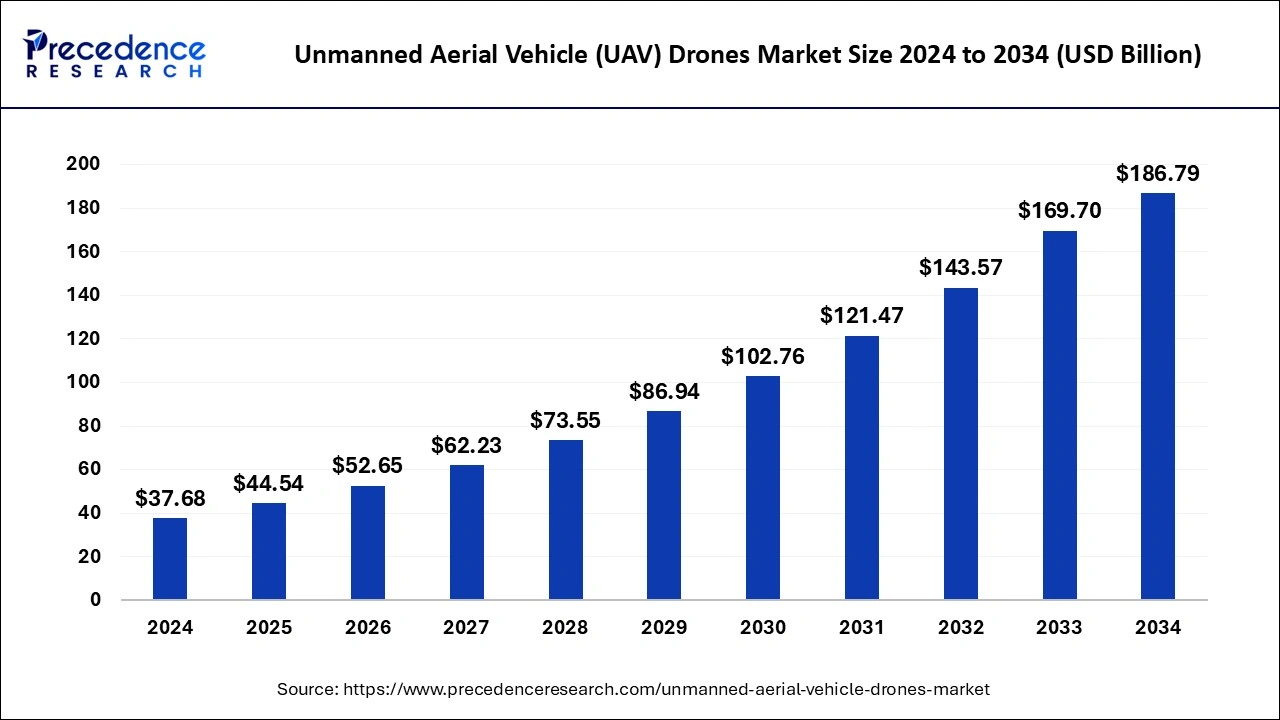
The global unmanned aerial vehicle (UAV) drones market size surpassed USD 44.54 billion in 2025 and is estimated to increase from USD 52.65 billion in 2026 to approximately USD 209.91 billion by 2035, growing at a CAGR of 16.77% between 2026 and 2035.
Why is Drone Technology Becoming a Global Priority?
Nowadays, drone technology is rapidly being used to gain a powerful new platform for data collection, safety monitoring, and operational efficiency. One of the biggest advantages of using drones is that they save time and effort. Tasks that took several hours or days can be done in a fraction of the time. For example, surveying a large piece of land manually would take days, but by using a drone, the same data can be captured within hours. This allows companies to save time and money.
UAV drones equipped with cameras and sensors can capture detailed information in real time. This helps companies to make better decisions in time. For example, farmers can access crop health, track growth, and even use drones for spraying fertilisers and pesticides.
Many industries involve risky environments such as mining areas, construction sites, and oil rigs. Humans working in such areas carry a risk to their lives. UAV drones can reduce that risk by handling inspection and data collection remotely.
Key Technologies: Back boning to the Unmanned Aerial Vehicles (UAV) Drones
Drones rely on several technologies working together to function smoothly:
- Flight Control System – The flight control system is the central processing unit of the drone. The main control of UAVs is through the Real Time Operating System (RTOS). The flight control system includes the flight management system, safety module, communication control component, mission control module, and monitoring systems.
- GPS and Navigation Systems – GPS allows drones to follow specific routes and reach exact locations. The navigation system of UAVs includes Global Navigation Satellite Systems (GNSS), inertial navigation, and visual navigation. The advanced navigation system helps the drone to avoid obstacles and maintain stable flight.
- Sensors and Cameras – Drones are equipped with cameras and sensors that capture images, videos, and environmental data. These include camera-like RGB, thermal, and multispectral sensors, and sensors include IMUs (Inertial Measurement Units), GPS, LiDAR (Light Detection and Ranging), obstacle detection sensors, magnetometer, and barometer.
- Battery and Power System – Improved battery technology has made drones more reliable and capable of longer flight times. This is important for large-scale operations. Drone battery and power system consist of rechargeable packs such as Lithium-ion / LiPo, Lithium-ion (Li-ion), Solid – State Batteries (SSBs), and Battery Management Systems (BMS).
- Data Processing and Software – The data collected by drones is processed using software that converts raw sensor data into useful insights. The software used in UAVs is Agisoft Metashape, Pix4D, and RealityCapture.
Top 10 Countries and Their Local Companies in the Drone Industry
These are the top countries and companies using drones in professional and military operations, and autonomous solutions, leading globally with advanced UAVs for surveillance, combat, strategic missions, infrastructure inspection, and agriculture.
| Rank | Country | Companies |
| 1 | China | DJI, |
| 2 | United States | AeroVironment, General Atomic Aeronautical Systems, Skydio, MQ-9 Reaper, RQ-4 Global Hawk |
| 3 | Turkey | Baykar, Anka - 3 |
| 4 | Israel | Israel Aerospace Industries (IAI) |
| 5 | Russia | ZALA Aero Group, Kronshtadt Group, geoscan, Rubicon, Emlid |
| 6 | Iran | Iran Aircraft Manufacturing Industries (HESA), Qods Aviation Industry Company, Sahara Thunder |
| 7 | United Kingdom | BAE Systems, QinetiQ, Thales UK, Evolve Dynamics, Scios |
| 8 | India | IdeaForge Technology Ltd, Garuda Aerospace, Dhaksha Unmanned Systems, Throttle Aerospace Systems (TAS) |
| 9 | South Korea | Doosan Mobility Innovation, Korea Aerospace Industries (KAI), UCONSYSTEM Co., Ltd, Korean Air Aerospace Division (KAL) |
| 10 | France | Parrot Drones SAS, Delair, Azur Drones, Elistair, and Delta Drone Group. |
What Technological Transformation Have Unmanned Aerial Vehicles (UAV) Drones Witnessed Recently?
Emerging Innovations in UAV Drones Technology:
Drone technology is still evolving, and there are some interesting developments ongoing:
- Swarm Intelligence - Swarm intelligence allows multiple drones to work together without a single controller. Each drone communicates with others and shares data. This approach makes operations faster and more flexible, especially in tasks like surveillance and large-scale monitoring.
- Edge Artificial Intelligence – Edge artificial intelligence processes data where it is collected, either on the drone or within local infrastructure. By handling data locally, edge AI makes drones more responsive and reliable. This helps in situations where quick decisions are needed and reduces dependency on continuous connectivity. Edge AI implemented on a drone can detect temperature variation, safety hazards, and trigger automated responses.
- All-Weather Autonomy – modern drones can operate smoothly even when weather conditions are not ideal. Earlier drones struggled in rain, fog, heat, or snow, but newer technologies, including anti-icing systems, sealed components for water and dust resistance, and strong stabilization algorithms, help in handling challenges better. Organizations using FlytBase Orchestration technology to achieve uninterrupted monitoring and inspection.
- Interactive and Bidirectional Drones – Interactive and bidirectional drones focus on real-time communications. Next-generation drones integrate robotics attachments, AI, and advanced sensor technology to perform active maintenance and logistics with bidirectional communication to receive commands and send feedback at the same time.
Drone Technology Transforming Industries
Various industries are being influenced through the adoption and use of UAV Drones, including:
| Industries | Insights |
| Agriculture | 1. Farmers are using drones to monitor charts of their fields with precision for a better understanding of their fields. 2. UAVs are also used to observe crop health and to spray fertilizers or pesticides. 3. This saves the time of farmers and helps in the better management of land. |
| Construction | 1. Construction companies use drones to keep track of projects.2. They can be used to monitor progress, aerial mapping, and structural inspections.3. This makes it easier to manage large projects and avoid delays. |
| Supply Chain |
1. Companies are exploring drone usage to deliver packages, especially in areas that are hard to reach and where traditional delivery methods fail.2. This can lower the operational cost compared to vehicle delivery services.3. It also provides the convenience of contactless delivery with limited human intervention. |
| Mapping |
1. UAV drones are used in mapping to capture high-resolution aerial images by using sensors like cameras, RTK GPS, and LiDAR.2. It is a cost-effective method and offers faster surveying of large areas, reducing labour costs. |
| Emergency Services | 1. In emergencies, such as natural disasters, fire, or search operations, drones can be sent quickly to assess the situation.2. Drones help the rescue team by providing a clear aerial view faster, even in harsh weather. |
| Military and Defence | 1. UAVs are used in the military for surveillance, precision attack, and to deliver mission-critical supplies.2. It offers persistent target acquisition and precision strikes while eliminating risk to pilots and reducing operational cost |
| Logistics |
1. UAV drones are used to deliver small packages and medical supplies, bypassing road traffic, reducing noise pollution, and carbon emissions.2. Both military and commercial companies use UAVs for logistic tasks.3. In defence, it is used to supply ammunition, food, and communication equipment in remote or dangerous areas.4. In businesses, it offers quick delivery among industrial campuses. |
| Cinematography | 1. Drones are trending in cinematography as they deliver seamless shots in different angles with less manual intervention.2. Previously, to take such shots, filmmakers used helicopters, cranes, or planes, which are expensive.3. UAV Drones have transformed documentaries and commercial films. |
What are the Major Limitations the UVA Drone Industry is Facing?
One of the biggest challenges for drones is government regulations. Many countries have different regulations on the usage of drones. Permissions, no-fly zones, and licensing requirements can slow down the adoption of drones. The drone collects images, videos, and other data, and privacy becomes a major concern. There is always a risk of misuse or unauthorized access to sensitive information. Safety regulations require strict guidelines to ensure public safety and ethical use of drones.
Most of the drones can fly for 20-40 minutes before recharging. This limits their use for long-distance operations. Frequent recharging and battery replacement interrupt the operational efficiency.
What are Recent Breakthroughs in the UAV Drone Field?
- Flight trials of Unmanned Aerial Vehicle have been successfully conducted by the Defence Research and Development Organisation (DRDO) of India, or the launch of Precision Guided Missile (ULPGM) – V3 in Andhra Pradesh, India. This missile was released from a UAV. The ULPGM – V3 is equipped with a dual-channel seeker that can strike a wide variety of targets and can be fired in plain and high-altitude areas.
- Ukraine launched a central mission control for UAVs, enabling real-time monitoring, automated data processing, and unifying battlefield visibility. This system is integrated into Ukraine’s DELTA combat ecosystem. It allows data entry for missions such as launch type, route, tasks, and drone details into a single shared platform.
- China launched the world's first drone mothership named JiuTian, a 16-tonne, around 35,000-pound unmanned aerial aircraft that can launch more than 100 smaller drones. The drone mother ship can carry up to 6 tonnes of ammunition and small drones, including kamikaze UAVs.
Building the Future with UAV Drone Technology:
Drones are becoming a practical tool that industries can rely on. The UAV drones offer advantages such as saving time, reducing risk, and providing valuable insights, making them an important part of modern operations. As technology continues to improve, drones can become more reliable.
UAVs are used in agriculture for monitoring crops, to rescue people in emergencies, in cinematography, and in defence for surveillance, to target enemies. UAV drones are adopted by many industries. But the regulatory and technical concerns remain challenging. With the regulatory strict compliance framework, the usage of UAV drones can transform industries.
About the Authors

Aditi Shivarkar
Aditi, Vice President at Precedence Research, brings over 15 years of expertise at the intersection of technology, innovation, and strategic market intelligence. A visionary leader, she excels in transforming complex data into actionable insights that empower businesses to thrive in dynamic markets. Her leadership combines analytical precision with forward-thinking strategy, driving measurable growth, competitive advantage, and lasting impact across industries.



Aman Singh
Aman Singh with over 13 years of progressive expertise at the intersection of technology, innovation, and strategic market intelligence, Aman Singh stands as a leading authority in global research and consulting. Renowned for his ability to decode complex technological transformations, he provides forward-looking insights that drive strategic decision-making. At Precedence Research, Aman leads a global team of analysts, fostering a culture of research excellence, analytical precision, and visionary thinking.

Piyush Pawar
Piyush Pawar brings over a decade of experience as Senior Manager, Sales & Business Growth, acting as the essential liaison between clients and our research authors. He translates sophisticated insights into practical strategies, ensuring client objectives are met with precision. Piyush’s expertise in market dynamics, relationship management, and strategic execution enables organizations to leverage intelligence effectively, achieving operational excellence, innovation, and sustained growth.