






 Request Consultation
Chilled beam systems are advanced water-based HVAC solutions offering energy-efficient, quiet, and comfortable cooling and heating for modern buildings. With passive, active, and multi-service options, these systems reduce energy consumption by up to 40%, maximize ceiling space, and enhance indoor air quality. Ideal for offices, schools, and healthcare facilities, chilled beams provide sustainable, low-maintenance HVAC performance that supports green building certifications and reduces a building’s carbon footprint.
As engineers, architects, and building owners are increasingly seeking to enhance energy efficiency while improving occupant comfort, traditional HVAC systems, such as variable air volume (VAV) systems, are being increasingly replaced by chilled beam systems as innovative and sophisticated technology. With the potential to reduce cooling loads by up to nearly 30 to 40%, chilled beams represent a significant shift from air-based cooling to water-based cooling. Chilled beams are ideal for environments where the demand for sensible cooling is higher than the requirement for ventilation and latent cooling. Common applications include office spaces, schools, research laboratories, hospital patient rooms, and other similar settings.
What is a Chilled Beam System?
A chilled beam is a type of convection HVAC system designed to heat and cool spaces, usually installed in the ceiling. It includes a heat exchanger, usually consisting of copper pipes and aluminum fins, contained within a metal casing. Chilled beam systems are versatile; they are able to cool and heat large spaces simultaneously, performing better than alternative forced-air systems. A chilled beam system efficiently circulates air in a room by running chilled water through a copper beam located near the ceiling. This process cools the surrounding air, causing the colder air to fall while the warmer air rises, which provides effective air circulation throughout the building while maintaining space efficiency.
Chilled beam systems allow for taller ceilings. A one-inch water pipe can transfer the same amount of cooling energy as an 18-inch square air duct. The chilled beam system is widely being adopted, driven by the rising construction of commercial buildings, particularly in developed and developing nations, such as high-end office spaces, healthcare facilities, and schools, requires precise temperature regulation, low noise, and improved indoor air quality.
How the Chilled Beam System Works
Chilled beam systems function through a combination of convection and radiant heat transfer.
- Warm Air Rises: The naturally warm air, generated by computers, lights, people, and office machines, rises to the ceiling.
- Heat Exchange: The warm air passes through the chilled beam, where it loses heat to the chilled water circulating in the tubes.
- Cool Air Descends: As the air cools, it becomes denser and sinks back down into the floor, creating a continuous and natural convection loop that cools the roomoccupied space.
This establishes a self-sustaining natural circulation pattern. They mainly handle sensible cooling, which includes lowering the temperature. They need to be paired with a ventilation system that manages latent cooling (humidity and moisture management).
What is the Chilled Beam System Market Size in 2026?
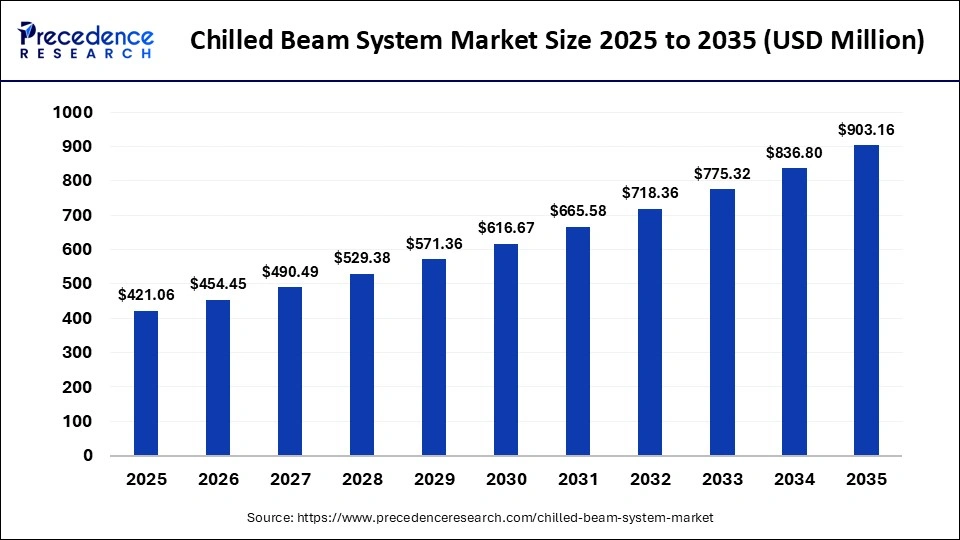
The global chilled beam system market size was calculated at USD 421.06 million in 2025 and is predicted to increase from USD 454.45 million in 2026 to approximately USD 903.16 million by 2035, expanding at a CAGR of 7.93% from 2026 to 2035
Expert Opinion: The Business Case for Chilled Beam Systems
According to industry experts, chilled beam systems are proving to be a game-changer in the HVAC industry, particularly in terms of energy efficiency and long-term cost savings. As businesses increasingly prioritize sustainability and operational efficiency, chilled beams offer an attractive alternative to traditional air-based cooling systems. These systems can reduce cooling loads by up to 30-40%, significantly lowering energy costs over time.
Chilled beam systems not only help companies reduce their carbon footprint, but they also improve occupant comfort by providing quieter, more uniform cooling with minimal air movement. For companies investing in green building certifications such as LEED, chilled beams are a critical component in meeting energy-efficient requirements, offering a competitive edge in the market.
Furthermore, with rising utility costs and increasing pressure to comply with environmental regulations, businesses are turning to chilled beam systems as a smart investment in their operational infrastructure. These systems offer low-maintenance, high-performance cooling solutions that align with long-term business goals, making them a wise choice for companies looking to optimize both their financial and environmental impact.
Chilled Beams Explained: Discover the Different Types for Your HVAC Needs
The three major classifications of chilled beams are: Passive, Active, and Integrated/multi-service beams.
- Passive Chilled Beams: Passive chilled beams do not supply primary air. This system has no fans, no ducts, and no moving parts. After reaching the ceiling through natural buoyancy, warm air cools as it surrounds the beam and then descends back into the open space. The whole process relies strictly on gravity-driven natural convection.
- Best for: Buildings with high sensible cooling loads but low ventilation needs, mainly where they already have a separate ventilation system.
- Active Chilled Beams: Active chilled beams are connected to a central Air Handling Unit (AHU). Active chilled beams are used for both cooling and heating. The ventilation air is delivered to the beam by a central air-handling system via ductwork. Active chilled beams provide high-performance cooling and heating with low acoustic signatures by using water for thermal transfer and a quiet induction process rather than fans. They typically provide high levels of occupant thermal comfort and enhance energy efficiency. Active Chilled Beams (ACBs) are best suited for projects with limited ceiling plenum space or retrofits needing low-maintenance, efficient, and water-based cooling solutions.
- Best for: Buildings that require high energy efficiency, superior indoor air quality, and excellent thermal comfort with noise-sensitive spaces, such as modern open-plan offices, university laboratories, hospitals, schools, and hotels.
- Multi-service beams : Multi-Service Chilled Beams (MSCBs) are advanced and prefabricated ceiling units that integrate multiple building services into a single unit, including HVAC (cooling/heating), lighting, fire sprinklers, speakers, cable trays, sprinkler apertures, fire protection, and acoustic insulation. They can either be passive or active. Multi-service chilled beams offer optimal fitting of various service systems, making the installation easier. The benefits offered by multi-service beams include increased maintenance accessibility, space saving, and less time required to construct the building
- Best for: The high-occupancy commercial projects seeking maximum energy efficiency, acoustic comfort, and integrated services in confined spaces. Their capability to integrate heating, cooling, lighting, and sensors into a single prefabricated unit makes them widely adapted for use in schools, office buildings, and hospitals.
Key Advantages of Chilled Beam Systems
- Significant Energy Savings: Because they use water for cooling, which is more efficient than large fans, chilled beam systems can drastically reduce energy consumption. Chilled beam systems provide significant energy savings by using water to handle cooling loads, reducing fan power by 40%–70%, and avoiding reheating, which results in lowering annual HVAC energy consumption.
- Improved Occupant Comfort: Unlike conventional VAV systems that force high-velocity air into space, chilled beam systems operate with lower air volumes and low discharge velocities. Without internal motors or fans, chilled beam systems operate almost silently, creating a quieter environment. They provide draft-free, quiet, and uniform temperatures, which are ideal for schools, offices, hotels, and hospitals.
- Maximized Space Saving: Chilled beam systems provide an efficient HVAC solution that maximizes space by replacing large and bulky ductwork with small water pipes. The space needed above the ceiling is reduced, potentially allowing for lower building heights or taller ceilings, saving construction material and money.
- Low Maintenance: Chilled beam systems offer excellent low-maintenance benefits as they lack internal moving parts, filters, and fans, which significantly reduces mechanical failure risks. The beams are engineered to avoid condensation, eliminating the need for condensate drain pans, which significantly lowers maintenance.
- Higher Water Temperatures: Chilled beam systems using higher chilled water temperatures, around 55°F to 67°F (13°C–18°C), which is much higher than conventional systems. This increases the efficiency of the chiller. This technology assists in significant energy savings by increasing chiller efficiency and enabling passive cooling. Unlike Variable Air Volume (VAV) systems that cool air to low temperatures to remove moisture and then reheat it for comfort, whereas chilled beams systems handle sensible cooling separately, preventing wasteful simultaneous heating and cooling.
What You Need to Know: Disadvantages and Risks of Chilled Beam Systems
Despite their various benefits, chilled beam systems are not suitable for all applications.
- Condensation Risk: The most important concern is the potential risk of condensation on cold coils if humidity is not adequately controlled, which may lead to the formation of water droplets that may drip into the room.
- Not Ideal for High-Humidity Areas: They are not well-suited for high-latent load spaces like kitchens, locker rooms, or swimming pools.
- High Initial Cost: The high initial installation costs of piping, air handlers, and specialized coils can be higher than those of conventional systems.
Applications: Where Should You Use Chilled Beams?
Chilled beams are best suited for buildings with high sensible loads (computers, office machines, lights, and people) and stringent occupant comfort requirements.
- Office Buildings: They are ideal for high-occupancy office spaces, offering improved comfort via draft-free air distribution, such as open-plan offices, conference rooms, and meeting rooms.
- Classrooms and Libraries: Without fans AND moving parts at the beam, chilled beams provide a low-noise and high-comfort profile, essential for libraries and focused learning in classrooms.
- Healthcare Facilities: Chilled beam systems, particularly Active Chilled Beams (ACBs), are increasingly becoming an energy-efficient, quiet, and low-maintenance HVAC solution for healthcare facilities. These systems provide highly sensitive cooling via water and reduce fan energy, enhancing indoor air quality (IAQ). They are ideal for non-critical areas like patient rooms, administration, and diagnostic laboratories.
What’s Behind the Increasing Demand for Energy-Efficient Chilled Beams?
Rising Focus on Reduced Carbon Footprint
By optimizing cooling and heating demands, chilled beam technology significantly contributes to lower energy consumption and reduced CO2 emissions, crucial for meeting stringent environmental regulations. With no moving parts, fans, or filters within the units themselves, chilled beams have a long lifespan and require minimal maintenance, with many various components like copper and aluminum being highly recyclable.
The Role of Government
Several governments around the world are playing a crucial role in promoting chilled beam technology as part of broader green building and sustainability initiatives. Governments are offering attractive tax benefits and financial incentives for adopting energy-efficient technologies. Government-supported certifications such as LEED and IGBC in India encourage builders to adopt chilled beams to achieve high energy ratings.
Summary: A Bright Greener Future
Chilled beam technology is a mature and proven technology that offers one of the best ways to reduce a building’s carbon footprint while improving occupant comfort. As we move toward a greener future, the adoption of the chilled beams system is rapidly increasing as the new standard in premium commercial design. Chilled beams systems typically operate with higher chilled water temperatures (14–17°C) in comparison with traditional systems (6–12°C), which results in increasing the chiller efficiency and enabling more "free cooling" opportunities in high and moderate weather.
About the Authors

Aditi Shivarkar
Aditi, Vice President at Precedence Research, brings over 15 years of expertise at the intersection of technology, innovation, and strategic market intelligence. A visionary leader, she excels in transforming complex data into actionable insights that empower businesses to thrive in dynamic markets. Her leadership combines analytical precision with forward-thinking strategy, driving measurable growth, competitive advantage, and lasting impact across industries.



Aman Singh
Aman Singh with over 13 years of progressive expertise at the intersection of technology, innovation, and strategic market intelligence, Aman Singh stands as a leading authority in global research and consulting. Renowned for his ability to decode complex technological transformations, he provides forward-looking insights that drive strategic decision-making. At Precedence Research, Aman leads a global team of analysts, fostering a culture of research excellence, analytical precision, and visionary thinking.

Piyush Pawar
Piyush Pawar brings over a decade of experience as Senior Manager, Sales & Business Growth, acting as the essential liaison between clients and our research authors. He translates sophisticated insights into practical strategies, ensuring client objectives are met with precision. Piyush’s expertise in market dynamics, relationship management, and strategic execution enables organizations to leverage intelligence effectively, achieving operational excellence, innovation, and sustained growth.