



Chilled Beam System Market Trends, Companies, Revenue / Sales Performance, Manufacturing Yield, Fab Capacity, Export & Import Dynamics, Supply Chain Analysis, Competitive Landscape, and Growth Forecast
Chilled Beam System Market (By Design: Active Chilled Beams, Passive Chilled Beams, Multi-Service Chilled Beams; By Function: Cooling Only, Cooling and Heating; By Application: Commercial Offices, Educational Institutions, Healthcare Facilities, Hotels, Others) - Global Industry Analysis, Size, Trends, Leading Companies, Regional Outlook, and Forecast 2026 to 2035
Source: https://www.precedenceresearch.com/chilled-beam-system-market
 Get a Sample
 Table Of Content


What is the Chilled Beam System Market Size in 2026?
The global chilled beam system market size accounted for USD 421.06 million in 2025 and is predicted to increase from USD 454.45 million in 2026 to approximately USD 903.16 million by 2035, expanding at a CAGR of 7.93% from 2026 to 2035. The chilled beam system market is experiencing unprecedented growth, driven by a rising demand for energy efficiency, stringent green building standards, and the increasing integration of smart and Internet of Things technologies into chilled beam systems.
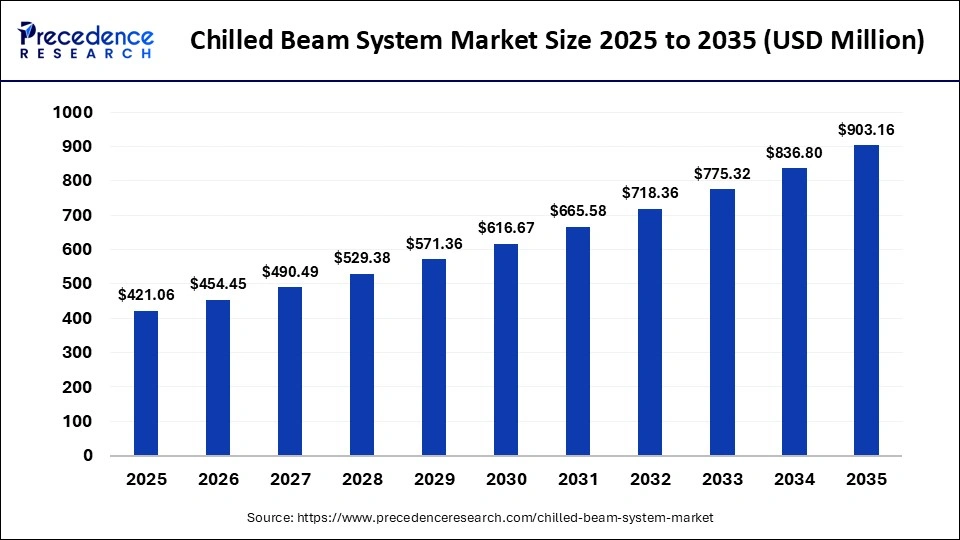
Key Takeaways
- North America held the largest share of the chilled beam system market in 2025.
- Asia Pacific is expected to expand at the fastest CAGR in the upcoming period.
- By design, the active chilled beams segment held the largest market share in 2025.
- By design, the passive chilled beams segment is expected to grow at the fastest CAGR between 2026 and 2035.
- By function, the cooling only segment contributed the biggest revenue share in the market in 2025.
- By function, the cooling and heating segment is expected to expand at the fastest growth rate between 2026 and 2035.
- By application, the commercial offices segment held a dominant market share in 2025.
- By application, the hotes applications segment is expected to grow at the highest CAGR from 2026 to 2035.
Market Overview
Chilled beam systems are versatile systems that are capable of both heating and cooling a large space simultaneously at a superior level. By utilizing radiant cooling or reduced induction airflow, this technology eliminates the noisy, drafty environment often created by a Variable Air Volume (VAV) system. There are mainly three types of chilled beam systems, including active chilled beams, passive chilled beams, and multi-service chilled beams. Chilled beams are well-suited for buildings with high sensible loads and stringent comfort requirements like office buildings, classrooms and libraries, healthcare facilities, and laboratories.
How is AI Impacting the Growth of the Chilled Beam System Market?
In the rapidly evolving technological landscape, the integration of Artificial Intelligence (AI) emerges as a game changer and is significantly accelerating the growth of the chilled beam system market. AI-driven chilled beam system optimizes energy efficiency, improves occupant comfort, and enables proactive maintenance. AI also facilitates the installation of chilled beam technology in existing buildings, allowing older structures to meet stringent energy efficiency regulations. AI-powered systems can automatically adjust to reduce air-based contaminants and maintain optimal Indoor Air Quality (IAQ).
By leveraging machine learning, chilled beams accurately analyze occupancy patterns, weather forecasts, and internal loads to dynamically adjust cooling outputs in real-time. AI algorithms analyze real-time data from sensors to detect potential issues before they occur, minimizing downtime, extending the lifespan of components, reducing maintenance costs, and enhancing operational efficiency.
What are the Emerging Trends in the Market?
- The growing focus on reducing carbon emissions is expected to accelerate the growth of the market during the forecast period. Chilled beam technology offers one of the best ways to reduce a building's carbon footprint while improving occupant comfort.
- The rapid urbanization, rising electricity costs, and the rising desire for improved indoor comfort are anticipated to promote the market's growth during the forecast period.
- The rapid growth of multiservice chilled beams is anticipated to drive the market's expansion in the coming years. Multiservice chilled beams are advanced and prefabricated HVAC units that combine conventional water-driven cooling and heating functionality with various other building services within a single unit. Multiservice chilled beams are designed as "all-in-one" units, integrating lighting, sensors, and other services into the HVAC unit.
- The increasing adoption of sustainable building projects is expected to contribute to the overall growth of the market. Chilled beam systems are highly preferred for LEED and IGBC certifications, particularly in countries where commercial real estate is growing rapidly.
- The rising construction of commercial buildings, such as high-end office spaces, healthcare facilities, and schools, requires precise temperature regulation, low noise, and improved indoor air quality, which are anticipated to bolster the market's growth in the coming years.
Market Scope
| Report Coverage | Details |
| Market Size in 2025 | USD 421.06 Million |
| Market Size in 2026 | USD 454.45 Million |
| Market Size by 2035 | USD 903.16 Million |
| Market Growth Rate from 2026 to 2035 | CAGR of 7.93% |
| Dominating Region | North America |
| Fastest Growing Region | Asia Pacific |
| Base Year | 2025 |
| Forecast Period | 2026 to 2035 |
| Segments Covered | Design, Function, Application, and Region |
| Regions Covered | North America, Europe, Asia-Pacific, Latin America, and Middle East & Africa |
Segment Insights
Design Insights
What Made Active Chilled Beams the Dominant Segment in the Market?
The active chilled beams segment dominated the chilled beam system market with the largest share in 2025. The segment's dominance is attributed to the increasing demand for energy-efficient HVAC solutions, stringent green building norms, and growing focus on superior indoor air quality (IAQ). Active chilled beams have a primary air supply and include a fin-and-tube heat exchanger housed within the ductwork. This system operates by utilizing a combination of convective and radiant cooling principles to efficiently cool throughout the space. People often use them for sensible heating, cooling, and ventilation of large and small spaces. In addition, the active chilled beams system provides high thermal comfort with low maintenance, reduced fan power, and quiet operation in commercial buildings, which drives the growth of the segment.
The passive chilled beams segment is expected to grow at the fastest CAGR between 2026 and 2035, owing to the rising need for energy-efficient HVAC solutions and rapid commercial real estate development. Passive chilled beams do not have ductwork; they include a suspended fin-and-tube heat exchanger with tubes for chilled water flow. A passive chilled beam is an HVAC system component that cools a space without requiring a dedicated air supply. This system operates silently and efficiently, as it does not require a separate air supply. Their rising integration into various ceiling or architectural designs makes them aesthetically pleasing and unobtrusive.
Function Insights
Why Did the Cooling Only Segment Dominate the Chilled Beam System Market?
The cooling only segment contributed the highest market share of 52% in 2025. The segment dominance is attributed to its high energy efficiency, improved indoor air quality (IAQ), and low maintenance requirements. The rapid urbanization, along with rising construction in hot and humid climates, has significantly driven demand for dedicated cooling solutions. Cooling-only chilled beams utilize water for sensible cooling, supporting the global push towards sustainable green building certifications like LEED. Cooling-only units are widely adopted in laboratories, healthcare facilities, and schools seeking to reduce airborne risks.
The cooling and heating segment is expected to expand at the fastest rate from 2026 to 2035, owing to the growing demand for versatile and energy-efficient HVAC solutions capable of providing year-round climate control in healthcare, commercial, and educational buildings. By efficiently integrating both functions into a single unit, it simplifies HVAC design, which lowers operating costs and assists in aligning with global sustainability goals. Cooling and heating functionality enables superior energy efficiency compared to conventional HVAC systems. Moreover, the stringent government regulations regarding environmental standards often incentivize developers to adopt the cooling and heating (dual-functionality), which saves more energy over traditional forced-air systems.
Application Insights
How Do Commercial Offices Segment Dominate the Market?
The commercial offices segment dominated the chilled beam system market in 2025. The segment's dominance is mainly driven by the rising trend of urbanization in developing economies and the growing demand for energy-efficient, quiet, and sustainable HVAC solutions in commercial offices. Chilled beam systems are extensively adopted in modern commercial buildings as they provide superior thermal comfort with low-velocity air distribution, quiet operation, reduced draft risk, and better indoor air quality (IAQ), which improves occupant comfort and productivity.
The hotels segment is expected to witness the fastest growth in the market over the forecast period, owing to the increasing need for high energy-efficient, quiet, and low-maintenance HVAC solutions. The growing demand for personalized comfort with low noise and the rising need to comply with green building certifications in hotels are driving the growth of the segment during the forecast period. The rising modernization of older hotels, which often have limited ceiling space, highly prefers the compact and sleek design of active chilled beams. Moreover, the rising integration with smart technology like smart controls, IoT, and AI-enabled systems allows for optimizing performance and enhancing energy savings, driving its adoption in hotels.
Regional Insights
What Made North America the Leading Region in the Chilled Beam System Market?
North America dominated the chilled beam system market, holding the largest share in 2025. The region's dominance is attributed to the presence of robust manufacturing industries and stringent environmental standards, which increase the adoption rates of advanced and energy-efficient building systems. The region is experiencing a strong shift toward LEED-certified and sustainable buildings in commercial, healthcare, and educational sectors, which spurs the demand for chilled beams in the region. The significant investment in hospitals, laboratories, schools, and office construction in the region often requires high-quality air handling and a precise temperature control system. Additionally, the rapid technological innovation in active chilled beams has improved high cooling capacity with lower operational costs and improved indoor air quality.
U.S. Chilled Beam System Market Analysis
The U.S. holds a substantial share of the market and is the major contributor to the market in North America. The stringent building codes in the U.S. promote energy-saving HVAC technologies, lowering dependency on conventional and high-energy systems. The country is home to leading market players such as Johnson Controls, Titus HVAC, AirFixture, LLC, Nuclimate Air Quality Systems, Inc., Dadanco, TWA Panel Systems, Inc., Mestek Inc., and others. These companies are focusing on developing and offering advanced active, passive, and multi-service chilled beam systems.
These companies also heavily benefit from the increasing demand for energy-efficient solutions and LEED-certified building standards in the country. Moreover, the rising integration with smart technology, such as Building Management Systems (BMS) and IoT sensors, allows for demand-based cooling and reduced operational costs, driving its adoption in commercial buildings.
How is the Opportunistic Rise of Asia Pacific in the Chilled Beam System Market?
Asia Pacific is expected to grow at the fastest CAGR in the market during the forecast period. The region's growth is attributed to the rapid urbanization, the rising demand for superior thermal comfort, the growing need for high energy efficiency, and sustainability in commercial buildings. The region is experiencing significant investment in smart city initiatives, which boosts the integration of advanced technologies and automated cooling solutions in the region. In addition, strict energy regulations, along with the rising need to reduce operational costs, are expected to accelerate the adoption of energy-saving HVAC technologies like chilled beam systems in commercial buildings and healthcare facilities, including hotels, offices, schools, and laboratories, which are anticipated to drive the growth of the market in the region.
China Chilled Beam System Market Analysis
The market in China is driven by a strong presence of global HVAC leaders and local manufacturers, which allows for rapid adoption of the chilled beam system. The government is strictly implementing environmental and energy conservation codes, encouraging or mandating the adoption of energy-efficient systems. The growth of the market in the country is supported by the rapid urbanization & industrialization, growing awareness about environmental sustainability, significant investment in construction, rising integration of smart technology, and the growing demand for energy-efficient cooling solutions across various sectors, including healthcare facilities, educational institutes, commercial offices, and hotels.
Chilled Beam System Market Supply Chain Analysis
- Raw Material and Component Supply
At the beginning of the value chain, basic materials such as aluminum, copper, steel, and plastics, along with components like coils, nozzles, heat exchangers, and hydronic parts, are sourced from material suppliers.
Key Players: TROX GmbH, Halton Group, and FläktGroup
- Manufacturing and System Integration
This stage involves the production, assembly, and integration of chilled beam units, where raw materials and components are turned into finished products.
Key Players: TROX GmbH, Swegon Group AB, Lindab and Flakt Woods
- Distribution and Sales Channels
After production, chilled beams move through distribution networks that include direct sales to developers, HVAC installers, and building contractors, as well as through authorized HVAC distributors and system integrators.
Key Players: Johnson Controls, Systemair AB, and Price Industries
Chilled Beam System Market Companies
- EB AIR CONTROL INC.
- FTF Group
- Level Solutions Group
- Halton Group
- Fläkt Woods
- Temperature Equipment Corporation (TEC)
- TROX GmbH
- Dadanco
- Arbonia
- Krantz Systems
- Aermec (UK)
- AirFixture, LLC
- Swegon Group AB
Recent Developments
- In June 2024, Jaga Climate Systems announced the launch of the Astra Beam active chilled beam system. This Astra Beam is an innovative non-ducted fan coil. The Astra Beam harnesses the power of chilled water to extract heat from the indoor air, ensuring a consistently comfortable temperature without noise, hefty energy bills, or carbon footprint. (Source: https://www.pmmag.com)
- In February 2025, Swegon announced the signing of an agreement to acquire American Geothermal, a U.S.-based manufacturer of heating and cooling systems for the concrete industry, as well as heat pumps and chillers for the healthcare, commercial, industrial, and institutional sectors. American Geothermal has a strong position in the production of water heating and cooling equipment for the concrete industry. This expertise has enabled the development of the ChillMaster range, a line of heat pumps and chillers designed for the commercial and industrial HVAC market.(Source: https://www.blueboxcooling.com)
Segments Covered in the Report
By Design
- Active Chilled Beams
- Passive Chilled Beams
- Multi-Service Chilled Beams
By Function
- Cooling Only
- Cooling and Heating
By Application
- Commercial Offices
- Educational Institutions
- Healthcare Facilities
- Hotels
- Others
By Region
- North America
- Latin America
- Europe
- Asia-pacific
- Middle and East Africa
For inquiries regarding discounts, bulk purchases, or customization requests, please contact us at sales@precedenceresearch.com
Frequently Asked Questions
Tags





Ask For Sample
No cookie-cutter, only authentic analysis – take the 1st step to become a Precedence Research client
 Get a Sample




 sales@precedenceresearch.com
 Schedule a Meeting
