






 Request Consultation
Cloud computing is transforming healthcare through secure data management, AI integration, telemedicine, and scalable digital infrastructure solutions.
Healthcare Cloud Computing Market
The Growing Role of Cloud Computing in Modern Healthcare
Healthcare is shifting slowly towards technological advancement. After the COVID – 19 pandemic, healthcare facilities are significantly adopting cloud computing in the healthcare industry. Hospitals, clinics, and research institutions are moving away from traditional, on-premises systems and adopting cloud computing to manage data, streamline operations, and improve patient outcomes.
This blog helps to understand how cloud computing is reshaping the healthcare industry, its benefits, challenges, and future innovations.
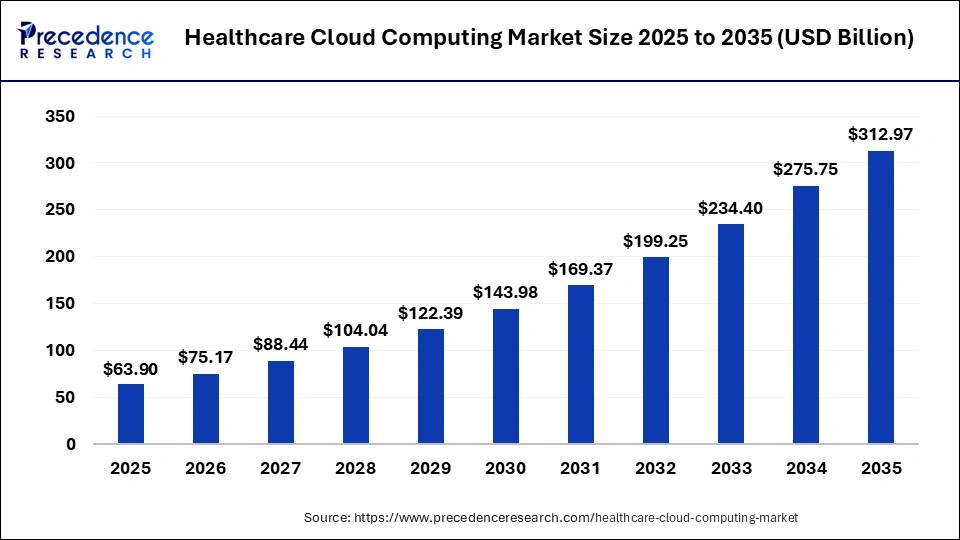
Healthcare Cloud Computing Market Size 2026 to 2035
The global healthcare cloud computing market is experiencing significant expansion worldwide. Valued at USD 63.9 billion in 2025, the market is expected to reach around USD 312.97 billion by 2035, growing at a strong CAGR of 17.22% between 2026 and 2035.
Get a Free Sample Report with Key Market Trends: https://www.precedenceresearch.com/sample/1081
Understanding Cloud Computing in Healthcare
Cloud computing in healthcare refers to the on-demand delivery of computing resources, such as storage, networking, servers, and software applications, over the internet. Instead of keeping everything on local computers or hospital servers, healthcare organizations can adopt secure cloud-hosted medical IT services. It allows healthcare providers to access healthcare information anytime, from anywhere, while maintaining a high level of security and compliance. Cloud computing offers three primary service models : Infrastructure as a Service (IaaS), Platform as a Service (PaaS), and Software as a Service (SaaS). These models support patient record storage, advanced analytics, and telemedicine platforms.
- For example, Electronic Health Records (EHRs), once stored in a physical file or local systems, are commonly hosted on cloud platforms. This allows doctors to securely access patient history instantly, even if the patient has visited multiple facilities in different locations.
Cloud systems also support interoperability, which means different healthcare systems can communicate with each other more efficiently.
Key Benefits of Healthcare Cloud Computing
Cloud computing in healthcare is transforming the healthcare industry.
Improved Accessibility and Collaboration – One of the most highlighted advantages of cloud computing is accessibility. Healthcare professionals can securely access patient data from virtually anywhere, whether they are in the hospital, at a clinic, or consulting remotely. The easy access improves collaboration among doctors, specialists, and care teams. The patient data can be shared virtually in real time for review and treatment, making an informed decision. This improves patient engagement and minimizes duplicate tests.
Cost Efficiency – Traditional IT infrastructure requires significant investment in hardware, software, and maintenance. Cloud computing reduces these charges by offering a pay-as-you-go model. Healthcare organizations only pay for the resources they use. This is particularly helpful for smaller clinics and startups, which may not have a budget for a large-scale IT setup but need reliable and secure data management.
Enhanced Data Security – The healthcare industry deals with a massive amount of patient data, which is highly sensitive. There is a risk of data breaches and cyber attacks, hence data protection must be a priority. Cloud providers invest heavily in advanced security measures, including end-to-end encryption, multi-factor authentication, advanced firewalls, and continuous monitoring to protect patient data. They also ensure compliance with healthcare regulations and standards like HIPAA (Health Insurance Portability and Accountability Act) in the United States and GDPR (General Data Protection Regulation) in Europe. Scalability and Flexibility – Cloud systems can easily scale up or down depending on needs. Healthcare needs can change during the pandemic and seasonal surges, where hospitals need to handle a sudden increase in patient data and system usage. This flexibility helps to remain efficient during peak demand, which is not provided by physical on-site servers.
Support for Advanced Technologies – The cloud platform supports integration of advanced technologies such as artificial intelligence (AI), machine learning (ML), and big data analytics. These tools can help in early disease detection, predictive analysis, personalized treatment plans, and real-time clinical decision making. Also, AI can analyse large datasets to identify patterns that may not be visible manually.
Applications of Cloud Computing in Healthcare
In healthcare, the application of cloud computing is in multiple domains, transforming the ways how medical services are delivered and managed.
Electronic Health Records (EHRs) – Cloud-based EHR systems allow secure storage, retrieval, and management of health records, making patient records securely accessible to authorized healthcare providers anytime and anywhere. Cloud EHRs also simplify updates and facilitate interoperability between different healthcare systems, which leads to improved treatment outcomes and optimized patient data management.
- For example, Kaiser Permanente - uses cloud based EHRs to enhance patient care coordination across its network.
Telemedicine and Virtual Care – Cloud computing supported the wide adoption of telemedicine, allowing remote consultations, virtual follow-ups, and remote diagnosis. Patients can now consult doctors without visiting a hospital, which is especially helpful for rural or underserved areas, while reducing travel and waiting time.
- For example, Teladoc Health and the Cleveland Clinic use cloud computing to provide telemedicine services.
Remote Patient Monitoring (RPM) – Medical devices equipped with IoT and sensors help to monitor and collect patient health data like vital signs, chronic conditions, and post-operative recovery in real time. Cloud platform stores and processes this data, allowing healthcare providers to track patient health. This approach is useful for managing chronic conditions such as diabetes and hypertension.
- For example, Apple Watch and Fitbit use cloud based IoT technology to monitor heart rate, oxygen levels, and sleep patterns.
Medical Imaging and Diagnostics – Cloud storage allows storing and processing high resolution medical images such as X-rays, MRIs, and CT scans. Healthcare providers can easily access these images quickly and even share them securely with specialists, enabling collaborative diagnostics for more accurate results.
- For example, Google Health and NetApp provide AI-driven diagnostic tools that help radiologists to detect tumours.
Data Analytics – Healthcare organisations generate a vast amount of data. Cloud computing enables analysis of this data to improve patient care, optimise operations and reduce costs. Healthcare organisations can leverage cloud computing to aggregate and analyse data from multiple sources, such as EHRs and wearables, to identify at-risk populations, monitor trends, and design targeted interventions.
Recent Developments in Healthcare Cloud Computing
- Oracle Health launched the Oracle AI Center of Excellence for Healthcare to help organisations take advantage of advances in artificial intelligence. This AI center provides resources and experts that will help health systems and hospitals to deploy AI across their organisation. This initiative highlights a growing shift towards cloud platforms usage in advanced technologies, enabling hospitals to adopt AI more confidently and deliver more efficient patient care.
- Collective Health collaborated with Google Cloud to launch a new AI-powered system called Collective AI. This new AI system helps members navigate benefits and streamlines plan administration for employers. The collaboration with Google Cloud provides technology infrastructure and allows Collective AI to run smoothly in a healthcare setting. The Collective AI was built using a privacy-by-design framework, which ensures employee health data is protected.
- Healthcare companies moved their virtual desktop infrastructure from on-premise systems to Amazon Web Services, using services like Amazon WorkSpaces and Amazon AppStream 2.0. This shift allowed the organisation to provide thousands of users with faster and more reliable access to applications and resources. This results in improved work efficiency, resolution of technical issues proactively and reducing overall operation costs while maintaining security standards.
- Oracle Health launched a next generation electronic health record (EHR) solution built with agentic artificial intelligence and voice capabilities. The new HER system is trained on clinical concepts, including conditions, lab results, medications, and care pathways. This allows AI agents to interpret clinical meaning more accurately. This tool will be available for ambulatory providers in the United States.
- A Virginia-based health system, Sentara Health, operates multiple hospitals, medical groups, and other care facilities, and is migrating its EHR systems to the cloud – Epic on Microsoft Azure. Sentara Health launched a joint venture called OptaFi, which offers best practices and technical capabilities for moving Epic workloads from on-premise to the cloud.
Challenges in adopting Cloud Computing
While cloud computing for healthcare offers various advantages, the technology also comes with significant risks and challenges.
Data Security and Privacy concerns
- The healthcare data is extremely sensitive; handling such data on cloud solutions raises security and privacy concerns. Organisations must ensure that their cloud providers comply with strict data protection regulations. The patient data must remain confidential, while sharing among healthcare professionals is also a challenge.
Integration with Existing IT Infrastructure
- Many healthcare facilities are still using traditional on-premises IT infrastructure systems. The integration of cloud computing into existing systems can be very difficult. Transitioning to cloud computing required planning to avoid the disruption.
Downtime and Service Disruptions
- The cloud system is highly reliable, but during downtime and service disruption, it affects access to critical applications and data. Healthcare providers must have contingency plans to ensure continuous access to critical data.
Regulatory Compliance
- Healthcare is a highly regulated industry. Organisations must ensure that the cloud system they are using meets all regulatory compliance requirements.
The Future of Healthcare Cloud Computing
The future of healthcare is linked to cloud computing, and technological advances will continue to play a central role. As more healthcare organisations understand the benefits of cloud computing, they will increasingly adopt hybrid and multi-cloud strategies for optimized performance and cost effectiveness. Over the time, smaller clinics and healthcare facilities will also adopt cloud computing and deliver high-quality healthcare services.
As technology evolves, we can expect more seamless integration of artificial intelligence and machine learning for personalized diagnostics and predictive analytics, while the proliferation of IoT services will enable real-time health monitoring. The integration of edge computing will enhance cloud capabilities by processing data closer to its source. This will reduce latency and improve response times, particularly in critical care solutions.
Conclusion
Cloud computing in healthcare is transforming the way healthcare services are delivered, managed, and optimised by enabling better data management, improving collaboration, and supporting advanced technologies. At the same time, challenges such as data security and regulatory compliance must be addressed efficiently to maximise the benefits of cloud computing. As healthcare continues to evolve, cloud computing will remain the key driver of innovation to deliver high-quality services.
About the Authors

Aditi Shivarkar
Aditi, Vice President at Precedence Research, brings over 15 years of expertise at the intersection of technology, innovation, and strategic market intelligence. A visionary leader, she excels in transforming complex data into actionable insights that empower businesses to thrive in dynamic markets. Her leadership combines analytical precision with forward-thinking strategy, driving measurable growth, competitive advantage, and lasting impact across industries.



Aman Singh
Aman Singh with over 13 years of progressive expertise at the intersection of technology, innovation, and strategic market intelligence, Aman Singh stands as a leading authority in global research and consulting. Renowned for his ability to decode complex technological transformations, he provides forward-looking insights that drive strategic decision-making. At Precedence Research, Aman leads a global team of analysts, fostering a culture of research excellence, analytical precision, and visionary thinking.

Piyush Pawar
Piyush Pawar brings over a decade of experience as Senior Manager, Sales & Business Growth, acting as the essential liaison between clients and our research authors. He translates sophisticated insights into practical strategies, ensuring client objectives are met with precision. Piyush’s expertise in market dynamics, relationship management, and strategic execution enables organizations to leverage intelligence effectively, achieving operational excellence, innovation, and sustained growth.