






 Request Consultation
Discover how gas turbines generate power, their advantages, applications, and latest innovations driving modern energy and industrial systems.
Gas turbines are one of the most important machines that are used in today's industrial and energy sectors. From generating electricity in large scale power plants to powering aircraft and supporting oil and gas refineries, gas turbines remain the cornerstone of modern engineering. Their ability to deliver high power output with rapid start-up makes them important in a world that increasingly demands reliability.
What is the Gas Turbine Market Size?
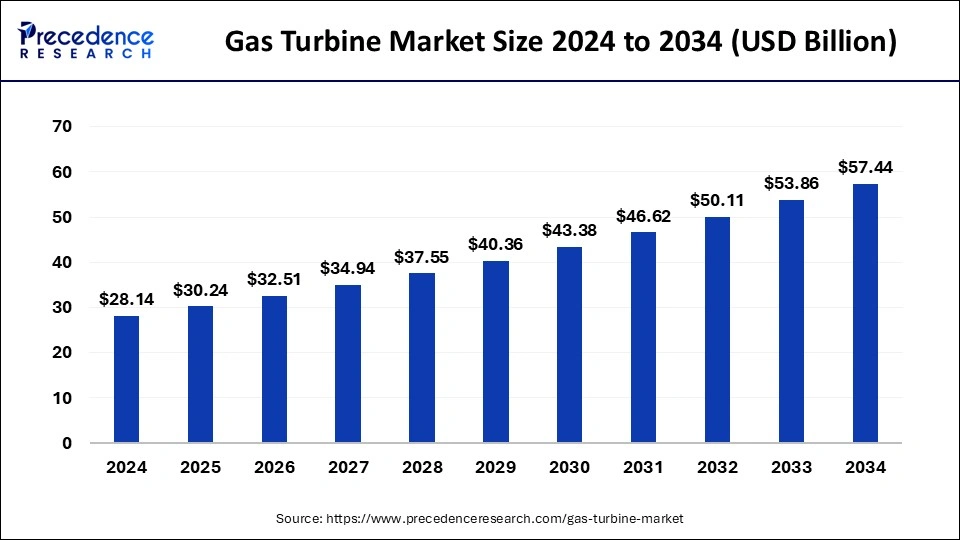
The global gas turbine market size surpassed USD 30.24 billion in 2025 and is estimated to increase from USD 32.51 billion in 2026 to approximately USD 61.13 billion by 2035, rugistuiring a CAGR of 7.29% between 2026 and 2035.
Understanding the Basics of a Gas Turbine
A gas turbine is a machine that produces mechanical energy from natural gas using controlled combustion. The mechanical energy will rotate the generators, and electricity will be produced. The gas turbines consist of three main components – the compressor, the combustion chamber, and the turbine. The mechanism of a gas turbine is as follows: first, air is pulled in by the compressor and compressed. The compressed air is mixed with fuel – usually natural gas or liquid fuels and burned in a combustion chamber. The resulting high temperature, high pressured gases expand and spin the turbine blades. The rotation generates mechanical energy, which is then used to run equipment like generators, compressors, or pumps. These turbines are more efficient, run smoothly and continuously, unlike the reciprocating engines that operate in cycles. This is why gas turbines are preferred in large scale and high speed operations where smooth running is required.
Advantages of Gas Turbines
Gas turbines offer several advantages that make them the preferred choice across industries. The main advantage of the gas turbines is high energy efficiency due to the cogeneration process. Cogeneration or combined heat and power (CHP) is the process in which two types of energy, electrical energy and heat, are produced at once. The waste heat from turbines is used for heating and other industrial processes. This combined generation of energies gives system efficiency and reduces energy waste.
Gas turbines have a high power to weight ratio compared to other power generation technologies. They can produce a large amount of power without occupying much space. This is suitable for applications like aircraft and ships, where space is limited.
Another advantage is their fast start-up capability. Gas turbines can reach full power output within minutes, making them ideal for meeting peak electricity demand or providing backup power during outages.
Gas turbines are also known for lower emissions compared to other power generation technologies. Advanced combustion technology produces lower emissions of sulphur dioxide (SO2), nitrogen oxides (NOx), and particulate matter, making gas turbines more environmentally friendly.
Gas turbines can operate on a wide range of fuels such as natural gas, diesel, and various fuels. This flexibility in fuels supports the adaptation to changing availability or price fluctuations.
Challenges and Limitations
Gas turbines offer many advantages, but some challenges remain. One of the primary concerns is their efficiency at partial loads. This means they perform well at full capacity when loads are at maximum capacity, but their efficiency drops when operating below their maximum capacity. This can be a limitation where demand fluctuates frequently. This results in high fuel consumption and reduced cost-effectiveness.
Another challenge is the high initial cost for installing gas turbine systems, especially for large units. Gas turbines require high investments in both equipment and infrastructure. The materials used in gas turbines must withstand high temperature and pressure, which also increases cost and manufacturing complexity. This can be a significant barrier to the adoption of gas turbines in energy production.
Gas turbines require regular maintenance and servicing to ensure optimal performance and reliability. Maintenance includes cleaning, periodic inspections, and repair or replacement of components. The maintenance cost and downtime may impact the operational efficiency and productivity.
The environmental impact is another challenge of gas turbines. The combustion of fossil fuels emits carbon dioxide, which contributes to climate change. Also, the gas turbines generate significant noise and vibrations during operations, which negatively affect the surrounding environments.
Technological Advancement in Gas Turbines
The advancement in gas turbine technology is driving improvement in productivity, efficiency, and sustainability. Innovation in manufacturing processes, materials, digital technologies, combustion methods, and aerodynamics is reshaping the gas turbine industry.
Advanced material and coating – the gas turbines operate under extreme conditions, such as high temperature and pressure. The materials and coating should be designed to operate under such conditions to maintain efficiency. The superalloy made of nickel can be used to make turbine parts as it can stay strong and stable at high pressure. The thermal barrier coating (TBCs) is also used to protect components from extreme heat. TBCs are the ceramic coatings that keep metal cooler.
Digital monitoring and control systems have also transformed gas turbine operations. A digital twin is a simulation of physical gas turbines under various conditions. By using a digital twin, an operator can monitor and analyse turbine performance in real-time and can also identify potential issues. Another digital advancement is predictive maintenance. Predictive maintenance algorithms help in scheduling maintenance, reducing downtime and maintenance cost. This also extends the lifespan of the equipment.
The integration of renewable energy is another area of innovation. Gas turbines are increasingly using hybrid systems that combine gas turbines with renewable energy sources such as solar and wind power systems. The integration of energy storage solutions, such as batteries or thermal storage, can store excess energy. This approach ensures optimal usage and improves overall system efficiency.
The innovation in combustion technology helps in enhancing efficiency and minimising environmental impact. The low-Nox combustion, the traditional combustion process, produces nitrogen oxides, which are harmful pollutants. The new low-NOx combustors were developed to minimize the production of NOx without compromising performance. Another technology is hydrogen combustion. Hydrogen is emerging as a potential fuel for gas turbines. Hydrogen combustion produces only water vapour as a byproduct and eliminates CO2 emissions. Researchers and manufacturers are working on technologies that allow turbines to run on hydrogen.
Aerodynamics and blade design advancement support improvement in turbine productivity. The advanced blade cooling designs are important because turbine blades are exposed to extremely high temperatures. The blade cooling techniques, such as film cooling and internal cooling channels, help in maintaining blade performance in extreme conditions. The use of computational fluid dynamics (CFD) and 3D printing allows aerodynamically optimized blade designs. This design improves air flow and reduces energy loss.
Applications Across Industries
Gas turbines are used across a wide range of industries.
- In the power generation sector, gas turbines are used in both simple cycle and combined cycle for electricity generation. Due to fast start up time, single cycle plants are often used for peak power demand. In combined cycle plants, waste heat is used to produce steam and is widely used due to its high efficiency.
- The aviation industry heavily relies on gas turbines in the form of jet engines. These engines provide the thrust needed for the aircraft. Turbofan engines are widely used in commercial airlines, turboprop engines are used in smaller aircraft to provide efficiency at lower speeds and for short distances, and turboshaft engines are used in helicopters. Continuous advancement in gas turbines provides high thrust, reliability, and efficiency.
- In the oil and gas industry, gas turbines are used to drive equipment like compressors, pumps, and generators. They play an important role in transporting natural gas through pipelines over long distances and supporting drilling operations. Their reliability and ability to operate in harsh environment makes them suitable for application in the oil and gas industries.
- Manufacturing industries also use gas turbines for combined heat and power (CHP) or cogeneration. In these setups, the turbines produce electrical energy and waste heat that is used for heating or other industrial operations. This is used in industries such as chemicals, pharmaceuticals, paper mills, and refineries, where both power and heat are needed.
- For emergency power and backup generators, gas turbines offer fast startups, the ability to produce a large amount of power in a short time and are highly reliable. This makes them ideal for emergency applications in hospitals, data centres and power plants for energy backups.
Real-world Examples
- The Japanese companies Kawasaki Heavy Industries and Kobe Steel launched a new hydrogen fuel supply system designed for power generation. This new facility is the first system in the world capable of supplying hydrogen fuel to a power plant using a combination of an Intermediate Fluid Vaporizer (IFV) and a high-pressure liquid hydrogen pump. This launch aims to improve the technology for building a reliable hydrogen supply chain.
- China launched the world’s first 30 megawatt-class pure hydrogen gas turbine called “Jupiter I”. It is the world's largest single-unit pure hydrogen gas turbine for power generation. The gas turbines can reduce carbon emissions compared to conventional thermal power units of the same capacity.
- UK-based power systems developer Rolls-Royce launched new modular solutions for gas engine power plants. This supports and accelerates the implementation of the German government’s Power Plant strategy, moving the country toward 80% renewable electricity. The engines are designed to provide backup power during low wind and low sunlight, and also act as bridging solutions.
- Boom Supersonic introduced a natural gas turbine designed to meet the rising electricity needs of AI data centres. The superpower turbines are based on Symphony engine architecture. These new turbines can maintain their outputs in extreme heat without the requirement of water for cooling, which reduces the cost.
Conclusion
Gas turbines are powerful and efficient engines that play a critical role in modern power generation and industrial systems. Their ability to deliver high power output efficiency and adapt to various applications makes them a reliable choice for a wide range of uses. As energy demands grow and industries continue to grow, gas turbines will remain a key element in innovation and supporting both economic growth and the shift towards cleaner energy solutions.
About the Authors

Aditi Shivarkar
Aditi, Vice President at Precedence Research, brings over 15 years of expertise at the intersection of technology, innovation, and strategic market intelligence. A visionary leader, she excels in transforming complex data into actionable insights that empower businesses to thrive in dynamic markets. Her leadership combines analytical precision with forward-thinking strategy, driving measurable growth, competitive advantage, and lasting impact across industries.



Aman Singh
Aman Singh with over 13 years of progressive expertise at the intersection of technology, innovation, and strategic market intelligence, Aman Singh stands as a leading authority in global research and consulting. Renowned for his ability to decode complex technological transformations, he provides forward-looking insights that drive strategic decision-making. At Precedence Research, Aman leads a global team of analysts, fostering a culture of research excellence, analytical precision, and visionary thinking.

Piyush Pawar
Piyush Pawar brings over a decade of experience as Senior Manager, Sales & Business Growth, acting as the essential liaison between clients and our research authors. He translates sophisticated insights into practical strategies, ensuring client objectives are met with precision. Piyush’s expertise in market dynamics, relationship management, and strategic execution enables organizations to leverage intelligence effectively, achieving operational excellence, innovation, and sustained growth.