






 Request Consultation
Explore how streaming platforms, AI, and short-form video are transforming how people watch, learn, and engage with content globally.
How Video Streaming is Transforming Content Consumption Habits?
Nowadays, the way of video consumption by people consume video has changed dramatically. As online media grows, video streaming has become a hub for digital entertainment, education, marketing, and communication, transforming how content is delivered and experienced. This shift is occurring due to ongoing advancements in internet infrastructure, cloud computing, and technologies.
Video streaming refers to the process of delivering video content, such as movies, TV shows, and live broadcasts, over the internet without the need for downloading full media files on the device. This approach eliminates delays and reduces storage dependency on devices. Video streaming offers smooth delivery and continuous playback of short as well as long-format videos when provided with a stable internet connection.
Video streaming has two types: live streaming and real-time broadcasting of events such as webinars, sports matches, or live shows. And on-demand streaming- previously recorded videos that users can watch anytime, such as movies, series, and tutorials.
What is the Unmanned Aerial Vehicle (UAV) Drones Market Size?
The global video streaming market size surpassed USD 159.98 billion in 2025 and is estimated to increase from USD 195.85 billion in 2026 to approximately USD 873.21 billion by 2035, rugistuiring a CAGR of 18.5% between 2026 and 2035.
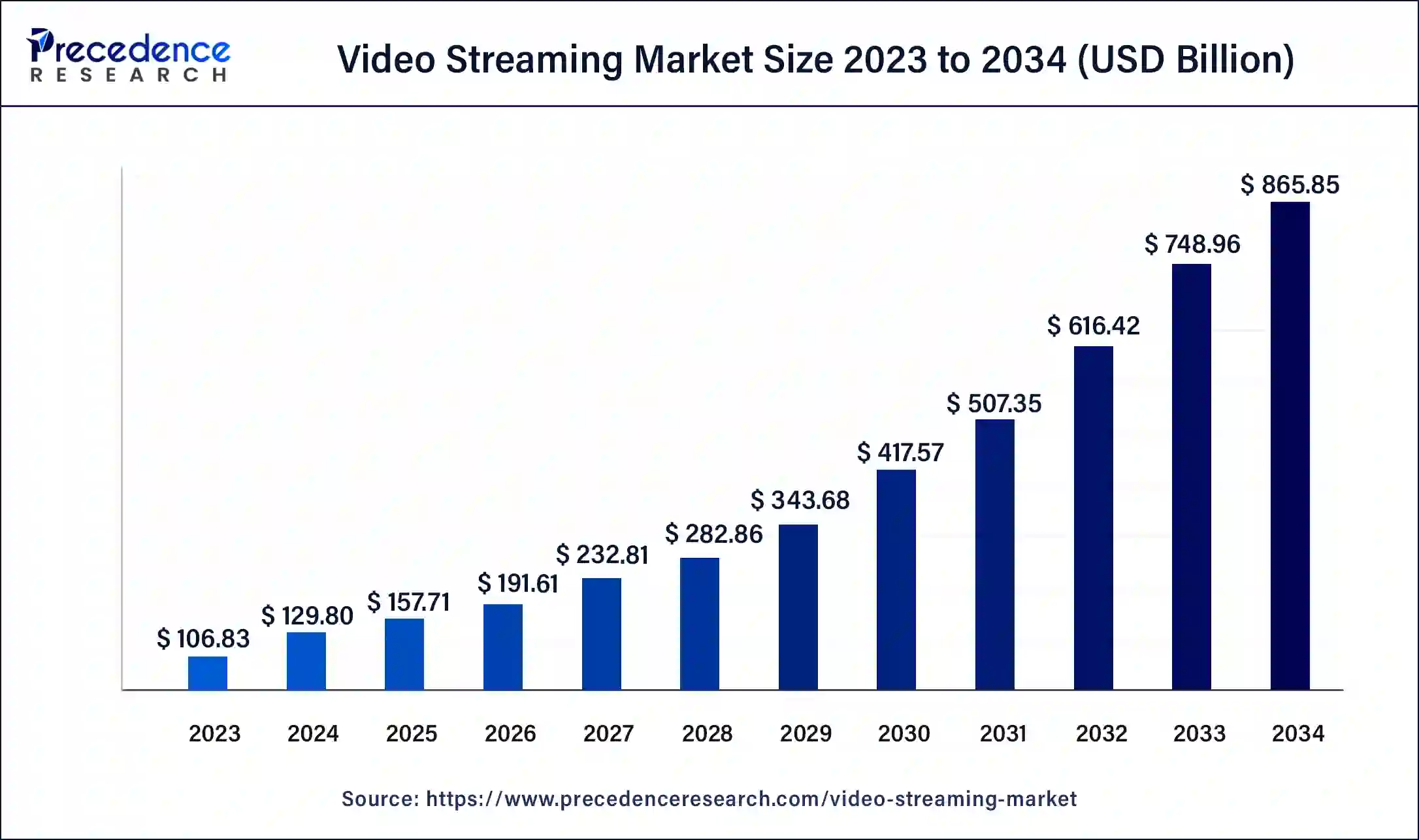
Understanding the Difference Between Video Streaming and Downloading
The main difference between video streaming and downloading is the way it brings to the users. Video streaming is the continuous transmission of audio and video to the user over the internet. The content watched on video streaming is not stored in the device. Video streaming requires an internet connection. It is a better option for immediate consumption of content and also gives a wide variety of content.
The downloading requires a complete file transfer to the device before its playback. It consumes device storage space, which allows content to be seen offline, without worrying about internet speed, as it does not require an internet connection. The downloading option is better for repeated viewing.
How Does Video Streaming Work?
Video streaming works by compressing media and breaking down the video file into small chunks called data packets. These small segments are continuously delivered from the server to the device using the internet. The player on the device converts compressed data back and begins playback in near real time without downloading the entire file. Content delivery networks are used to make streaming possible on a large scale. This network distributes data from servers closest to the user to minimise delays.
The use of adaptive bitrate streaming enhances the experience of video streaming by adjusting quality based on the user's internet speed. If the connection is weak, the resolution of the video content drops to avoid buffering, and if the internet speed improves, the quality increases automatically.
What are the Key Technologies in Video Streaming?
To keep video streaming smooth and seamless experience various technologies are used –
- Adaptive Bitrate (ABR) Streaming – ABR monitors the internet speed of the device and adjusts the video quality by switching between higher and lower resolutions to prevent buffering or lag. This provides a seamless viewing experience despite unstable or fluctuating internet speeds.
- HTTP Live Streaming (HLS) – This is developed by Apple and is currently the most used protocol on every possible device and browser, and also supports adaptive bitrate streaming. This uses HTTP servers for live or on-demand video streaming.
- Content Delivery Network (CDN) – The CDN is a network of servers distributed across different geographical locations to deliver web content more efficiently. It brings content closer to the user's location and helps in content distribution to users with minimal delay.
- Video Encoding and Codecs – video files are too large to stream efficiently; codecs compress these files into smaller sizes for transmission and then decode the file on the user's device for playback. The commonly used codecs are H.264 (AVC) and H.265 (HEVC). The AV1 is a modern, open source codec that offers superior compression efficiency.
The Role of Internet and Cloud Structure
The rise in video streaming is because of improved internet speed and easy accessibility. The high-speed broadband and mobile data made it possible to stream high-resolution content without interruptions. Cloud computing has also played a critical role. Cloud computing provides on-demand access to virtual computing resources such as storage, applications, and processing power without the need to own and build infrastructure. The use of cloud-based storage allows for scaling and handling millions of users simultaneously and delivering content globally.
What are the Major Applications of Video Streaming Across Various Industries?
- Entertainment and Media – Video streaming has transformed the entertainment and media industry. Viewers are no longer waiting for the scheduled traditional broadcasting method; due to the internet-based consumption model of video streaming, viewers can now watch anything at any time. This provides on-demand access to movies, series, and sports with major platforms like Netflix and YouTube. This has led to the rise of binge-watching and personalized content recommendations.
- Education and E-learning – Educational institutions and training centres use video streaming to deliver lectures, tutorials, and workshops. This allows students to learn at their own pace and revisit the complex topics whenever needed. The live streaming of lectures and tutorials allows interactive learning experiences. During and post-pandemic, the E-learning approach is rising due to its flexibility, cost-effectiveness, and easy accessibility.
- Corporate Communications – video streaming in corporate communication enables real-time, global internal and external stakeholders, increasing engagement through live town halls. The platforms, such as Teams and Zoom, allow efficient communication among teams, especially in remote and hybrid work environments.
- Marketing and Advertising – video is becoming a powerful tool in marketing. The brands are leveraging live or on-demand video streaming on platforms such as YouTube and social media to showcase products, promote brand services, and build trust with customers. Brands are using video streaming across a variety of digital platforms, including their own website and social media marketing. This helps in increasing the reach of products or services to the target audience.
- Gaming and E-sports – the live video streaming is significantly rising in the gaming sector. The platforms, such as Twitch and YouTube, enable gaming players to broadcast gameplay and interact with the audience in real time and build communities. These platforms opened new opportunities for gamers to show their abilities and generate revenue from gaming. Esports events streamed online are attracting millions of viewers.
Major Key Benefits of Video Streaming
The widespread adoption of video streaming is driven by the following benefits it delivers to both users and businesses.
| Major Applications | Insights |
| Convenience and Accessibility |
|
| Convenience and Accessibility |
|
| Personalization |
|
| Global Reach |
|
What are the Key Challenges in Video Streaming?
The streaming industry is stuck between rapid technological progress and tough financial situations. The following challenges need to be addressed in the video streaming world:
- Latency Issues - Delivering video content is not just about uploading a file anymore; it is about ensuring a smooth and uninterrupted experience for millions of users at the same time. In the live streaming of sports and games or streaming videos on the internet, maintaining low latency is challenging due to an unstable network.
- Scaling Cost – Growth brings its own set of challenges. As more users join a platform, the cost related to bandwidth, cloud storage, and infrastructure increases. These operational costs increased s with scale, which made it challenging to maintain profitability for smaller and emerging platforms.
- Piracy and Ad Challenges – Despite the advancement in technology, piracy remains a challenge in video streaming. Piracy can impact the revenue and waste the advertising budget. The ad- supported platforms face issues with ad-blocking tools and fraudulent traffic.
Overall, while streaming has transformed the way of content consumption, the industry is still evolving. Balancing performance, cost, and user expectation remains an ongoing challenge.
Emerging Trends in Video Streaming Industry:
The video streaming industry is evolving faster than ever. The technological innovation became a multi-dollar ecosystem covering TV, sports, education, and creator-led platforms.
- Short-Form Content – Short-form videos popularised by TikTok, Instagram Reels, and YouTube Shorts have completely changed the content consumption perspective.
This format is booming in the video streaming industry. This has changed the traditional viewing of content into interactive experiences that increase people's engagement.
- Ultra-High-Definition streaming – With the ongoing advancement in technology, the increasing availability of 4K and 8k displays, platforms are investing in higher resolution content to deliver a more immersive viewing experience
- Rise of Agentic AI – In the current time, AI has become agentic, which means it not only suggests content but also analyzes the behavior of the users. This can give a fully personalized experience.
What Kind of Future Does Video Streaming Hold?
The future of video streaming seems to be bright. As internet connectivity improves and technology advances, the boundaries between traditional broadcasting and digital streaming can continue to blur.
Virtual reality (VR) and augmented reality (AR) are transforming the way users experience digital content and play a significant role in shaping immersive streaming experiences. Artificial intelligence in video production, blockchain and video distribution, and personalised video content integration can support the evolution in video streaming.
As user expectations increase, platforms may need to focus on delivering more meaningful experiences.
Conclusion
Video streaming is transforming the way users consume video content. It has provided users with a personalized choice and flexibility for surfing the content. Video streaming is becoming an integral part and offers a combination of convenience, cost-effectiveness, and global reach in the entertainment, education, communication, and marketing sectors. As technologies such as 5G and artificial intelligence-powered tools continue to evolve, the barrier between content and consumers becomes shorter.
About the Authors

Aditi Shivarkar
Aditi, Vice President at Precedence Research, brings over 15 years of expertise at the intersection of technology, innovation, and strategic market intelligence. A visionary leader, she excels in transforming complex data into actionable insights that empower businesses to thrive in dynamic markets. Her leadership combines analytical precision with forward-thinking strategy, driving measurable growth, competitive advantage, and lasting impact across industries.



Aman Singh
Aman Singh with over 13 years of progressive expertise at the intersection of technology, innovation, and strategic market intelligence, Aman Singh stands as a leading authority in global research and consulting. Renowned for his ability to decode complex technological transformations, he provides forward-looking insights that drive strategic decision-making. At Precedence Research, Aman leads a global team of analysts, fostering a culture of research excellence, analytical precision, and visionary thinking.

Piyush Pawar
Piyush Pawar brings over a decade of experience as Senior Manager, Sales & Business Growth, acting as the essential liaison between clients and our research authors. He translates sophisticated insights into practical strategies, ensuring client objectives are met with precision. Piyush’s expertise in market dynamics, relationship management, and strategic execution enables organizations to leverage intelligence effectively, achieving operational excellence, innovation, and sustained growth.