






 Request Consultation
Explore regenerative medicine industry growth, top companies, innovations, and therapies shaping the future of healthcare and biotechnology.
What is the Significance of the Regenerative Medicine Industry?
The regenerative medicine industry is an important segment of the pharma sector. This industry deals in the production and distribution of regenerative medicines for the end-users. Regenerative medicine is a multidisciplinary field focused on replacing, repairing, or regenerating tissues, human cells, or organs to restore impaired function which are caused by disease, injury, and aging. There are various products developed in this sector comprising gene therapies, cell therapies, cell-based immunotherapy products, cord blood / progenitor cell therapies and tissue engineering products. This industry is likely to gain immense growth owing to the rapid expansion of the biotechnology sector.
What is the Regenerative Medicine Market Size?
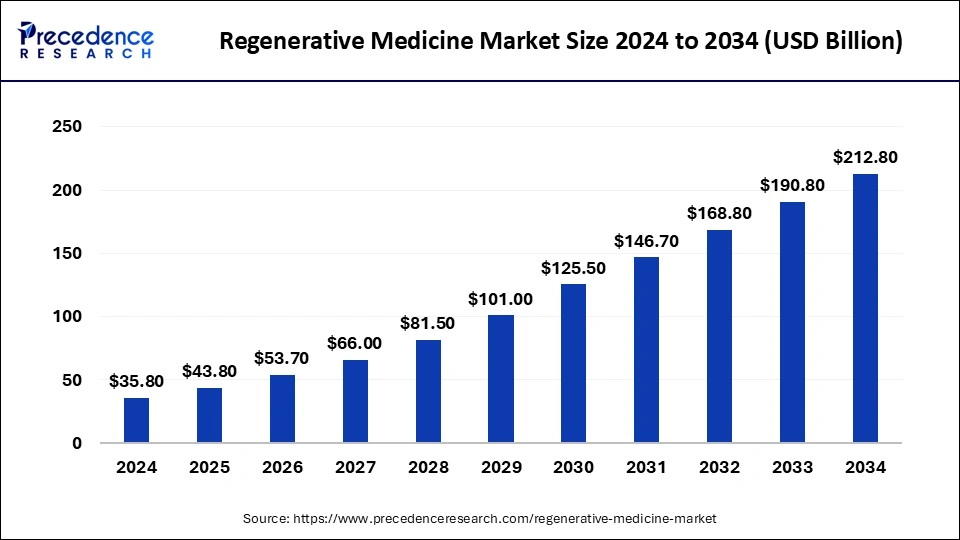
The global regenerative medicine market size surpassed USD 43.77 billion in 2025 and is estimated to increase from USD 53.65 billion in 2026 to approximately USD 234.85 billion by 2035, rugistuiring a CAGR of 18.29% between 2026 and 2035.
Who are the Top Companies in the Regenerative Medicine Industry?
The prominent companies in the regenerative medicine industry, along with their business expansions, are listed in tabular form.
| Brands | Business Expansions |
| Amgen |
In October 2025, Amgen announced to invest around US$ 600 million. This investment is made to establish a state-of-the-art center for science and innovation in California, U.S. |
| AstraZeneca |
In March 2026, AstraZeneca announced to open an innovative cell therapy center in Shanghai, China. This new center was established to develop a wide range of medicines for treating cancer. |
| Abbott |
In April 2025, Abbott announced an investment of around US$ 500 million. This investment is made to establish a drug discovery center in the Dallas-Fort Worth and Chicago areas. |
| Bayer |
In September 2025, Bayer opened a new cell therapy center in Berlin, Germany. This center was established to enhance research and development of novel therapeutics. |
| Novartis |
In February 2026, Novartis announced to invest around US$ 23 billion. This investment is made to open a biomedical research center in San Diego, California, U.S. (Source: https://www.dcatvci.org/top-industry-news/novartis-breaks-ground-on-new-research-center-in-us/ ) |
| Merck |
In October 2025, Merck invested around US$3 billion. This investment is made to inaugurate a pharmaceutical manufacturing unit in Elkton, Virginia, U.S. |
| GSK |
In September 2025, GSK announced to invest US$30 billion. This investment is made to establish R&D and manufacturing in the United States in the next 5 years. |
| Integra LifeSciences |
In February 2026, Integra LifeSciences announced plans to open a new production center in Princeton, U.S. This new manufacturing unit was established to enhance drug discovery in this region. |
| Astellas |
In June 2025, Astellas announced to invest around US$100 million. This investment is made to open a new gene therapy manufacturing facility in North Carolina, U.S. |
What are the Main Products Developed in this Industry?
The main products that are developed in the industry comprise primary cell-based therapeutics, stem cell & progenitor cell-based therapeutics, cell-based immunotherapies, and gene therapies.
- Primary Cell-Based Therapeutics: Primary cell-based therapeutics deal with the use of living, patient-derived, or donor cells to replace, repair, or regenerate damaged tissues and treat various diseases. These therapies are used for regenerative medicine, immunotherapy, disease modeling, drug discovery, and vaccine production. It offers precise, dynamic, and complex biological functions by treating rare conditions.
- Stem Cell & Progenitor Cell-Based Therapeutics: Stem cell and progenitor cell-based therapeutics are used in the manufacturing of regenerative medicine to repair, replace, or regenerate dysfunctional or injured tissues and human organs. These therapies function by differentiating into specific types of cells that modulate immune responses, lower inflammation, and promote tissue remodeling.
- Gene Therapies: Gene therapies are designed to treat several diseases by modifying, replacing, or inactivating faulty genes, for targeting genetic disorders, cancers, and rare diseases. These therapies work by delivering functional genetic material through vectors to receptor cells for restoring normal protein production. It uses genome editing techniques, which help to fix genetic defects.
- Cell-Based Immunotherapies: Cell-based immunotherapies are advanced cancer treatments that involve modifying a patient’s own immune cells (T-cells, NK cells) to specifically detect and destroy cancer tissues. These therapies are mainly used to treat blood cancers with the aim of delivering long-lasting remission.
About the Authors

Aditi Shivarkar
Aditi, Vice President at Precedence Research, brings over 15 years of expertise at the intersection of technology, innovation, and strategic market intelligence. A visionary leader, she excels in transforming complex data into actionable insights that empower businesses to thrive in dynamic markets. Her leadership combines analytical precision with forward-thinking strategy, driving measurable growth, competitive advantage, and lasting impact across industries.



Aman Singh
Aman Singh with over 13 years of progressive expertise at the intersection of technology, innovation, and strategic market intelligence, Aman Singh stands as a leading authority in global research and consulting. Renowned for his ability to decode complex technological transformations, he provides forward-looking insights that drive strategic decision-making. At Precedence Research, Aman leads a global team of analysts, fostering a culture of research excellence, analytical precision, and visionary thinking.

Piyush Pawar
Piyush Pawar brings over a decade of experience as Senior Manager, Sales & Business Growth, acting as the essential liaison between clients and our research authors. He translates sophisticated insights into practical strategies, ensuring client objectives are met with precision. Piyush’s expertise in market dynamics, relationship management, and strategic execution enables organizations to leverage intelligence effectively, achieving operational excellence, innovation, and sustained growth.