



Internet of Things (IoT) in Agriculture Market Size, Key Companies, Company Market Share, User Adoption, Technology Deployment, Revenue Growth, Competitive Positioning, and Demand Forecast
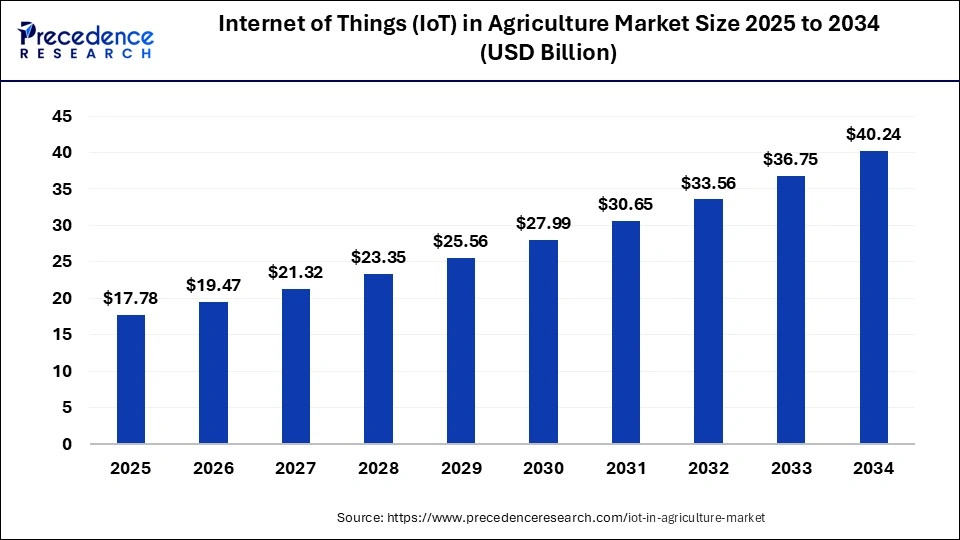
The global Internet of Things (IoT) in agriculture market was valued at USD 19.47 billion in 2026 and is projected to grow from USD 19.47 billion in 2026 to USD 41.29 billion by 2035, expanding at a CAGR of 8.79% during the forecast period. Market growth is driven by the increasing adoption of precision farming, smart irrigation systems, AI-powered analytics, connected livestock monitoring, and farm automation technologies.
Source: https://www.precedenceresearch.com/iot-in-agriculture-market
 Get a Sample
 Table Of Content


The global internet of things (IoT) in agriculture market size is calculated at USD 17.78 billion in 2025 and is predicted to increase from USD 19.47 billion in 2026 to approximately USD 41.29 billion by 2035, expanding at a CAGR of 8.79% from 2026 to 2035. The growth of the market is driven by the adoption of precision farming, severe labor shortages, government initiatives, and climate change.
Key Takeaways
- Asia-Pacific dominated the market in 2025 and is expected to grow at the fastest CAGR during the forecast period.
- By component, the hardware segment dominated the market with the largest share in 2025.
- By component, the software segment is expected to grow at the fastest CAGR over the forecast period.
- By type, the large farms segment dominated the market with the largest share in 2025.
- By type, the small farms segment is expected to grow at the fastest CAGR over the forecast period.
- By application, the precision farming segment dominated the market with the largest in 2025.
- By application, the precision aquaculture segment is expected to grow at the fastest CAGR over the forecast period.
Global Internet of Things (IoT) in Agriculture Market Overview
The Internet of Things (IoT) in agriculture market is changing the way people farm by plugging in connected devices, soil sensors, drone fleets, automation platforms, and data analytics services right into day-to-day operations. With IoT, farmers can do real-time watching of soil conditions, crop vigor, shifting weather cues, irrigation control, and even livestock status. This sort of setup lets them tune how resources are used, push productivity a bit higher, and also bring down day-to-day costs of running the farm.
More and more folks are asking for sustainable agriculture methods, stronger food security, and precision farming, so adoption keeps growing across regions. At the same time, Governments, agribusiness players, and tech suppliers are putting money into smart farming programs, better digital infrastructure, and broader connected farming ecosystems. When you mix IoT with artificial intelligence, cloud computing, and sharper advanced analytics, it turns into a more data-guided style of decision-making. And yeah, that supports higher farm efficiency while also backing resilient agricultural production systems.
Key Technological Shifts and AI in the Internet of Things (IoT) in Agriculture
Artificial intelligence acts like an intelligence layer that somehow turns IoT -generated agricultural data into results you can actually use and decisions that happen with less delay. It can digest info coming from connected sensors, drones, weather stations, satellite images, and even livestock monitoring devices, and then it helps with predictive analytics, precision irrigation, crop health checks, disease detection, and yield forecasting, mostly in a smoother way.
AI-powered computer vision is transforming modern agriculture by enabling early detection of crop stress, weeds, and pest infestations, allowing farmers to take targeted actions before problems become severe. In livestock management, AI-based systems analyze behavioral patterns and biometric data to identify potential health issues at an early stage, improving animal welfare and reducing losses. When integrated with IoT-enabled farming systems, these technologies enhance productivity, optimize resource utilization, support sustainable agricultural practices, and enable more profitable, resilient, and data-driven farm operations.
Internet of Things (IoT) in Agriculture Market Trends
- Precision Farming & Real-Time Monitoring: The use of IoT-based sensors and connected devices is making precision farming a mainstay of modern agriculture. These technologies continuously measure moisture, temperature, nutrients, PH, and crop conditions in real-time.
- Growing Popularity of Real-Time Monitoring Solutions: Real-time monitoring solutions are rapidly gaining popularity in large and small-scale farms, as farms strive to become more efficient and sustainable.
- Modern Irrigation & Water Management System: With water scarcity becoming an issue, smart irrigation systems with IoT technologies are gaining traction. Data from connected sensors for soil moisture, humidity, rainfall forecasting, and crop water needs enable automation of irrigation processes. They provide a very accurate delivery of water when and where it is most needed to reduce waste and over-irrigation.
- Emergence of Automated Irrigation Systems: Automated irrigation systems help save water resources and also reduce energy usage and operation costs. As water resources face greater pressure due to increasing global water volumes and the need to implement sustainability measures, smart water management solutions are becoming a key part of the modern agricultural infrastructure.
- Integrating AI and Edge Computing: AI and edge computing are building the intelligence of agriculture systems based on IoT. These algorithms use AI to process large volumes of field data, providing valuable insights such as yield predictions, disease forecasting, and recommendations for resource usage.
- Robotics and Autonomous Machinery: The use of robotics, autonomous vehicles, and drones is growing as agriculture becomes increasingly automated. Drones are being deployed more and more to monitor crops from the air, spray precisely, map fields, and assess the health of crops. Autonomous tractors, harvesters, and robotic systems carry out repetitive operations without requiring much human participation, such as planting, weeding, and harvesting.
- Connected Livestock Management: Farmers are increasingly adopting connected livestock management solutions to gain access to more information about animal health and welfare. Because they're equipped with the internet and various devices like RFID tags, smart collars, and biometric sensors, livestock are tracked constantly for their location, feeding habits, activity, and health. Real-time monitoring helps farmers identify any signs of disease, stress, or unusual behavior early, allowing them to act quickly.
Internet of Things (IoT) in Agriculture Market Growth Factors
- The increasing use of IoT and AI agricultural solutions is not only providing better crop yields but also monitoring livestock and making farm management more efficient.
- The establishment of precision agriculture and resource optimization as main areas has become the principal driver of the demand for data-based decision-making tools and smart devices.
- The growing awareness of sustainable agriculture methods is one of the factors that is supporting the implementation of connected sensors for water, fertilizer, and energy wastage reduction.
- The global market for smart farming is being driven by the expansion of smart farming infrastructure, which is being supported by the progress made in connectivity and automation technologies.
- The synergy of modern technologies, such as variable rate technology, remote sensing, and GPS guidance, is enhancing both productivity and profitability along the agricultural value chain.
Market Report Coverage and Key Metrics
| Report Coverage | Details |
| Market Size in 2025 | USD 17.78 Billion |
| Market Size in 2026 | USD 19.47 Billion |
| Market Size by 2035 | USD 41.29 Billion |
| Growth Rate from 2026 to 2035 | CAGR of 8.79% |
| Base Year | 2025 |
| Forecast Period | 2026 to 2035 |
| Segments Covered | Component, Type, Application, and Region |
| Regions Covered | North America, Europe, Asia-Pacific, Latin America, and Middle East & Africa |
Internet of Things (IoT) in Agriculture Market Dynamics
Driver
Rising Food Demand and Population Growth
The growing global population is increasing pressure on agricultural systems to produce higher food output while managing limited resources more efficiently. IoT-enabled technologies are supporting precision farming by optimizing irrigation, fertilizer application, and crop monitoring through real-time data collection and analysis. By providing farmers with actionable insights, IoT solutions help improve productivity, reduce resource wastage, increase crop yields, and address global food security challenges through more efficient and sustainable farming practices.
Restraint
Technical Complexity and Skill Gaps
The adoption of IoT solutions in agriculture faces challenges due to technical complexity, limited digital skills among farmers, and the need for continuous management of connected devices and data systems. Effective use of IoT technologies requires farmers to understand data analytics, maintain digital infrastructure, and manage technology-enabled farming processes, which can create operational difficulties. High training requirements, implementation costs, and practical barriers are slowing adoption, particularly among small-scale farmers and traditional agricultural communities with limited access to technical resources.
Opportunity
AI and 5G Integration
The integration of IoT, AI, and 5G technologies is creating significant opportunities for the growth of smart agriculture by enabling faster connectivity, advanced data processing, and improved farm management. High-speed 5G networks support real-time data transmission from field sensors, drones, and connected agricultural equipment, while AI-driven analytics help identify patterns and generate actionable insights for better decision-making. Together, these technologies enable predictive crop management, early disease detection, optimized resource utilization, and automated farming operations, improving overall agricultural productivity, efficiency, and sustainability.
Market Segmentation Analysis
Component Insights
Why Did the Hardware Segment Dominate the Market?
The hardware segment dominated the Internet of Things (IoT) in agriculture market in 2025, owing to the widespread use of sensors, drones, GPS, and weather stations, and connected farming machinery. These hardware solutions are the cornerstone of IoT ecosystems since they are responsible for gathering data from the field. The global increase in investments in farm automation is still leading to the demand for hardware.
The software segment is expected to grow at the fastest CAGR during the forecast period. The growth of this segment is attributed to the increasing need for cloud platforms, predictive analytics, farm management systems, and AI-powered decision support tools. Through software solutions, farmers are able to transform raw data into actionable insights, enabling them to optimize their productivity and resource management.
Type Insights
The Small Farms Segment Held a Major Market Share in 2025
The small farms segment dominated the Internet of Things (IoT) in agriculture market with a major share in 2025, as there is a large number of smallholder farmers across the globe. The convenience of IoT solutions, the availability of mobile applications, and support programs by the government have been driving the uptake. The technologies support farmers to better manage their crops, lower expenses, and boost productivity in a resource-constrained environment.
The large farms segment is expected to grow at the fastest CAGR during the forecast period. Larger agricultural operations begin to use sophisticated IoT platforms, autonomous equipment, and data analysis platforms. They are also more financially secure and have an interest in making their operations efficient, which helps them implement smart farming technologies quickly.
Application Insights
How Does the Precision Farming Segment Lead the Market in 2025?
The precision farming segment dominated the Internet of Things (IoT) in agriculture market in 2025 due to its ability to optimize agricultural inputs and improve overall crop productivity. Connected sensors, drones, and real-time monitoring systems provide farmers with valuable field insights, enabling more accurate decisions related to irrigation, fertilization, and pest management. These technologies help reduce resource wastage, minimize environmental impact, and enhance yields through more efficient and data-driven farming practices.
The precision aquaculture segment is expected to register the fastest CAGR during the forecast period due to the increasing adoption of IoT-based solutions for sustainable seafood production and efficient farm management. IoT technologies enable continuous monitoring of water quality, oxygen levels, feeding patterns, and fish health, helping farmers improve productivity and reduce operational risks. Growing demand for sustainable aquaculture practices and the need for optimized resource management are further accelerating the adoption of smart aquaculture solutions.
Market Regional Analysis: North America, Europe, Asia-Pacific
Asia Pacific Internet of Things (IoT) in Agriculture Market Size and Growth 2026 to 2035
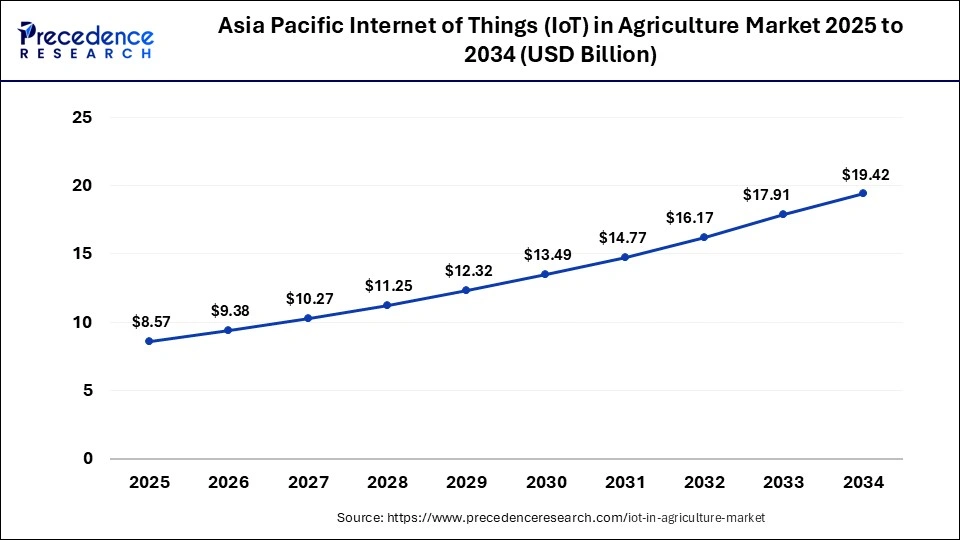
The Asia Pacific internet of things (IoT) in agriculture market size was evaluated at USD 9.38 billion in 2026 and is predicted to be worth around USD 19.97 billion by 2035, rising at a CAGR of 8.83% from 2026 to 2035.
What Made Asia Pacific the Dominant Region in the Market?
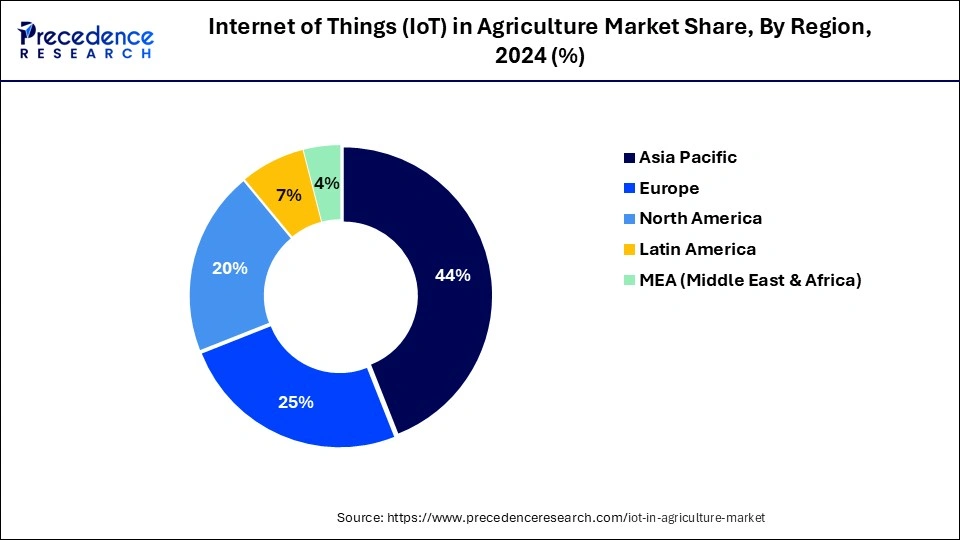
Asia Pacific dominated the Internet of Things (IoT) in agriculture market with a major share in 2025 and is expected to grow at a significant CAGR during the forecast period. This is mainly due to the increasing demand for food and decreasing arable land in the Asia-Pacific. Smart farming is encouraged by governments with subsidies and digital agriculture programs. The proliferation of connected irrigation and farm monitoring systems and farm automation technology is driving agricultural productivity and food security.
India Market Trends
India is witnessing increasing adoption of IoT in agriculture, driven by the availability of affordable, mobile-based solutions and the growing need to improve productivity among smallholder farmers. Farmers are increasingly using real-time soil monitoring, weather data, and crop analytics to make informed decisions regarding irrigation, crop management, and resource utilization. Additionally, IoT-enabled drones and imaging technologies are supporting early detection of pests and diseases, helping reduce crop losses and improve agricultural efficiency across farming regions.
How is North America Growing in the Internet of Things (IoT) in Agriculture Market?
North America is expected to witness significant growth in the market, supported by advanced digital infrastructure, strong investments in agricultural technology, and widespread adoption of smart farming solutions. Large-scale farms are increasingly integrating connected machinery, robotics, and data analytics platforms to improve operational efficiency and optimize resource use. The high cost of agricultural labor is further encouraging automation, enabling farmers to enhance productivity, reduce operational costs, and increase crop yields through data-driven decision-making.
U.S. Market Trends
The U.S. is at the forefront of IoT-based agriculture adoption, driven by the integration of artificial intelligence, connected farm equipment, and advanced analytics platforms. Real-time sensor data, weather forecasting tools, and predictive analytics are helping farmers optimize irrigation, crop management, and overall farm operations. Additionally, the adoption of smart tractors and automated machinery is improving precision planting, chemical application efficiency, and farm productivity while supporting more sustainable agricultural practices.
What are the Driving Factors of The Internet of Things (IoT) in Agriculture Market in Europe?
The market in Europe is driven by sustainability targets and stringent environmental laws. Farmers in the region are turning to IoT technologies to minimize fertilizers, emissions, and resource use. The adoption of precision agriculture tools helps meet EU policies, while also boosting productivity and soil health and improving the long-term sustainability of farms throughout the region. The use of connected farming technologies is widespread and supported by government incentives. With the growing sustainability goals comes the push to use data to manage agricultural resources.
Germany Market Trends
Germany continues to be one of the world's leading countries in high-tech agriculture. Smart Greenhouses use IoT technology to optimize the environment of greenhouses: temperature, humidity, and light. In today's high-tech farming, farmers are increasingly adopting technologies like sensors, drones, and autonomous equipment to monitor crops, optimize resource use, and enhance harvesting accuracy. The agriculture sector is becoming technologically advanced to deploy automation quickly. Boosting investments in smart farming leads to better efficiency of farming operations.
How is the Opportunistic Rise of Latin America in the Internet of Things (IoT) in Agriculture Market?
Latin America is expected to experience strong growth in the market during the forecast period, driven by the increasing adoption of smart farming solutions across large commercial farms. The region is leveraging IoT technologies to improve crop quality, enhance operational efficiency, and support the production of export-oriented agricultural products. Growing broadband connectivity, rising investments in agritech, and improvements in digital infrastructure are accelerating the adoption of connected farming solutions across the region.
Brazil Market Trends
Brazil is increasingly adopting IoT solutions in agriculture, particularly in precision farming and resource optimization applications. Technologies such as soil sensors, satellite imagery, and smart irrigation systems are helping farmers improve productivity, optimize input usage, and enhance sustainability. On large-scale farms, satellite-based IoT solutions are addressing connectivity challenges in remote agricultural areas while supporting climate-resilient farming practices, with continued investments from major agricultural enterprises driving the adoption of advanced precision agriculture technologies.
Why is the Market in the Middle East & Africa Gaining Momentum?
The Middle East & Africa Internet of Things (IoT) in agriculture market is gaining momentum due to increasing challenges related to water scarcity, harsh climatic conditions, and the need for sustainable food production. Governments and commercial farms are investing in smart irrigation systems, soil monitoring technologies, and climate-controlled agriculture solutions to improve water management, enhance crop productivity, and support sustainable farming practices in arid regions. Additionally, government-led agricultural modernization and digital transformation initiatives are accelerating the adoption of IoT technologies to improve resource efficiency and strengthen food security.
UAE Market Trends
The UAE is increasingly adopting IoT-based agricultural technologies to enhance food security and reduce dependence on food imports. Investments in smart greenhouses, hydroponics, vertical farming, AI-powered irrigation systems, and soil monitoring solutions are increasing to improve agricultural productivity in challenging desert environments. These advanced agritech solutions enable efficient water usage, optimize crop growth conditions, and support the expansion of sustainable local food production through smart farming practices.
Market Competitive Landscape: Leading Companies and Strategies
The market is semi-consolidated, with a mix of established leaders and emerging innovators competing through technology, product differentiation, and geographic expansion. A few bigger names keep a firm grip, thanks to broad portfolios, sturdy R&D engines, global distribution channels, and those strategic partnerships that keep showing up in every briefing. At the same time, smaller niche players tend to lean on specialized solutions and previously underserved segments, just to carve out space.
Overall, rivalry keeps moving because of mergers and acquisitions, cross-company collaborations, product launches, licensing agreements, and steady investments into advanced technologies. Innovation still acts like the main lever here, including AI integration, automation, precision-driven platforms, and next-generation solutions that sound a bit like the future. There are also heavy regulatory requirements, major capital investments, plus the usual need for intellectual property protection and deep technical expertise, which together create pretty clear entry barriers. Even so, ongoing innovation is expected to keep reshaping the way this market plays out going forward.
Value Chain Analysis
- Manufacturing: A variety of IoT features/components are procured from sensors, communication modules, and microcontrollers, ensuring cost-effectiveness and reliable agriculture performance.
- Key Players: John Deere, Trimble
- Further Research and Development (R&D) and Product Design: It involves the development of innovative IoT hardware and software solutions with functional designs for automation and smart data analytics.
- Key Players: Robert Bosch GmbH, CropIn
- Hardware Manufacturing and Assembly: Manufacture, test, and assemble IoT agricultural devices with the maintenance of quality standards for durability and performance of devices.
- Key Players: Deere & Company, Libelium
- Marketing and Sales: Sales promotions are carried out for IOTF devices that are agriculturally related in the farmer's commercial activities, and commercial seeding is carried out to promote market awareness and adoption.
- Key Players: Farmers Edge, AGRIVI
- Technological Development: We are improving our software altogether in these cases with analytics and through cloud development to arrive at an upward scale in the realm of IoT integration, data processing systems, and agriculture functionality.
- Key Players: Microsoft, IBM
Internet of Things (IoT) in Agriculture Market Companies and Their Offerings
- Trimble Inc.: It offers connected agriculture platforms that combine guidance, cloud analytics, variable-rate applications, and water management solutions for increased productivity and sustainability.
- Deere & Company: Its Operations Center platform provides precision agriculture technologies to integrate autonomous equipment, computer vision, and real-time monitoring.
- AGCO Corporation: Brand agnostic precision farming solutions from AGCO Corporation include PTx and Precision Planting for automated guidance, sensing, and crop management.
- Raven Industries, Inc.: It is a specialist in driverless grain carts, precision application technologies for farms, autonomous farming systems, and cloud-based intelligence networks for farms.
- Komatsu, Ltd.: The company is contributing to agriculture by providing cutting-edge equipment, digital terrain mapping, automated guidance, and smart solutions to support operational efficiency.
Other Major Internet of Things (IoT) in Agriculture Market Companies
- Farmer Edge Inc.
- CropX, Inc.
- The Climate Corporation
- AgJunction Inc.
- TeeJet Technologies
- Antelliq Corporation
- Topcon Positioning Systems, Inc.
- ICKEY-john
Key Market Developments
- On February 15, 2022, Kacific Broadband Satellite Ltd, a Singapore based provider of fast, strong, and negligible cost satellite web to homes, associations, and states across Asia Pacific, detailed plans with Farmer Charlie, a UK-based provincial information and dominance provider, to bring satellite-controlled green information and expertise to farmers in remote and confined bits of Southeast Asia and the Pacific. Plus, Kacific and Farmer Charlie will collaborate to outfit smallholder farmers and agribusinesses with agrarian guidance, bound environment information, and agribusiness information, consolidating data from in-field sensors, with a ultimate objective to help them with additional creating region the chiefs and food creation utilizing clever high level contraptions. The help is likewise expected to help ranchers in decreasing post-collect misfortune, dealing with the gamble of dry season, floods, and other outrageous climate occasions, and managing the impacts of environmental change.
- On February 3, 2022, Semtech Corporation, arranged in California, said ICT International, an IoT plan provider for environmental applications, has composed Semtech's Long-Range contraptions and the Long-Range Wide-Area Network standard into their water quality really taking a look at system. LoRaWAN development engages long-range, low-power, wide-district network consideration, allowing these sensors to impart assessed data, for instance, temperature, water level or tide, water pungency, and more to shellfish farmers in the area.
- AKVA Group has consented to supply a full RAS office west of Shanghai to Nordic Aqua Ningbo in November 2020. In 2026, the undertaking is supposed to create 8,000 tons.
- Deere and Company will purchase Unimil (Brazil), a Brazilian maker of secondary selling parts for sugarcane gatherers, in September 2020. The firm made interests in the Brazilian market because of this buy, which will help clients in Brazil cut their sugarcane creation costs. This obtaining would likewise permit Deere to give a more extensive exhibit of parts that give clients practical arrangements.
- DeLaval purchased milkrite|InterPuls (UK), a draining point arrangement provider to dairy makers, in July 2020 to grow its item advertising. Milkrite|InterPuls would keep on working autonomously following the obtaining.
Recent Developments
- In April 2026, the UAEU launched the Smart Mushroom House, a cutting-edge research facility utilizing IoT to enhance sustainable agriculture and support the National Food Security Strategy 2051. Developed by the College of Agriculture and Veterinary Medicine at Al Foah Research Farm, it focuses on date palm waste management and mushroom production, led by Dr. Shyam Kurup. (Source: https://www.mediaoffice.abudhabi)
- In June 2025, Professor Jayashankar Telangana Agricultural University is launching the Agri Robotics IoT Solutions for Agriculture Lab, partnering with BITS Pilani and IIT Hyderabad, funded with Rs 12 crore. (Source: https://timesofindia.indiatimes.com)
- In February 2025, Thailand launched "HandySense B-Farm," a smart farming platform using sensors, AI, and IoT for improved farm management and efficiency. (Source: https://www.nationthailand.com)
- In June 2025, Professor Jayashankar Telangana Agricultural University is launching the Agri Robotics IoT Solutions for Agriculture Lab, partnering with BITS Pilani and IIT Hyderabad, funded with Rs 12 crore. (Source: https://timesofindia.indiatimes.com)
- In February 2025, Thailand launched "HandySense B-Farm," a smart farming platform using sensors, AI, and IoT for improved farm management and efficiency. (Source: https://www.nationthailand.com)
Segments Covered in the Report
By Component
- Hardware
- Irrigation Controllers
- Flow and Application Control Devices
- Variable Rate Controllers
- Soil Sensors
- Water Sensors
- Climate Sensors
- Sensors for Livestock
- Automation and Control Systems
- Sensing and Monitoring Devices
- Guidance and Navigation
- Drones
- Handheld Computers
- Displays
- Smart Harvesters & Forwarders
- RFID Tags and Readers
- LED Grow Lights
- Software
- On-premise
- Cloud-based
- Connectivity & Services
By Type
- Small Farms
- Mid-Sized
- Large
By Application
- Precision Aquaculture
- Precision Farming
- Smart Greenhouses
- Precision Livestock
- Precision Forestry
- Others
By Region
- North America
- U.S.
- Canada
- Europe
- U.K.
- Germany
- France
- Asia-Pacific
- China
- India
- Japan
- South Korea
- Malaysia
- Philippines
- Latin America
- Brazil
- Rest of Latin America
- Middle East & Africa (MEA)
- GCC
- North Africa
- South Africa
- Rest of the Middle East & Africa
For inquiries regarding discounts, bulk purchases, or customization requests, please contact us at sales@precedenceresearch.com
Frequently Asked Questions





Ask For Sample
No cookie-cutter, only authentic analysis – take the 1st step to become a Precedence Research client
 Get a Sample




 sales@precedenceresearch.com
 Schedule a Meeting
