



Internet of Things (IoT) in Energy Market Size, Key Companies, Company Market Share, User Adoption, Technology Deployment, Revenue Growth, Competitive Positioning, and Demand Forecast
ICT industry specialist Gautam Mahajan estimates the internet of things (iot) in energy market at USD 39.22 billion in 2026, with continued technology adoption expected to take the market to USD 123.93 billion by 2035 at a CAGR of 13.67%. Leading internet of things (iot) in energy market providers such as abb ltd, schneider electric se, siemens ag, general electric are expanding their capabilities across segments including components, solution, service, network technology, application.
Source: https://www.precedenceresearch.com/internet-of-things-in-energy-market
 Get a Sample
 Table Of Content


What is the Internet of Things (IoT) in Energy Market Size?
The global internet of things (IoT) in energy market size was accounted for USD 39.22 billion in 2026 and is anticipated to reach around USD 123.93 billion by 2035, growing at a CAGR of 13.67% from 2026 to 2035. The growing market demand for energy efficient solutions, integration of Internet of Things (IoT) in various sectors for optimizing energy consumption, technological advancements, the rising environment concerns and active government support are promoting the growth of Internet of Things (IoT) in energy market.
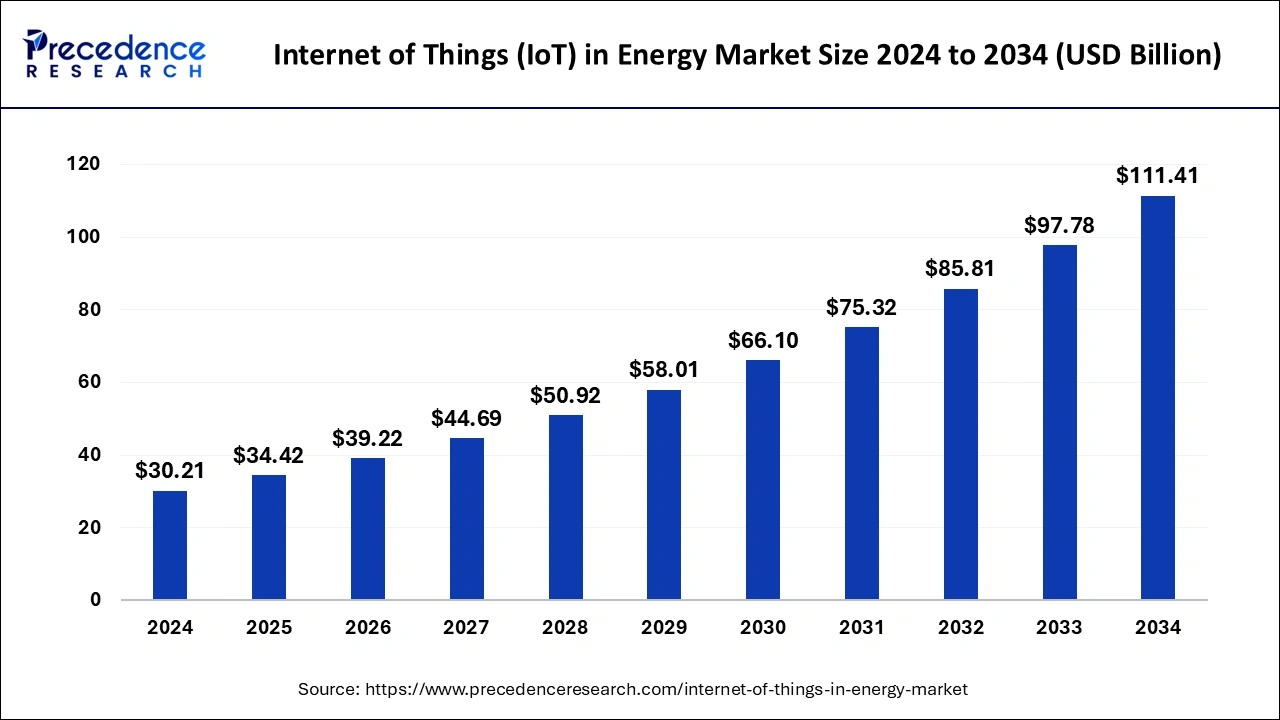
Internet of Things (IoT) in Energy Market Key Takeaways
- North America dominated the global internet of things (IoT) in energy market with the largest market share of 37% in 2025.
- Asia Pacific is expected to expand at a solid CAGR of 16.03%% during the forecast period.
- By application, the smart grid segment contributed the highest market share in 2025.
- By application, the coal mine segment is projected to grow at a significant CAGR during the forecast period.
Role of AI in IoT for Energy Sector
The integration artificial intelligence with Internet of Things (IoT) in the energy sector has various applications such as enabling advanced data analysis form connected sensors, for predictive maintenance, in smart grid management, for optimizing energy consumption, for adjusting and transmission of energy output in renewable energy sources, for demand forecasting and data transmission thereby cutting energy costs, improving dependability on grid and enhancing the operational efficiency ultimately promoting sustainability.
Key Trends in Internet of Things in the Energy Market
- IoT enables smart meter technologies for energy efficiency, and enhancing the processing of billing is a growing trend that fuels the growth of the market.
- The integration of IoT helps in the advancement of energy management and also helps in making automated decision-making, which helps in the growth of the market.
- Government initiatives and regulations for the adoption of IoT technologies in the energy sector for energy efficiency and sustainability boost the growth of the market.
- The cost-effective and cost-saving trends through energy optimization with the integration of IoT help in the growth of the market.
Internet of Things (IoT) in Energy Market Growth Factors
- Increasing demand for energy efficient solutions due to growing awareness about environmental impacts and climate changes globally
- Active government support for integrating IoT in energy sector
- Development of IoT-driven smart grids for optimizing power consumption and demand
- Implementation of AI and machine learning tools for analysing vast amounts of data generated by IoT for examining energy inefficiencies and optimizing energy usage by predicting demand patterns
- For remote monitoring and control of energy systems
- Predictive maintenance and minimized downtime by monitoring the status of energy infrastructure components with IoT
- Rising investments of industries and governments for adoption of energy sectors with high efficiency
- Integration of IoT powered smart meters and home energy management systems providing consumers real-time monitoring of energy consumption thereby assisting them in making informed decisions for reducing energy usage
Report Scope of the Internet of Things (IoT) in Energy Market
| Report Coverage | Details |
| Market Size in 2026 | USD 39.22 Billion |
| Market Size by 2035 | USD 123.93 Billion |
| Growth Rate from 2026 to 2035 | CAGR of 13.67% |
| Largest Market | North America |
| Base Year | 2025 |
| Forecast Period | 2026 to 2035 |
| Segments Covered | Component, Solution, Service, Network Technology, Application, Geography |
| Regions Covered | North America, Europe, Asia-Pacific, Latin America, and Middle East & Africa |
Segments Insights
Component Insights
The solutions segment accounted largest revenue share in 2025. The internet of things (IoT) is used on a large scale in the power and energy generation sector. The solutions in energy sector helps in the energy generation with efficiency and effectiveness. Thus, all these factors are driving the growth of the segment.
The services segment is fastest growing segment of the IoT in energy market in 2020. The internet of things (IoT) in energy sector is providing various types of services. Those services are transmission, energy generation, asset management, distribution, security, and workforce management. These services are increasing operational efficiency in energy sector.
Service Insights
The integration and deployment segment dominated the internet of things (IoT) in energy market in 2025. The integration and deployment help to integrate internet of things (IoT) solutions with favorable information technology infrastructure. This results into more efficient and effective processes in energy generation. Thus, this service is deployed on large scale.
The support and maintenance segment is expected to grow faster from 2026 to 2035. After installation of internet of things (IoT) solutions in energy sector, the main task is to maintain the systems with regular checkups. Thus, the support and maintenance service are deployed in energy sector.
Application Insights
The smart grid segment contributed the highest market share in 2025. The oil and gas deploy internet of things (IoT) technologies on a large scale. This technology helps in day-to-day operations in oil and gas sector. In addition, the adoption of innovative and advance technologies is also driving the growth of the segment.
The coal mine segment is projected to grow at a significant CAGR during the forecast period. The internet of things (IoT) technology has made coal mining easy. With this technology, the position of miners can be tracked easily. The internet of things (IoT) technology also helps to monitor whole process of mining.
Regional Insights
What is the U.S. Internet of Things (IoT) in Energy Market Size?
The U.S. internet of things (IoT) in energy market size was evaluated at USD 9.55 billion in 2025 and is predicted to be worth around USD 35.22 billion by 2035, rising at a CAGR of 13.94% from 2026 to 2035.
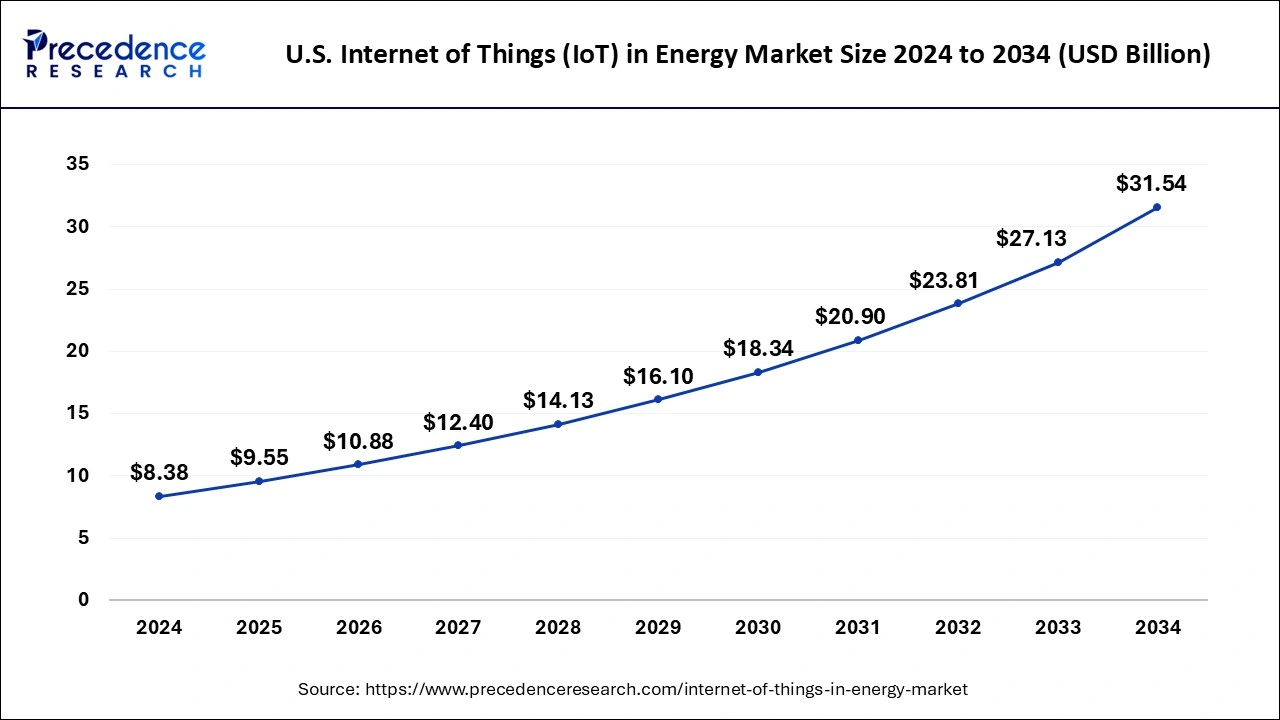
North America dominated the global internet of things (IoT) in energy market with the largest market share of 37% in 2025. The factors such as growing number of energy projects and adoption of innovative technologies such as internet of things (IoT) and big data analytics. The growth of internet of things (IoT) in energy market in North America region is also driven by growing research and development activities.
The U.S. is a mature Internet of Things (IoT) in the Energy Market, and the growth in the country is driven by the government initiatives and investment for smart grids and renewable energy on IoT technologies, and IoT plays a vital role in managing and optimizing the integration of renewable energy sources into the grid. These factors play a major role in the growth and expansion of the market in the country.
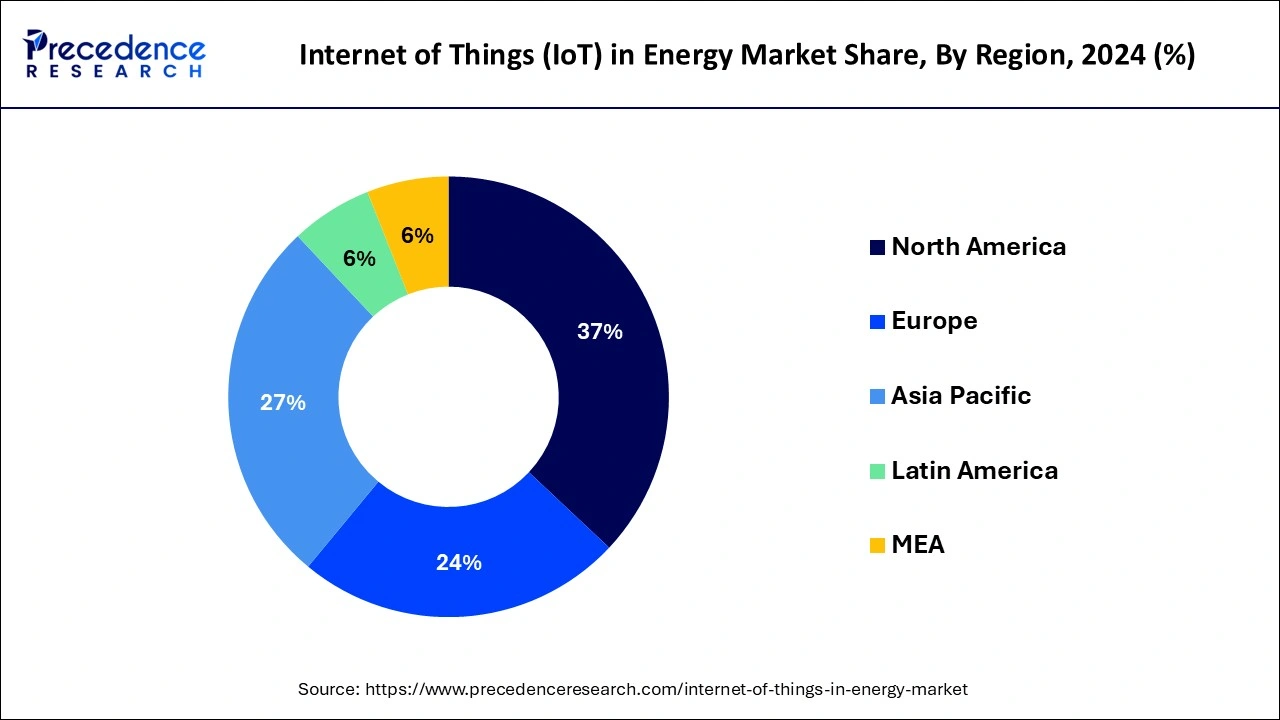
Asia-Pacific expected to expand at a solid CAGR of 16.03%% during the forecast period. China dominates the internet of things (IoT) in energy market in Asia-Pacific region. The growth of internet of things (IoT) in energy market in Asia-Pacific region is being driven by technological advancements. In addition, favorable government regulations are also creating opportunities for the growth of internet of things (IoT) in energy market in the region.
India has seen a significant growth in the Internet of Things (IoT) in the Energy Market, the growth is driven by rapid urbanization, industrialization, and government initiatives in renewable energy sources and smart grid helping in energy management and optimization and also manage energy consumption of energy which fuels the growth of the market in the country. The country's fast-paced development increases the demand for IoT for efficient energy management, driving the growth and expansion of the market in the country.
Will Europe Grow in the Internet of Things (IoT) in Energy Market?
Europe is expected to grow at a considerable CAGR in the upcoming period, due to the need to reduce carbon footprint, the usage of smart meters, and renewable energy sources. Among European countries, Germany plays a vital role in green energy, due to determinants such as the government's policies on energy, industry automation, and usage of the Internet of Things (IoT).
How is Latin America Growing in the Internet of Things (IoT) in Energy Market?
Latin America is expected to grow at a notable CAGR in the foreseeable future. IoT use in this industry aims at boosting the reliability of grids, reducing power losses, and facilitating the incorporation of renewable energy solutions. Brazil leads in IoT usage because of the rise in the number of smart meters, the need for hydropower, and investments in digital energy systems.
What are the Advancements of the Middle East and Africa in the Internet of Things (IoT) in Energy Market?
The Middle East and Africa are expected to grow at a considerable CAGR in the upcoming period. The sector is gaining momentum due to the establishment of smart cities, renewable energy, and the need for proper power management. UAE is the dominant player in this sector due to its presence of smart grid technology, renewable energy, and IoT in buildings for energy management.
Competitive Landscape
The Internet of Things (IoT) in energy is an evolving transition followed by green trends and clean implementation in the tech, industrial and relevant sectors. The constant push for regenerating tech approaches for safe and brilliant deployment of integrative smart energy solutions highlights the required efficiency in management operations, representing a green flag for further business endeavours. The market giants such as ABB Ltd., Schneider Electric SE, Siemens AG, General Electric (GE Vernova), and IBM Corporation are fuelling the market status.
Company Profiles
ABB Ltd.
- HQ: Zurich, Switzerland.
- Founded: 1988
- Ownership: Technology giant.
- Business Overview: ABB is a well-known face of electrifying, automation and robotic businesses delivering suitable solutions across industries seeking a tech-influenced innovation integrated to energy. The advanced manufacturing ecosystem encourages more motion-backed innovation to fulfil industries' needs.
- Products: Switchgear, panelboards, industrial robots, wiring accessories, etc.
- Geographic Presence: ABB's business is across 100 countries.
- Revenue: The company's 2025 annual revenue was $33.22 billion and is expected to grow during the forecast period.
- Recent Development: In June 2026, Samsung and ABB joined hands, which features the unification between Samsung SmartThings Pro and ABB Ability™ BuildingPro. This alliance allows operators and building owners to get insightful of controls and data shaping the respective companies' top development.
- Key Strategies: ABB aims on funding strategy for bolstering the research and development space since the technologies' deployment is heavily influencing the demand spectrum for smart energy.
Schneider Electric SE
- HQ: Rueil-Malmaison, France.
- Founded: 1836
- Ownership: Energy management and digital automation giant.
- Business Overview: Schneider's business revolution starts with specialized factors featuring energy management and digital automation. This specialization allows the company to manufacture and introduce a range of products and services for smooth business.
- Products: Software, services and hardware.
- Geographic Presence: The company's business is popular across 100 countries.
- Revenue: The company's updated revenue is €38.15 billion.
- Recent Development: In March 2026, Schneider ramped up its full-fledged ‘Energy Technology Solutions' in favor of the healthcare industry and to contribute AI legacy at HIMSS26. These solutions are the turning point for the company's expansion.
- Key Strategies: Schneider's targets AI unification, digitalization, EcoStruxure platforms and effective sustainable innovations to propel its value in the market.
Siemens AG
- HQ: Munich and Berlin, Germany.
- Founded: 1847
- Ownership: Engineering and technology company (Public stock corporation).
- Business Overview: Siemens's business captures the fundamental operations, including mobility, smart infrastructure, and desired automation, for dominating the suitable industries seeking these three pillars for smooth profit and intelligent intervention.
- Products: Programmable logic controllers, industrial software, industrial automation hardware, etc.
- Geographic Presence: The company's reach is across 200 countries.
- Revenue: The company's 2025 revenue was €78.91 billion and is expected to expand in the coming years.
- Key Strbategies: Siemens' motive is to promote digitalization to shape a manufacturing hub that accelerates value in AI, data and software.
General Electric (GE Vernova)
- HQ: Cambridge, Massachusetts, United States.
- Founded: April 2024.
- Ownership: Public company.
- Business Overview: GE's long-standing technology business is a boon to the electricity sector, while its power production and services are a strong financial base of the company. Its excellence in turbine designs and developing power grids, energy storage and software is a milestone.
- Products: Turbines, HRSG, heat exchangers, condensers, etc.
- Geographic Presence: The company's reach is across 100 countries.
- Revenue: In 2025, GE earned in the range of $38.07 billion to $38.1 billion and is expected to expand in the coming years.
- Key Strategies: The company's strategy is to unify its technology pipeline to natural gas, grid, wind and nuclear solutions. The heavy installation of wind and gas turbines will be a win-win situation for this strategy.
IBM Corporation
- HQ: Armonk, New York.
- Founded: 1911
- Ownership: Consulting and technology company.
- Business Overview: IBM is famous for its consulting, financing, infrastructure and software business. The tech innovations and top-notch research are the strong backing for the company's business that builds engagement across big industries.
- Products: AI platforms, consulting services, hybrid cloud infrastructure, etc.
- Geographic Presence: The company's business is across 175 countries with around 260,000 employees.
- Revenue: The company's 2026 Q1 revenue ranges from $15.7 billion to $15.9 billion.
- Key Strategies: IBM's strategy is to bolster its collaboration with giants such as Adobe, Schlumberger, etc. Its AI unification and hybrid cloud are a smart motive for the company's business success.
Other Major Key Players
- Cisco Systems
- AGT International
- Altair Engineering
- HCL Technologies
- Rockwell Automation
- Infosys
- Davra Networks
- Wind River
- IBM Corporation
- Siemens
Recent Developments
- In December 2025, RA6W1 and RA6W2, which were designed specifically for IoT and connected home systems, were announced by Renesas Electronics and feature Wi-Fi 6 functionality. They also feature dual-band connectivity, Bluetooth LE capability, ultra-low power consumption, and Matter 1.4 compliance. (Source: https://www.hackster.io)
- In October 2024, Titan Intech Ltd., a leading software development signed a MoU with Kakatiya Energy Systems Pvt Ltd. For acquiring 26% stake in the company. This collaboration allows Titan Intech for expanding its product offerings including energy storage solutions, IoT applications, solar products and smart city infrastructure.
- In September 2024, Indus Towers, a leader in telecom space announced the adoption initiatives which promote the utilization of AI, IoT and advanced analytics tools for enhancing energy efficiency and safety across different sources in their telecom infrastructure.
Segments Covered in the Report
By Component
- Platform
- Solutions
- Services
By Solution
- Asset Management
- Predictive Maintenance
- Asset Condition Monitoring
- Data Management and Analytics
- SCADA
- Energy Management
- Safety
- Physical Security
- Cybersecurity
- Connected Logistics
- Fleet Management
- Freight Management
- Port Management
- Compliance and Risk Management
- Sustainability Monitoring
- Emission Monitoring and Control
- Mobile Workforce Management
- Network Management
By Service
- Consulting
- Integration and Deployment
- Support and Maintenance
By Network Technology
- Cellular Network
- Satellite Network
- Radio Network
- Others
By Application
- Oil and Gas
- Upstream
- Midstream
- Downstream
- Coal Mining
- Open-pit Mining
- Underground Mining
- Smart Grid
- Generation
- Power Transmission and Distribution
- Substation Automation
By Geography
- North America
- Latin America
- Europe
- Asia-pacific
- Middle and East Africa
For inquiries regarding discounts, bulk purchases, or customization requests, please contact us at sales@precedenceresearch.com
Frequently Asked Questions





Ask For Sample
No cookie-cutter, only authentic analysis – take the 1st step to become a Precedence Research client
 Get a Sample




 sales@precedenceresearch.com
 Schedule a Meeting
