



IoT in Manufacturing Market Size, Key Companies, Company Market Share, User Adoption, Technology Deployment, Revenue Growth, Competitive Positioning, and Demand Forecast
IoT in Manufacturing Market (By Component: Software, Services; By Solution: Data Management, Network Management, Device Management, Connectivity Management Platform, Application Management, Smart Surveillance; By Connectivity: Satellite Network, Cellular Network, Near Field Communication (NFC), Others; By Deployment Mode: On-premises, Cloud; By Organization Size: Small and Medium Enterprises, Large Enterprises; By Service: Managed services, Professional services; By Vertical: Process manufacturing, Discrete manufacturing; By Application: Predictive Maintenance, Asset Performance Management, Quality Management, Supply Chain Management) - Global Industry Analysis, Size, Trends, Leading Companies, Regional Outlook, and Forecast 2026 to 2035
Source: https://www.precedenceresearch.com/iot-in-manufacturing-market
 Get a Sample
 Table Of Content


What is the IoT in Manufacturing Market Size?
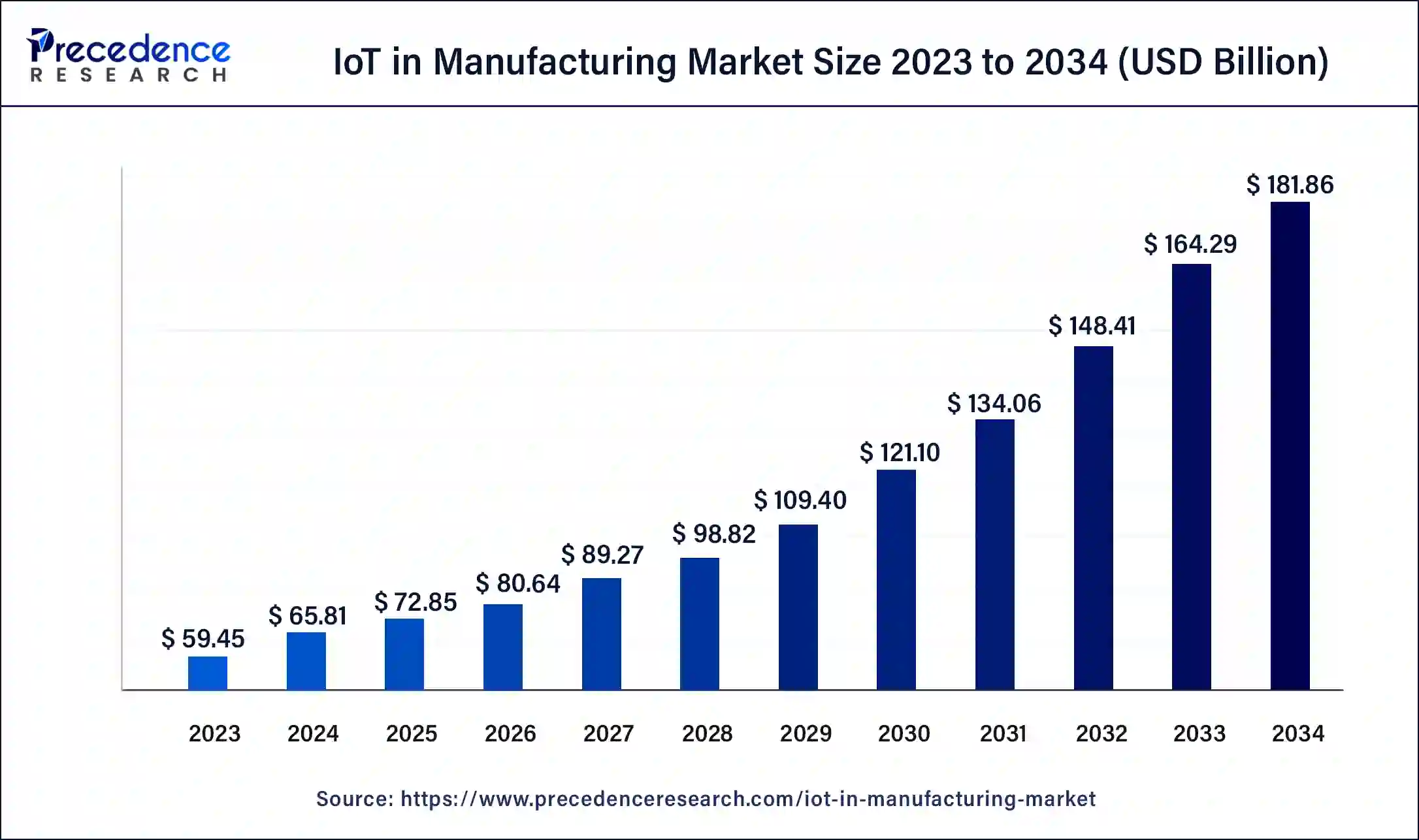
The global IoT in manufacturing market size is calculated at USD 72.85 billion in 2025 and is predicted to increase from USD 80.64 billion in 2026 to approximately USD 198.30 billion by 2035, expanding at a CAGR of 10.53% from 2026 to 2035. IoT in manufacturing market growth is driven by increasing adoption of smart factories, Industry 4.0 initiatives, predictive maintenance, industrial automation, real-time monitoring, and connected production systems improving efficiency.
Market Highlights
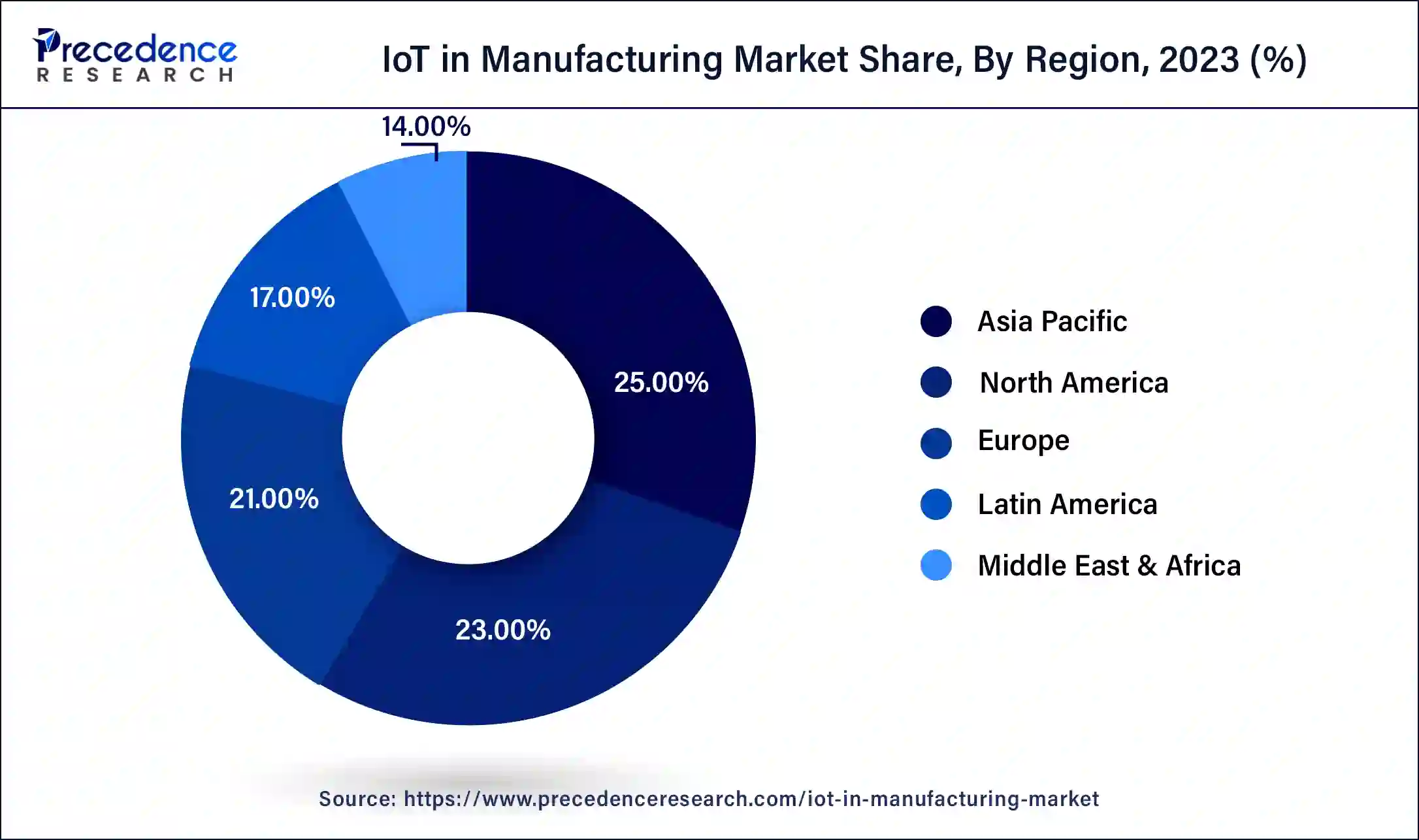
- Asia Pacific led the global market with the highest market share of 25% in 2025.
- North America is expected to grow at a notable CAGR in the foreseeable future.
- By application, the predictive maintenance segment accounted highest share 29% in 2025.
- By application, the asset performance management segment is expected to grow at the fastest CAGR in the market between 2026 and 2035.
- By components, the software segment has reached 60% revenue share in 2025.
- By components, the services segment is expected to witness the fastest growth in the market over the forecast period.
- By solution, the data management segment held a dominant position in the market share in 2025.
- By solution, the smart surveillance segment is expected to grow with the highest CAGR in the market during the studied years.
- By connectivity, the Near Field Communication (NFC) segment held a major revenue share in the market in 2025 and also expected to witness the fastest growth in the market over the forecast period.
Capability Overview of IoT in Manufacturing Sector.
The networking of physical tools and machines is known as the Internet of Things (IoT), and it has applications in the automotive, electronics, insurance, industrial, manufacturing, and retail sectors. It makes use of device connectivity to remotely control or detect objects.
The difficulty of operating more effectively has faced industrial manufacturing organizations for a long time. Businesses have had to decide whether to relocate their facilities or make significant efficiency improvements in their current ones because they are under assault from rivals who have manufacturing capabilities in areas with cheaper labor costs. The benefits associated with the advancements in technology has benefitted the manufacturing market. The ecosystem's diversity and competitiveness are the results of the existence of numerous significant participants. IoT in manufacturing is a method of digital transformation that manufacturing businesses use to improve the productivity of their personnel and machinery. Critical production data are gathered via a network of sensors, and cloud and analytics tools are then utilized to transform the data into information that can be used to make informed decisions regarding the manufacturing operations. With the implementation of IoT, industrial facilities may automate their processes, which lowers costs, accelerates time to market, allows for mass customization, and boosts safety.
IoT in Manufacturing Market Growth Factors
The IoT in manufacturing market is being driven by the rising adoption of automated & intelligent technologies, which result in great production efficiency and less environmental effect. Efficiency is increased by the application of intelligent production and process management strategies in various production facilities. These criteria let manufacturers create items more quickly and cheaply, allowing them to invest in more capable jobs. These technologies enable businesses to learn about customer preferences and design products accordingly. High demand is being generated by the adoption of IoT technology by international firms due to improved worker safety, customer service, and competitive benefits.
The industrial automation has grown significantly in the manufacturing sector. Producers are concentrating more on producing large quantities of high-quality products as a result of increased consumer demand and market competitiveness. As a result, they are now focusing on important aspects of the plant like the manufacturing process, asset monitoring, and asset maintenance and support. By using automation, manufacturers could increase productivity, reduce direct labor costs and expenses, improve the consistency of their processes or products, and produce higher-quality goods. The improvement of industrial automation in the manufacturing industry depends on the Internet of Things (IoT).
The connected supply chain and smart manufacturing processes depend heavily on connected and smart items. Additionally, the introduction of inexpensive connected devices has made it possible for manufacturers to implement IoT technologies to reduce resource consumption and boost overall productivity. Additionally, because IoT applications have a low operational cost, many manufacturers seek to integrate them into their products in order to increase efficiency while lowering costs. These reasons are driving the IoT in manufacturing market.
Future Trends In IoT in Manufacturing Market
- Intelligent Manufacturing Automation - Manufacturers are utilizing artificial intelligence along with IoT platforms to execute predictive maintenance, automate production systems, check quality, and optimize processes in real-time to cut operational costs and downtime.
- Edge Computing Developments- Edge computing is becoming popular among producers who have begun processing IoT data more closely to devices which allows for quicker decision-making, reduced dependency on cloud systems, and lower latency, making the processes more efficient.
- Digital Twin Technology - Digital twins use IoT technologies to help manufacturers make virtual copies of factories and equipment so that the work can be simulated and enhanced.
- Eco-Friendly Manufacturing- IoT can help manufacturers track energy consumption, emissions, and utilization of natural resources thus promoting going green in production processes.
Market Outlook
Start-up Ecosystem
- With every new technology research, experimentation, and execution join the intelligent workforce and ecosystem. The specialization of the brilliant minds aims at Edge AI to prove and encourage AIoT. To support integration across AI tools and features, the startups have expertise in processing data on machine learning, the need for accuracy, and cloud costs mitigation. Access to integration is required to confirm the potential of technology to continue using it in the manufacturing process.
Industry Growth Overview
- Due to diversified opinions and increased startsups the industry is experiencing a shift into the IoT in the manufacturing sector. The manufacturers are the reason IoT has been experiencing an intensified research, and so the suitable tech giants are also getting hype that doubles the IoT industry growth.
- The growth aims for Industry 5.0 to uplift the sector and reshape the future of technology to gain trust in the tech-based industrial and operational domain. Alongside industry is also demanding robotics and autonomous systems harnessing IoT at the core.
Market Scope
| Report Coverage | Details |
| Market Size in 2025 | USD 72.85 Billion |
| Market Size in 2026 | USD 80.64 Billion |
| Market Size by 2035 | USD 198.30 Billion |
| Growth Rate from 2026 to 2035 | CAGR of 10.53% |
| Base Year | 2025 |
| Forecast Period | 2026 to 2035 |
| Segments Covered | Component, Solution, Connectivity, Deployment Mode, Organization Size, Service, Region |
| Regions Covered | North America, Asia Pacific, Europe, Latin America, Middle East and Africa |
Segments Insights
Application Insights
The predictive maintenance sector dominated the market of 2025 with its share of 29%, as companies shifted more towards utilizing IoT sensors and real-time analytics in order to perform effective pre-failure detection which reduces unplanned downtimes, improves productivity and prolongs the lifetime of machines.
The asset performance management (APM) sector is predicted to grow the fastest CAGR due to the increasing need for permanent asset tracking and asset lifecycle management and many firms are now embracing IoT based APM solutions which ensure reliable operation, better utilization of equipment, lower energy consumption, and data-driven decisions regarding maintenance and investments.
Component Insights
Software segment is estimated to hold the 60% revenue share due to its major function in receiving, analyzing, and processing manufacturing data collected from connected IoT devices. The implementation of advanced software platforms allows manufacturers to apply predictive analytics, create digital twins, monitor production, and automate processes that contribute to improved productivity and more efficient quality control.
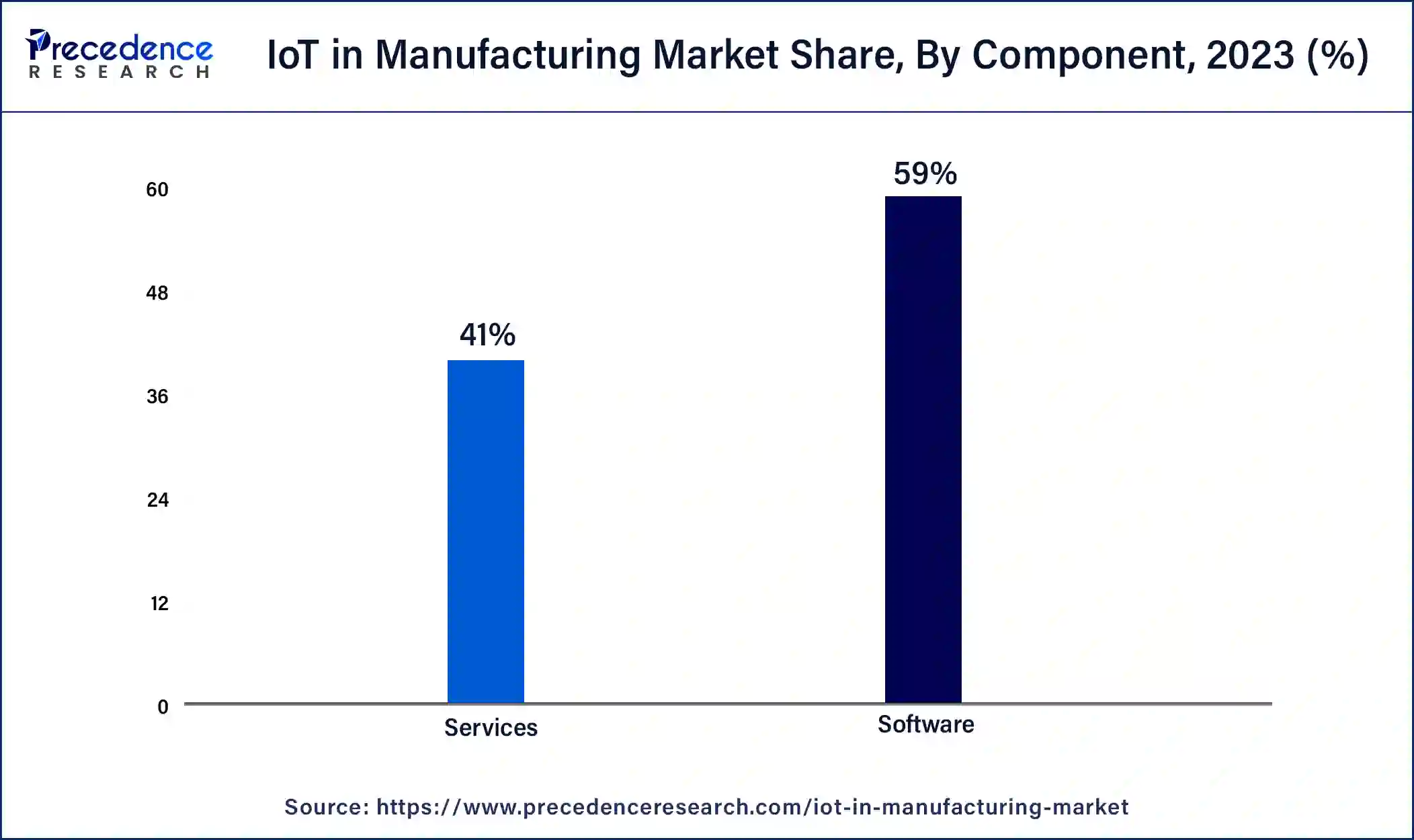
The services segment is predicted to be the fastest-growing sector in the upcoming years since it is becoming increasingly important for manufacturers to acquire consulting, system integration, deployment, and managed support services for IoT construction operations.
Solution Insights
Depending upon the solution, the data management segment accounted largest share in 2025. Due to the rising deployment of end-to-end data management solutions for more effective and flexible capitalization of IoT data across companies, the market for IoT data management is growing. Modernizing data warehouse design, expanding use of data encryption for IoT device security, and growing need for data security and data traffic management are the main factors propelling the market's expansion. The acceptance rate of IoT data management solutions has increased as a result of opportunities including the adoption of established content models in businesses, the emergence of unified metadata services, and effective procedures for boosting return on investment.
Smart surveillance has a significant share in the IoT in manufacturing market during the forecast period. It includes central monitoring system, and video analytics and events. The Internet of Things (IoT) phenomenal expansion has created novel commercial opportunities and enabled operational models across many different sectors and use cases. Beyond security and video surveillance, the Internet of Things supports business operations, monitoring, and even internal projects like marketing and advertising. For analytics, targeted marketing, and improved branch operations, banks can now deploy smart IoT-enabled video surveillance solutions.
Connectivity Insights
During the projected period, the near field communication segment is anticipated to be the largest in the IoT in manufacturing market. Easy connections, quick transactions, and straightforward data transmission are all advantages of NFC. It addresses the issue of network access being unavailable for powered things. These non-powered items' embedded NFC tags enable the addition of intelligence anyplace. To enhance the user experience, tap an NFC-enabled device to open a URL and provide content. Additionally, it facilitates simple and straightforward device connection. There is no need for tedious data entering or hand shaking.
In order to undertake remote facility monitoring and real-time asset management at unmanned sites and offshore platforms, business activities that extend to geographically remote areas depend on satellites to supply the essential communication infrastructure. Additionally, city managers all over the world are using the IoT to push for energy-saving policies and more intelligent resource allocation in an effort to make cities more sustainable. For example, satellite technology is essential for extending smart grids to remote areas where terrestrial networks are inadequate.
Regional Insights
What is the Asia Pacific IoT in Manufacturing Market Size?
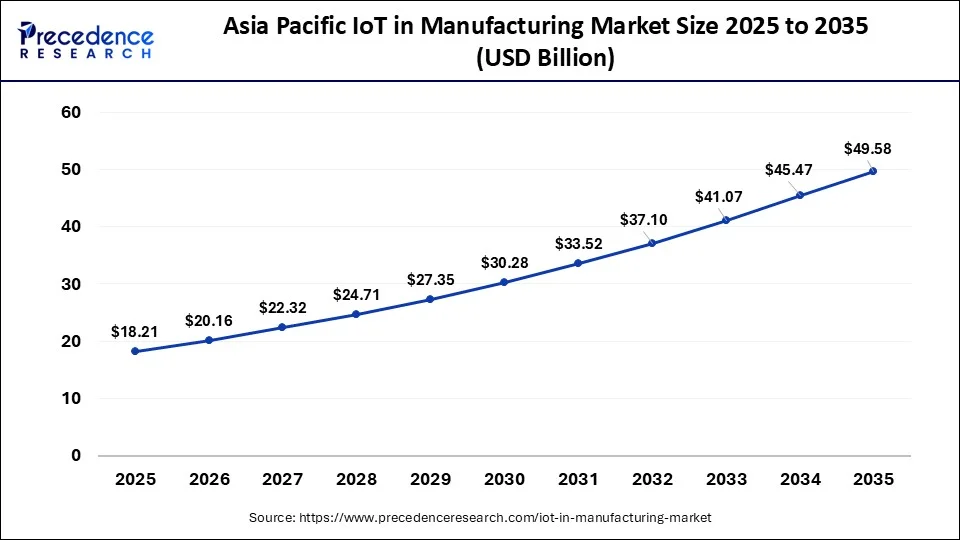
The Asia Pacific IoT in manufacturing market size is estimated at USD 20.16 billion in 2026 and is predicted to be worth around USD 49.58 billion by 2035, at a CAGR of 10.53% from 2026 to 2035.
Asia-Pacific is anticipated to expand rapidly over the next few years as a result of the region's ongoing economic expansion, ageing labor force, and increasing use of mobile devices for work. This will drive the adoption of enterprise mobility solutions to meet the rising demand for safeguarding and protecting sensitive data. The primary drivers of this rapid growth in APAC include regional government programs to encourage the adoption of technology, increased levels of automation at businesses, and the growing digitization of people's lives. Moreover, the presence of impending technological advancements in IoT, creating a lucrative market potential.
The rising investment by government and R&D organizations in IoT manufacturing solutions is expanding due to the uptick in the IT environment. Increased regulatory requirements and the application of AI in IoT will accelerate industry expansion. China is the region's fastest-growing manufacturer; hence it is anticipated that it will have the greatest CAGR. With recent developments in IoT and telematics, which have improved communications, connectivity, and responsiveness to bring infotainment, security, and safety to drivers, passengers, and commuters, India is also a developing technology powerhouse.
China IoT in Manufacturing Market Trends
China holds the number one position in Asia Pacific with smart factories and digitalization programs undertaken on a large scale. Heavy investments in developed manufacturing, robotics, industrial connectivity, and AI industrial systems favor manufacturers in their attempts to raise efficiency, lower costs, and stay competitive globally.
North America IoT in Manufacturing Market Trends
North America is considered as second largest region in IoT in manufacturing market during the forecast period. This region includes mainly U.S., and Canada. The expansion of the regional market will be aided by the rising number of start-ups and the increasing application of machine learning algorithms in both software and hardware.
U.S. IoT in Manufacturing Market Trends
The U.S. is the market leader in the region with investments in smart manufacturing, robotic engineering, and AI-based production systems. Federal initiatives to support manufacturing and semiconductor industry and a well-entrenched use of industrial IoT solutions drive connected factory deployments.
Europe's Strategic Advancement in IoT in Manufacturing Industry
Europe's unmatched advancement in this industry is its continuous dedication, a drive to transform Industry 4.0 to give full power to IoT. With this, the IoT will let smart factories learn to use real and valid data without any misconceptions to win over the efficiency and automation competition. To bolster and encourage IoT in manufacturing line several advancements landed on the ground of connectivity, digital twins, predictive maintenance, and edge computing transformation.
Apart from this, the strong funding, go green deals, and government frameworks gave shape to the tech advancements. European Green Deal took IoT to the regions here, and Horizon Europe program allocated €150 million to conduct research and introduce the best-in-class IoT use and signal computing to further trust the technology in the manufacturing process.
Germany IoT in Manufacturing Market Trends
Germany is the number one country in Europe due to its developed manufacturing industry and early use of Industry technologies. Connected manufacturing systems, including industry sensors and smart automation, are used by manufacturers in automotive and machinery segments to improve operational performance.
Latin America brings sense to IoT in Manufacturing with its Initiatives
The major regional initiatives stand on collaborations with the same interests and digitalisation intent. To accelerate the operational efficiency, Mexico and Brazil contributed the most, stimulating the thought of IoT in manufacturing. Brazil introduced PAC 4.0 and an IoT plan featuring a smart city survey. The funding throughout this program built an unbreakable infrastructure, alongside it, fostering a hassle-free work atmosphere.
Technology hastens and eases the work, but its potential has to be proven to be implicated in the huge companies' huge responsibilities. Brazil's program approach made a significant attempt to introduce sound to the IoT in the manufacturing sector. The private sector and other industrial applications brought various projects and partnerships into the frame to promote the sector as a whole.
Brazil
Brazil is the dominant country in the region in terms of its manufacturing might and growing investments in factory automation and industrial digitalization. Manufacturers from automotive, food processing, and FMCG sectors are using industrial IoT monitoring systems to boost performance.
Competitive Landscape
The IoT in manufacturing market is semi-consolidated, where leading industrial technology companies are competing with specialized IoT platform vendors and automation firms. Factors such as digital transformation initiatives, interoperability, cybersecurity capabilities, and scalable industrial connectivity influence competition despite entry barriers for newcomers.
The established players take advantage of their well-rounded IoT platforms, industrial automation know-how, AI-based analytics, and worldwide service networks. At the same time, the new entrants go for predictive maintenance, edge computing, and industry-specific smart manufacturing technologies.
The competitive intensity is growing due to strategic partnerships, mergers and acquisitions, cloud platform integrations, product innovations, and investments in industrial AI and cybersecurity. However, high implementation costs, technical know-how, and regulatory compliance are still main barriers, while increasing demand for connected factories is projected to boost competition even further.
IoT in Manufacturing Market Companies
- Cisco Systems Inc.
- Hitachi Ltd.
- IBM Corporation
- Microsoft Corporation
- PTC Inc.
- Robert Bosch GmbH
- SAP SE
- Software AG
- Texas Instruments
- Zebra Technologies
Recent Developments
- IBM and ClearBlade, a provider of edge computing software and an industrial IoT platform, declared their intention to work together to enable Edge IoT asset monitoring for near-real-time asset management.
Segments Covered in the Report
By Component
- Software
- Services
By Solution
- Data Management
- Network Management
- Device Management
- Connectivity Management Platform
- Application Management
- Smart Surveillance
By Connectivity
- Satellite Network
- Cellular Network
- Near Field Communication (NFC)
- Others
By Application
- Predictive Maintenance
- Asset Performance Management
- Quality Management
- Cognitive Process & Operations Management
- Supply Chain Management
- Others
By Region
- North America
- Europe
- Asia Pacific
- Latin America
- Middle East and Africa
For inquiries regarding discounts, bulk purchases, or customization requests, please contact us at sales@precedenceresearch.com
Frequently Asked Questions
Tags





Ask For Sample
No cookie-cutter, only authentic analysis – take the 1st step to become a Precedence Research client
 Get a Sample




 sales@precedenceresearch.com
 Schedule a Meeting
