



Artificial Intelligence (AI) in Manufacturing Market Size, Share, and Trends 2026 to 2035
Artificial Intelligence (AI) in Manufacturing Market (By Offering: Hardware, Software, Services; By Technology: Machine Learning, Context Awareness, Natural Language Processing, Computer Vision; By Application: Process Control, Quality Control, Logistics and Inventory Management, Predictive Maintenance and Machinery Inspection, Production Planning, Others; By Industry: Automotive, Medical Devices, Semiconductor and Electronics, Energy and Power, Heavy Metal and Machine Manufacturing, Others) - Global Industry Analysis, Size, Trends, Leading Companies, Regional Outlook, and Forecast 2026 to 2035
Source: https://www.precedenceresearch.com/artificial-intelligence-in-manufacturing-market
 Get a Sample
 Table Of Content


What is the Artificial Intelligence (AI) in Manufacturing Market Size?
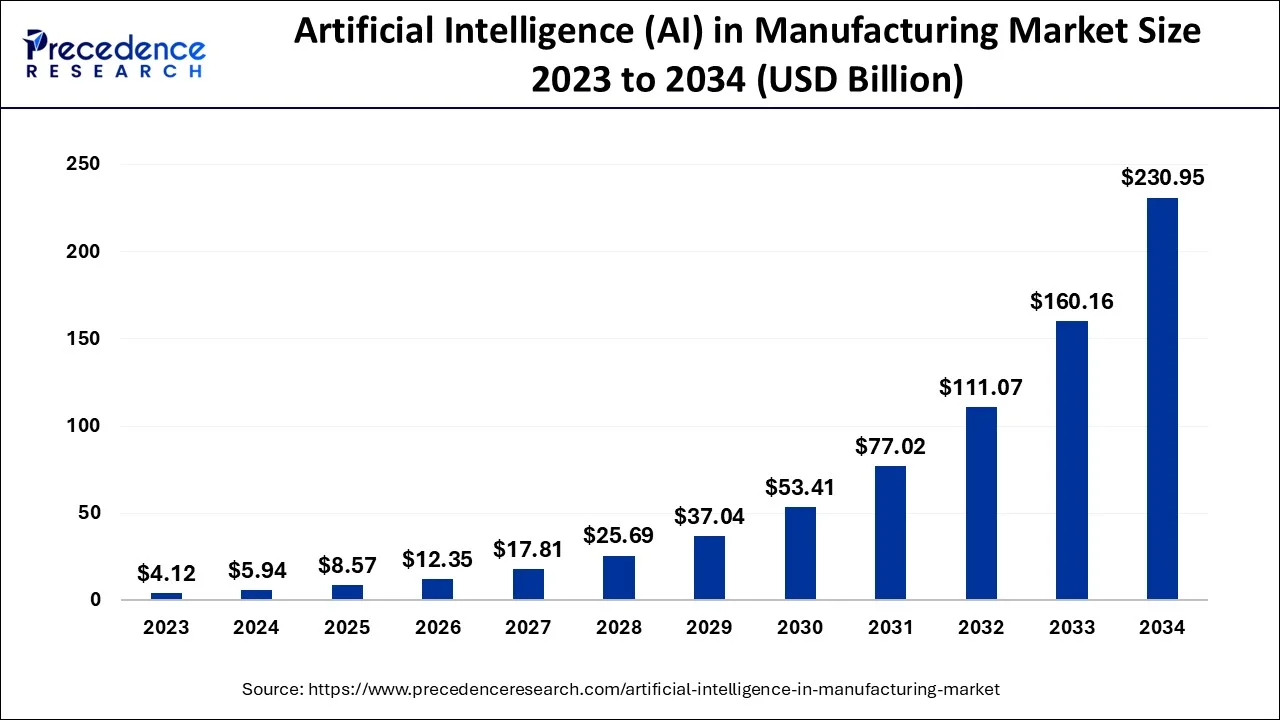
The global artificial intelligence (AI) in manufacturing market size accounted for USD 8.57 billion in 2025 and is predicted to increase from USD 12.35 billion in 2026 to approximately USD 287.27 billion by 2035, expanding at a CAGR of 42.08% between 2026 to 2035.
Artificial Intelligence (AI) in Manufacturing Market Key Takeaways:
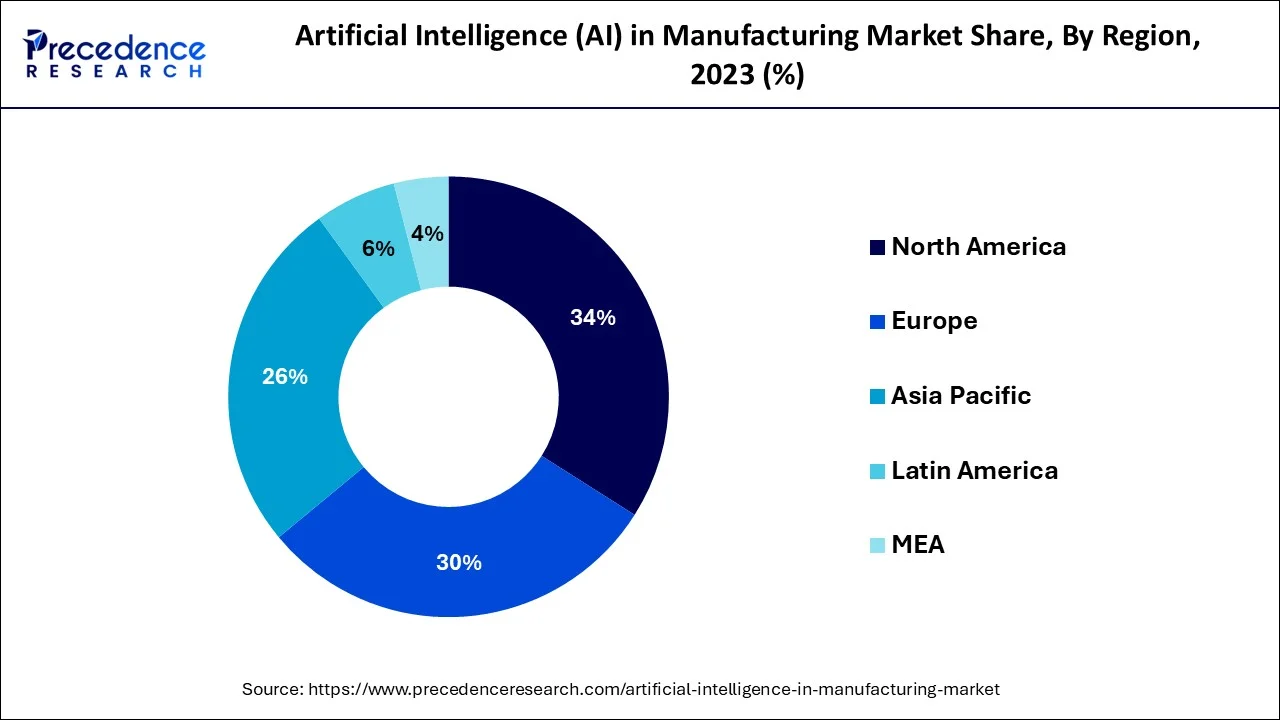
- North America had the largest share of the market in 2025.
- Asia Pacific is expected to expand at the fastest CAGR between 2026 to 2035.
- By Offering, the software segment captured more than 32% of revenue share in 2025.
- By Technology, the computer vision segment is projected to register a significant CAGR from 2026 to 2035.
- By Application, the predictive maintenance and machinery inspection segment is estimated to hold a significant share of the market between 2026 to 2035.
- By Industry, the medical devices segment is predicted to hold the largest share of the market between 2026 to 2035.
Strategic Overview of the Global Artificial Intelligence (AI) in Manufacturing Industry
Artificial intelligence (AI) in manufacturing market refers to the application of AI technologies and techniques in the manufacturing industry. AI is transforming the manufacturing sector by enabling machines and systems to perform tasks that traditionally required human intelligence. Artificial intelligence (AI) in manufacturing utilizes solution methods such as deep learning and machine learning to optimize manufacturing processes while offering improved analysis and controlling abilities to the end users. Artificial intelligence (AI) in manufacturing market has offered multiple opportunities for industries to transform, innovate and redesign the existing manufacturing models. The penetration of AI in manufacturing processes offers risk management, virtual assistance, and real-time analysis.
Artificial Intelligence (AI) in Manufacturing Market Statistics and Data
- According to the PwC's recent survey, 54% of firms in India are showing an upward deployment trend towards the adoption of artificial intelligence and analytics.
- Deloitte stated in its survey report about the adoption of AI in manufacturing that 93% of companies believe artificial intelligence will be a crucial technology for innovation.
- The IBM 2022 Global AI Adoption Index report stated that 1 in 4 companies are adopting artificial intelligence solutions due to labor and skill shortage.
- According to the report published by Rockwell in 2023, 59% of companies in India are currently planning to shift towards smart manufacturing. Whereas manufacturers in India 35% of their operating budgets in technological advancements.
- According to McKinsey, by 2030, the manufacturing industry with the penetration of AI will contribute almost 19% to the economic growth of China.
Artificial Intelligence (AI) in Manufacturing Market Growth Factors
As multiple industries and manufacturing units shift towards digital transformation, the market for artificial intelligence in manufacturing is expected to grow significantly. The manufacturing units of several end-user industries across the globe are adopting services that offer artificial intelligence-based solutions owing to the changing consumer preferences, rising demand for better supply chain and logistics services and maintaining regulations in the manufacturing activities.
In addition, multiple industries such as automotive, electronics and defense are adopting advanced distribution models, this element is expected to stand as a growth factor for the global artificial intelligence (AI) in the manufacturing market. Along with this, multiple government initiatives that promote the adoption of advanced solutions to boost manufacturing efficiencies are predicted to boost the growth of the market.
Market Outlook
- Market Growth Overview: The artificial intelligence (AI) in manufacturing market is expected to grow significantly between 2025 and 2034, driven by the rising Industry 4.0 and smart factories, rising efficiency and cost reduction, and enhanced quality control.
- Sustainability Trends: Sustainability trends involve resource optimization and waste reduction, rising energy efficiency, and growing circular economy and product lifecycle.
- Major Investors: Major investors in the market include Microsoft, Alphabet, NVIDIA, IBM, Amazon Web Services, and Intel.
- Startup Economy: The startup economy is focused on smart factory automation, growing digital twins and simulation, and rapid predictive analytics.
Market Scope
| Report Coverage | Details |
| Market Size in 2025 | USD 8.57 Billion |
| Market Size in 2026 | USD 12.35 Billion |
| Market Size by 2035 | USD 287.27 Billion |
| Growth Rate from 2026 to 2035 | CAGR of 42.08% |
| Largest Market | North America |
| Fastest Growing Market | Asia Pacific |
| Base Year | 2025 |
| Forecast Period | 2026 to 2035 |
| Segments Covered | By Offering, By Technology, By Application, and By Industry |
| Regions Covered | North America, Europe, Asia-Pacific, Latin America, and the Middle East & Africa |
Market Dynamics
Driver
Rising demand for supply chain optimization
As industries have started focusing on offering advanced optimized supply chain services for consumer satisfaction, it is observed to drive the growth of the market. Artificial intelligence algorithms can leverage historical data, market trends, and external factors to accurately forecast demand. This helps manufacturers optimize inventory levels, production schedules, and resource allocation. AI can identify and assess risks in the supply chain, including disruptions such as natural disasters, geopolitical events, or supplier issues. By proactively identifying potential hazards, manufacturers can implement contingency plans and build a more resilient supply chain.
Restraint
Lack of expertise in AI
A lack of personnel with engineering expertise is observed to hamper the growth of artificial intelligence in the manufacturing market. The management of the operations associated with artificial intelligence also requires a set of skills. Developing and deploying AI systems in manufacturing requires specialized knowledge and expertise. Without a sufficient number of skilled personnel, companies may struggle to effectively implement AI technologies. The lack of expertise in areas such as machine learning, data analytics, and robotics can hinder the successful integration of AI into manufacturing processes.
According to the IBM 2022 Global AI Adoption Index report, approximately 19% of companies globally don't have enough skilled personnel to use artificial intelligence-based tools and software. Whereas 22% of organizations tackled the operation of new automation software and tools.
Opportunity
Rising requirement for smart manufacturing
The rising importance of technologically driven machinery and solutions for production processes has highlighted the requirement for smart manufacturing. Smart manufacturing addresses the issues with traditional manufacturing while covering the loopholes. The penetration of artificial intelligence in manufacturing processes is observed to support the requirements for smart manufacturing, which will open lucrative opportunities for the market to grow in the upcoming years. In smart manufacturing, AI is capable of supporting order management, automated scheduling, and factory automation.
Smart manufacturing aims to achieve real-time data and automation with enhanced connectivity, the AI algorithms can offer required insights with proper data analysis process. In addition, the optimized supply chain operations and rising demand for customized products from smart manufacturing demand AI-based solutions, which opens up a plethora of opportunities for the market.
Segment Insights
Offering Insights
The software segment holds the largest share of the market; the segment will continue to grow at a significant rate during the forecast period. Software solutions in the market offer scalability and also allow manufacturers to modify the capabilities of artificial intelligence-based services as per the requirements. Moreover, the ease of integration of software solutions promotes the segment's growth.
On the other hand, the hardware segment is expected to witness a noticeable growth rate during the forecast period. The growth of the hardware segment is attributed to the rapid shift towards AI-based solutions from the traditional infrastructure at manufacturing firms. Hardware offering allows easy integration of AI solutions in the infrastructure.
Technology Insights
The computer vision segment is expected to register significant growth during the forecast period. The growth and dominant position of the computer vision segment in the market is attributed to its capability to offer accurate and actionable insights for various manufacturing processes. The penetration of robotics in multiple industries promotes the application of computer vision for process optimization. The manufacturing environment requires safety and security measures and computer vision technology offers accurate safety and security measures that can easily detect hazardous conditions in the environment.
The machine learning segment is expected to be the most attractive segment of the market. Machine learning technology carries multiple algorithms that can extract insights and patterns from a wide range of data. The requirement for data management in the manufacturing sector promotes the segment's growth.
Application Insights:
The predictive maintenance and machinery inspection segment is predicted to hold a significant share of the market in the forecast period. Multiple manufacturing industries face production stoppages due to machine failure, this highlights the importance of predictive maintenance and inspection. The ability of artificial intelligence to evaluate multiple variables to reflect the machinery's active status helps in making predictions about equipment failures effectively.
The penetration of artificial intelligence in the manufacturing sector is capable of predicting machine failure which reduces the waste of raw materials. The demand for solutions to reduce expensive downtime in manufacturing supports the growth of the predictive maintenance and machinery inspection segment.
Industry Insights
The medical devices segment is expected to hold the largest share of the market during the forecast period. The rising prevalence of diseases across the globe, along with the infrastructural development in the healthcare sector, highlights the demand for advanced medical equipment/devices. The penetration of AI in the manufacturing of medical equipment offers opportunities to create disruptive and efficient medical devices.
Australia-headquartered EMVision recently developed a lightweight brain scanning device utilizing NVIDIA's AI platform and DGX systems. This portable scanner is capable of diagnosing a brain stroke within minutes.
On the other hand, the automotive segment is growing significantly. The adoption of automation and robotics in the automotive sector promotes the utilization of artificial intelligence in the automotive industry. Automotive manufacturing units involve complicated machinery management that requires maintenance to ensure optimal performance; the algorithms of AI are capable of analyzing data, maintenance records, and machine logs. Moreover, recent technologies such as autonomous and electric vehicles heavily rely on advanced solutions such as machine learning and deep learning, which support the adoption of artificial intelligence in automotive manufacturing firms.
Regional Insights
What is the U.S. Artificial Intelligence (AI) in Manufacturing Market Size?
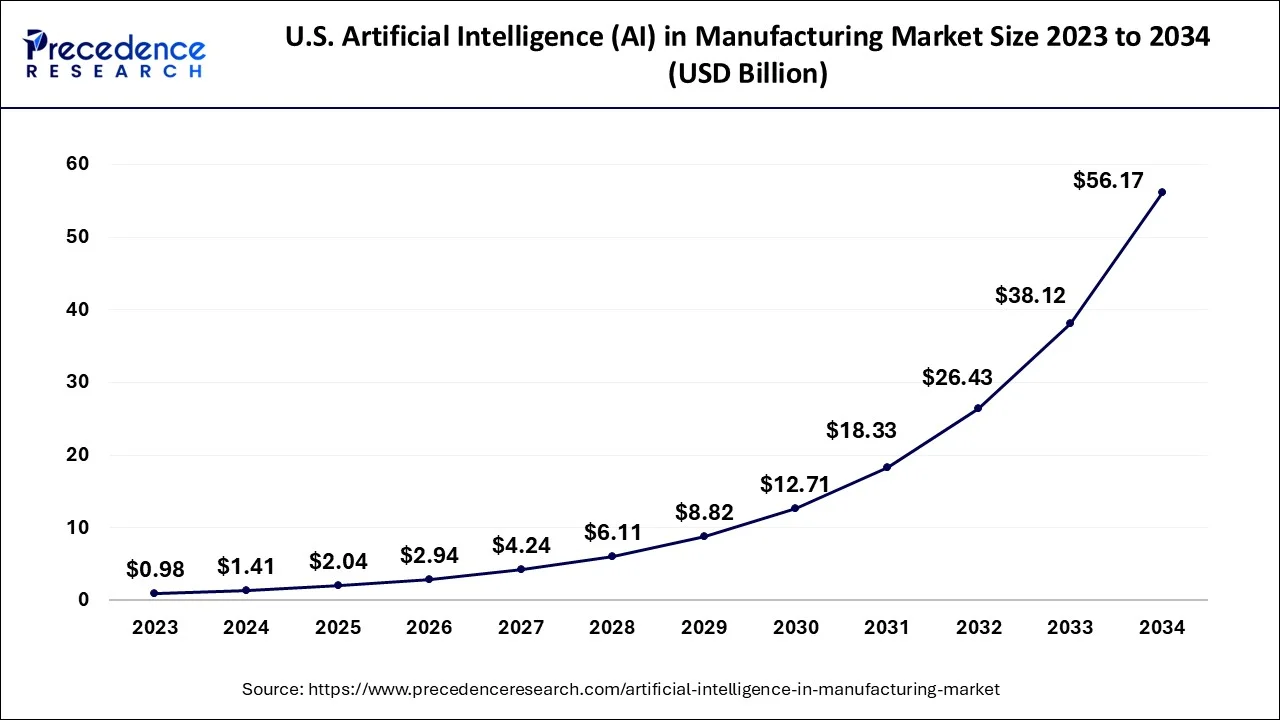
The U.S. artificial intelligence (AI) in manufacturing market size is estimated at USD 2.04 billion in 2025 and is expected to be worth around USD 69.98 billion by 2035, growing at a CAGR of 42.41% from 2026 to 2035.
Why North America Dominated the Artificial Intelligence (AI) in Manufacturing Market?
North America had a significant share of the market in 2025, and the willingness to adopt advanced technologies has supported the growth of the market in the region. North America is home to innumerable manufacturing firms. With rising competitiveness, especially in the automotive, healthcare, and electronics industries, the manufacturing sector has rapidly adopted artificial intelligence-based solutions for production processes.
U.S. Artificial Intelligence (AI) in Manufacturing Market Trends
The U.S.'s rapid expansion of software and analytics, which now outpaces hardware growth. The surge of Generative AI has revolutionized operational insights and simulation, allowing for unprecedented levels of predictive maintenance and real-time quality control.
What Makes Asia Pacific the Fastest-Growing Region in the Artificial Intelligence (AI) in Manufacturing Market?
Asia Pacific is expected to register the fastest growth in the market during the forecast period. The current drive towards digitization in the manufacturing industries is expected to supplement the growth of the market in the upcoming period. Additionally, increasing industrialization, a growing number of businesses, a booming e-commerce industry, and demand for accountable manufacturing solutions are a few factors to supplement the growth of the market in Asia Pacific.
The surging deployment of collaborative robots in the automotive industry across several countries, such as India, China, Japan, South Korea, and Singapore, for enhancing operational efficiency is boosting the market expansion. Also, the growing investment by governments for deploying AI in the manufacturing sector, as well as the rapid expansion of the semiconductor industry, is playing a vital role in shaping the market's landscape. Moreover, the presence of various market players, such as Mitsubishi Electric Corporation, Fanuc, TCS, and Wipro, is expected to drive the growth of the market in this region.
China Artificial Intelligence (AI) in Manufacturing Market Trends
China's industrial AI sector is leveraging its unrivaled access to massive datasets to achieve global leadership in machine learning-driven process optimization. Supported by state-backed funding and a vast talent pool, tech giants like Baidu and Huawei are creating proprietary models for robotics and predictive maintenance.
Increasing labor costs, requirements for quality control, and increased demand for productivity are fueling the growth of the market in the Asia Pacific. Along with this, several governments are collaborating with private companies to foster the development and deployment of AI in production processes. Such partnerships are expected to propel the growth of the market in the region.
Along with this, governments are also promoting various incentive programs to support the domestic manufacturing sector; this will supplement the use of artificial intelligence services in manufacturing units.
For instance, the government of India has launched a Production-Linked Incentive (PLI) Scheme; the scheme offers incentives to industries to expand their manufacturing units in the country. This is expected to encourage manufacturers in India to adopt favorable solutions to boost their manufacturing capabilities.
How Did Europe Notably Grow in the Artificial Intelligence (AI) in Manufacturing Market?
Europe's transition toward Industry 5.0 prioritizes human-machine collaboration and circular sustainability. The market is underpinned by secure data sharing through Gaia-X and sovereign cloud initiatives, ensuring that large-scale AI deployment aligns with strict GDPR and ethical data mandates.
Germany Artificial Intelligence (AI) in Manufacturing Market Trends
Germany's rapid software expansion and the integration of Edge AI for low-latency, real-time decision-making. High adoption across the automotive and chemical sectors is supported by government initiatives like "AI Made in Germany," which emphasize ethical innovation and global competitiveness.
How is the Opportunistic Rise of Latin America in the Artificial Intelligence (AI) in Manufacturing Market?
Latin America is expected to grow at a considerable CAGR during the forecast period. This is mainly due to the rising demand for AI hardware in several countries, such as Brazil, Argentina, Peru, and Venezuela. Additionally, numerous government initiatives aimed at expanding the manufacturing sector, along with the rise in the number of energy startups, are positively impacting the market. Moreover, the presence of numerous market players, such as MercadoLibre, Globant, BairesDev, and Emi Labs, is expected to boost the growth of the artificial intelligence (AI) in manufacturing market in this region.
Argentina Artificial Intelligence (AI) in Manufacturing Market Trends
The market in Argentina is growing due to a strong focus of manufacturing companies on deploying AI in their production centers to enhance operational efficiency. Additionally, the rapid investment by the medical device companies in using AI-based platforms for manufacturing a wide range of healthcare devices is playing a vital role in shaping the industrial landscape.
How is MEA Emerging in Artificial Intelligence (AI) in Manufacturing Market?
The Middle East & Africa (MEA) has emerged as a prominent region in the artificial intelligence (AI) in manufacturing market. The growing adoption of AI-based robots by electronics companies across several countries, including the UAE, Saudi Arabia, South Africa, and Qatar, is boosting the market expansion. The rapid investment by power generation companies for deploying AI to enhance their operational efficiency, as well as technological advancements in the manufacturing sector, are playing a vital role in shaping the industrial landscape. Moreover, the presence of several AI providers, such as Saal.ai, Verofax, Injazat, and Krazimo, is expected to proliferate the growth of the market in this region.
UAE Artificial Intelligence (AI) in Manufacturing Market Analysis
The rapid adoption of AI software by semiconductor companies for enhancing the operational efficiency in their production units is driving the market expansion. Additionally, the rise in the number of automotive startups, coupled with the rapid expansion of the logistics sector, is positively impacting the industry.
Artificial Intelligence (AI) in Manufacturing Market Companies
- Mitsubishi Electric Corporation: The company provides a wide range of factory automation solutions, including AI-enabled PLCs and edge computing devices that optimize production processes and predict maintenance needs within manufacturing environments.
- NVIDIA Corporation: NVIDIA contributes to AI in manufacturing by providing high-performance GPUs and the CUDA platform, powering complex simulations, training advanced machine learning models, and enabling real-time quality control with computer vision on the factory floor.
- Intel Corporation: Intel offers high-performance processors and AI-specific accelerators that drive AI inference at the edge, helping manufacturers implement intelligent defect detection and real-time process optimization with low latency.
- Siemens AG: Siemens utilizes its comprehensive Digital Enterprise portfolio, including the MindSphere IoT platform, to integrate AI into industrial operations, optimizing entire value chains through predictive analytics, digital twins, and autonomous systems.
- International Business Machines Corporation: IBM leverages its Watson AI platform and hybrid cloud capabilities to help manufacturers analyze vast amounts of production data, optimize supply chains, and implement cognitive quality control systems.
Other Major Key Players
- Oracle Corporation
- Robert Bosch GMBH
- Cisco Systems Inc.
Recent Developments:
- In November 2025, Rockwell Edge-Based GenAI launched integration of NVIDIA Nemotron Nano brings generative AI directly to industrial edge devices, enabling real-time, air-gapped intelligence for factory floors. (Source: https://www.rockwellautomation.com/)
- In June 2023, a prominent provider of hardware and software technologies, Kalray announced the launch of Coolidge2, a third-generation version DPU processor. The new DPU processor by Kalray is developed to optimize artificial intelligence and intensive data processing. According to the company, the launch of Coolidge2 will allow greater performance relevant to applications such as deep learning.
- In June 2023, a Taiwan headquartered computer manufacturer, IBASE announced the launch of its EC3500 artificial intelligence computing system targeting AI applications in manufacturing, healthcare and retail industries. EC3500 is the ultimate solution for multiple AI applications.
- In June 2022, Pratt & Whitney announced the launch of an advanced artificial intelligence-based tool, Percept. The tool is made for managing the analysis of aircraft engines. Percept is a computed vision developed for operating inspection of engine and check part-by-part which reduces the time taken for inspection by nearly 90%.
- In March 2023, Desktop Metal announced the launch of an end-to-end software hub, Live Suite. The software hub is developed to offer generative AI solutions, especially for additive manufacturing. Live Suite is a powerful solution, compatible with multiple 3D printing systems. It also manages build preparation, printers and accessories with cloud-based solutions.
Segments Covered in the Report:
By Offering
- Hardware
- Software
- Services
By Technology
- Machine Learning
- Context Awareness
- Natural Language Processing
- Computer Vision
By Application
- Process Control
- Quality Control
- Logistics and Inventory Management
- Predictive Maintenance and Machinery Inspection
- Production Planning
- Others
By Industry
- Automotive
- Medical Devices
- Semiconductor and Electronics
- Energy and Power
- Heavy Metal and Machine Manufacturing
- Others
By Geography
- North America
- Europe
- Asia-Pacific
- Latin America
- Middle East and Africa
For inquiries regarding discounts, bulk purchases, or customization requests, please contact us at sales@precedenceresearch.com
Frequently Asked Questions





Ask For Sample
No cookie-cutter, only authentic analysis – take the 1st step to become a Precedence Research client
 Get a Sample




 sales@precedenceresearch.com
 Schedule a Meeting
