



Location Intelligence Market Size, Key Companies, Company Market Share, Location Data Adoption, Technology Deployment, Cloud Adoption, Competitive Positioning, and Demand Forecast
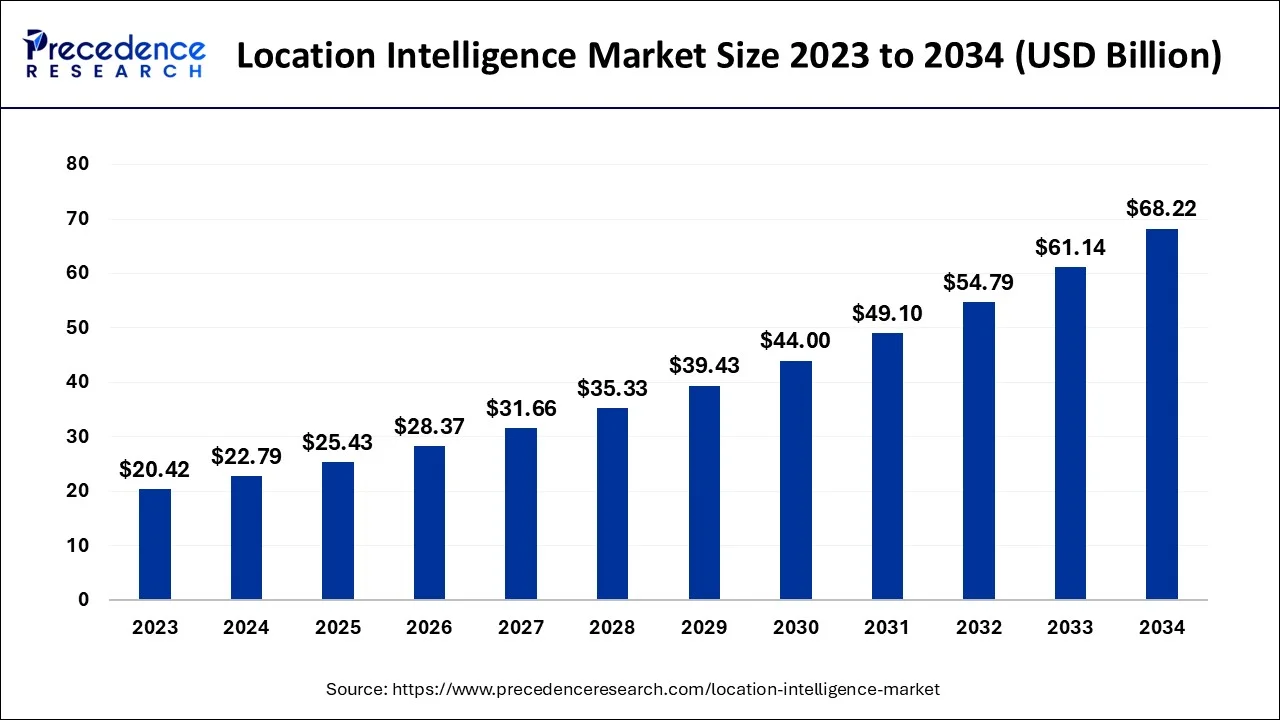
ICT industry specialist Shivani Zoting estimates the location intelligence market at USD 28.37 billion in 2026, with continued technology adoption expected to take the market to USD 74.81 billion by 2035 at a CAGR of 11.39%. Leading location intelligence market providers such as Bosch Software Innovations GmbH, Esri, HERE Technologies, are expanding their capabilities across segments including by application, by service, by solution, by location type, by vertical.
Source: https://www.precedenceresearch.com/location-intelligence-market
 Get a Sample
 Table Of Content


What is the Location Intelligence Market Size?
The global location intelligence market size is accounted at USD 25.43 billion in 2025 and predicted to increase from USD 28.37 billion in 2026 to approximately USD 74.81 billion by 2035, representing a CAGR of 11.39% from 2026 to 2035. The market is driven by rising adoption of GIS technologies, IoT, big data analytics, and demand for real-time location-based insights across industries.
Location Intelligence Market Key Takeaways
- By application, the sales and marketing optimization segment held the largest share of around 20.7% in 2025, the segment is expected to sustain its dominance during the forecast period.
- By service, the system integration segment dominated the market with a revenue share of 46.2% in 2025, the segment is expected to witness a significant rate of growth during the forecast period.
- By vertical, the transportation and logistics segment accounted highest revenue share of over 19.4% in 2025, the segment will continue to grow at a significant rate during the forecast period.
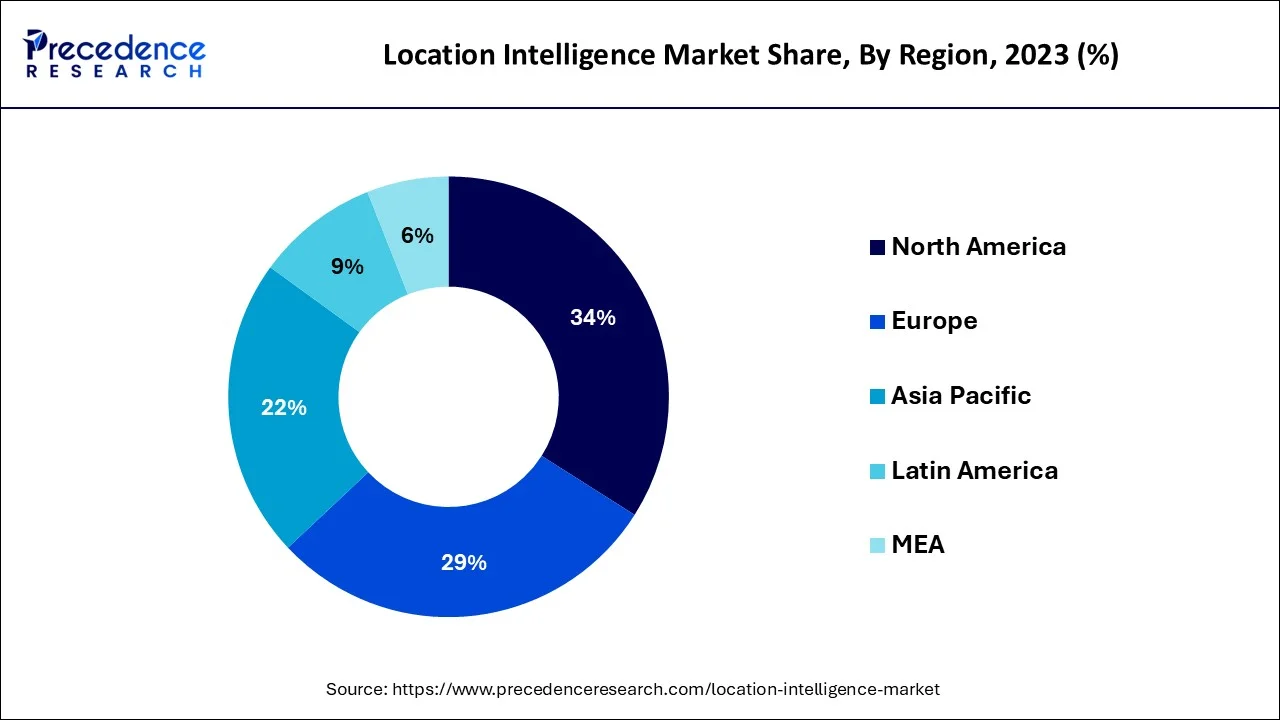
- By region, North America dominated the market in 2025 with 34% revenue share, the region is expected to sustain its dominance during the forecast period. On the other hand, Asia Pacific is anticipated to witness the fastest rate of growth throughout the forecast period.
Market Overview
The location intelligence market offers collection, analysis and utilization of geospatial data to derive valuable insights for businesses and organizations. Location intelligence often integrates with other technologies such as Internet of Things (IoT), artificial intelligence (AI), and big data analytics to enhance its capabilities and provide more comprehensive insights. Location intelligence has a wide range of applications across various industries, including real estate, transportation and logistics, retail, urban planning, public safety, environmental monitoring, and marketing. Organizations use location intelligence to optimize operations, improve customer experiences, and enhance decision-making. Location intelligence solutions often include interactive maps and visualizations that help users understand complex spatial relationships and patterns. These maps can display data points, routes, heatmaps, and other information relevant to specific use cases.
Location Intelligence Market Growth Factors
The sector is primarily driven by the increasing adoption of smart devices and rising investments in internet of things and network services in order to provide smarter applications and improved network connectivity. The COVID-19 pandemic led to a growth in the use of location intelligence systems to handle the shifting business environment since they make it easier for companies to analyse, map, and share customer location data.
Market Scope
| Report Coverage | Details |
| Market Size in 2025 | USD 25.43 Billion |
| Market Size by 2035 | USD 74.81 Billion |
| Growth Rate from 2026 to 2035 | CAGR of 11.39% |
| Largest Market | North America |
| Base Year | 2025 |
| Forecast Period | 2026 to 2035 |
| Segments Covered | Application, Service, Solution, Location Type, Vertical, and Region |
| Regions Covered | North America, Europe, Asia-Pacific, Latin America, and the Middle East & Africa |
Market Dynamics
Driver
Growth of IoT and connected devices
The market for location intelligence has been significantly fueled by the development of the Internet of Things (IoT) and connected devices. IoT stands for the internet-based network of interconnected devices that exchange data and communicate with one another. These gadgets produce a ton of geospatial data, including position data, due to their different sensors. Organizations may use this data for insightful analysis and decision-making due to the integration of location intelligence with the Internet of Things. For instance, location intelligence can be used to optimize routes, track assets, and keep an eye on supply chain activities in the transportation and logistics sector. Businesses can find inefficiencies, cut costs, and enhance overall operational efficiency by analyzing real-time location data from linked devices.
Location intelligence is also very important for the creation of smart cities. IoT devices are spread out over metropolitan areas to collect data on many factors, such as traffic patterns, energy usage, and air quality, as cities become more linked and digitally changed. Platforms for location intelligence can process and examine this data, giving city administrators useful information for resource allocation, infrastructure development, and urban planning. Additionally, the ramifications of IoT-enabled location intelligence extend to industries including healthcare, agriculture, and environmental monitoring.
Restraint
Data privacy and security concerns
The location intelligence sector is significantly constrained by factors such as data security and privacy. Sensitive information about people and organizations, such as precise geographic coordinates, residential addresses, or travel patterns, is frequently included in location-based data. Although this data may be extremely important, its handling could result in hazards. Access to location information that is not authorized is one of the key issues. Sensitive information can be accessed by malevolent actors if it is not sufficiently protected, which could result in misuse or exploitation. Organizations may suffer reputational harm, financial losses, and legal repercussions as a result of data breaches.
The high-profile data breaches in recent years have increased regulatory attention and raised worries about data privacy. Businesses in the location intelligence sector use strict security measures to allay these worries. This comprises access limits, authentication methods, and regular security audits, as well as the encryption of data both in transit and at rest. Despite these measures, privacy and security concerns are observed to restrain the growth of the market.
Opportunity
Integration of real time analytics
The integration of real-time analytics is observed to present multiple opportunities for the growth of the location intelligence market. Real-time analytics offers invaluable insights into consumer behavior, industry trends, and competitive environments. Companies can acquire a thorough picture of the preferences, movements, and interactions of their target audience by combining location data with other sources, giving them the ability to make data-driven decisions with previously unheard-of speed. Location data is becoming increasingly available and plentiful as mobile devices and IoT technologies proliferate. Utilizing this information, businesses may better understand client preferences, track customer foot traffic, and optimize store layouts to improve the entire shopping experience. Businesses can respond rapidly to new opportunities or possible problems due to real-time data.
Retailers can more effectively target their marketing efforts by using location intelligence to identify underperforming locations or unexplored markets. Businesses can, for instance, keep track of how a promotional campaign is affecting foot traffic in various places and modify their strategy as necessary. Real-time analytics built on location information in the logistics and transportation sector optimizes routes, forecasts delivery times, and follows goods. By giving customers precise delivery updates, this not only lowers costs but also increases customer happiness.
Application Insights
The sales and marketing optimization segment dominated the global market in 2023, the segment is expected to witness a significant rate of growth during the forecast period. Sales and marketing teams rely heavily on customer data and insights to target their efforts effectively. Location intelligence can provide valuable information about customer demographics, preferences, and behaviors, allowing businesses to tailor their marketing campaigns and sales strategies. Location intelligence allows businesses to personalize their marketing efforts. By understanding the location of their customers, businesses can tailor their marketing messages and offers to be more relevant. Personalized marketing often leads to higher conversion rates and increased customer loyalty. Location intelligence tools provide valuable insights into consumer behavior, demographics, and preferences based on location data. This information is crucial for businesses to target the right audience effectively and optimize their sales and marketing strategies.
Service Insights
Based on services, the system integration segment held the largest share of the market and is expected to continue the trend throughout the forecast period. Many organizations have unique requirements when it comes to location intelligence. System integration services can help tailor location intelligence solutions to meet specific business needs. Customization often involves integrating location data into existing systems, such as CRM, ERP, or analytics platforms, to derive maximum value. Ensuring the quality and consistency of location data is critical for accurate decision-making. System integration services can help cleanse, standardize, and maintain data integrity as it flows into and out of location intelligence systems.
Vertical Insights
The transportation and logistics segment dominated the market and expected to generate significant revenue throughout the forecast period. Transportation and logistics operations often involve complex spatial considerations. Location intelligence solutions provide valuable insights into route optimization, vehicle tracking, and geospatial analysis. This complexity necessitates advanced tools and technologies, making this sector a natural fit for location intelligence. In the era of e-commerce and rapid delivery expectations, customers demand real-time tracking and accurate estimated delivery times. Location intelligence enables companies to meet these expectations by providing precise information.
Regional Insights
U.S. Location Intelligence Market Size and Growth 2026 to 2035
The U.S. location intelligence market size accounted for USD 6.05 billion in 2025 and is predicted to be worth around USD 18.63 billion by 2035, growing at a CAGR of 11.90% from 2026 and 2035.
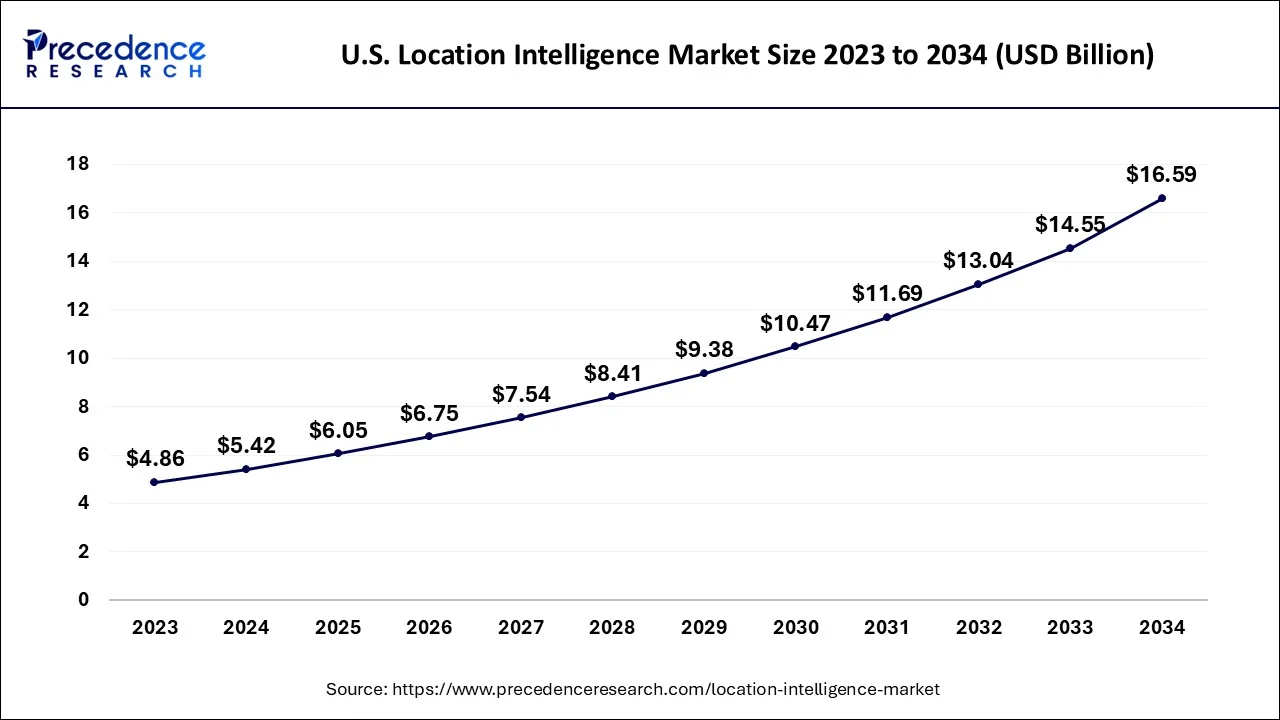
North America dominated the global local intelligence market in 2025, the region is expected to sustain its dominance during the forecast period. The overall rise in smartphone usage in the region with the presence of technologically advanced nature of network industry. As a result, it is projected that the local network, logistics and transportation industries will expand at a significant rate while promoting the growth of the market. North America has a substantial customer base for location intelligence solutions, including government agencies, businesses, and non-profit organizations.
U.S. Market Trends
The location intelligence market in the U.S. is growing due to increasing adoption of AI and IoT technologies, which enable real-time spatial data analysis and predictive insights. Widespread cloud integration and the need for data-driven decision-making across industries such as retail, transportation, and government are further driving demand. Additionally, businesses are leveraging location intelligence to optimize operations, enhance customer experiences, and improve strategic planning.
The region is home to many leading technology companies, research institutions, and startups that specialize in location intelligence. These organizations continually innovate and develop cutting-edge solutions to address various industries' needs. This customer demand drives the growth and development of the market. Many leading companies in the location intelligence market are based in North America. These companies offer a wide range of products and services that cater to global and regional markets. North America has a wealth of geographic data, including detailed maps, demographic information, and business data. These data sources are critical for location intelligence applications, and their availability contributes to the region's dominance.
What Makes Asia Pacific the Fastest-Growing Region in the Market?
Asia Pacific is expected to witness the fastest rate of growth throughout the forecast period. Governments and public sector organizations in the region are utilizing location intelligence for various purposes, including disaster management, public health, and infrastructure development. The growth of e-commerce in Asia Pacific has led to increased interest in location intelligence for supply chain optimization, targeted marketing, and customer experience enhancement. Countries in Asia Pacific are focusing on environmental monitoring and management, using location intelligence to track and mitigate environmental challenges such as air quality, water pollution, and natural disasters.
India Market Trends
The location intelligence market in the U.S. is growing due to the integration of AI and machine learning, enabling deeper insights from spatial data. Increasing demand for real-time logistics tracking, hyperlocal marketing, and IoT-driven analytics, along with government initiatives in public safety and urban planning, is further fueling market expansion. These factors make location intelligence a high-potential, dynamic sector across multiple industries.
How is the Opportunistic Rise of Europe in the Market?
Europe is experiencing opportunistic growth in the location intelligence market due to increasing adoption of GIS, IoT, and AI-driven analytics across industries like transportation, retail, and urban planning. Government initiatives focused on smart cities, public safety, and environmental monitoring are further driving demand. Additionally, the region's emphasis on data-driven decision-making and technological innovation is creating new opportunities for location intelligence solutions.
Competitive Landscape
The location intelligence market is semi-consolidated as it merges the established technology players with specialized companies involved in mapping, analytics, and geospatial software. Competition revolves around data accuracy, availability of real-time data, integration with the platform, and analytics capabilities, creating moderate to high entry barriers for newcomers.
The leading companies in this sector include Esri, HERE Technologies, Google, TomTom, and Precisely. Esri takes advantage of its overall GIS ecosystem, and HERE and TomTom focus on mapping and location services. Google uses a huge pool of geospatial data and cloud capabilities while Precisely concentrates on data enrichment and location intelligence.
Firms in the sector are reinforcing their positions on the market due to cloud integration, artificial intelligence-driven analytics, partnership with other players, strengthening their platforms, and undertaking acquisitions that boost their solutions and extend customer outreach.
The major obstacles to entry seem to be high costs of data acquisition, regulatory environment, confidentiality issues, intellectual property, and technological know-how, and competition is expected to become tougher as the technologies become better, AI/real-time analytics are spreading, and more devices become interconnected.
Company Profiles
Autodesk, Inc.
- HQ: San Francisco, California, USA
- Founded: 1982
- Ownership: Public
Company Overview:
- Autodesk is a company producing software for design and engineering purposes based around common themes used in architecture, engineering, construction, manufacturing, infrastructure, and media industry. Its portfolio includes packages such as AutoCAD, Revit, Civil 3D, Fusion, Inventor, and Autodesk Construction Cloud. Technologies such as the ones mentioned enable creating high-quality digital representations for buildings, infrastructure, products, and manufacturing processes and allow for creating digital twins in business. The company focuses on the development of AI, integration of processes, and modernization of all technologies leading to successful usage of digital models in operations. The company has been in the industry since 1982.
Key Strengths:
- Leader in CAD/BIM/specialized 3D design/engineering software technology.
- Strong registered users among construction and architecture, manufacturing and infrastructural businesses.
- Increased use of AI technologies, cloud communication, and the integration of project tasks.
Key Vulnerabilities:
- Being mostly a software-centric solution, the company depends on the availability of sensors, IoT, and operational systems for a comprehensive implementation of the full-scale digital twin.
- Competitors offer their specialized BIM and other simulation technologies used for this purpose.
- High complexity can lead to the necessity of implementation and operational training.
Bosch Software Innovations GmbH
- HQ: Berlin, Germany
- Founded: 2008
- Ownership: Bosch Group
Company Overview:
- Bosch Software Innovations GmbH referred to Bosch's software and IoT solutions business that aimed towards connected products, services, and business models. In 2021, Bosch merged Bosch Software Innovations with other specialized IoT and digital teams, forming Bosch.IO, which brought together Bosch's IoT and digital capabilities under one roof. The company invented IoT technologies for IoT platforms, connected assets, analytics, and digital services, which makes it an important player in Bosch's development of digital twin and connected Industry technology. Currently, Bosch's digital solutions are employed in connected factories, buildings, mobility, and asset management solutions and include asset tracking and IoT data visualization systems, to name a few.
Key Strengths:
- Strong industrial IoT history and experience of linking physical assets with software platforms.
- Benefits from Bosch's wide presence in mobility, manufacturing, building, and industrial technology areas.
- Possesses the combination of sensor, IoT, analytics, and software expertise.
Key Vulnerabilities:
- Bosch Software Innovations is no longer an independent company limiting its current effectiveness on the market.
- Digital twin solutions are included in Bosch's broader technology ecosystem.
- Competing with specialized cloud, IoT, industrial software, and digital twin companies.
Esri
- HQ: Redlands, California, USA
- Founded: 1969
- Ownership: Private
Company Overview:
- Esri is a key player in the field of GIS, mapping, and location intelligence technology provider. It has a robust ArcGIS platform which is capable of carrying out mapping, spatial analytics, 3D GIS, imagery, remote sensing, and data management. The platform is very important for the development of digital twins for the cities, utilities companies, transportation systems, environmental systems, and infrastructure as geographical context and real-time spatial information are required. Since it has a large number of customers in different sectors like government, public utilities, and infrastructure companies, it can effectively support large geospatial digital twin deployments.
Key Strengths:
- Has strong expertise in GIS, 3D mapping, spatial analytics, and location intelligence.
- Has a strong position in industries like government, public utilities, infrastructure, transportation, etc.
- ArcGIS has established itself as a reliable system for combining geographic, sensor, image, and operational data.
Key Vulnerabilities:
- Although it has a very adept geospatial platform, it does not offer a complete stack of industrial digital twin solutions.
- The enterprise GIS is complicated so it needs a lot of expertise.
- Is under a threat from mapping platform providers, engineering software developers, and other cloud-based geospatial companies.
HERE Technologies
- HQ: Eindhoven, Netherlands
- Founded: 1985 (through the company's predecessor)
- Ownership: Private
Company Overview:
- HERE Technologies is a global provider of digital mapping and location technology that offers mapping, navigation, positioning, routing, location intelligence, and geospatial data that meets automotive requirements. Its capability to create high-definition and real-time maps makes HERE highly relevant to digital twins, connected cars, smart mobility, logistics optimization, and autonomous driving fields. The firm's focus on a uniform live map enables regularly updated digital models of physical areas and transportation systems.
Key Strengths:
- Established automotive-grade mapping and location intelligence competencies.
- Strong partnerships with automotive companies, logistics firms, and transport service providers.
- Capabilities with high added value in the field of real-time mapping, routing, positioning, and connected cars.
Key Vulnerabilities:
- Focused exposure to automotive and mobility markets compared with general enterprise digital twin platforms.
- Needs to integrate external data from IoT, engineering, and operational systems to create a complete digital twin.
- Experiences strong competition with the companies providing mapping, navigation, cloud, and location intelligence solutions.
MDA Corp. / MDA Space Ltd.
- HQ: Brampton, Ontario, Canada
- Founded: 1969 heritage
- Ownership: Public
Company Summary:
- MDA Space Ltd., previously known as MDA Corp./MDA Ltd, is a space tech corporation from Canada which focuses on satellite solutions, space robots, earth observation and geography-based intelligence. Its geography intelligence solutions use space pictures, satellite imaging, and analysis to generate useful data for defence, nature conservation, sea observation, and infrastructure assessment. Thus MDA Space is a near but not the classic digital-twin software developer, since it provides high-value earth observation and geography-based intelligence input data for big digital representations of the physical world. Its planned merger with CLS in 2026 will help it to develop further AI-powered analytics in earth observation and merge satellite data with downstream analytics.
Key Strengths:
- A deep knowledge of geography-based intelligence and earth observation.
- Strong experience in space robots and satellite systems.
- The ability to provide high-value earth intelligence for such industries as infrastructure and environmental protection.
Key Vulnerabilities:
- Not a standard enterprise digital-twin software creator.
- High costs of both space data infrastructure and data provision and usage.
- Business dependence on governmental and army space programs may lead to unnecessary concentration in the market.
Top Companies Operating in the Location Intelligence Market & Their Offerings
- Autodesk, Inc.: It provides GIS-enabled design and modeling software that integrates spatial data for planning, infrastructure, and urban development projects.
- Bosch Software Innovations GmbH: It offers IoT and location-based analytics solutions for smart logistics, mobility, and industrial applications.
- ESRI: It delivers comprehensive GIS and location intelligence platforms, including ArcGIS, for mapping, spatial analysis, and data visualization.
- HERE Technologies: It provides mapping, geolocation, and real-time traffic data services for logistics, automotive, and enterprise applications.
- MDA Corp.: It offers satellite imaging, geospatial analytics, and location-based intelligence solutions for defense, government, and commercial markets.
Location Intelligence Market Companies
- Autodesk, Inc.
- Bosch Software Innovations GmbH
- ESRI
- HERE Technologies
- MDA Corp.
- Navizon, Inc.
- Pitney Bowes, Inc.
- Qualcomm Technologies, Inc.
- Supermap Software Co., Ltd.
- Tibco Software, Inc.
- Trimble, Inc.
- Trueposition, Inc.
- Wireless Logic
Recent Developments
- In February 2022, an Indian startup that specialises in location information, DataSutram, said that it has raised US$2.07 million from a group of investors that included Varanium Capital and Yatra Angel Network. The company intended to use the funds raised to increase its activities in the Gulf and South-East Asian regions.
- In November 2022, an advertisement technology company, TapTap announced the launch of geospatial intelligence platform for programmatic media in Italy. The launch of new service and offering is a result of the company's expansion in Europe.
Segments Covered in the Report
By Application
- Workforce Management
- Facility Management
- Risk Management
- Asset Management
- Sales & Marketing Optimization
- Remote Monitoring
- Customer Management
- Others
By Service
- Consulting
- System Integration and Implementation
- Support and Maintenance
By Solution
- Type
- Geocoding and Reverse Geocoding
- Reporting and Visualization
- Thematic Mapping and Spatial Analysis
- Data Integration and ETL
- Others (Demographic Data, Route Optimization)
- Deployment
- Cloud
- On-premises
By Location Type
- Indoor Location
- Outdoor Location
By Vertical
- Retail and Consumer Goods
- Manufacturing & Industrial
- Government & Defense
- BFSI
- IT & Telecom
- Transportation & Logistics
- Utilities & Energy
- Media & Entertainment
By Geography
- North America
- Europe
- Asia-Pacific
- Latin America
- Middle East and Africa
For inquiries regarding discounts, bulk purchases, or customization requests, please contact us at sales@precedenceresearch.com
Frequently Asked Questions





Ask For Sample
No cookie-cutter, only authentic analysis – take the 1st step to become a Precedence Research client
 Get a Sample




 sales@precedenceresearch.com
 Schedule a Meeting
