



Low Glycemic Index Rice Market Trends, Companies, Revenue / Sales Performance, Food Production, Processing Capacity, Sales Volume, Distribution Performance, Competitive Landscape, and Industry Outlook
Low Glycemic Index Rice Market (By Type: Basmati-dominated, Jasmine, Brown-fastest-growing, Branded; By Application: Diabetes Management-dominated, Weight Management-fastest-growing, Sports Nutrition, General Health and Wellness; By Distribution Channel: Supermarkets/Hypermarkets-dominated, Online Retailers-fastest-growing, Health Food Stores, Pharmacies) - Global Industry Analysis, Size, Trends, Leading Companies, Regional Outlook, and Forecast 2026 to 2035
Source: https://www.precedenceresearch.com/low-glycemic-index-rice-market
 Get a Sample
 Table Of Content


What is Low Glycemic Index Rice Market Size in 2026?
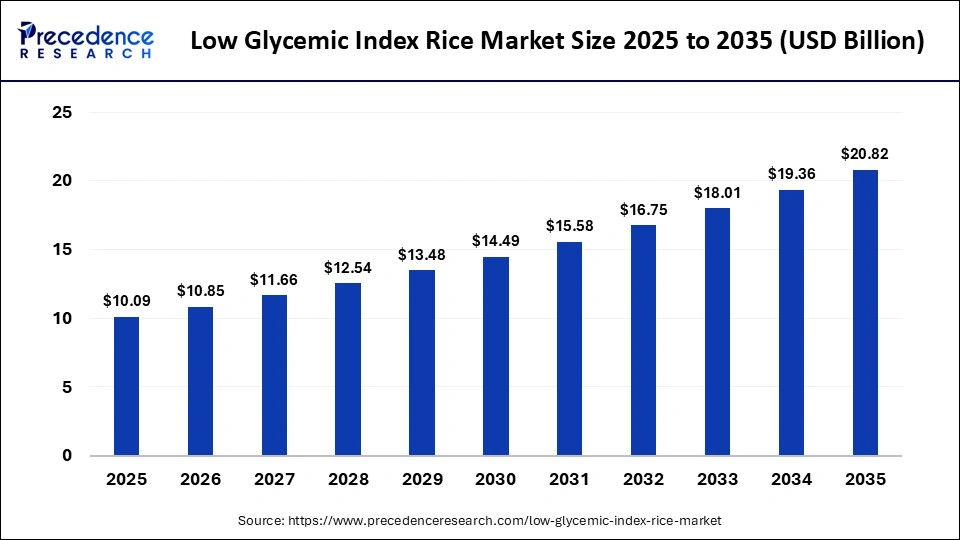
The global low glycemic index rice market size was calculated at USD 10.09 billion in 2025 and is predicted to increase from USD 10.85 billion in 2026 to approximately USD 20.82 billion by 2035, expanding at a CAGR of 7.51% from 2026 to 2035. The low glycemic index rice is a promising solution for diabetes management and improved healthcare due to the rising incidence of several health problems, such as obesity, cancer, heart conditions, and diabetes.
Key Takeaways
- Europe dominated the low glycemic index rice market in 2025.
- Asia Pacific is expected to grow at the fastest CAGR in the market during the forecast period.
- By type, the basmati segment dominated the market in 2025.
- By type, the brown segment in the market is expected to grow at the fastest CAGR in the market during the forecast period.
- By application, the diabetes management segment dominated the market in 2025.
- By application, the weight management segment is expected to grow at the fastest rate in the market in 2025.
- By distribution channel, the supermarkets/hypermarkets segment dominated the market in 2025.
- By distribution channel, the online retailers segment is expected to grow at the fastest CAGR in the market during the forecast period.
Low Glycemic Index Rice: Promising Solution to meet Energy and Nutrient Needs
The low glycemic index rice market is expanding due to its great importance in managing diabetes and related health conditions, and its global reach as the main staple food for humans. The International Rice Research Institute (IRRI) and the Max Planck Institute are dedicated to exploring the potential of low glycemic index rice, owing to the rising prevalence of type 2 diabetes. Furthermore, the developed countries, like the Asia Pacific, are witnessing the rising health challenges of acute diabetes, driven by the high consumption of refined carbohydrates, calorie-dense sugary drinks, and ultra-processed food. Asia Pacific experiences a high demand for polished white rice, which is a staple food associated with the increased glycemic load. Research suggests that over 537 million people were affected by diabetes in 2021, and it is expected to exceed 780 million by 2045.
What is the Role of AI in the Low Glycemic Index Rice Market?
The various techniques and advanced technologies like thermal imaging, hyperspectral imaging, machine vision, Artificial Intelligence based data modelling techniques, and spectroscopy are vital in predicting characteristics of rice, such as shape, color, hardness, and milling yield. Recent AI innovations across the rapidly expanding market enable data-driven modelling and process optimization to deliver improved rice quality. AI is used to conduct several functions, such as implementing control strategies, assessing food quality, generating predictive insights, and classifying food products.
Low Glycemic Index Rice Market Trends
- Biofortification: There is a surging demand for fortified low glycemic index rice, and the increased focus on glycemic control with essential micronutrients. Moreover, there is a high demand for ultra-low GI and high protein varieties that further expand the low glycemic index rice market. The high preference for ready-to-eat products and specialty blends by urban consumers is due to a rapid shift towards convenience and healthy food.
- Climate Resilience: The new varieties include drought-resistant and low-emission varieties. There are increased efforts to meet global sustainability mandates while maintaining low glycemic index properties.
Market Scope
| Report Coverage | Details |
| Market Size in 2025 | USD 10.09 Billion |
| Market Size in 2026 | USD 10.85 Billion |
| Market Size by 2035 | USD 20.82 Billion |
| Market Growth Rate from 2026 to 2035 | CAGR of 7.51% |
| Dominating Region | Europe |
| Fastest Growing Region | Asia Pacific |
| Base Year | 2025 |
| Forecast Period | 2026 to 2035 |
| Segments Covered | Type, Application, Distribution Channel, and region |
| Regions Covered | North America, Europe, Asia-Pacific, Latin America, and Middle East & Africa |
Segmental Insights
Type Insights
How does the Basmati Segment Dominate the Low Glycemic Index Rice Market in 2025?
The basmati segment dominated the market in 2025, owing to the distinct features of basmati rice and its ease of use for different types of menus. Health-conscious consumers prefer higher-quality, nutritious food like Basmati rice due to its high nutritional value. Basmati maintains a competitive edge in international trade through sustainable and ethical farming practices.
The brown segment is expected to grow at the fastest CAGR in the market during the forecast period due to the nutritionally superior performance of whole grains, including millet, oats, brown rice, whole wheat bread, and rye. The brown rice is rich in vitamins, dietary fiber, and minerals. Brown rice is rich in magnesium, thiamin, phosphorus, manganese, selenium, vitamin B6, and niacin.
Application Insights
What made Diabetes Management the Dominant Segment in the Low Glycemic Index Rice Market in 2025?
The diabetes management segment dominated the market in 2025, owing to the increased emphasis on blood sugar regulation, hormonal response, and complication prevention. The consumers are adopting genetically improved and traditionally favorite varieties. The low glycemic index rice has become a primary dietary solution to combat the global diabetes epidemic.
The weight management segment is estimated to grow at the fastest rate in the market during the predicted timeframe due to the growing need and improved treatments for appetite regulation, insulin sensitivity, and fat oxidation. There is a high preference for natural varieties like black rice and red rice, including whole grains like brown basmati, and specially formulated white rice. The low glycemic index rice has emerged as an integral solution for sustainable weight management.
Distribution Channel Insights
How did the Supermarkets/Hypermarkets Segment Dominate the Low Glycemic Index Rice Market in 2025?
The supermarkets/hypermarkets segment dominated the market in 2025, owing to high market penetration of whole grain and low GI rice products to meet the rising demand from fitness-conscious and diabetic consumers. These stores act as a bridge between important and healthy foods and their consumption. The major grocery chains like Walmart, Trader Joe's, Whole Foods, and Costco have increased their stocking of whole grain and low glycemic index rice solutions.
The online retailers segment is anticipated to grow at a notable rate in the low glycemic index rice market during the upcoming period due to various platforms as an information hub for informed purchasing and online retail as the primary distribution engine. There are improvements in logistics and delivery infrastructure, including 10-minute delivery options. E-commerce enables small-scale producers to reach international markets directly.
Regional Insights
How does Europe dominate the Low Glycemic Index Rice Market in 2025?
Europe dominated the market, owing to government and public health initiatives, sustainability, health awareness, and chronic disease management. There is a rapid shift in regulatory bodies and industries towards health-conscious rice imports. The European Commission is dedicated to implementing new regulations to protect its domestic rice industry. It also makes efforts to promote sustainable agri-foods by allocating funds. It also focuses on promoting functional and healthy staples like low glycemic index grains. The EU farming initiatives aim to establish a more innovative and resilient food system by prioritizing nutrition and public health.
Germany Low Glycemic Index Rice Market Analysis
The public health campaigns, the expansion of retail and digital technologies, and dietary lifestyle trends are accelerating the growth of the market in Germany. In August 2025, the German government launched US$2.9 million initiative to accelerate climate-smart rice rice production in Nigeria. This initiative is a three-year project that focuses on reducing greenhouse gas emissions, including methane, from rice cultivation. This project aims to support 12,000 smallholder farmers in Benue, Kano, and Nasarawa States to adopt climate-smart rice farming practices.
What is the Potential of the Low Glycemic Index Rice Market in the Asia Pacific?
Asia Pacific is expected to grow at the fastest CAGR in the market during the forecast period due to diabetes crisis management, government-led biofortification programs, and the expansion of modern retail. The major government programs and initiatives are taken by several Asian Pacific countries, like the Philippines, through the Nourishing Futures program, and India through the nutritional security partnership. The scientific innovations focus on enabling the conversion of popular white rice varieties into healthier versions without compromising yield.
India Low Glycemic Index Rice Market Trends
Indian consumers are focusing on managing blood sugar, moving towards wellness trends, and adopting advanced breeding techniques that boost the growth of the market. The Agricultural and Processed Food Products Export Development Authority (APEDA) collaborated with the IRRI South Asia Regional Centre (ISARC) to transform the rice-based agri-food systems in India by enhancing the value of non-basmati rice varieties. This expanding initiative also focused on advancing the production of nutrient-rich rice-based food products. It will create opportunities in both domestic and international markets.
How is the Noticeable Growth of North America in the Low Glycemic Index Rice Market?
North America is expected to grow at a notable rate in the market in 2025, owing to the increased adoption of health-focused, ketogenic, low-carbon, and weight management diets, and the popularity of global cuisines. In March 2025, the U.S. Department of Agriculture/Foreign Agricultural Service (USDA/FAS) received the critical international marketing and promotion funding of $5million, in addition to the $6.5 million in the Regional Agricultural Promotion Program (RAPP) funds. The other major regional growth drivers include Walmart expansion, the acquisition of Dainty Foods, and new product launches.
U.S. Low Glycemic Index Rice Market Analysis
The expanded retail footprint, advances in food processing and marker-assisted breeding, and increasing rates of diabetes and obesity are driving the market in the U.S. The U.S. International Trade Commission published a report on global competitiveness and the rice industry in the U.S. This report offers a qualitative and quantitative assessment of the impact of government programs and policies on food security in developing countries and the rice industry in the U.S.
Low Glycemic Index Rice Market Value Chain Analysis
- Raw Material Procurement (Farms, Fisheries, etc.)
- This stage includes advanced post-harvest technology and the selection of specific breeds and specialized strains by procurement teams.
Key Players: Ricegrowers Limited, Nestiva, Sugar Watchers Low GI Staples, Daawat Foods, Chaman Lal Setia Exports Ltd., Parish Rice, Advanta Seeds, Corteva Agriscience, Syngenta Group, SDLG Radiant Pvt. Ltd., The Little Rice Company, Lundberg Family Farms, Siam Lotus. - Retail Sales and Marketing
In this stage, brands focus on using e-commerce to assess benefits and pricing, and consumers prefer organic varieties.
Key Players: Ricegrowers Limited, LT Foods, Lundberg Family Farms, Tilda, Chaman Lal Setia Exports, Sugar Watchers, Parish Rice, Nestiva, DiabeSmart. - Waste Management and Recycling
This stage involves wastewater management, including circular recovery and bio-based products, and recycling involves rice husk and rice bran.
Key Players: Veolia Environment S.A., SUEZ, Antony Waste Handling Cell, Organic Recycling Systems Limited, Ricegrowers Limited, Nestiva, ITC Limited, Chaman Lal Setia Exports Ltd., Daawat Foods.
Top Companies in the Low Glycemic Index Rice Market and Their Offerings
- Ricegrowers Limited: SunRice low GI white rice, SunRice Doongara low GI brown rice, SunRice low GI microwave rice, SunBrown Calrose rice.
- LT Foods: Daawat quick cooking black rice, Daawat I'm organic range, Daawat quick cooking brown rice, specialty health variants.
- KRBL Limited: India Gate Uplife Lite everyday rice, India Gate Uplife weight watchers brown rice, India Gate Uplife gut pro basmati brown rice.
- Tilda Ltd: Pure original Basmati rice, wholegrain Basmati rice, Tilda Rozana & Nazarana, ready-to-heat range.
- Sugar Watchers: Low GI white rice, low GI rice-based products, trial and combo packs.
Other Companies in the Low Glycemic Index Rice Market
- Nestiva
- Parish Rice
- Chaman Lal Setia Exports
- SDLG Radiant Pvt. Ltd.
- First Choice Food Products Pvt Ltd.
- Siam Lotus
- The Little Rice Company
- Cahokia
Recent Developments
- In July 2025, LT Foods made a partnership with Sustainable Rice Platform (SRP) and technical experts to launch a pioneering initiative that aims to advance rice cultivation through climate-smart and scalable practices. Moreover, the SRP introduced its Low-Carbon Assurance methodology, which is a framework designed to support science-based approaches to reduce greenhouse gas emissions in rice production systems. (Source: https://sustainablerice.org)
- In February 2026, KRBL Limited announced the expansion of its health-focused rice portfolio with a low glycemic index variant under its health-oriented Uplife brand. This initiative has targeted consumers who look for sustained energy levels and blood sugar management.
(Source: https://economictimes.indiatimes.com)
Segments Covered in the Report
By Type
- Basmati-dominated
- Jasmine
- Brown-fastest-growing
- Branded
By Application
- Diabetes Management-dominated
- Weight Management-fastest-growing
- Sports Nutrition
- General Health and Wellness
By Distribution Channel
- Supermarkets/Hypermarkets-dominated
- Online Retailers-fastest-growing
- Health Food Stores
- Pharmacies
By Region
- North America
- Europe
- Asia-Pacific
- Latin America
- Middle East & Africa
For inquiries regarding discounts, bulk purchases, or customization requests, please contact us at sales@precedenceresearch.com
Frequently Asked Questions





Ask For Sample
No cookie-cutter, only authentic analysis – take the 1st step to become a Precedence Research client
 Get a Sample




 sales@precedenceresearch.com
 Schedule a Meeting
