



Minivans Market Trends, Leading Companies, Company Revenue / Sales Performance, Manufacturing Capacity, Production Cost, Supply Chain Performance, Pricing Analysis, Competitive Landscape, and Industry Outlook
Minivans Market (By Fuel Type: Diesel, Petrol, Electric, Other) - Global Industry Analysis, Size, Trends, Leading Companies, Regional Outlook, and Forecast 2026 to 2035
Source: https://www.precedenceresearch.com/minivans-market
 Get a Sample
 Table Of Content


What is Minivans Market Size?
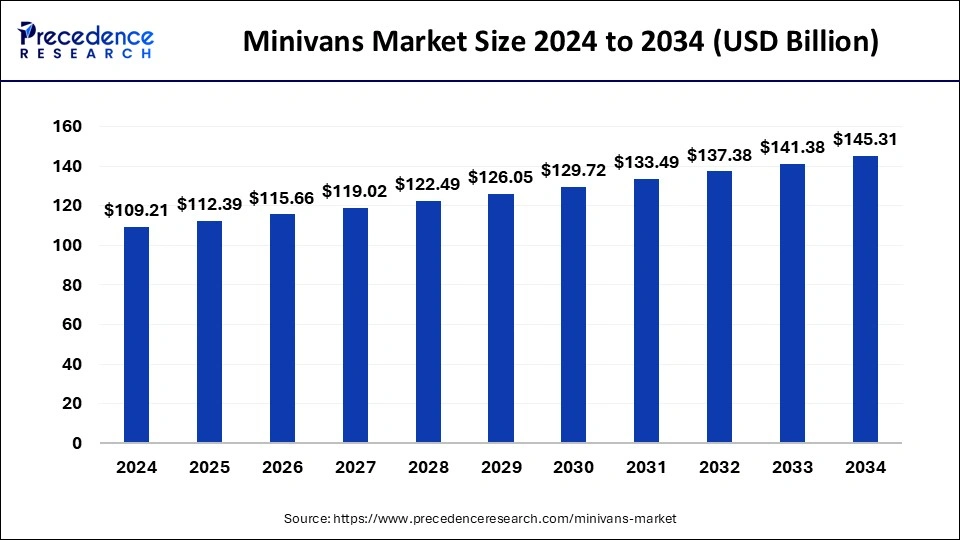
The global minivans market size is estimated at USD 112.39 billion in 2025 and is predicted to increase from USD 115.66 billion in 2026 to approximately USD 149.29 billion by 2035, expanding at a CAGR of 2.88% from 2026 to 2035. Increasing disposable income, affordability, and spending on passenger vehicles are major factors influencing the minivans market growth.
Market Highlights
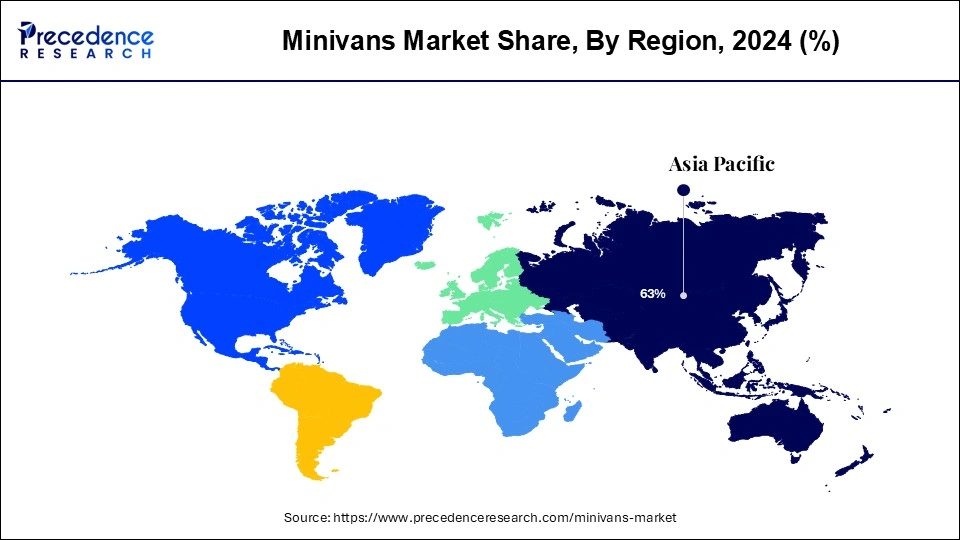
- Asia Pacific dominated the market with the largest revenue share of 63% in 2025.
- North America is expected to grow at a solid CAGR of 3.52% during the period studied.
- By fuel type, the diesel segment has contributed more than 90% of revenue share in 2025.
- By fuel type, the electric segment will grow at the fastest rate over the forecast period.
Minivans Market Overview: Understanding Driving Comfort
A minivan is a vehicle built on a small-car platform with a unibody design, integrating the chassis and body into a single structural unit. These vehicles can accommodate up to eight passengers and serve as multi-purpose vehicles capable of transporting both people and cargo. The growth of the minivans market is driven by the expansion of the travel and tourism industry, the development of the electric vehicle sector, and the introduction of a wider variety of products. Manufacturers are launching new, stylish minivans featuring excellent passenger and cargo space, flexible floor plans, and connected technologies, which are key selling factors for these vehicles.
Minivans Market Growth Factors
- Rising product launches along with improved functionality can drive the minivans market growth shortly.
- Rising demand for electric vehicles is expected to fuel the market growth of minivans.
- Electric minivans cater to environmental concerns and reduce fuel costs, which can drive the minivans market growth further.
- Technological advancements in the industry will also likely help in the minivans market expansion.
Market Outlook
- Market Growth Overview: The minivans market is growing due to the rising demand for family-oriented vehicles, enhanced safety features, and versatile seating configurations. Additionally, increasing disposable incomes and urbanization are driving consumers toward multi-purpose vehicles for both personal and commercial use.
- Global Expansion: The market is expanding worldwide as automakers introduce fuel-efficient, hybrid, and electric minivan models to meet diverse consumer needs. Emerging regions such as Asia-Pacific and Latin America present growth opportunities due to increasing urban populations, rising middle-class income, and expanding transportation infrastructure.
- Major Investors: Key investors in the market include automobile manufacturers, private equity firms, and automotive technology investors. Their contributions focus on R&D for electric and hybrid models, advanced safety features, and innovative infotainment systems, which are enhancing vehicle appeal and market adoption globally.
Market Scope
| Report Coverage | Details |
| Market Size in 2025 | USD 112.39 Billion |
| Market Size in 2026 | USD 115.66 Billion |
| Market Size by 2035 | USD 149.29 Billion |
| Growth Rate from 2026 to 2035 | CAGR of 2.90% |
| Largest Market | Asia Pacific |
| Base Year | 2025 |
| Forecast Period | 2026 to 2035 |
| Segments Covered | Fuel Type and Regions |
| Regions Covered | North America, Europe, Asia-Pacific, Latin America, and Middle East & Africa |
Market Dynamics
Drivers
Innovative features
The minivans market is marked by continuous innovation and a dynamic landscape. Automotive manufacturers in this sector are committed to enhancing the driving experience through the introduction of advanced features. These include state-of-the-art safety technologies, entertainment systems, and improved fuel efficiency. By focusing more on the evolving expectations of consumers, minivan manufacturers are leading the way in integrating technological advancements into their vehicles. This dedication to innovation not only drives market growth but also ensures that minivans remain appealing to a wide range of consumers seeking modern and efficient transportation solutions for their families.
- In March 2024, BYD, a prominent Chinese electric car manufacturer, made a significant foray into the European automotive landscape by introducing the eye-catching D9 minivan as part of its Denza brand's grand debut. The D9 minivan, an elegant people mover, is not just a vehicle; it's a fusion of innovation and luxury.
Restraint
High purchase prices can impede market growth.
Minivans generally have a higher purchase price compared to automobiles. Hence, consumers in developing countries are expected to prefer more affordable cars over minivans. Additionally, minivans do not offer an all-wheel-drive option and typically have lower fuel efficiency compared to other passenger vehicles by consuming more fuel. These factors may hinder the growth of the global minivans market during the forecast period.
Opportunity
Rising demand for electric and hybrid options
An exciting opportunity in the minivans market lies in addressing the increasing demand for environmentally sustainable transportation. With growing global awareness of climate change, consumers are seeking electric and hybrid options. By introducing eco-friendly minivan models, manufacturers can access a burgeoning market segment focused on reducing carbon footprints. Moreover, Major trends during the forecast period include the development of more compact and fuel-efficient models, an emphasis on luxury features and premium interiors, the use of lightweight materials and aerodynamic designs for improved efficiency, customization of minivans for specialized applications, and collaboration between automakers and technology companies.
- In October 2023, Volvo, a brand synonymous with SUVs, sedans, and wagons, unveiled its first-ever minivan, the EM90, in a rather unconventional way. The EM90 will be an all-electric offering, making it a clean alternative in the minivans market mostly populated by combustion engines.
Segment Insights
Fuel Type Insights
The diesel segment dominated the market in 2024 and is expected to grow at a rapid pace in the minivans market during the forecast period. The higher customer preference for diesel minivans can be attributed to the diesel fuel segment's significant revenue share in the market. Diesel-powered minivans and other multipurpose vehicles, which are ideal for light-duty carrying and towing, offer efficiency and power. These vehicles can effectively manage cargo while maintaining lower operating costs compared to other fuel types. Furthermore, most available minivan models are equipped with diesel engines, reinforcing their market dominance.
The electric segment will grow at the fastest rate in the minivans market over the forecast period. The electric vehicle market is rapidly expanding and evolving due to advancements in battery technology and related areas. Reducing fossil fuel consumption and combating global warming have become key priorities for global leaders and automotive manufacturers. Government initiatives and a surge in new product launches are anticipated to drive growth in the global minivans market. For example, media reports indicate that more than ten electric minivan models are expected to be launched in the coming years, including the Chrysler Pacifica EV, Voyah Dreamer, Mercedes EQT, and Hyundai Staria FCEV.
- In January 2022, King Long Longyao Electric Minivan Launched in the Chinese Car Market. King Long is one of China's largest commercial vehicle makers, best known for their King Long branded city and long-distance buses. Like so many Chinese automakers, the company has gone full into electric vehicles in recent years.
Regional Insights
What is the Asia Pacific Minivans Market Size?
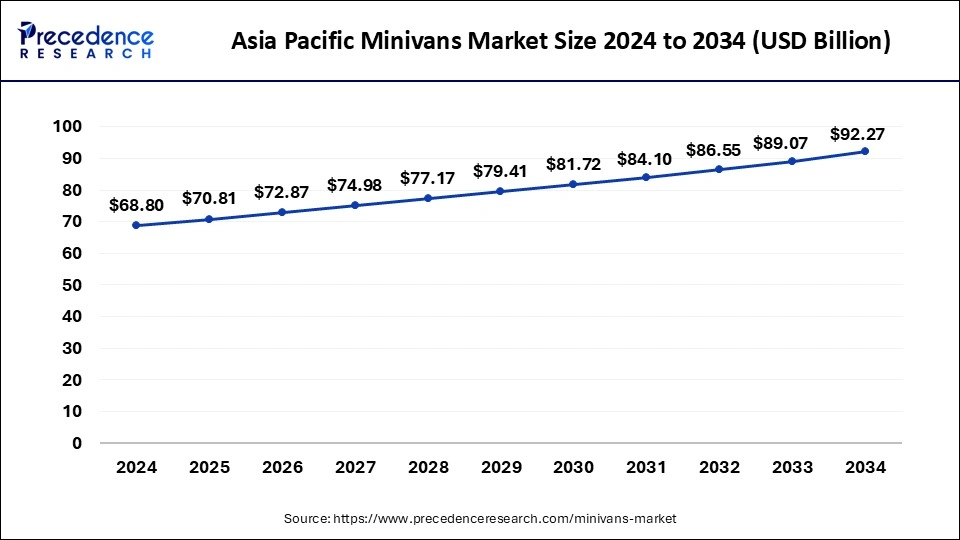
The Asia Pacific minivans market is valued at USD 70.81 billion in 2025 and is expected to be worth around USD 95.02 billion by 2035, at a CAGR of 2.98% from 2026 to 2035.
What Made Asia Pacific the Dominant Region in the Market in 2024?
Asia Pacific dominated the global minivans market in 2024. There is a notable demand for minivans among consumers in China and Japan. Buyers in these regions prefer minivans due to their body construction and ample luggage capacity. Additionally, the strong presence of major market players, coupled with increased brand recognition and market penetration, contributes to a larger market share. The market in this region is well established, with higher income levels linked to frequent product releases.
- In May 2024, Honda unveiled the third-generation Freed ahead of its market launch in Japan, scheduled for June 2024. The small three-row minivan adopts styling cues inspired by the larger Step WGN. It is available in standard Air and rugged Crosstar versions, offering the option between gasoline and self-charging hybrid powertrains.
Changing Consumer Perceptions Drives North America
North America is expected to host the fastest-growing minivans market during the period studied. The region's highest growth rate is primarily due to changing consumer perceptions of minivans, now seen as luxurious and stylish vehicles. Key players are driving market growth through increased product launches and deeper market penetration. New minivan models offer added perks that enhance their luxurious appearance and provide comfortable space, which makes them ideal for outings with family and friends.
- In 2022, the new Kia Corporation has plans to sell a minivan in the United States called the Carnival Hi Limousin
Large Population Fuels China
Due to the presence of a large population, the demand for minivans in China is increasing. Additionally, the rapid urbanization and expanding industries are increasing the use of these minivans for comfort and utility. This, in turn, is increasing their productivity and advancements.
Demand For Electric Minivans Propels Europe
Europe is expected to grow significantly in the minivans market during the forecast period, due to growing demand for electric minivans. The presence of stringent regulations is also increasing their development, where the investments are driving their development. The companies are developing luxury minivans with versatility suitable for families, which is promoting the market growth.
U.S. Driven by Modern Minivans
The U.S. is developing various modern minivans, which are attracting consumers and driving their production rates. The growing demand for multi-passenger vehicles is slowly increasing their adoption due to their flexible seating and larger cargo capacity. The companies are also redesigning and developing hybrid models.
Compact Minivans Push UK
The companies in the UK are developing compact minivans due to their growing consumer demands. Additionally, the growth in the adoption of electric vehicles is also increasing the development of electric and hybrid minivans. Moreover, the companies are integrating advanced technologies and safety tech to enhance user experiences.
How is the Opportunistic Rise of Latin America in the Minivans Market?
Latin America is expected to grow at a substantial rate throughout the forecast period. This growth is driven by the increasing demand for personalized and versatile transportation solutions. Rising urbanization and the need for efficient, cost-effective mobility options also boost the demand for minivans for commercial and recreational purposes. Additionally, economic factors, such as rising disposable incomes and favorable financing options, also enable consumers and businesses to invest in minivans. Government initiatives and tax incentives in the region are also promoting sustainable transportation, which further contributes to the market.
Brazil Market Analysis
The minivans market in Brazil is growing due to the rise in tourism and expanding ride-sharing services, which are increasing demand for spacious, cost-effective vehicles. These vehicles are particularly favored for group travel, airport transfers, and intercity mobility, making minivans a practical choice for both commercial and personal transportation needs in the country.
What Opportunities Exist in the Middle East & Africa for the Market?
The Middle East & Africa (MEA) offers immense opportunities for the minivans market. This is due to the growing preference for family-oriented vehicles, which offer greater space and flexibility compared to traditional sedans. The market is further boosted by the shift toward electric and hybrid minivans and technological advancements in safety and connectivity features, making these vehicles increasingly appeal to tech-savvy and environmentally conscious consumers.
Saudi Arabia Market Analysis
The minivans market in Saudi Arabia is growing due to rising commercial and institutional demand, rather than private ownership. These vehicles are extensively used for shared transportation, airport shuttles, religious tourism, and school services, driving consistent demand for spacious and reliable minivans across the country.
Minivans Market Value Chain Analysis: Mapping the Minivans Manufacturing & Distribution
- Raw Material Sourcing
Raw material sourcing of minivans involves the procurement of materials like steel, aluminum, plastics, and rubber from the suppliers.
Key players: ArcelorMittal, Goodyear, BASF - Testing and Quality Control
The testing and quality control of the minivans includes crash testing, emissions testing, functional component check, and road testing.
Key players: Toyota, Kia, Bosch - Aftermarket Services and Spare Parts
Aftermarket services and spare parts of minivans offer the sale of genuine parts through dealership networks, independent retail stores, and retailers.
Key players: Toyota, Honda, Bosch
Minivans Market Key Players' Offering
- Stellantis N.V.: The company provides Pacifica and Grand Caravan.
- Nissan Motor Co. Ltd.: Serena is the minivan provided by the company.
- Toyota Motor Corporation: The company offers the Sienna.
- Honda Motor Company: The Odyssey is provided by the company.
- Kia Corporation: Carnival is the minivan provided by the company.
Minivans Market Companies
- Kia Corporation
- General Motors Company
- Hyundai Motor Company
- Daimler AG
- Tata Motors Limited
- Mahindra & Mahindra
- Suzuki Motor Corporation
Recent Developments
- In April 2025, Renault announced a plan to develop a new range of electric vans in partnership with the last-mile delivery specialist Flexis. Flexis is a joint venture between Renault Group, CMA, and Volvo Group. The new Trafic, Goelette, and Estafette will be built on an electric skateboard platform.
(Source: https://www.bing.com/ ) - In January 2025, Suzuki Motor Corporation, DAIHATSU MOTOR CO., LTD., and Toyota Motor Corporation are aiming to launch their mini-commercial van electric vehicles (BEVs), respectively. The van combines Suzuki and Daihatsu's expertise in creating small cars with Toyota's electrification technology. (Source: https://www.bing.com/ )
- In March 2023, Penske Truck Leasing, a leading global truck leasing company, announced that it had acquired a fleet of 10,000 used trucks. The acquisition will help Penske to expand its used truck leasing business and meet the growing demand for used trucks in the global market.
- In February 2023, Navistar, a leading global truck manufacturer, announced that it would be investing $1 billion in its used truck business. The investment will be used to expand Navistar's used truck reconditioning facilities and to develop new used truck sales and marketing programs.
- In January 2022, Toyota introduced the new Noah and Voxy minivans in Japan. These minivans were remodeled on a TNGA (GA-C) chassis, and they featured comfy seats and a wide passenger area.
Segments Covered in the Report
By Fuel Type
- Diesel
- Petrol
- Electric
- Other
By Region
- North America
- Europe
- Asia Pacific
- Latin America
- Middle East & Africa
For inquiries regarding discounts, bulk purchases, or customization requests, please contact us at sales@precedenceresearch.com
Frequently Asked Questions
Tags





Ask For Sample
No cookie-cutter, only authentic analysis – take the 1st step to become a Precedence Research client
 Get a Sample




 sales@precedenceresearch.com
 Schedule a Meeting
