



Motorcycle Helmet Market Size, Share, and Trends 2026 to 2035
North America Diabetic Foot Ulcer Treatment Market (By Ulcer Type: Neuro-Ischemic Ulcers, Neuropathic Ulcers, Ischemic Ulcers; By Treatment: Wound Dressing, Non-adhesive Dressings, Foam and Alginate Dressings, Hydrogels, Inadine and Silver Dressings, Occlusive Dressings, Wound Care Devices, Biologics, Others; By End-user: Hospitals, Ambulatory Surgical Centers, Others; By Country: United States, Canada) - Global Industry Analysis, Size, Trends, Leading Companies, Regional Outlook, and Forecast 2026 to 2035
Source: https://www.precedenceresearch.com/motorcycle-helmet-market
 Get a Sample
 Table Of Content


Motorcycle Helmet Market Size and Forecast 2026 to 2035
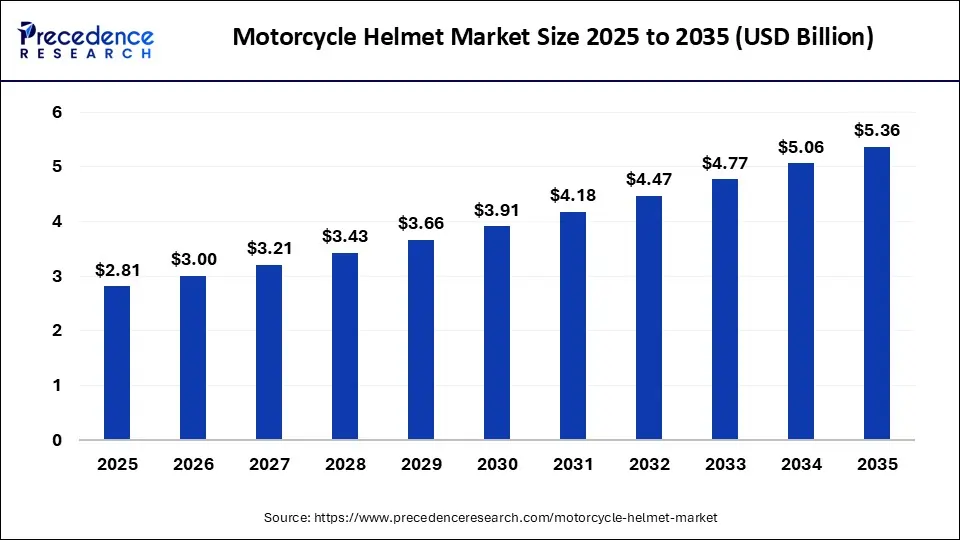
The global motorcycle helmet market size accounted for USD 2.81 billion in 2025 and is predicted to increase from USD 3.0 billion in 2026 to approximately USD 5.36 billion by 2035, expanding at a CAGR of 6.67% from 2026 to 2035. The primary reasons behind the motorcycle helmet market growth are a rise in motorbike popularity and an increase in the number of motorcycle accidents.
Motorcycle Helmet Market Key Takeaways
- The global motorcycle helmet market was valued at USD 2.63 billion in 2025.
- It is projected to reach USD 5.06 billion by 2035.
- The market is expected to grow at a CAGR of 6.76% from 2026 to 2035.
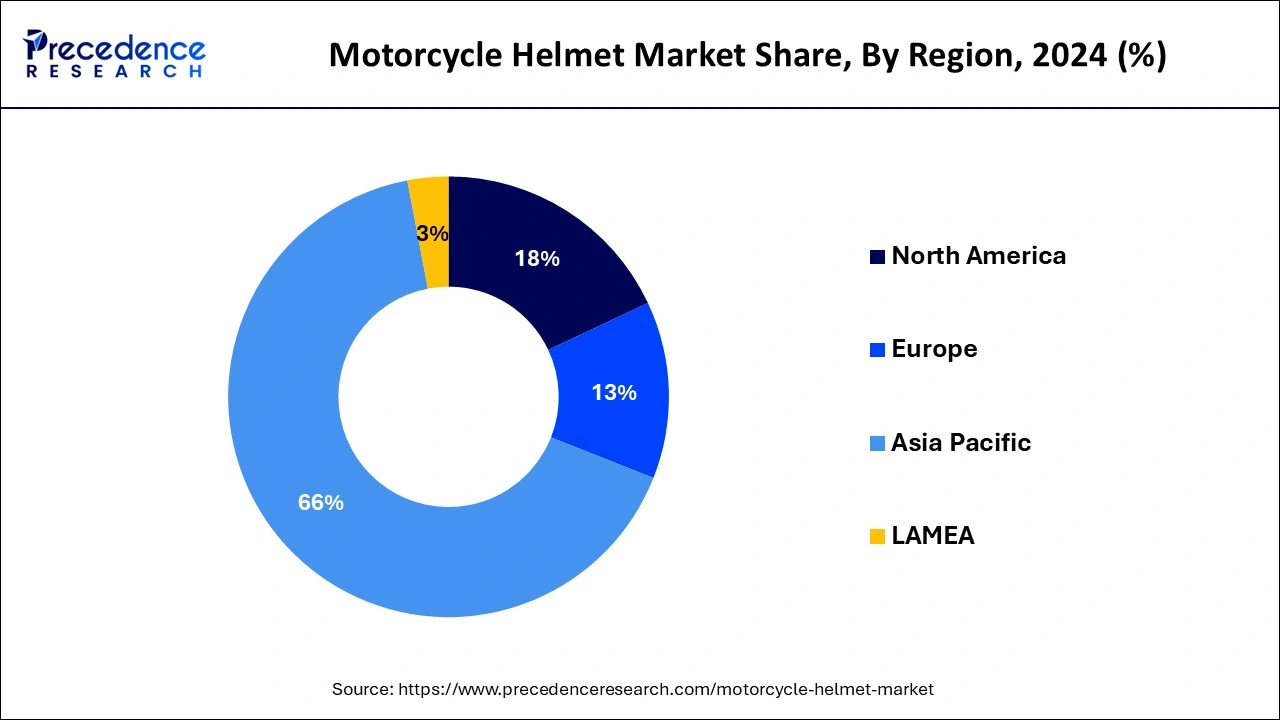
- Asia Pacific dominated the market with the largest revenue share of 66% in 2025.
- Europe is expected to expand at the fastest CAGR of 8.04% during the forecast period.
- By product, the full face segment has held a major revenue share of 60% in 2025.
- By product, the open face segment is expected to witness the fastest CAGR of 7.14% during the forecast period.
- By end-user, the rider segment accounted more than 89% of revenue share in 2025.
- By end-user, the passenger segment is projected to show significant CAGR of 7.52% during the forecast period.
- By distribution channel, the offline segment has held the largest revenue share of 81% in 2025.
- By distribution channel, the online segment is growing at a solid CAGR of 7.53% during the forecast period.
Market Overview
A motorcycle helmet is a helmet designed for motorcycle riders. They are designed for the rider's safety. With the help of motorcycle helmets, the Rider's head is protected from a violent impact after an accident. The risk of head injuries is reduced tremendously with the help of motorcycle helmets. Many countries have made it compulsory for citizens to wear helmets, and there are strict regulations and fines for not obeying the rule.
The outer shell of the helmet is made up of hard materials, and the inner part of the helmet consists of soft styrofoam to absorb the shock and impact. There is a variety of helmets; some only cover the head, and the mouth and nose are open, whereas some cover the entire skull. Some helmets have additional features like proper ventilation, face shields, and ear protection. Some advanced helmets even have the feature of connecting phones and taking calls.
- In a study conducted in 2008, it was found that there was a reduction of head injury risk by 69 percent because of helmets, and the death risk decreased by 42 percent.
How Does the Integration of AI Advance the Motorcycle Helmet?
The integration of artificial intelligence (AI) is transforming the motorcycle helmet industry by improving rider safety, connectivity, and overall user experience. AI-enabled helmets are increasingly being developed with advanced features such as real-time hazard detection, smart communication systems, voice assistance, and accident prevention technologies.
Manufacturers are increasingly using AI and advanced computing to create safer, smarter, and more responsive machines. Global tech leaders use AI and big-data modelling to collect and learn from millions of data points on every lap. AI-driven safety features and radars are now standard on many adventure motorcycles and premium touring models. Modern navigation apps use AI-driven routing engines to suggest routes designed for biking preferences.
Motorcycle Helmet Growth Factors
- The popularity of motorbikes among the working class drives the growth of the motorcycle helmet market.
- Stringent safety regulations and compulsion to wear helmets.
- Better designs and improved quality of products in the motorcycle helmet market are available to the public.
- Growing reach of e-commerce and increasing online vendors that support customization.
- Manufacturers are investing in recyclable components, circular economy principles, and bio-based composites to meet the needs of eco-conscious consumers.
- Customization and digital retail allow users to access customized style palettes online and specialized fitment tools.
- Increasing road traffic accidents are accelerating a cultural shift toward premium safety features.
- The other major growth drivers of the motorcycle helmet market are tightening safety regulations and standardization in the form of stricter certification upgrades and mandatory enforcement.
What are the Major Trends in the Market?
- Increasing Adoption of Smart Helmets - The integration of advanced technologies such as AI, Bluetooth connectivity, GPS navigation, and voice assistance is becoming a major trend in the motorcycle helmet market. Smart helmets are enhancing rider safety and convenience by offering features such as real-time communication, accident detection, and navigation support.
- Growing Focus on Lightweight and Advanced Safety Materials - Manufacturers are increasingly using materials such as carbon fiber, fiberglass composites, and advanced polymers to develop helmets that provide better protection while reducing weight. The demand for comfortable, durable, and high-performance helmets is driving innovation in helmet design and manufacturing.
- Rising Demand for Sustainable and Eco-Friendly Helmets - Increasing environmental awareness is encouraging manufacturers to develop helmets using recyclable materials and sustainable production methods. Companies are focusing on reducing environmental impact while maintaining safety standards and improving product lifecycle management.
Market Scope
| Report Coverage | Details |
| Growth Rate from 2026 to 2035 | CAGR of 6.67% |
| Market Size in 2025 | USD 2.81 Billion |
| Market Size in 2026 | USD 3.0 Billion |
| Market Size by 2035 | USD 5.36 Billion |
| Largest Market | Asia Pacific |
| Base Year | 2025 |
| Forecast Period | 2026 to 2035 |
| Segments Covered | Product, End-user, and Distribution Channel |
| Regions Covered | North America, Europe, Asia-Pacific, Latin America, and Middle East & Africa |
Market Dynamics
Drivers
Increased safety regulations
The primary driver of the motorcycle helmet market is the need for safety of motorbikes. Strict regulation standards are set by the government, and bike users have to abide by these regulations while riding. Not only that, but companies too are required to abide by these regulations while producing helmets and produce helmets of the best quality and strength.
Travel vloggers and motorbikes
Due to a rise in social media platforms like Instagram, Facebook, YouTube, etc., there is rising popularity among youths who take up traveling as a passion. Motorbikes are being favored by youths for traveling to scenic destinations. As the vloggers post their videos, they ensure that the helmets are being used. Helmets are available in many attractive designs, and hence, they are used as the new ‘cool' thing among youths. There is a rise in motorbike sales, and this is helping the motorcycle helmet market grow.
Restraints
Suffocation and discomfort
Helmets are important for safety, but there are many problems associated with it. Helmets cause suffocation in many users, and a sense of discomfort is the biggest restraint that makes them unattractive for users. Many users also face hair loss because of wearing helmets, as their heads get heated more when they use helmets. This usually happens if users buy low-quality helmets. Low-quality helmets also might lead to serious accidents. People in rural areas are not serious about helmets, and people in urban areas, too, use helmets only to avoid problems from traffic police.
Competition with cheap helmets
Nowadays, there are people who produce cheap quality helmets that look expensive and high-quality but are fragile because they are made of poor-quality materials. These helmets can be extremely dangerous to use and can lead to death in case of accidents. Many people choose to save money and end up compromising with life. Some people just wear it for the sake of wearing it. These cheap helmets can still compete with high-quality helmets and affect their sales. Helmets need to be properly tested before releasing in the motorcycle helmet market.
Opportunities
Increased motorbike and motorbike accessory sales
As the motorbike helmet market grows, this will help in the growth of motorbike sales, too. Helmets and a biker's jacket are perceived as an identity of a dedicated biker. Many users buy helmets to seek such validation.
More advancements
More innovation can be brought into helmets to make them more attractive and comfortable. Helmets can be made more ventilation-friendly. More advancements can be brought in the helmets and built-in communication systems, and even virtual reality can be integrated into the helmets to make them more attractive to buy. Customized helmets can also be introduced, where buyers can choose the design of their choice and can add necessary features.
Segment Insights
Product Insights
How does the Full Face Segment Dominate the Motorcycle Helmet Market in 2025?
The full face segment dominated the market in 2025, owing to a rise in premium smart-tech integration, stringent global safety regulations, and growing safety awareness among riders. Full-face helmets offer the most detailed head and facial protection during high-speed impacts. The mandatory helmet laws and tighter certification standards are also driving the growth of full-face helmets.
The open face segment is expected to grow at the fastest CAGR in the market during the forecast period due to the rising demand for open face helmets for comfort and visibility, and expanding adoption of electric two-wheelers. Open-face configurations offer flexibility and better lateral visibility. Open-face helmets equipped with heads-up displays and minimalist Bluetooth communication tools are designed for urban tech-savvy riders and millennials.
End-user Insights
What made Rider the Dominant Segment in the Motorcycle Helmet Market in 2025?
The rider segment dominated the market with the largest share in 2025, owing to stricter government safety mandates and shifting consumer preference toward premium, smart technology. Stricter certifications, point-of-sale mandates, and urban enforcement are boosting the expansive reach of riders. Local authorities across the globe are tightening penalties for non-certified headgear, which further drives immediate demand for approved protection.
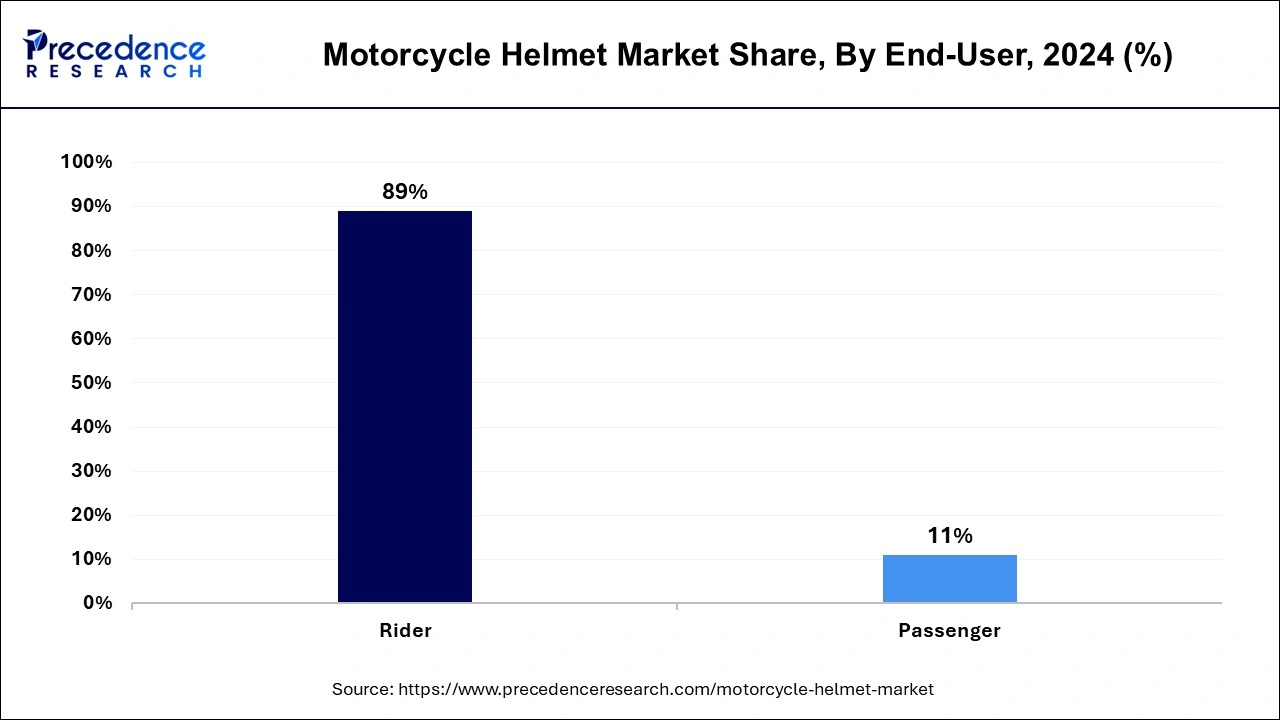
The passenger segment is expected to grow at the fastest rate in the market during the predicted timeframe due to the increased focus on fuel efficiency, rapid urbanization, and the rise in everyday two-wheeler commuting. The segment is also driven by a notable rise in rallies, recreational motorcycle tours, and long-distance travel. It has created a highly targeted demand for passenger-focused communication systems and helmet accessories.
Distribution Channel Insights
How did the Offline Segment Dominated the Motorcycle Helmet Market in 2025?
The offline segment dominated the market in 2025, owing to mandatory dealership bundling laws, expert guidance and trust, and expansion of the dealer network. Global helmet manufacturers are expanding their footprint in developed regions. They are establishing dedicated retail outlets and localized physical networks to meet daily commuter demand.
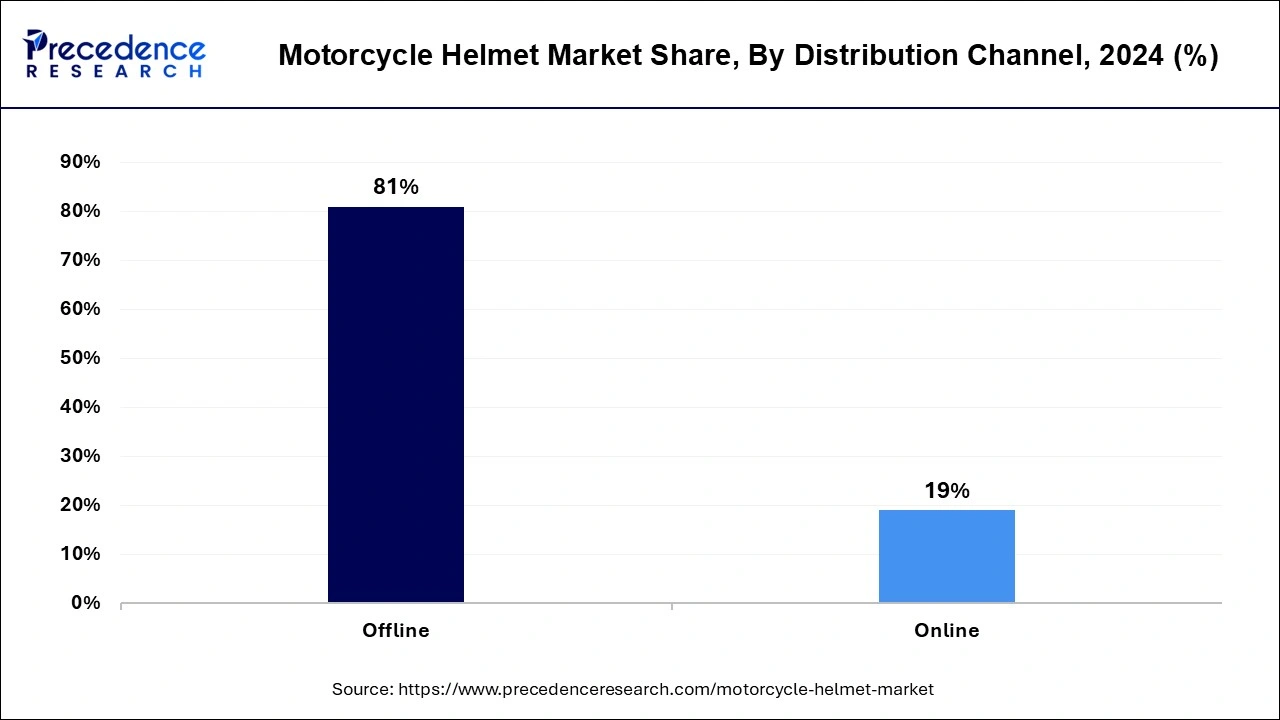
The online segment is anticipated to grow at a notable rate in the market during the upcoming period due to global access to international brands and product variety, and informative digital experiences. The online channels are also driven by targeted advertising and informed decision-making. Competitive pricing and flexible payments are also major growth factors for the expansion of online distribution channels.
Regional Insights
Asia Pacific Motorcycle Helmet Market Size and Growth 2026 to 2035
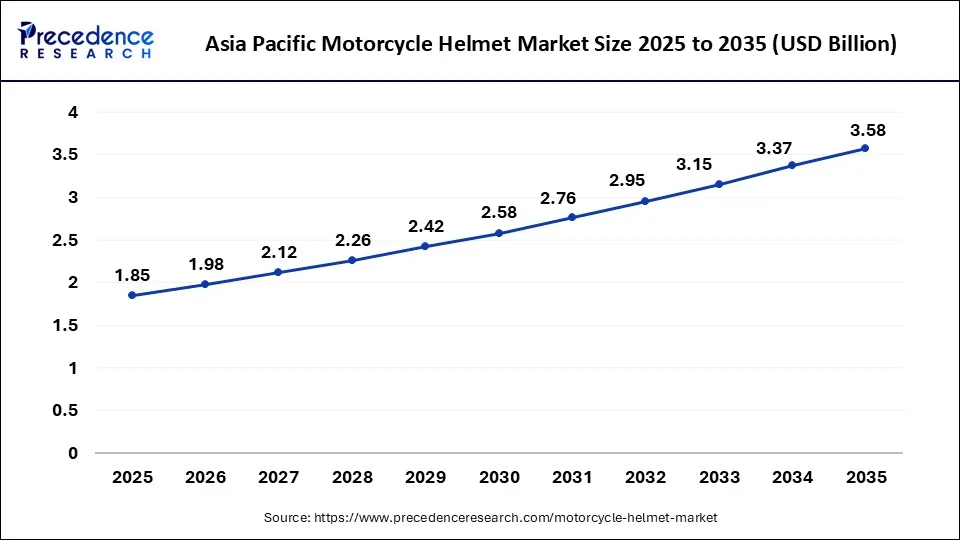
The Asia Pacific motorcycle helmet market size was exhibited at USD 1.85 billion in 2025 and is projected to be worth around USD 3.58 billion by 2035, growing at a CAGR of 6.82% from 2026 to 2035.
What Made Asia Pacific the Dominant Region in the Motorcycle Helmet Market?
Asia Pacific dominated the motorcycle helmet market with the largest share in 2025 due to the massive expansion of e-commerce and digital retail platforms and strict enforcement of updated regional safety certifications and mandatory helmet laws. The regulatory shifts are reshaping retail compliance, manufacturing standards, and consumer purchasing habits. Localized supply chains and smart and connected helmet subsidies are further driving regional market growth.
India Market Trends
The Indian motorcycle helmet market is expanding due to rapid infrastructure development, increasing road safety awareness, and the implementation of stricter government regulations. Government initiatives led by organizations such as the Bureau of Indian Standards (BIS) and the Ministry of Road Transport and Highways (MoRTH) are strengthening helmet safety standards and encouraging the adoption of certified protective gear.
How is the Opportunistic Rise of North America in the Motorcycle Helmet Market?
North America is expected to grow at a significant rate in the coming years, owing to the integration of smart and connected technology, high disposable income, rising ownership of motorcycles, and regulatory compliance. The rigorous post-market compliance, legal frameworks, state-level universal helmet mandates, and integration standards for smart and connected helmets are also expanding the regional growth. Governing authorities are collaborating on transnational road safety frameworks and targeting stricter enforcement. The legal frameworks are focusing on standardized vehicle criteria, building stricter helmet laws, and better regional data collection.
U.S. Market Trends
The market in the U.S. is growing due to a high consumer preference for high-performance and premium protective gear, stringent government safety regulations, and rapid advancements in smart helmet technologies. The broad safety framework updates, educational grants, and behavioral enforcement are the primary areas of focus for the motorcycle helmet industry in the U.S.
What Makes Europe the Fastest-Growing Region in the Motorcycle Helmet Market?
Europe is expected to grow at the fastest rate in the market in the coming years, driven by the high adoption rate of next-gen features and connected smart helmets, equipped with Heads-Up Displays (HUD), integrated Bluetooth intercoms, automatic emergency eCall systems, and augmented reality. The government is actively promoting quality verification, which allows users to check a manufacturer's license number. The two-helmet mandate has created massive growth for licensed helmet manufacturers.
Germany Market Trends
The motorcycle helmet market in Germany is booming due to a rising adoption of micro-mobility and electric vehicles, and Germany's strict legal enforcement of the harmonized safety standard. The major driving forces are smart mobility and green safety subsidies, government infrastructure incentives, and eco-friendly standards.
Why is the Motorcycle Helmet Market Expanding in Latin America?
The market in Latin America is expanding due to stricter traffic regulations, increasing demand for premium and full-face options, and growth of e-commerce. The government initiative actively updates national legislation and trains law enforcement regarding high-quality helmet standards and speed management. Mexican transport authorities implemented localized safety regulations and targeted infrastructure. Government initiatives are enforcing stricter technical regulations, safety policies, and standardized certification mandates.
Brazil Market Trends
Brazil experiences a surging demand for technology-integrated premium and passenger helmets and continuous demand for urban mobility and affordable personal transportation. The major initiatives revolve around digital authentication, consumer verification, and regulatory compliance. The market is strongly influenced by the road safety policy from the Pan American Health Organization (PAHO).
What Factors are Boosting the Motorcycle Helmet Market in the MEA?
The market in the Middle East & Africa (MEA) is propelled by the implementation of stringent safety mandates, increasing adoption of two-wheelers for primary transportation, and surging popularity of smart and premium helmets. The regional government initiatives strongly focus on adopting international safety standards, boosting compliance to protect riders, and standardizing local quality certifications. Regional safety programs, primary regulatory actions, and market-shaping policies are boosting regional expansion.
Saudi Arabia Market Trends
Saudi Arabia's motorcycle helmet market is witnessing growth due to the rapid expansion of urban smart city infrastructure under Vision 2030, stricter government road safety regulations, and the growing adoption of last-mile delivery fleets. The increasing use of motorcycles and light-mobility solutions for transportation and delivery services is creating higher demand for advanced and certified safety equipment.
Competitive Landscape
The global motorcycle helmet market is characterized by advancements in aerodynamic designs, premium safety certifications, and the integration of smart technologies. Leading companies operating in the market include Shoei Co., Ltd., Arai Helmet Ltd., AGV Helmets/Dainese S.p.A., and Schuberth GmbH, which are focusing on innovation, product performance, and enhanced rider protection.
These companies are introducing advanced helmet solutions equipped with features such as integrated communication systems, heads-up displays, proactive monitoring technologies, AI-enabled diagnostics, premium shell materials, and modular as well as urban helmet designs.
Increasing consumer demand for safer, more connected, and technologically advanced riding equipment is encouraging manufacturers to expand their product portfolios.
Motorcycle Helmet Market Companies
- HJC Europe S.A.R.L
- Shoei Co. Ltd
- Arai Helmet Ltd.
- Alpine Stars S.p.A
- Schuberth GmbH
- BELL HELMET
- FOX
- STUDDS Accessories Limited
- Royal Enfield
- Caberg S.p.a.
Recent Developments
- In November 2025, Ultraviolette, a Bengaluru-based electric motorcycle manufacturer, partnered with Cardo Systems to advance connected riding solutions. The company also announced the launch of UV Crossfade, which is a carbon fibre smart helmet that integrates connectivity and safety features.
- In September 2025, Holley's Simpson Motorcycle helmet expansion targets the rapidly growing safety gear and global motorcycle helmet market. Holley Performance Brands announced strategic growth in its Simpson Motorcycle division.
- In March 2024, NEXX updated its helmet range and introduced some new models with modifications. X.WED3 adventure motorcycle helmet is one of the adventure motorcycle helmets in this range, and it is described as a two-in-one. It has a toolless adjustment, which allows the wearer to convert the helmet from a focused adventure helmet with a full peak into a regular full-face helmet.
Segments Covered in the Report
By Product
- Full Face
- Open Face
- Off-Road/Racing
- Others
By End-user
- Rider
- Passenger
By Distribution Channel
- Offline
- Online
By Geography
- North America
- Asia Pacific
- Europe
- Latin America
- Middle East & Africa
For inquiries regarding discounts, bulk purchases, or customization requests, please contact us at sales@precedenceresearch.com
Frequently Asked Questions
Tags





Ask For Sample
No cookie-cutter, only authentic analysis – take the 1st step to become a Precedence Research client
 Get a Sample




 sales@precedenceresearch.com
 Schedule a Meeting
