



CMTA Advances Drug Repurposing with an Additional $225,720 Investment in CMT1B and CMT1E Research
Published: 14 Aug 2026
Author: Towards Healthcare



The project extends continuing CMTA-funded research in CMT1A that targets protein-clearance machinery to reestablish peripheral nerve function.
The Charcot-Marie-Tooth Association (CMTA) announced a $225,720 spending in novel research led by Maurizio D’Antonio, PhD, at Ospedale San Raffaele in Milan, Italy. The research tests two treatments for their capability to restore peripheral nerve function in CMT1B and CMT1E by improving the protein-clearance machinery in Schwann cells. The first is an FDA-approved phosphodiesterase type 5 (PDE5) inhibitor that raises cyclic GMP levels. The second is a therapeutic candidate from an Approaches to Accelerate Research (CMTA-STAR) Alliance Partner.
CMTA’s commitment to therapeutic repurposing is significant to the organization’s approach to shift therapeutic solutions through the drug development pipeline as rapidly as possible. Because repurposed therapeutics already have established safety information, they reach patients rapidly and at lower expenses than a novel molecule, a decisive benefit for a rare disease such as CMT, which still has no approved management.
In CMT1B and CMT1E, gene mutations cause peripheral nerve myelin proteins to misfold and build up inside Schwann cells. This buildup pressures the cell’s main technology for clearing damaged proteins, the proteasome, and drives peripheral nerve degeneration. Continuing CMTA-funded research led by Jordan VerPlank, PhD, is investigating this pathway in CMT1A and has shown that targeting it with a repurposed medicine restores proteasome activity and improves peripheral nerve function in preclinical CMT1A models. The D’Antonio lab tests whether the same approach applies to CMT1B and CMT1E and, significantly to various forms of CMT, is developing a significant CMTA-STAR aim of targeting shared biological pathways in the multiple CMT subtypes.
“We are grateful to the Charcot-Marie-Tooth Association for supporting this work, which addresses a critical gap in our understanding of how CMT1B and CMT1E damage the peripheral nerve,” says D’Antonio. “This project is designed to define how disrupted protein handling contributes to peripheral nerve damage and to determine whether restoring this system could be developed into a treatment strategy for these subtypes and potentially others.”
“The D’Antonio lab extends our CMT1A work into CMT1B and CMT1E and helps to determine whether this approach has broader application across multiple CMT subtypes,” says Katherine Forsey, PhD, CMTA Chief Research Officer. “By connecting ongoing research from the VerPlank laboratory, repurposing approved drugs, and bringing in additional candidate therapeutics from CMTA-STAR Alliance Partners, this project demonstrates how CMTA-STAR unites academic researchers and industry around a shared biological approach that moves treatments to patients faster. If successful, this approach could help create new treatment options for people living with CMT.”
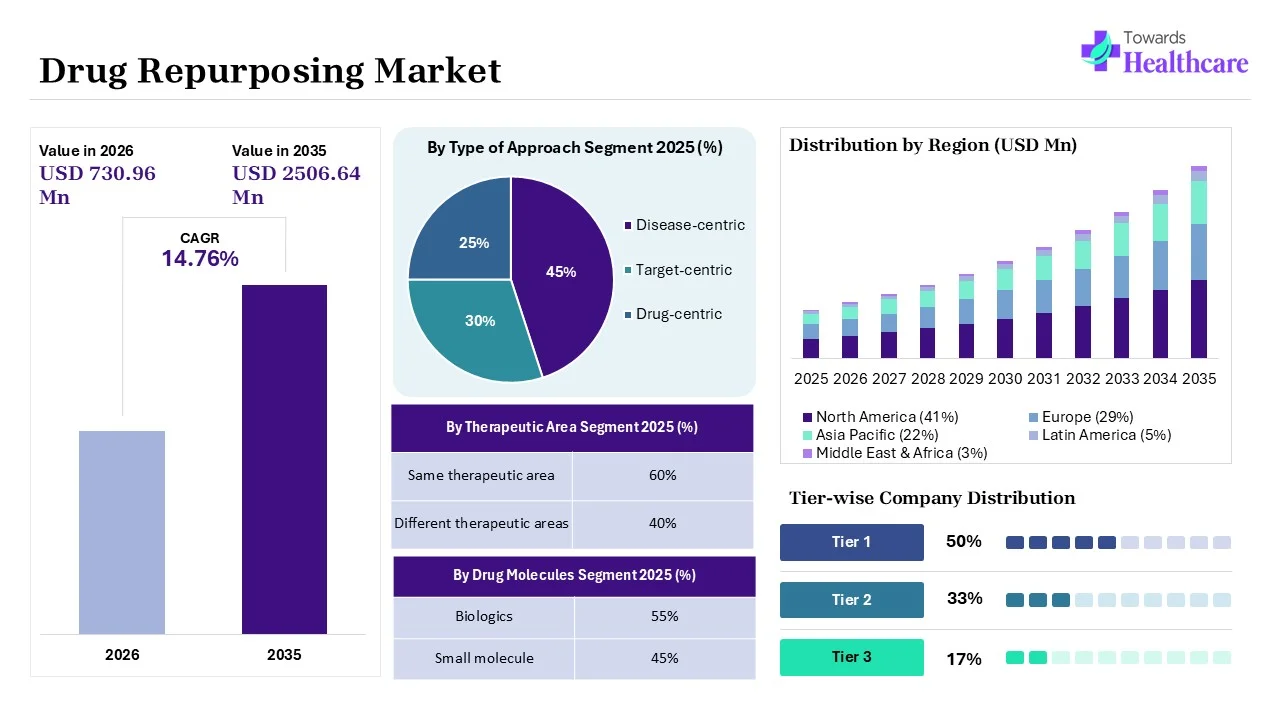
According to Towards Healthcare, the drug repurposing market is projected to grow significantly, with estimates indicating the market size will increase from USD 730.96 billion in 2026 to approximately USD 2506.64 billion by 2035. The market is expanding at a CAGR of 14.76% between 2026 and 2035.Drug repurposing provides multiple benefits, involving lowered toxicity, improved therapeutic effectiveness, the strength for dose reduction without compromising efficiency, and overcoming resistance mechanisms generally observed in present oncology treatments. Drug repurposing is a more inexpensive and time-efficient strategy than de novo drug advancement, significantly expanding the spectrum of clinically available cancer therapies. Drug repurposing is a more economical and time-efficient approach than de novo drug development, significantly broadening the spectrum of clinically available cancer therapies. Drug repurposing is typically the output of retrospective research, which is susceptible to time-to-death bias and selection bias.
About Charcot-Marie-Tooth Disease (CMT)
Charcot-Marie-Tooth disease is a group of rare, inheritable peripheral neuropathies. Named after Jean-Martin Charcot, Pierre Marie, and Howard Henry Tooth, who first described it in 1886, CMT causes progressive muscle weakness, loss of sensation, impaired balance, and various debilitating challenges. There is currently no cure or approved management.
About the Charcot-Marie-Tooth Association (CMTA)
The Charcot-Marie-Tooth Association (CMTA) is the leading nonprofit organization intended to enhance the lives of patients living with Charcot-Marie-Tooth disease (CMT). As the largest philanthropic funder of CMT research, CMTA has spent more than $33 million since 2008 to accelerate research leading to novel treatments and eventually a cure. Through a strategic model that integrates specific funding, dedicated scientific tools and resources, and strong patient collaboration, CMTA drives promising science toward meaningful results for patients living with CMT.
A recent report by Towards Healthcare highlights that the drug repurposing market is growing, as drug repurposing, also called drug repositioning, identifies advanced indications for approved or clinically failed/investigational therapeutics that have not been approved. Drug repurposing is used to lower expenses and research time investments in Research & Development. It is applied for the diagnosis and treatment of different diseases. Drug repurposing identifies novel applications for already approved or existing therapeutics on the market. In drug design, drug repurposing plays an important role because it helps with preclinical advancement. It lowers time efforts, spending, and failures in drug discovery technology.