



Emirates Cardiac Resuscitation Society Launches CPR Programme to Train 10,000
Published: 03 Sep 2026
Author: Towards Healthcare



The Emirates Cardiac Resuscitation Society has launched the first combined national programme for cardiopulmonary resuscitation (CPR) and first aid.
The programme aims to train and qualify 10,000 patients working in medical and non-medical sectors and reach 10 million beneficiaries via awareness campaigns and life-saving skills over the next five years.
The Resuscitation Coalition, which brings together regulatory, private, and non-profit organizations, is supervising the programmes. It is an initiative of the National Medical Preparedness and Response Programme (Jahiziyah), with academic, technical, operational, and logistical support from the National Training Foundation, in coordination with relevant official and government bodies in the UAE.
The initiative aims to equip community members with the skills to recognize early signs of cardiac arrest and stroke, contact emergency services, immediately begin CPR, and use an automated external defibrillator during the significant minutes before ambulance and emergency teams arrive.
It seeks to endorse proactive and safe intervention and a culture of shared accountability for saving lives, supporting increased survival rates and reducing deaths and challenges caused by late response.
Target groups include healthcare, nursing, technical and administrative staff at hospitals and medical care solutions; employees of government and private entities; school and university staff; and workers in factories, companies, shopping centres, hotels, and tourism and sports solutions.
The programme targets family members, women's and youth relations, patients with disabilities and their caregivers, volunteers, first responders, and community members of all age groups.
The programme relies on practical training, healthcare simulations, and realistic scenarios, improving participants' capability to make sound decisions and implement life-saving interventions effectively, rapidly, and safely.
The initiative aims to establish a national network of certified trainers, standardise scientific and training content in line with the recent international standards and solutions, and advance specialized train-the-trainer programmes to support its sustainability and expansion in the UAE.
It also establishes a national database of trainers, volunteers, first responders, and qualified solutions in CPR and first aid, and conducts periodic exercises and simulations to assess response times and team effectiveness, detects areas for advancement, and strengthens coordination in participating institutions, medical care solutions, ambulance services, and community organizations.
Dr. Adel Al-Shamri Al-Ajami, CEO of the Zayed Giving Initiative, Chairman of the Emirates Doctors Initiative, President of the Emirates Society for Cardiac Resuscitation, and CEO of Jahiziyah, said the first few minutes after heart arrest are the most significant and that starting CPR and using an AED before paramedics arrive significantly enhance the chances of survival and lessen complications.
He said the programme aims to build an inclusive national technology encompassing community awareness, the training of instructors and volunteers, accreditation of ready facilities, broader availability of automated external defibrillators, and regular readiness assessment movements.
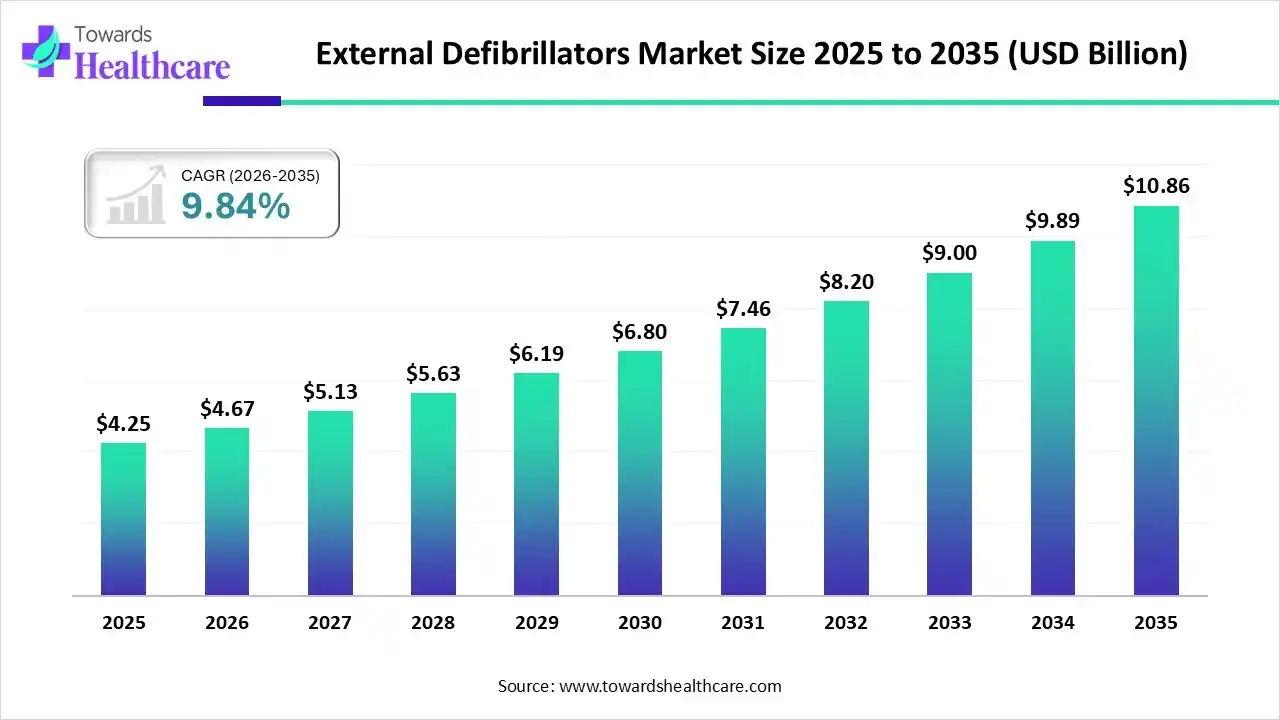
According to Towards Healthcare, the external defibrillators market is projected to grow significantly, with estimates indicating the market size will increase from USD 4.67 billion in 2026 to approximately USD 10.86 billion by 2035, expanding at a CAGR of 9.84% from 2026 to 2035. The major applications of a defibrillator are a significant component in the management of cardiac arrest. It offers a rapid response, easy maintenance, enhanced survival rates, and lessens the risk of long-term challenges. The increased availability and applications of defibrillators have led to increasing public awareness of the significance of prompt action during cardiac arrest. This raised awareness has led to more patients being trained in CPR and enhanced survival rates overall. Defibrillators are available in a portable format, making them standard for use in settings outside of a hospital. This involves public spaces like airports, sports stadiums, and shopping malls. Defibrillators need little maintenance, making them a cost-effective choice for businesses and organizations. Major models are intended to perform self-tests, confirming they are always in working order when required.
About Emirates Cardiac Resuscitation Society
Emirates Cardiac Society (ECS) is a non-profit company comprising cardiologists in the UAE that work under the umbrella of the Emirates Medical Association. ECS is determined to enhance cardiovascular health via education, research, and advancing quality patient care. ECS supports patients in understanding the importance of healthy lifestyle choices and offers science-driven treatment guidelines to medical care professionals to support them in providing quality care to their patients.
A recent report by Towards Healthcare highlights that the external defibrillators market is growing, as automated external defibrillators are life-saving tools intended to manage sudden cardiac arrest in emergencies. The significant advantages of an AED are that it supports restoring the heart rhythm rapidly before healthcare support arrives. Key advantages of using a defibrillator for first aid, how a semi-automatic defibrillator works, and why having reliable cardiac arrest evolving tools from a trusted semi-automatic defibrillator supplier is significant for safety. A defibrillator machine is a small, transportable tools applied in evolving when someone’s heart suddenly stops beating correctly. AEDs provide life-saving advantages that cannot be ignored. A defibrillator for first aid helps restore the heart rhythm rapidly, lessen brain damage, and increase survival probabilities. A semi-automatic defibrillator is simple, safe, and simple to use even for non-medical patients.