



Enhertu Plus Pertuzumab Recommended for Approval in the EU by CHMP as First-Line Treatment for Patients with HER2-Positive Metastatic Breast Cancer
Published: 30 Jul 2026
Author: Towards Healthcare



Approval based on DESTINY-Breast09 phase 3 trial output that showed Enhertu plus pertuzumab lowered the risk of disease progression or death by 44% versus THP, with a median progression-free survival of three years. If approved, Daiichi Sankyo and AstraZeneca’s Enhertu plus pertuzumab would become the first novel management in the EU in more than a decade for first-line HER2-positive metastatic breast cancer.
Enhertu (trastuzumab deruxtecan) in combination with pertuzumab has been recommended for approval in the European Union for the first-line treatment of adult patients with unresectable or metastatic HER2-positive (immunohistochemistry [IHC] 3+ or in-situ hybridization [ISH]+) breast tumors.
Enhertu is a specifically engineered HER2-directed DXd antibody drug conjugate (ADC) developed by Daiichi Sankyo and being cooperatively developed and commercialized by Daiichi Sankyo and AstraZeneca.
The Committee for Medicinal Products for Human Use (CHMP) of the European Medicines Agency (EMA) based its positive opinion on results from theDESTINY-Breast09 phase 3 trial presented at the 2025 American Society of Clinical Oncology Annual Meeting and subsequently published in The New England Journal of Medicine. The recommendation will now be reviewed by the European Commission, which has the authority to grant marketing authorizations for medicines in the EU.
In DESTINY-Breast09, Enhertu in combination with pertuzumab reduced the risk of disease progression or death by 44% versus a taxane, trastuzumab and pertuzumab (THP) in patients with HER2-positive metastatic breast tumor who had not received prior chemotherapy or HER2 targeted therapy or had received neoadjuvant or adjuvant HER2 targeted therapy more than six months before the diagnosis of well-developed or metastatic disease. Median progression-free survival (PFS) was 40.7 months with Enhertu in combination with pertuzumab compared to 26.9 months with THP as assessed by blinded independent central review (BICR).
The PFS advantage was consistent in subgroups, involving the prespecified stratification factors of hormone receptor (HR) status, de novo or recurrent disease, and PIK3CA mutation position.
“Enhertu in combination with pertuzumab improved progression-free survival by more than one year compared with the current first-line standard of care, representing a meaningful advantage early in the treatment of patients with metastatic HER2 positive disease,” said John Tsai, MD, Global Head, R&D, Daiichi Sankyo. “Today’s positive CHMP opinion brings us closer to making Enhertu available in the EU as a first-line treatment option for eligible patients with HER2 positive metastatic breast cancer, marking an important milestone in moving this medicine earlier in the treatment pathway.”
“HER2 positive metastatic breast cancer is an aggressive subtype, so starting patients on an effective HER2 targeted treatment early and continuing it for as long as they benefit can have a meaningful impact on long-term outcomes,” said Susan Galbraith, MBBChir, PhD, Executive Vice President, Oncology Hematology R&D, AstraZeneca. “DESTINY-Breast09 sets a new benchmark with a median progression-free survival of more than three years, underscoring the potential of Enhertu plus pertuzumab to redefine first-line treatment for patients with HER2-positive metastatic breast cancer.”
The safety profile of Enhertu in combination with pertuzumab in DESTINY-Breast09 was consistent with the known profiles of each treatment, with no new safety concerns identified. The most common grade 3 or higher treatment-associated adverse effect that occurred in patients managed with Enhertu in combination with pertuzumab was neutropenia, hypokalemia, and anemia. Interstitial lung disease (ILD) or pneumonitis occurred in 12.1% of patients managed with Enhertu in combination with pertuzumab as determined by an independent adjudication committee. The majority of ILD or pneumonitis events were low grade. There were two grade 5 events (0.5%) of ILD or pneumonitis in the Enhertu plus pertuzumab arm.
Enhertu in integration with pertuzumab is approved in India, Israel, Saudi Arabia, Singapore, South Korea, Switzerland, the United Arab Emirates and the U.S. as a first-line management for adult patients with unresectable or metastatic HER2-positive breast cancer, as determined by a locally or regionally accepted test, based on the results from the DESTINY-Breast09 trial.
Enhertu is also under review in the EU for patients with HER2-positive breast tumors who have residual invasive disease after neoadjuvant HER2 targeted treatment based on data from the DESTINY-Breast05 trial.
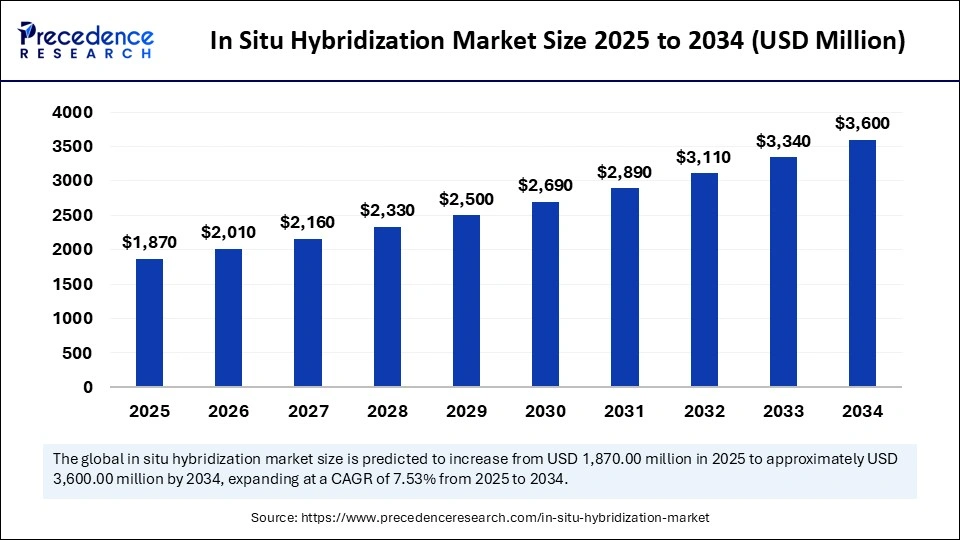
According to Towards Healthcare, the in situ hybridization market is projected to experience significant growth, with estimates suggesting the market size will increase from USD 1.79 billion in 2026 to approximately USD 3.37 billion by 2035, representing a compound annual growth rate (CAGR) of 7.33% from 2026 to 2035. In situ hybridization is a process to identifies RNA or DNA material in cells or tissues. So, an oligonucleotide around 20 nucleotides in length with the complementary sequence is used. This oligo binds to the DNA or RNA Sequence of interest through base pairing (hybridization). The synthetic or enzymatically produced oligonucleotide is generally fluorescent labeled to enable detection of the in-situ hybridization. The oligonucleotide is also called a (FISH) probe, which is derived from fluorescence in situ hybridization. In situ hybridization is broadly applied in research and translational research to localize RNA or DNA targets in the intact tissue.
About the Daiichi Sankyo and AstraZeneca Collaboration
Daiichi Sankyo and AstraZeneca entered into a worldwide collaboration to partner to develop and commercialize Enhertu and Datroway, except in Japan, where Daiichi Sankyo maintains exclusive rights for each ADC. Daiichi Sankyo is accountable for the manufacturing and supply of Enhertu and Datroway.
A recent report by Towards Healthcare highlights that the in situ hybridization market is growing, as in situ hybridization (FISH) is an advanced technique that targets specific sequences of interest, which is employed for imaging targets, chromosomal and genetic alterations, mitochondrial organelles, infectious diseases of bacteria and pathogens, and tumors. A major benefit of in situ hybridization is that it enables the maximum use of difficult-to-obtain tissue. Hundreds of diverse in situ hybridizations have been performed on similar tissue.