



STMicroelectronics and NUS Launch Four-Year Edge AI Lab in Singapore
Published: 26 Aug 2026
Author: Gautam Mahajan



The ST-NUS HELIX Corporate Lab a four-year strategic research project aimed at developing the next generation of Edge AI technologies in Singapore was established by STMicroelectronics and the National University of Singapore. To create AI systems that can analyze data closer to its source rather than just depending on cloud infrastructure, the collaboration combines semiconductor engineering with artificial intelligence research and academic experience.
Officially opened on August 24, 2026, the lab is housed at NUS College of Design and Engineering with collaboration from the School of Computing. It is funded by Singapore's Research innovation and Enterprise 2025 plan. The project will encompass the entire technology stack including memory systems circuit design silicon technologies, AI algorithms, accelerator designs, and application development.
For applications like robot drones and other intelligent devices that must analyze and react in real time, the program is especially focused on low power and energy efficient AI computing.
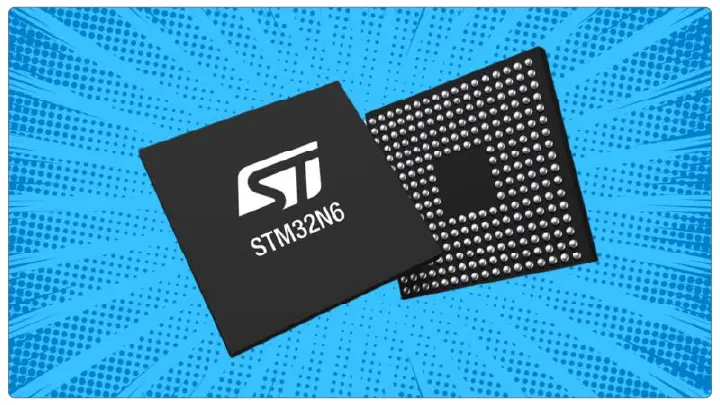
How the ST NUS HELIX Corporate Lab Works
Hardware for Embodied Low Power Intelligent Acceleration is referred to as HELIX. The lab goal is to create new computation and hardware techniques that will enable generative and embodied AI right at the edge.
Edge AI handles data on or near a device in contrast to cloud-based AI. This can lessen reliance on constant communication to decrease latency to enhance privacy and even increase energy efficiency. These features are especially crucial for intelligent machines and autonomous systems that operate in settings with sporadic or restricted network connectivity.
STMicroelectronics will provide NUS researchers with a design platform based on its P18 18nm Fully Depleted Silicon on Insulator technology. This gives researchers an industry-oriented foundation for developing and testing new AI accelerator concepts and exploring how research innovations can eventually be translated into semiconductor products.
The initiative will also focus on embodied AI where intelligence is integrated into physical machines such as robots and drones. These systems require rapid local decision making and efficient hardware because they cannot always depend on remote cloud servers.
Impact on AI Industry
The debut is indicative of the AI industry's increasing shift aways from cloud centric computing and toward distributed and edge based intelligence.
Generative AI applications and large AI models have historically relied significantly on data centers and robust cloud infrastructure. However, additional demands for low latency energy economy dependability and local processing are brought about by the growing use of AI in physical devices.
To overcome this difficulty the ST NUS HELIX Corporate Lab focuses on the underlying hardware needed to execute AI closer to the data generation point. Its efforts may help create AI systems that can make choices locally without continuously sending massive amounts of data to the cloud.
This could benefit applications across robotics drones autonomous systems industrial automation smart devices and other connected technologies.
The partnership also highlights the increasing importance of AI hardware innovation alongside software and model development. Improvements in algorithms alone may not be sufficient to support the next generation of AI-enabled physical devices. Efficient processors' memory architectures and specialized accelerators will also play an important role.
The development therefore strengthens the broader shift toward hardware software co design where AI models and semiconductor architectures are developed with each other in mind.
Impact on Semiconductor Market
The effort has the potential to significantly affect the semiconductor market, especially the segment that focuses on embedded memory low power processors, AI accelerators, and advanced computing architectures. Because contemporary AI applications demand significant processing power and memory bandwidth, AI workloads are putting growing strain on semiconductor infrastructure. However, implementing AI on tiny devices necessitates paying much more attention to physical size power consumption and thermal constraints.
HELIXs focus on memory centric architectures in memory computing, and advanced silicon technologies directly address these challenges. The research could help develop semiconductor architectures capable of delivering AI performance while reducing energy requirements.
The partnership also demonstrates the importance of collaboration between semiconductor companies and universities. Academic research can provide new approaches to computing architectures while industrial partners can contribute manufacturing knowledge, design platforms, and commercial experience.
Such collaborations could accelerate the movement of promising semiconductor research from laboratory environments toward practical applications.
Impact on Edge AI Market
The launch directly supports the growth of the Edge AI Market, where organizations are increasingly seeking ways to deploy artificial intelligence closer to devices of sensors and users.
Edge AI can provide faster response times because data does not always need to travel to a remote cloud environment. It can also support greater privacy by allowing sensitive information to be processed locally. Additionally, edge-based systems can continue operating in situations where internet connectivity is limited.
The HELIX initiative could accelerate innovation in these areas by developing hardware specifically designed for energy efficient AI processing. Autonomous robots drone industrial machinery smart cameras, networked gadgets and other intelligent systems are examples of potential uses. The need for specialized edge computing gear is expected to increase as AI becomes more prevalent in physical settings.
Additionally, rather than depending solely on general purpose, computing the project might drive semiconductor makers and technology suppliers to make larger investments in specialized AI accelerators made for edge workloads.
About STMicroelectronics
STMicroelectronics is a global semiconductor company developing technologies for electronics applications across automotive, industrial, personal electronics and other markets. Its capabilities span semiconductor technologies, embedded memory, circuit design, system development, and manufacturing.
The company has been investing in technologies that support low-power computing, edge processing, and intelligent systems. Its participation in HELIX provides NUS researchers with access to semiconductor design infrastructure and industrial expertise, helping bridge the gap between academic research and practical chip development.
About National University of Singapore
National University of Singapore (NUS) is a major research university with expertise spanning computing, engineering, artificial intelligence and semiconductor technologies.
Through the ST–NUS HELIX Corporate Lab, NUS is combining its research strengths with STMicroelectronics' semiconductor capabilities to investigate next-generation edge AI hardware.
The initiative represents a significant industry-academia collaboration aimed at developing energy-efficient AI technologies while strengthening Singapore's research ecosystem and building specialized talent for the future semiconductor and AI industries.
Overall, the ST–NUS HELIX Corporate Lab reflects the accelerating convergence of AI, semiconductors, robotics and edge computing. Its focus on system-to-silicon innovation could help shape the hardware foundation required for the next generation of intelligent devices, particularly as AI moves from cloud applications into physical machines and everyday connected environments.