



Feinstein Institutes Scientists Identify the Brain Breathing Alarm System
Published: 05 Aug 2026
Author: Towards Healthcare



Beyond automatic breathing reflexes, new research out of Northwell Health’s Feinstein Institutes for Medical Research exposed a brain circuit that keeps track of each inhale and exhale, explaining significant differences in how consumers perceive, or miss, breathing distress.
Published in Science Advances, the research shows that a region deep in the brain called the anterior insular cortex (AIC) significantly identifies mismatches between expected and actual breathing feelings, for instance, when inhaling suddenly feels harder than anticipated. The AIC then relays this data to other brain regions, involving the orbitofrontal cortex, which helps patients determine whether the change is significant enough to stimulate action. Stronger communication in this circuit was connected to better detection of breathing disturbances and quicker compensatory responses.
“Breathing is fundamental to life, and how the brain consciously monitors breathing has remained largely unknown,” said José L. Herrero, PhD, assistant professor in the Institute of Bioelectronic Medicine at the Feinstein Institutes and senior author of the study. “We identified a dynamic brain circuit that acts like an internal alarm system for breathing. Understanding how this system works may help explain why some patients fail to recognize dangerous breathing problems, while others experience persistent breathlessness without major lung abnormalities.”
The research team logged intracranial brain activity (iEEG) from neurosurgical patients previously undergoing monitoring for epilepsy management. Throughout the experiment, participants breathed via a mouthpiece while mild, unforeseen flow-resistive loads were infrequently added to participants' breaths. Patients stated whether they identified the resistance and how intense it felt, enabling researchers to directly link brain activity to conscious breathing perception. The research found that the AIC generated fast, short-lived responses that signaled breathing incongruity, while frontal and motor brain regions showed more sustained activity linked to evaluation and compensation.
Although the brainstem incessantly generates and controls breathing without conscious effort, forebrain circuits detect when breathing variations become consciously perceived and behaviorally relevant. Research findings directly tackle this, offering a new framework for understanding why some patients fail to perceive life-threatening respiratory disturbances, while others experience disabling breathlessness despite comparatively preserved lung function.
“The ability to observe these complex processes in the human brain is a rare and powerful tool,” said Kevin J. Tracey, MD, president and CEO of Feinstein Institutes and Karches Family Distinguished Chair in Medical Research. “These findings provide a roadmap for future research, including developing personalized neuro-interventions to restore breathing control in a variety of neurological and respiratory diseases.”
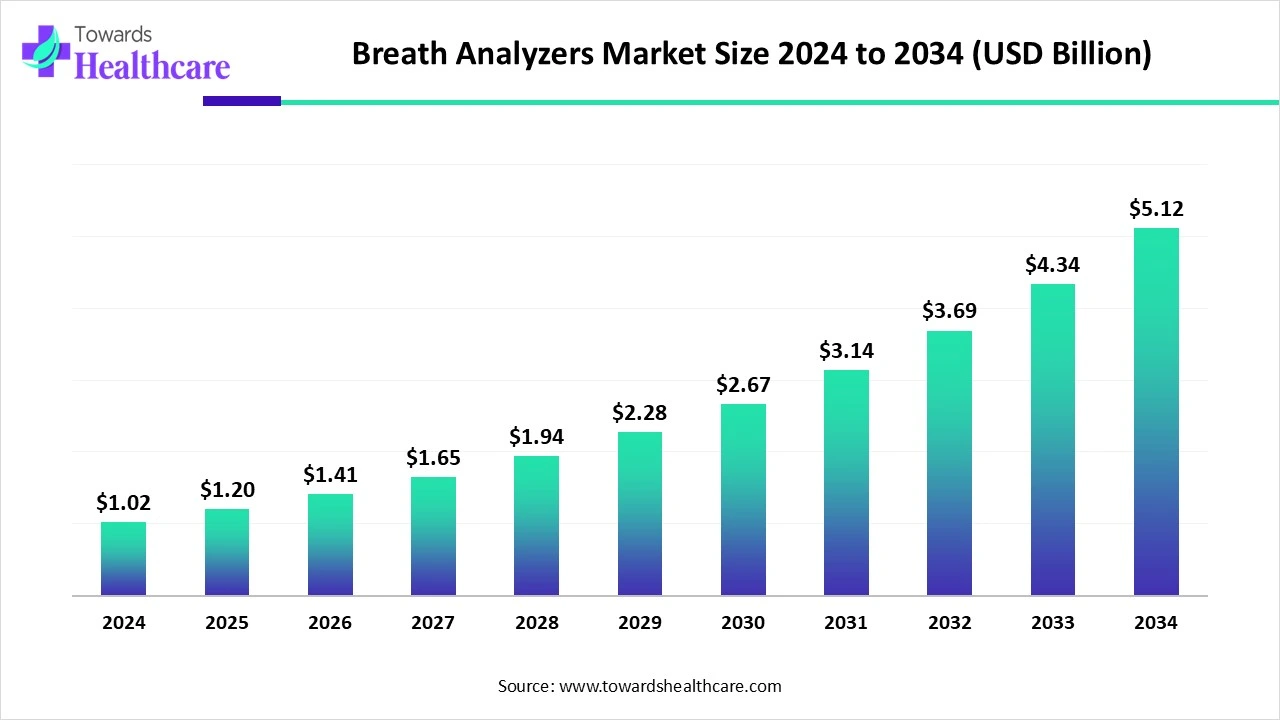
According to Towards Healthcare, the breath analyzers market is projected to experience significant growth, with estimates suggesting the market size will increase from USD 1.41 billion in 2026 to approximately USD 5.98 billion by 2035. Growth is expected at a steady CAGR of 17.44% in between 2026 to 2035Breath analysis has recently been used clinically to monitor asthma, diagnose transplant organ rejection, identify Helicobacter pylori infection, identify blood alcohol concentration, and monitor breath gases during anesthesia, mechanical ventilation, and respiration, in various other applications. Breath analysis provides a comparatively inexpensive, rapid, and non-invasive method for detecting a variety of diseases. With recent advancements in mass spectrometry (MS) and gas chromatography-mass spectrometry (GC-MS), it is possible to detect thousands of unique substances, like volatile organic compounds (VOCs) and elemental gases, in the breath.
About the Feinstein Institutes
The Feinstein Institutes for Healthcare Research is the hub of the research institutes of Northwell Health, a significant health care provider and private company in New York State. Encompassing 50+ research labs, 3,000 clinical research studies, and 5,000 scientists and staff, the Feinstein Institutes raises the standard of healthcare innovation via its six institutes of behavioral science, bioelectronic medicine, cancer, health system science, molecular technology, and translational research. This organization is the worldwide scientific leader in bioelectronic medicine, a groundbreaking sector of science that has the strength to revolutionize medicine. The Feinstein Institutes publishes two open-access, international peer-reviewed journals, Molecular Medicine and Bioelectronic Medicine. The Elmezzi Graduate School of Molecular Medicine provides an accelerated PhD program.
A recent report by Towards Healthcare highlights that the breath analyzer market is growing. Breath analyzer tools are applied to detect the amount of alcohol in the breath of persons suspected of being intoxicated or to identify the presence of infection or disease. A tool used to estimate the amount of alcohol in a patient's blood by measuring the alcohol present in their exhaled breath. It is used to estimate blood alcohol content (BAC), or how much alcohol is in the blood.