



GE HealthCare Photonova Spectra Gains CE Mark, Expanding International Access
Published: 03 Sep 2026
Author: Towards Healthcare



GE HealthCare has now attained the CE Mark for Photonova Spectra, a progressive photon-counting computed tomography (PCCT) technology with the organization’s proprietary Deep Silicon detector technology. The regulatory milestone increases access and allows clinical adoption of the technology in CE Mark–detecting countries and underscores GE HealthCare’s commitment to purposeful, customer-based innovation in computed tomography (CT).
“We are proud to deliver this new generation of photon-counting CT to the clinicians and patients around the world it was intentionally designed to serve,” shares Chad Rowland, Executive Director, Global CT, GE HealthCare. “At its core is our Deep Silicon detector technology, which enables Photonova Spectra to capture remarkably detailed, spectral information in every scan. That level of clarity and consistency aims to make a meaningful difference in both cutting-edge research and day to day care - from helping teams see subtle findings confidently to reducing steps across a wide range of exams. Ultimately, this innovative technology was created to advance imaging as well as support the people who rely on it.”
As medical care providers navigate increasing patient volumes and growing diagnostic complexity, physicians require clear, timely answers to inform decisions in the care pathways. Photonova Spectra was purposely engineered to support clinicians in tackling these realities.
By leveraging the significant potential of GE HealthCare’s proprietary Deep Silicon identifier technology, the solution’s ultra-high definition (UHD) imaging is intended to work with broad coverage, allowing rapid acquisition speeds and the accurate visualization of subtle tissue variations, small lesions, and vascular structures. With on-demand spectral and spatial imaging for each scan and a one-protocol setup for major identification, Photonova Spectra also seeks to empower physicians to detect, characterize, and monitor disease with confidence, while also lessening complexity and supporting effectiveness.
“Deep Silicon brings a meaningful evolution to photon-counting CT. Silicon's unique properties as a semiconductor enable precise photon energy measurement, helping power advanced spectral imaging capabilities,” adds Johan de Mey, MD, PhD, Chair of Radiology, UZ Brussel - Vrije Universiteit Brussel. “For us, that may offer new opportunities to differentiate materials like iodine, calcium and fat, as well as provide image quality that holds up even in challenging patient scenarios. Additionally, with Photonova Spectra’s rapid 0.23 second rotation speed and 80 mm detector coverage, we can achieve fast, motion‑free acquisitions across care areas, helping ensure that detail and diagnostic confidence aren’t compromised. These advancements aim to provide a more reliable picture of how a condition is evolving or whether a treatment is truly working, supporting more timely and informed decisions for every patient.”
The clinical potential of Photonova Spectra with Deep Silicon spans a broad range of specialties, seeking to create advanced levels of clarity, detail, and diagnostic confidence with the technology's design, involving:
- Neurology: Excellent visualization of tiny structures such as the inner ear and clear delineation between brain grey and white matter at the same time.
- Oncology: Clear lesion specification and precise quantification because of the technology's deep silicon detectors, supporting physician to make confident decisions for tumor identification. Its iodine mapping also aims to help physicians distinguish oncological findings and supports treatment monitoring.
- Musculoskeletal imaging: Remarkable visualization of small fractures and bone marrow edema, helping detailed assessments for orthopedic solutions.
- Thoracic imaging: Ultra-high-definition chest scans allow for revealing fine details with excellent clarity.
- Cardiology: Broad coverage that offers advanced imaging, while integrating ultra-high-definition and spectral imaging to allow in-stent lumen assessment, plaque characterization, and myocardial assessment.
Photonova Spectra’s well-developed photon-counting build and Deep Silicon identifier design, its aim to create new research opportunities, involving quantitative imaging, tissue characterization, and spectral biomarker discovery. By allowing richer spectral information, the technology also enables scientists to explore advanced clinical uses and imaging protocols that were previously constrained by conventional CT solutions.
“Across Europe, clinicians are looking for imaging solutions that keep pace with rising demand while elevating diagnostic confidence,” says Catherine Estrampes, President & CEO, Global Markets, GE HealthCare. “Deep Silicon photon‑counting CT gives them both – the clarity needed to see what truly matters and the efficiency required to deliver it consistently. With CE Mark for Photonova Spectra, we’re bringing this technology to European care teams with the added strengths of Deep Silicon, ultra‑high-definition imaging, and wide detector coverage to help support fast, robust acquisitions. It’s about giving clinicians tools that help them move quickly and decisively and reassuring their patients that their care is guided by the best information possible.”
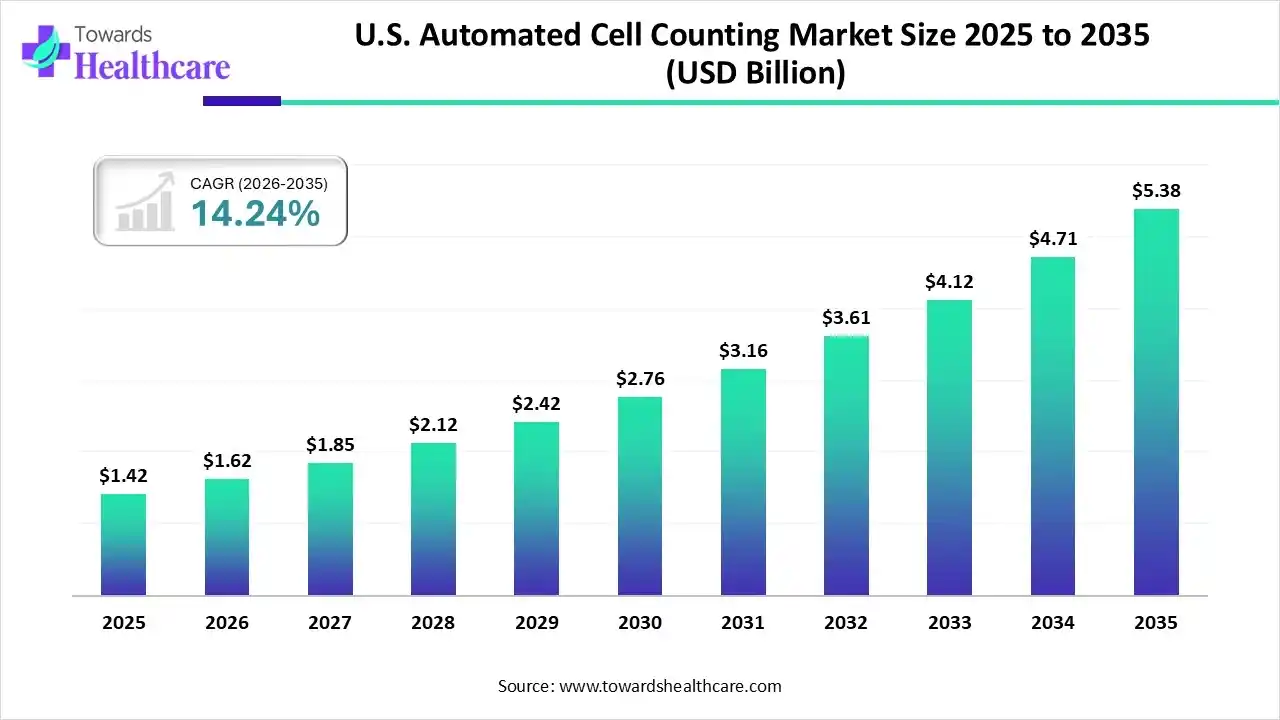
According to Towards Healthcare, the U.S. Automated Cell Counting Market is projected to grow significantly, with estimates indicating the market size will increase from USD 1.62 billion in 2026 to approximately USD 5.38 billion by 2035, expanding at a CAGR of 14.24% from 2026 to 2035. Automated counters apply well-developed imaging and counting algorithms to confirm that every measurement is highly precise. This leads to reliable outcomes, which is significant when analyzing information for vital biological research. By providing reproducible outputs, scientists trust the information they gather, which is significant for progressing with experiments and research. The automated cell counter has become an important tool in modern research laboratories. By providing increased speed, precision, and consistency, these tools enhance workflow and information reliability, all while reducing the challenges of individual error. Automated technologies are intended to meet the various requirements of cell researchers, providing flexible and adaptable services that fit seamlessly in a variety of laboratory settings.
About GE HealthCare Technologies Inc.
GE HealthCare is an important worldwide healthcare services provider of well-developed healthcare technology, medical diagnostics, and AI-driven technology, cloud and software solutions that support clinicians in tackling the world’s most challenging diseases. Serving patients and providers for 130 years, GE HealthCare is supplying bold innovations intended for the next era of therapeutics in its advanced imaging services, healthcare diagnostics, and patient care services segments to support physicians in delivering more targeted, precise patient care. This is a $20.6 billion business with around 54,000 colleagues working to create a world where healthcare has no restrictions.
A recent report by Towards Healthcare highlights that the U.S. automated cell counting market is growing, as cell counting is an important process in cell culture, diagnostic testing, and many other biological uses. Outdated processes often include physically counting cells under a microscope, which is both time-consuming and error-prone. With an automated cell counter, this process becomes significantly faster and more effective. These counter technologies count thousands of cells in seconds, saving valuable time for scientists and enhancing the overall workflow in the laboratory. An automated cell counter guarantees consistent and precise output with each count. Manual methods are subject to individual error, often influenced by factors such as fatigue or inconsistencies in procedures.