



Google Health to Launch Insulin Resistance Trends and Breathing Monitoring Features
Published: 27 Aug 2026
Author: Towards Healthcare



Significant expansion in small-molecule API commercial capacity and a new kilo-scale GMP facility dedicated to HPAPIs and ADC payloads.
A series of upcoming “Health Guardian” features will soon be launched on the Google Health app for Pixel Watch and Fitbit Air, tracking indicators like insulin resistance trends to deliver key health insights to consumers.
Based on reported evidence that detecting fluctuations in insulin resistance early provides the opportunity to enhance metabolic health through sleep habits, diet, and exercise changes, Google’s Insulin Resistance Trends feature is said to analyse physiological information from wearables to record trends and patterns. Correspondingly, a novel feature for blood pressure monitoring aims to spot higher cardiovascular trends that warrant lifestyle variations or a consultation with a health professional.
Two further features monitor breathing quality and breathing evolution; based on Google, grant consumer a daily summary of the amount of sleep time spent in optimal breathing, a monthly assessment to support recognizing longer-term patterns, and the choice to allow the Pixel Watch to automatically call evolving services when blood oxygen levels drop dangerously low.
“Bringing this technology to your wrist is the result of years of breakthrough AI research,” Google states. “Traditionally, teaching AI required experts to manually analyse and label thousands of hours of sensor data. Instead, we developed advanced AI models that taught themselves human biology by observing sensor data from millions of opted-in users across billions of minutes of everyday life.”
Insulin resistance trends have been advanced using a large sensor foundation model trained on more than a trillion minutes of data from five million consumers, Google reports, with an article investigative precision as validated by standard blood tests published in Nature. Blood pressure trends are powered by WavesFM, a foundation model trained on billions of minutes of heart and movement information, with data validated via independent Google research.
Consumers are supported in understanding their health insights via Google Health Coach, which provides practical guidance on enhancing health and wellness, Google shares.
“By powering Health Guardian features with advanced AI, we’re laying the foundation for a new wave of health insights,” the company says. “Moving forward, these models and advancements will allow your wearable to catch more subtle changes early, helping you take proactive steps toward a longer, healthier life.”
Wider Trend: Wearable Tech
Revolutionize UK has recognized 100 female founders in its latest Women in Innovation cohort, focusing on manufacturing, digital tech, and life sciences, with novelties spanning wearable tech, diagnostics, and AI. 61 of those selected will be receiving a £75,000 grant, along with 12 months of business support and training, Innovate UK reports. The outstanding 31 applicants will receive the 12 months of business support. Some of the projects named by Innovate UK involve wearable tech to identify dehydration challenges in older adults, looking to prevent avoidable illnesses and lessen hospital admissions. Mary-Brenda Akoda, another successful applicant, is using AI to reduce MRI scanning time by up to 90 %.
A total of £11.1 million in spending has been committed to the launch of a wearables and remote monitoring innovation cluster in Greater Manchester; a collaboration between Manchester University NHS Foundation Trust, The University of Manchester, Manchester Metropolitan University, and the NIHR Manchester Health Determinants Research Collaboration. The drive is to support reducing challenges to innovation in wearable and remote health monitoring technologies by advancing simpler technologies to bring them to the market.
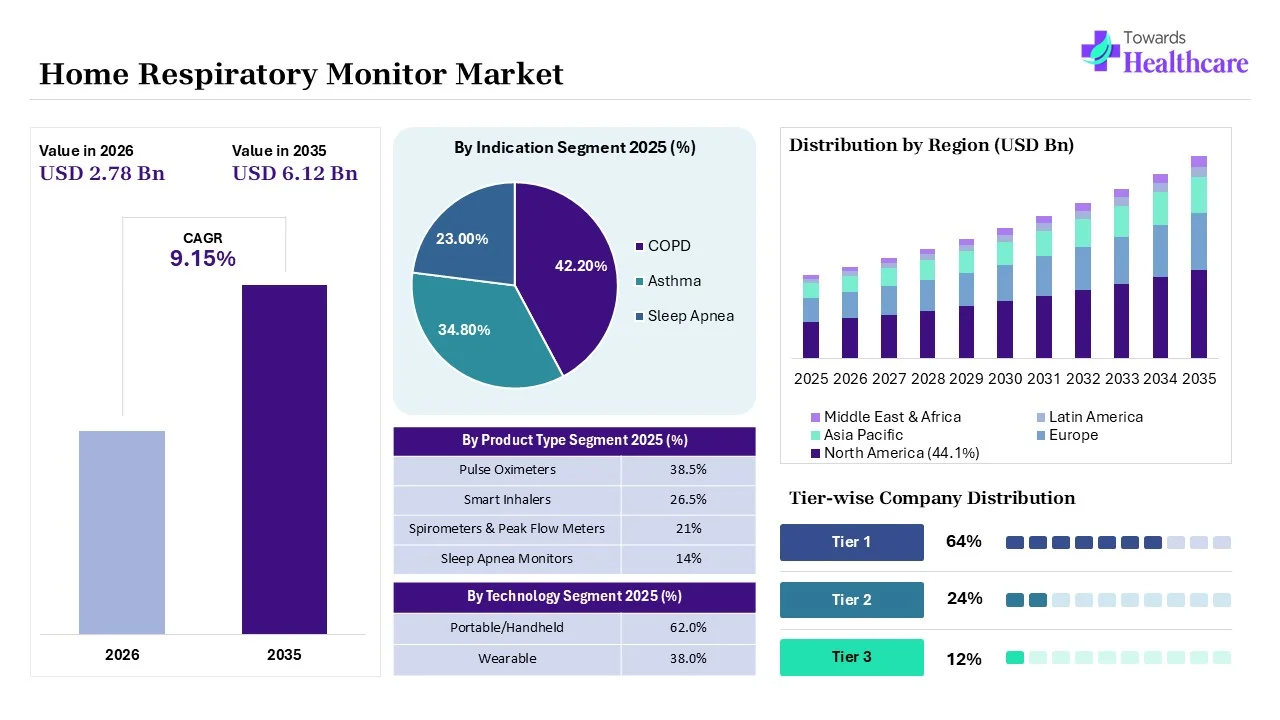
According to Towards Healthcare, the home respiratory monitor market is projected to grow significantly, with estimates indicating the market size will increase from USD 2.78 billion in 2026 to approximately USD 6.12 billion by 2035, expanding at a CAGR of 9.15% from 2026 to 2035. Respiratory remote monitoring improves patient adherence and empowers doctors to deliver advanced care. An at-home peak flow meter offers asthma patients and healthcare providers real-time information to strengthen condition management. With the ability to enhance patient adherence and allow early interventions, these innovative tools demonstrate the transformative power of remote monitoring. Remote monitoring is an essential tool in managing different prevalent long-term diseases. In the recent healthcare landscape, telehealth and remote monitoring programs are significant in efficiently managing chronic respiratory conditions.
About Google Health
Google Health connects wearable devices, health apps, smart tools, and medical records to give one holistic view of healthcare. With the Google Health Coach, built with Gemini, get access to targeted, adaptive, and proactive coaching with fitness plans, sleep insights, and 24/7 health and wellness guidance all tailored to the patient. Google Health is an integrated wellness platform and app that brings patients' fitness, sleep, and medical information together into a single hub. Google Health is an organization-wide initiative and product ecosystem rather than a standalone organization, focused on integrating artificial intelligence, customer health tracking, and clinical research. Google is collaborating with world-class medical care, public health, and academic organizations to deploy services for transformative health devices and solutions.
A recent report by Towards Healthcare highlights that the home respiratory monitor market is growing, as the technology provides benefits such as comfort, simplicity of use, and minimal interference with natural breathing, creating it suitable for different applications, involving sleep research, physical activity monitoring, and respiratory health evaluations. Developments in electronics design, particularly battery technology, low-power embedded processors, and the development of the software domain, which give tools advanced applications and more usable use cases, have allowed the development of new advanced wearables and remote technology. The applications of home remote patient monitoring could be related to 87% fewer hospitalizations, 77% fewer deaths, and reduced per-patient expenses. Home-based respiratory monitoring is its capability to identify exacerbations early. Exacerbations, characterized by unexpected worsening of symptoms, are a leading cause of COPD-associated hospitalizations.