



India Launches ICT Track Under BRICS Chairship to Strengthen Digital Cooperation
Published: 19 Aug 2026
Author: Gautam Mahajan



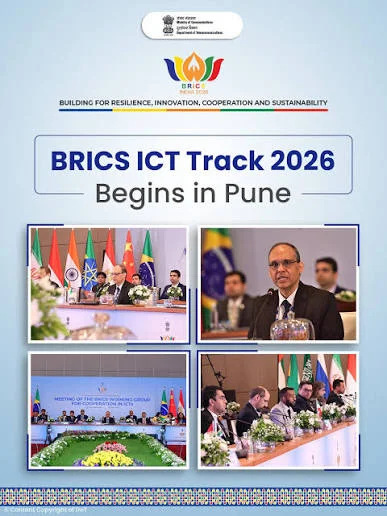
On 17 August 2026, under its BRICS chairmanship, India initiated the information and communication technologies track and started formal talks in Pune with the goal of enhancing collaboration throughout the digital industry. The initiatives' main goals are to increase cooperation, foster innovation, strengthen resilience, and enhance sustainability in the digital ecosystem. The ICT-related talks, which will culminate in the August 20 and 21 BRICS ICT Ministerial event and statement, are anticipated to involve representatives from all 11 BRICS member nations.
Amit Agrawal, the secretary of the Department of Telecommunications, spoke during the event and stated that the ICT track is the culmination of discussions carried out over the past year. With a focus on developing digital technologies and issues impacting the global technology ecosystem, the talks aim to create collective strategies and activities among the BRICS, which accounts for about half of the world's population; coordinated digital policies and technology cooperation might have a big impact on the global ICT scene.
The BRICS theme of “Building for Resilience, Innovation, Corporations, and Sustainability” has served as the framework for the ICT agenda. Artificial intelligence and cybersecurity are discussed, and a cybersecurity workshop is scheduled for August 20 to help member nations share best practices. The project is an example of how BRICS collaboration is growing beyond economic issues to include telecommunications, digital technologies, cybersecurity, artificial intelligence, and other technology-related fields.
Impact on the ICT Industry
International collaboration on digital infrastructure, cybersecurity, artificial intelligence, telecommunications, and other cutting-edge technologies may be strengthened by the establishment of the BRICS ICT track. Enhancing the resilience of these systems has become a top issue as nations rely increasingly on linked digital systems for vital infrastructure, financial transactions, enterprises, government services, and communications. Therefore, the emphasis on resilience under India's BRICS chairmanship may inspire member nations to share information and devise strategies for tackling shared digital concerns.
Technology firms that operate in the BRICS economies may find opportunities because of the focus on innovation and collaboration. Discussions about digital infrastructure, technology standards, cybersecurity procedures, AI applications, and cross-border digital cooperation may be sparked by more alignment among participating nations. Increased collaboration between emerging economies could open up new avenues for technology deployment and collaborations for ICT vendors, cloud service providers, cybersecurity firms, telecom operators, software developers, and technology infrastructure corporations.
One of the most significant fields to emerge from the ICT track is anticipated to be cybersecurity. The BRICS nations are paying more attention to coordinated approaches to digital security, as seen by the planned cybersecurity workshop and best practice exchange. Governments and businesses need more robust solutions to safeguard networks, data, applications, and vital infrastructure as cyber threats become more complex and digital infrastructure grows. Increased global information exchange could help participating economies build more robust cybersecurity capabilities.
Additionally, the project might have an impact on the creation of more sustainable digital infrastructure. As nations develop data centers, telecommunications networks, cloud infrastructure, and AI computing capabilities, the sustainability component of the ICT agenda is crucial. The demand for energy-intensive infrastructure is rising due to the growth of digital services, necessitating the development of technological techniques that strike a balance between digital expansion and sustainability and efficiency.
Thus, the BRICS proposal may signify a more general move toward cooperative digital development for ICT firms. Countries may increasingly look toward shared frameworks, information exchange, technical cooperation, and common approaches to growing digital concerns rather than developing technology policies independently.
Impact on the Cybersecurity Market
The global cybersecurity market size was valued at USD 301.91 billion in 2025, calculated at USD 339.96 billion in 2026, and is expected to reach around USD 969.45 billion by 2035. The market is expanding at a solid CAGR of 12.37% over the forecast period 2026 to 2035.
By emphasizing digital resilience, cybersecurity collaboration, information sharing, and the sharing of best practices, the BRICS ICT track may help the cybersecurity sector continue to grow. According to prior research, the need for cybersecurity is largely driven by rising cyberthreats, increased data protection concerns, cloud use, and digital transformation.
As the BRICS economies continue to develop digital government services, financial technology, telecommunications infrastructure, cloud platforms, and connected systems, the initiative's cybersecurity focus is especially pertinent. The need for solutions that can recognize threats, safeguard data, manage identities, keep an eye on networks, and react to security problems may increase with each new digital service.
Precedence Research states that while cloud security is anticipated to develop rapidly as more businesses shift workloads and applications into cloud environments, network security is still a crucial part of the cybersecurity sectors. Because secure cloud and network infrastructure will be necessary to provide dependable digital services. This development is consistent with the BRICS focus on digital resilience.
This connection may be strengthened even more by the expanding application of AI in cybersecurity. Large-scale data analysis, anomalous pattern recognition, threat identification, and more effective incident response are all possible with AI-based security solutions. The market for AI in cybersecurity is mostly driven by the adoption of AI-based security systems and the growing complexity of cyberattacks, according to precedent research.
Increased awareness of AI-enabled security solutions may result from the BRICS cybersecurity talks. Organizations may assess automated security monitoring, threat intelligence, identity protection, cloud security, and AI-supported incident response systems more frequently as nations share information about cybersecurity policies.
The initiative could also create opportunities for cybersecurity companies to expand into emerging markets. Technology vendors with solutions that can operate across different digital environments may find new opportunities as governments and enterprises strengthen their cybersecurity infrastructure.
Impact on the Artificial Intelligence Market
Another significant area of technology covered by the BRICS ICT track is artificial intelligence. An AI report presentation that highlights the significance of AI within the larger agenda of digital cooperation is part of the discussions. The increasing convergence of digital infrastructure and emerging technologies is reflected in the integration of AI with cybersecurity.
As businesses use machine learning, generative AI, natural language processing, machine vision, and other AI technologies across industries, the artificial intelligence industry is growing, according to Precedence Research. According to the research, generative AI is one of the quickly developing technological fields, and software is a crucial component of the AI ecosystem.
Increased collaboration of AI development adoption and application may result from the BRICS ICT project. Member nations can share information about cybersecurity automation, digital public services, enterprise apps, AI infrastructure, and responsible technology development. This kind of collaboration could improve AI capabilities in developing nations.
Additionally, telecommunications and AI are becoming more intertwined. AI can be used by telecom companies for traffic management, fraud detection, customer support, network optimization, predictive maintenance, and resource allocation. AI-enabled technologies can assist operators in managing infrastructure more effectively as digital networks get increasingly complicated.
Another significant possibility is the connection between cybersecurity and AI. Precedence Research highlights the increasing usage of AI technology to combat increasingly complex cyber threats and cities cybersecurity as a developing application area within the AI market.
This convergence may promote the creation of integrated solutions for ICT forms that incorporate data analytics, cloud computing, cybersecurity, telecommunications, and artificial intelligence. Thus, the BRICS ICT track includes cloud computing, cybersecurity, telecommunications, and artificial intelligence. This BRICS ICT track could facilitate a more expansive digital environment where AI is employed to enhance resilience, security, efficiency, and digital service delivery in addition to automation.
Research institutes and digital businesses may potentially benefit from the collaboration; increased interaction between the BRICS economies could promote technology development, research collaboration, innovation collaborations, and information exchange among emerging markets.
Impact on Digital Infrastructure and Telecommunications
The ecosystem of digital infrastructure and telecommunications may also be impacted by the ICT track. As part of its broader agenda, BRICS collaboration already includes telecommunications; the current ICT discussions further integrate digital technologies into the framework of the group cooperation.
Resilient telecommunications infrastructure is becoming more and more crucial as nations continue to grow their broadband connectivity, cloud infrastructure, data centers, mobile networks, and digital services. International collaboration could facilitate the exchange of information about cybersecurity technology, network resilience rollout, and sustainable infrastructure.
Increased focus on infrastructure development and digital connection could be advantageous for telecom providers. To support digital enterprises, government services, education, healthcare, financial services, and industrial applications, emerging markets still need to invest in dependable communication networks.
High-performance digital infrastructure is becoming more necessary as cloud computing and artificial intelligence become more widely used. These technologies will be supported in large part by data centers, connectivity networks, edge computing, and corporate platforms. Businesses may be inspired to investigate more effective infrastructure and technologies that lessen the environmental impact of growing digital systems by the BRICS emphasis on sustainability.
The ICT track could therefore contribute to a more connected and resilient digital environment across participating economies while creating opportunities for telecommunications providers, infrastructure companies, cloud platforms, and technology service providers.
About the Department of Telecommunications
India's Ministry of Communications oversees the Department of Telecommunications, which is crucial to the nation's telecom industry. The department is taking part in the ICT track and organizing talks about digital cooperation among member nations as part of India's BRICS chairmanship.
Resilience, creativity, collaboration, and sustainability in the digital environment are the main topics of discussion in ICT today. Cybersecurity and artificial intelligence are among the key topics of discussion in the official level of talks leading up to the BRICS ICT Ministerial event and declaration, according to DoT Secretary Amit Agarwal.
India's ongoing participation in the BRICS framework for cooperation is reflected in its current chairmanship. Beyond its initial economic focus, BRICS now encompasses cultural and people-to-people interactions, economic and financial collaboration, and political and security corporations. The gathering currently covers a wider range of topics, including digital collaboration and telecommunications.
Digital technology is thus positioned as a key element of India's BRICS program with the introduction of the ICT track. The effort could improve collaboration throughout the global ICT ecosystem by bringing member nations together to talk about artificial intelligence cybersecurity, digital resilience, innovation sustainability, and telecommunications.