



James City County partners with VCU to Test Drone Defibrillator Delivery
Published: 24 Aug 2026
Author: Towards Healthcare



Betsy Sink demonstrates one of the automated external defibrillators that can be flown to the scene of a heart attack in Toano by Air 10, a James City County-owned drone devoted to medical emergencies.
A first-of-its-kind research study exploring how airborne drones support enhancing heart attack survival rates is running in rural James City County.
The program, a partnership among the county and Virginia Commonwealth University in collaboration with Duke University, is accessible in the Toano region and in Forsyth County, N.C. It makes a drone with a robotic exterior defibrillator, or AED, which flies to the scene of a heart attack and accelerates lifesaving care.
Dr. Joseph Ornato of VCU is one of the patients leading the research. He chaired the university's department of evolving medicine for 23 years and has spent decades in emergency cardiac care. He worked closely with organizations like the American Heart Association to advance technology and devices to enhance results for patients having heart attacks outside of hospitals.
For the more than 350,000 patients who suffer a heart attack outside of the hospital every year in the United States, the time it takes for support to arrive can mean life or death. Ornato said about 10% of patients survive, and each minute that passes without care, the odds drop by 10%.
For those living in tremendously rural regions, the figure drops to "almost zero," Ornato said.
But on-the-ground response time, Ornato said, has largely hit a wall. Emergency medical vehicles can only go so fast in an urban or suburban setting, and take on average about eight minutes to reach a patient. After medics unload and prepare tools, it's typically minute 11 before a patient receives their first defibrillation.
"Hence the low survival," Ornato said.
That's where drones could create a difference. The program launched in Forsyth late last year and started up in James City on August 1, where Ornato's former healthcare resident at VCU, Dr. Amir Louka, is the fire department's EMS medical director. It is applying to have one drone owned by the county's police department to operate in a 5-mile circle around the county fire station in Toano.
James City police launched a drone team in 2021, but began its drones as a first-responder program in 2025. The drone used for this program, called Air 10, is committed solely to responding to heart attacks; a pilot will monitor only the calls in Air 10's 5-mile range in Toano, the county's most rural area, and dispatch the largely automated drone to support when required.
Once there, the drone will lower an AED around 100 feet down on a tether as on-the-ground help is on the way. Dispatchers and the AED's audible instructions coach bystanders through rendering aid in the meantime.
Though it hasn't yet responded to an emergency, some early deployments in the county got a drone overhead in two minutes, beating on-the-ground vehicles by six minutes.
"The potential for it to save lives is huge," said Betsy Sink, battalion chief of EMS operations for the James City County Fire Department. "I think the number of cardiac arrest patients that we could save if this grew to a national program could be tens of thousands."
James City County is the latest locality in Hampton Roads to create or increase programs using drones as first responders after Federal Aviation Administration regulations opened new opportunities for flying the vehicles in 2025.
Though a private organization, Archer First Response Systems, launched a drone AED transfer program in Tampa Bay in 2024, Ornato said the James City and Forsyth project is the first to test embedding the concept inside public evolving solutions. He said demonstrating that it works and can be replicated, even in a less compactly populated community, could create an alteration for agencies nationwide.
The project is funded through the end of June 2027 by the American Heart Association. Ornato isn't sure at present how, and if, such programs will be accepted around the U.S. after he and Dr. Monique Starks, his counterpart at Duke, have the research findings. But Ornato envisions a conceivable future where regional home paying several fast-acting medical drones stocked with AEDs, stop-the-bleed kits, EpiPens, and naloxone that dramatically enhance survival rates for health emergencies.
"Now, politically, is that going to be possible? Remains to be seen," Ornato said. "The future is uncertain, but wide open for potential exploration and cost-effective regionalization of the concept.
According to Towards Healthcare, the defibrillator market is projected to grow significantly, with estimates indicating the market size will increase from USD 9.29 billion in 2026 to approximately USD 18.80 billion by 2035, expanding at a CAGR of 8.14% from 2026 to 2035. A defibrillator can save a person's life if they’re in cardiac arrest. This tool delivers an electrical charge that stops the heart’s abnormal rhythm so the heart can get back to a normal rhythm. Even with defibrillation, heart arrest is fatal for many patients. It’s not infrequent for survivors to need multiple types of therapy to recover. A defibrillator is a tool that delivers an electric shock to the heart to help it to get out of a potentially fatal abnormal heart rhythm, or arrhythmia, ventricular tachycardia or ventricular fibrillation, and back to a usual rhythm. Both of these arrhythmias happen in the cardiac ventricles, or lower chambers.
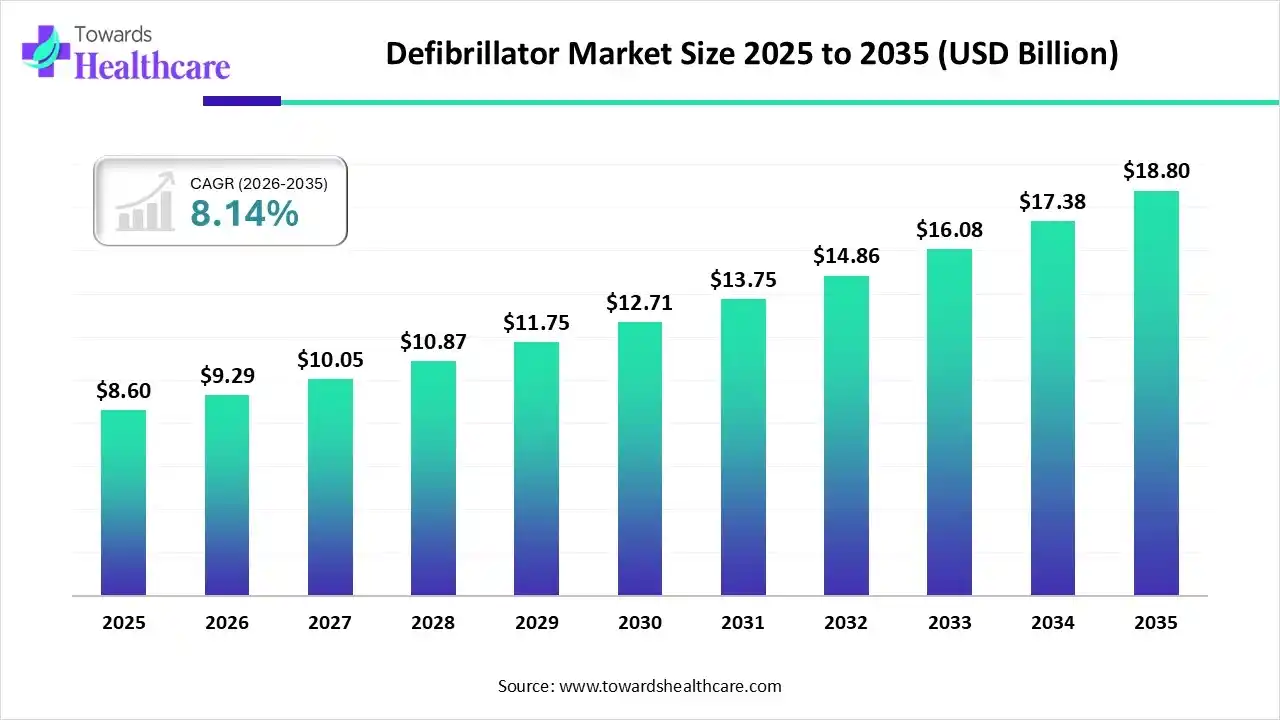
A recent report by Towards Healthcare highlights that the defibrillator market is growing, with increasing use of life-support defibrillators, which are heavy-duty resuscitation machines applied by healthcare paramedics and professionals. Older ALS defibrillator models used paddles, which a technician would press against a patient’s chest to administer a shock. Advanced life support defibrillators also monitor the patient’s blood pressure, carbon monoxide levels, and other key medical information. ALS defibrillators stabilize patients by making sure that their heart is pumping blood by delivering shocks routinely. Implantable cardioverter-defibrillators are medical devices that surgeons implant in a patient’s body.