



A Novel Method Allows Accurate Sequencing of Short Peptides Hidden in Food and the Human Body
Published: 08 Jul 2026
Author: Towards Healthcare



Daily food & our bodies are made up of full of tiny protein fragments known as peptides, which are generally small chains of amino acids that serve as biological messengers, further impacting processes ranging from sensory perception to physiological functions.
Ongoing breakthroughs in omics technologies have offered groundbreaking insights into the molecular processes that frame living systems, unveiling these molecules as major players across diverse biological functions. Alongside, precise sequencing of short peptides sustains as major challenge due to their small size, which facilitates restricted analytical information.
A current study was published in Analytical Chemistry on June 15, 2026, by Associate Professor Mitsuru Tanaka from Kyushu University’s Faculty of Agriculture & his team introduced a new method to address this concern. This method encompasses the utilization of mass spectrometry, an analytical technique that finds compounds by recording the mass-to-charge ratios of ions generated from a sample. An innovative strategy is being worked on by joining a coumarin-derived tag to the N-terminus, one end of peptides. Alongside, the researchers employed N-succinimidyl 7-methoxycoumarin-3-carboxylate (Me-Cou) as the tagging reagent.
Tanaka commented that, by leveraging this approach, one can determine the amino acid sequence step by step, starting from the tagged end, allowing highly accurate characterization of even the short ones.
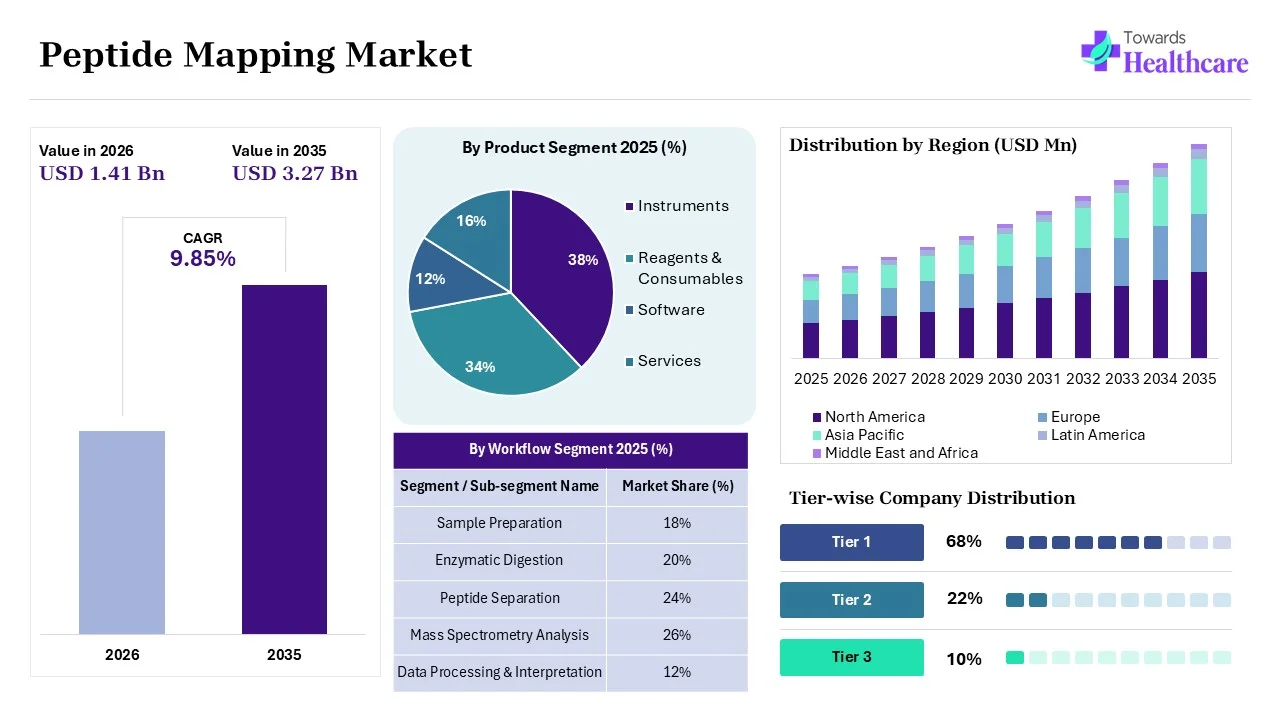
According to Towards Healthcare, the peptide mapping market is projected to experience significant growth, with estimates suggesting the market size will increase from USD 1.41 billion in 2026 to approximately USD 3.27 billion by 2035, representing a compound annual growth rate (CAGR) of 9.85% from 2026 to 2035.A massive expansion of biologic drugs, stricter regulatory requirements for batch release testing, & consistent technological advancements are driving the global market progression. Across the research activities, LC-MS/MS is developing as a premier technology to facilitate superior fragmentation-based sequence confirmation and accurate peptide mass information.
Execution of MAM & High-Throughput Workflows
According to Towards Healthcare, the peptide mapping market has prominent opportunities, including the implementation of a multi-attribute method (MAM). This approach substitutes conventional lot-release assays with a single LC-MS peptide mapping workflow. It enables the simultaneous identification, monitoring, and relative quantification of Critical Quality Attributes (CQAs) like deamidation, oxidation, & glycosylation.
Many robust laboratories are gradually using robotic liquid handling and automated sample preparation platforms. Along with automated digestion kits & online processing, workflows are accelerating, lowering human error, & providing perfect method reshoring.