



LabPMM Launches Global KMT2A MRD Testing Service to Support Menin Inhibitor Development and Acute Leukemia Care
Published: 07 Aug 2026
Author: Towards Healthcare



A highly sensitive digital PCR-based assay targets KMT2A rearrangements (KMT2Ar), which are critical oncogenic drivers in Acute Myeloid Leukemia (AML) and Acute Lymphoblastic Leukemia (ALL).
LabPMM, an Invivoscribe subsidiary, announced the global availability of its novel KMT2A measurable residual disease (MRD) testing service. The highly sensitive digital PCR solution is available to medical care providers, healthcare researchers, and biopharmaceutical partners via LabPMM’s global laboratory network, with CAP/CLIA-accredited testing available in the U.S. The service addresses a growing need for precise molecular monitoring in acute leukemias.
KMT2A rearrangements (KMT2Ar) are oncogenic drivers in acute myeloid leukemia (AML) and acute lymphoblastic leukemia (ALL). These rearrangements are present in about 80% of infant cases and 5-15% of childhood and adult leukemia cases. KMT2A-rearranged leukemias are related with chemotherapy resistance, high relapse rates, and poor clinical results.
The appearance of menin inhibitors is transforming the therapeutic landscape for patients with AML and ALL, specifically those with KMT2A-rearranged and NPM1-mutated disease. The first FDA approval of a menin inhibitor for relapsed or refractory acute leukemia with a KMT2A translocation established clinical validation for this emerging drug class. As menin inhibitor programs shift into frontline and integration research, there is a growing need for sensitive molecular testing that precisely characterizes KMT2Ar, quantifies deep molecular response, and tracks response durability over time.
Standardized MRD Testing for Global Clinical Development
LabPMM’s advanced test targets the most general KMT2A partner fusion genes in AML and ALL, aligning the assay with the KMT2A biology central to major current menin inhibitor advancement programs. The test offers a quantitative output reported as the percentage of KMT2Ar relative to a housekeeping gene. The assay helps disease characterization and longitudinal MRD monitoring with sensitivity down to 0.005% and a reversal time in as little as 48 hours. This launch increases Invivoscribe’s comprehensive myeloid testing portfolio, which involves worldwide standardized molecular assay kits and LabPMM solutions for screening and MRD monitoring of FLT3, NPM1, KMT2Ar, as well as AML MRD assessment by multiparametric flow cytometry. Composed, these integrated abilities allow drug developers and medical providers to monitor disease load over time with unprecedented accuracy and sensitivity.
“Menin inhibitors are creating important new possibilities for patients with KMT2A-rearranged leukemia, but continued development requires a partner that can deliver highly sensitive, standardized molecular data across clinical programs and geographies,” said Jeff Miller, CEO and CSO of Invivoscribe. “By making KMT2A MRD testing available through LabPMM, we are helping clinicians and biopharmaceutical partners measure meaningful responses earlier, monitor their durability, and ultimately improve patient care.”
Together, Invivoscribe and LabPMM offer an integrated worldwide ecosystem of standardized MRD testing, government expertise, and companion diagnostic abilities. Massively sensitive MRD testing supports defining molecular response depth, evaluating response durability, supporting patient stratification, and accelerating trials when applied as surrogate endpoints. By making consistent molecular data in global healthcare programs, this integrated strategy supports sponsors in making earlier, more informed decisions and lowering advancement risk from early clinical research via regulatory submission, approval, and commercialization.
Medical care providers and pharmaceutical sponsors emerging menin inhibitors for acute leukemia or other immunotherapies contact Invivoscribe to discuss the company's global testing programs.
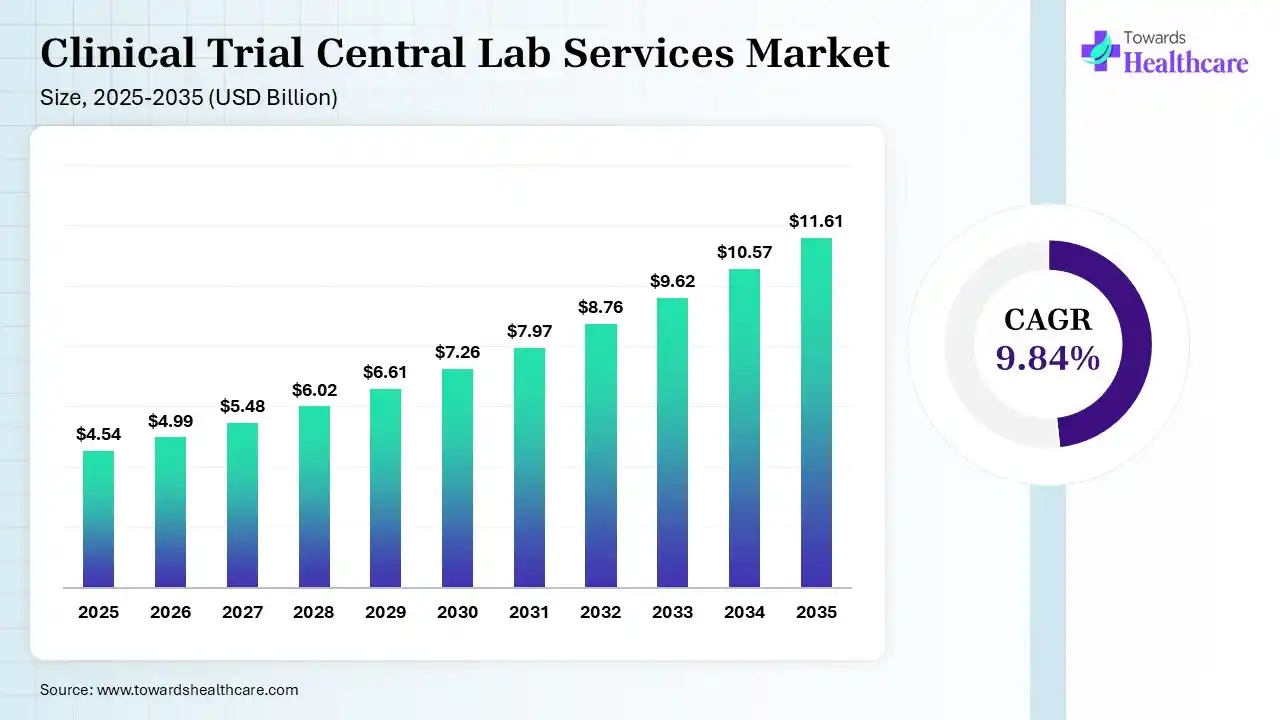
According to Towards Healthcare, the clinical trial central lab services market is projected to experience significant growth, with estimates suggesting the market size will increase from USD 4.99 billion in 2026 to approximately USD 11.61 billion by 2035. Growth is expected at a steady CAGR of 9.84% in between 2026 to 2035. Clinical central laboratory offers a comprehensive suite of services to support clinical trials. This provides global logistics, expert sample management, and a broad array of analytical testing options. This includes customized blood sampling kits and study- and site-specific laboratory manuals that promote consistency across all clinical sites. These technology-dedicated project management teams handle material expiry dates and coordinate the logistics for global sampling under various temperature conditions. The laboratory's analytical solutions encompass safety analysis, biomarkers, pharmacokinetics (PK), pharmacodynamics (PD), and testing compliant with good manufacturing practice (GMP) standards.
About Invivoscribe
Invivoscribe is a worldwide, vertically integrated biotechnology organization dedicated to enhancing lives with precision diagnostics. For over thirty years, Invivoscribe has enhanced the quality of medical care globally by offering high-quality standardized reagents, tests, and bioinformatics tools to advance the field of precision medicine. Invivoscribe has an effective track record of collaboration with pharmaceutical organizations interested in clinical trial testing via a worldwide lab network located in the U.S., Germany, Japan, and China, and in developing and commercializing companion diagnostics, with extensive expertise in both regulatory and laboratory solutions. Offering distributable kits, as well as clinical trial services through its worldwide-located clinical lab subsidiaries, LabPMM, Invivoscribe is an ideal partner from diagnostic advancement through clinical trials, government submissions, and commercialization.
A recent report by Towards Healthcare highlights that the clinical trial central lab services market is growing as these labs ensure standardized and consistent testing technology and quality control measures across multiple trial sites, which is technology specifically important for multinational or multicenter trials. Central labs are often equipped with advanced technology and have extensive experience in conducting particular types of tests or assays. They generally test and analyze a large number of samples collected from multiple trial sites or locations. The central lab gets the samples from the trial sites, performs the testing, and communicates the output back to the trial sites or the sponsor. A central lab is generally a large, particular laboratory facility that is typically independent of the clinical trial site or sponsor. It is responsible for performing a significant portion of the laboratory testing needed for the clinical trial.