



Mount Sinai Medical Center Among First in the Nation to Bring Ambient AI to Nurses
Published: 31 Jul 2026
Author: Towards Healthcare



Mount Sinai Medical Center announced that Chart with Art, an AI-powered documentation device, is now available to its inpatient nurses, creating it the first health technology in Florida and the fourth in the nation to extend the technology to nursing staff. The devices, developed by Epic, the organization behind Mount Sinai's electronic health record and MyChart patient portal, have already been in use by the health center's doctors.
Using a simple recording, Chart with Art turns a free-flowing conversation into the healthcare documentation that guides a consumer's care plan. The device works in both English and Spanish, a meaningful distinction in a public where more than 30 % of Mount Sinai's patients speak Spanish as their main language. It lets patients and families speak as they feel comfortable while the technology works in the background. That frees more of a nurse's time, involving some of the most sensitive conversations in care, for human assembly.
"Our nurses came into this profession to care for people. Chart with Art lets them step out from behind the keyboard and be fully present at the bedside. That presence is where care begins, and giving more time back to our nurses is why Chart with Art was implemented," said Wendy Stuart, Chief Nursing Officer at Mount Sinai Medical Center.
This is the first week Chart with Art is available to inpatient nurses, who are beginning a gradual rollout in the healthcare center.
"Patients should know we held this technology to the same standard we hold ourselves to. Our own physicians used Chart with Art and confirmed it before we brought it to the bedside, and nothing enters a patient's record until a clinician reviews and approves it. It safeguards the trust at the center of every visit, and that is good for the patient and good for us," said Dr. Alon Weizer, Chief Medical Officer at Mount Sinai Medical Center.
Over the past several months, Mount Sinai physicians have worked directly with Epic to refine how the technology performs in real healthcare scenarios. In that time, contributing physicians have lessened the time they spend in the chart per encounter by nearly 30 %, along with the certification they complete after hours. That evidence is what gave Mount Sinai the confidence to bring Chart with Art to its nurses.
"Mount Sinai is one of the first to bring Chart with Art to the bedside, and their nurses helped us get it right, capturing more of what their shifts involve as it happens," said Corey Miller, Vice President of Research and Development at Epic. "With their physicians expanding their use too, more of the care team can stay engaged with the patient rather than the documentation."
"We did not rush this. Our physicians spent months working side by side with Epic's on-site team to prove the technology in our own clinical settings. That rigor is why our nurses and physicians can trust what Chart with Art does, and that trust is what makes it genuinely useful at the bedside," said Tom Gillette, Chief Information Officer at Mount Sinai Medical Center.
Patients receiving care at Mount Sinai facilities are informed when Chart with Art is in use and can decline at any time. The device does not replace healthcare judgment, and each entry is reviewed and confirmed by the nurse or provider before it enters the patient's healthcare record.
For Mount Sinai, Chart with Art reflects deliberate, governed strategies to artificial intelligence. The healthcare center reviews each AI tool it adopts against a clear standard. Chart with Art clears that bar, returning to physicians the undivided attention that technology has too often taken from the test room.
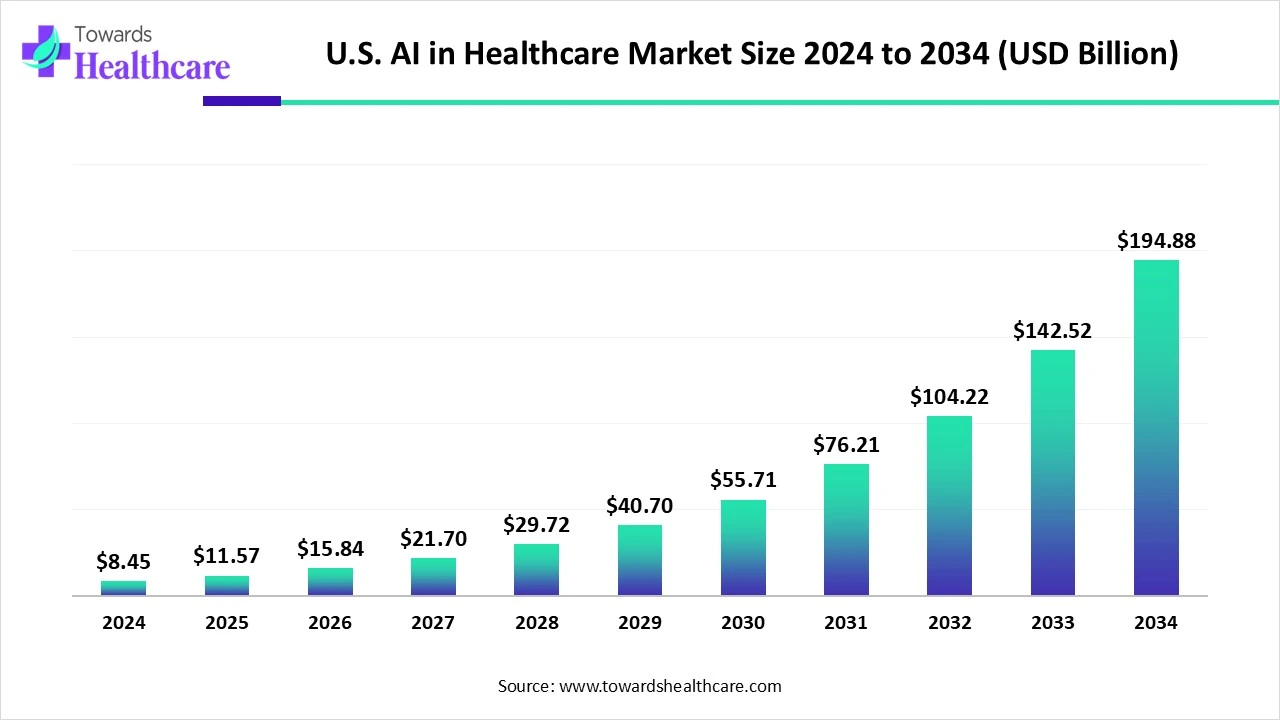
According to Towards Healthcare, the U.S. AI in healthcare market is projected to experience significant growth, with estimates suggesting the market size will increase from USD 15.85 billion in 2026 to approximately USD 268.90 billion by 2035, representing a compound annual growth rate (CAGR) of 36.97% from 2026 to 2035, driven by AI-driven technology analyses data much rapid than any human, involving healthcare research, healthcare records and genetic data which supports medical professionals come to a analysis. AI-based systems automate several routine tasks, like maintaining records, data entry, and scan analysis. By less time being spent on managerial tasks, healthcare professionals place more focus on patient care. AI-driven technology requirements to be extensively trained with curated data sets to perform as expected. However, due to privacy challenges, it can be problematic to access some of the data necessary to offer AI learning with the breadth and depth of information it requires.
About Mount Sinai Medical Center
Founded in 1949, Mount Sinai Medical Center is the main independent, private, not-for-profit learning hospital in South Florida. Mount Sinai's mission is to offer quality medical care to a diverse community improved via research, teaching, charity care, and economic responsibility. Mount Sinai's Centers of Excellence combine technology, research, and academics to offer innovative and comprehensive care in neuroscience, cardiology, oncology, orthopedics, and urology. One of the original statutory teaching hospitals in the state of Florida, Mount Sinai is the hospital of choice for those who seek the level of expertise and care that only an instructional hospital offers. Mount Sinai currently provides ten convenient locations in Miami-Dade County, involving three emergency centers and four specialty care offices in Monroe County.
A recent report by Towards Healthcare highlights that the U.S. AI in healthcare market is growing, as AI-base automate clerical responsibilities, analyzes patient data more effectively, and aids in diagnosing different medical conditions. AI-based technologies lessen the burden on health care workers by assisting with administrative work, data analysis, and image clarification. AI-based technology supports collecting, storing, and analysing significant data, involving healthcare records. This supports medical professionals in accessing the data they require faster and therefore work more efficiently. By analysing a patient’s records, healthcare research and expertise, AI-driven technology helps to determine the best course of management for a patient and assist medical professionals in finding a tailored and specific treatment.