



GRAIL Announced FDA Advisory Committee Meeting to Review Premarket Approval Application for the Galleri Multi-Cancer Early Detection Test
Published: 12 Aug 2026
Author: Towards Healthcare



Galleri has been commercially available since 2021 as a laboratory-developed test (LDT), which doctors can order but lacks formal FDA approval.
GRAIL, Inc., a medical care organization whose mission is to identify cancer early when it can be cured, announced that the U.S. Food and Drug Administration’s (FDA) Molecular and Clinical Genetics Panel of the Healthcare Devices Advisory Committee is scheduled to meet to review the Premarket Approval (PMA) application for the Galleri multi-cancer early detection (MCED) blood test.
The Galleri test is intended to identify cancer-specific methylation patterns shared by major types of cancer before symptoms appear, involving cancers that do not have recommended screening. When a cancer signal is identified, Galleri is intended to detect the cancer signal origin with enhanced precision to help guide diagnostic evaluation. The test is designed to be applied in addition to, and not as a replacement for, guideline-suggested screenings.
“Today, the status quo in cancer screening is simply unacceptable. Many cancers are detected too late, after symptoms appear and the disease is too advanced for effective or curative-intent treatments. In fact, 70-80% of cancer deaths occur due to cancers we are not screening for at all. GRAIL has pioneered a breakthrough technology, the Galleri test, designed to transform cancer screening by detecting more cancers before symptoms appear, including many of the deadly cancers that lack recommended screenings today. The Galleri technology is unique in how it is designed to examine the methylome using proprietary technology and artificial intelligence. We have generated extensive data in multiple studies to evaluate the impact of adding Galleri to standard-of-care screening, with positive results showing evidence of increases in screen-detected cancers, a low false positive rate and high signal origin prediction accuracy. Adding Galleri to recommended screening could result in a more effective and efficient cancer screening program in the U.S.,” said Josh Ofman, MD, MSHS, CEO at GRAIL. “Galleri is the only MCED test supported by large interventional and randomized, controlled studies in intended use populations. We appreciate the FDA’s leadership in advancing the review of the first premarket approval application for an MCED, and we look forward to discussing Galleri’s clinical data and the opportunity for multi-cancer early detection to address a significant unmet public health need, with the Advisory Committee.”
GRAIL submitted its PMA application for Galleri to the FDA. The FDA designated Galleri as a Breakthrough Device in 2018. The PMA submission is focused on the test performance and safety results from 25,490 consented participants with one year of follow-up in the US-driven PATHFINDER 2 study, as well as data from over 70,000 participants from the intervention arm of the prevalent screening round of the NHS-Galleri trial, the largest and only randomized, controlled trial of an MCED test in an intended use population. The submission is supported by an analysis to compare the performance of the version of Galleri used in the PATHFINDER 2 research and the NHS-Galleri trial to the updated PMA version, which has been submitted to the FDA for premarket approval.
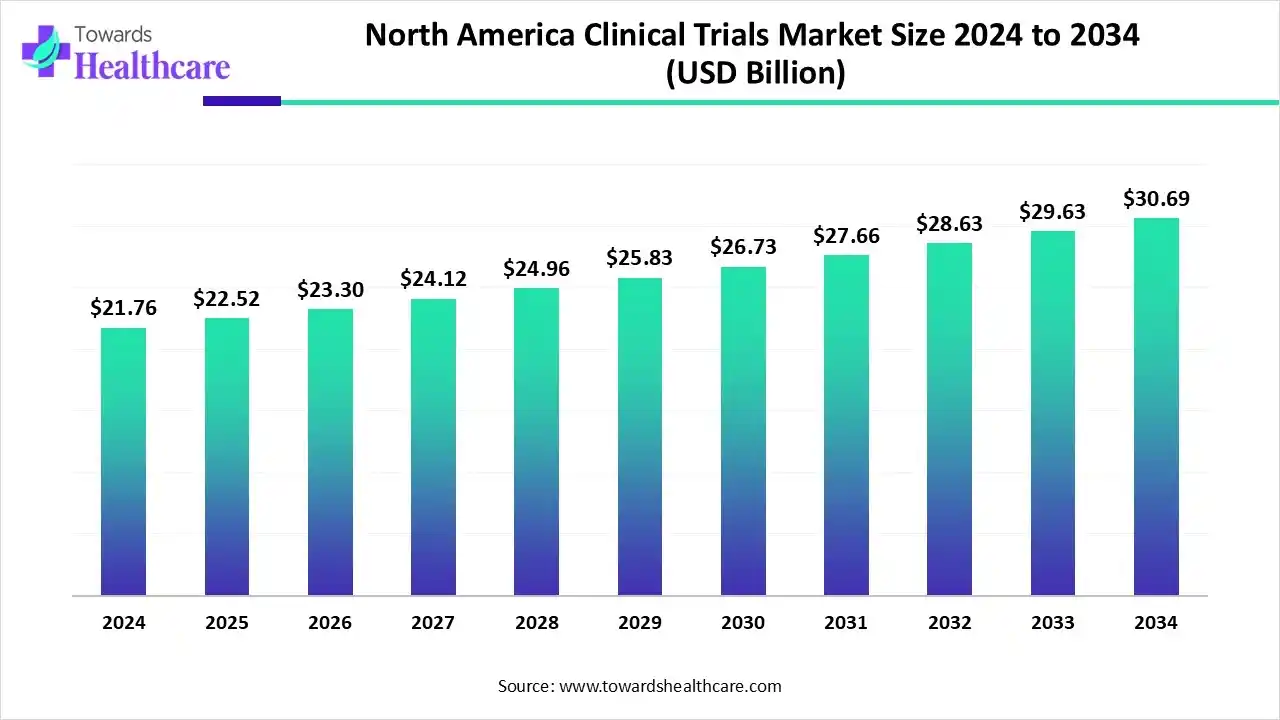
According to Towards Healthcare, the North America clinical trials market is projected to experience significant growth, with estimates suggesting the market size will increase from USD 58.82 billion in 2026 to approximately USD 99.10 billion by 2035, expanding at a CAGR of 5.40% between 2026 and 2035. Clinical trials play a significant role in modern medicine by offering valuable data about the safety, effectiveness, and appropriate dosing of novel drugs. They supports to enhnace public health, decreasing healthcare expenses, leading to discoveries related to the underlying biology of diseases, and developing management for rare conditions. Clinical trials support improving public health by detecting novel treatments for diseases that may have previously been fatal. Clinical trials are important in the advancement and approval of new drugs for healthcare applications. These trials provide invaluable insight into the safety, efficacy, and suitable dosing of potential pharmaceuticals, enabling healthcare professionals to offer patients the most efficient treatment options available. Clinical trials drive medical care forward by offering early access to advanced, life-saving therapies, confirming rigorous evaluation of drug safety and effectiveness, and increasing vital healthcare knowledge.
About GRAIL
GRAIL is a medical care organization whose mission is to identify cancer early, when it is curable. GRAIL is focused on alleviating the worldwide load of cancer by using the power of next-generation sequencing, population-scale clinical research, and advanced machine learning, software, and automation to identifies and identify multiple deadly cancer types in earlier stages. GRAIL’s targeted methylation-based platform can support the continuum of care for screening and precision cancer. GRAIL is headquartered in Menlo Park, Calif., with locations in Washington, D.C., North Carolina, and the United Kingdom.
A recent report by Towards Healthcare highlights that the North America clinical trials market is growing, as clinical trials allow the advancement of innovative management which can save lives and enhance the quality of life for patients. They provide patients access to advanced therapies before they become broadly available. Clinical trials rigorously test novel interventions to confirm they are both safe and efficient. Adverse effects and potential risks are carefully monitored throughout all phases. Clinical trials contribute to the advancement of treatments tailored to patients' genetic profiles, improving the effectiveness of therapies.