



Genprex Announces Collaboration with Roche Diagnostics for Biomarker Assay Validation Studies
Published: 13 Aug 2026
Author: Towards Healthcare



Collaboration Advances Biomarker-Driven Patient Selection and Precision Medicine in Oncology. Validation Studies Aim to Optimize Clinical Trial Patient Selection Criteria
Genprex, Inc., a clinical-stage gene therapy organization focused on advancing life-transforming therapies for patients with cancer and diabetes, announced its partnership with Roche Diagnostics to validate biomarkers for patient selection in clinical trials for non-small cell lung cancer (NSCLC). Building on promising preclinical and clinical data, this partnership aims to refine patient identification using TROP2 as a biomarker.
Genprex's initial research demonstrated that high TROP2 H-scores and low PTEN H-scores predicted patient response in preclinical research. These findings were further connected with longer Progression Free Survival (PFS) in clinical research, particularly for NSCLC patients with TROP2 H-scores above 100 and PTEN H-scores below 100. This information underscores the potential of these biomarkers to allow targeted patient selection and precision medicine. Added data have shown that intensity of TROP2 expression is correlated with PFS.
"This strategic partnership with Roche Diagnostics, a recognized leader in NSCLC assay development and the recipient of an FDA Breakthrough Device Designation for their AI-driven TROP2 diagnostic, is a testament to our shared commitment to advancing precision treatments in oncology," said Ryan Confer, President and Chief Executive Officer at Genprex. "By utilizing the same validated TROP2 antibody that Roche has used in other studies, we are poised to shorten the time for patient identification and recruitment for NSCLC clinical trials, ultimately delivering more effective, personalized treatment options."
The partnership leverages Roche Diagnostics' expertise in assay advancement. Roche Diagnostics established U.S. Food and Drug Administration (FDA) Breakthrough Device Designation for the first AI-based companion diagnostic for NSCLC, which uses a TROP2 score to assess NSCLC specimens, and Genprex uses the same antibody against TROP2 for its validation research. This strategic alignment confirms consistency and builds upon established diagnostic processes.
Genprex is increasing its preclinical and clinical research to possibly integrate TROP2 expression for patient selection in NSCLC clinical research. Roche Diagnostics performs the required assay validation using its TROP2 antibody. Genprex anticipates completing this validation research by approximately the end of 2026, with subsequent integration in its NSCLC clinical program shortly thereafter, based on the outputs of the validation research. This partnership exemplifies Genprex's commitment to delivering innovation that allows more precise diagnosis and treatment strategies in oncology, eventually goal of improving results for NSCLC patients.
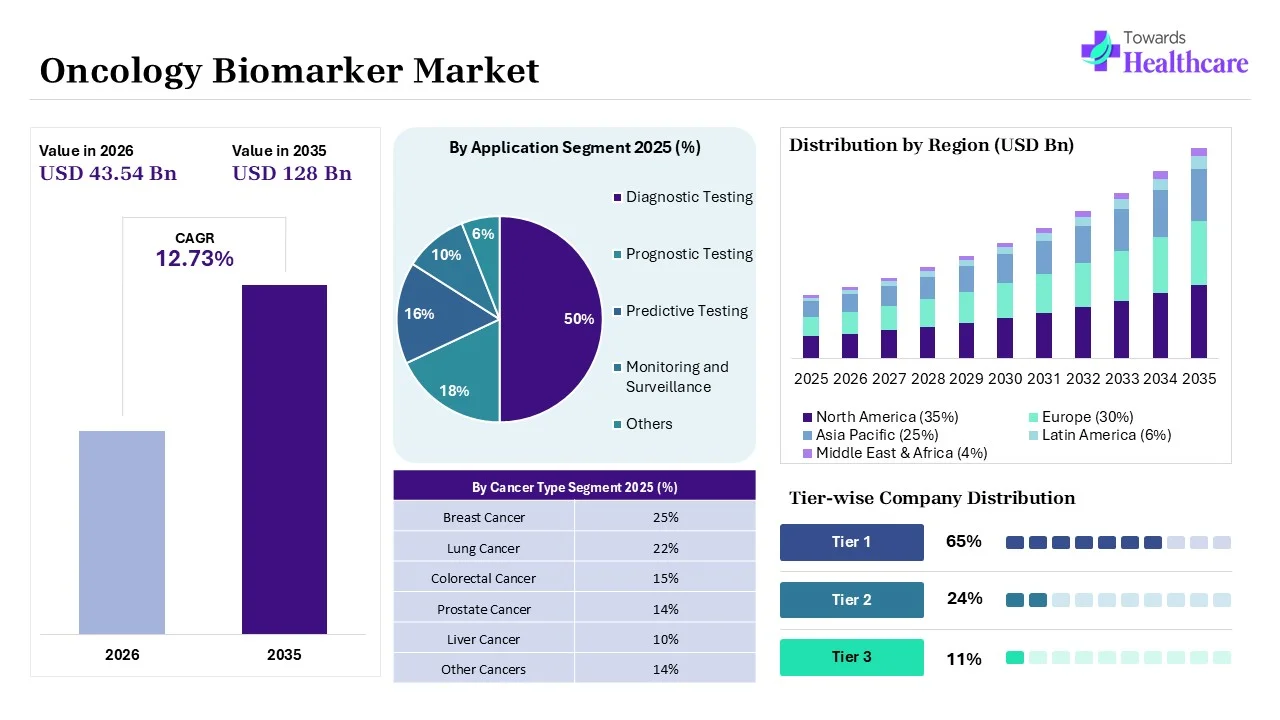
According to Towards Healthcare, the Oncology Biomarker Market is projected to grow significantly, with estimates indicating the market size will increase from USD 43.54 billion in 2026 to approximately USD 128 billion by 2035.The market is expanding at a CAGR of 12.73% between 2026 and 2035.Biomarkers are quantifiable indicators, molecules, genes, or imaging characteristics, showing normal or pathological bodily function. In the context of tumours, these biological markers identify the presence of tumour cells before symptoms appear. They are generally referred to as cancer biomarkers and are used to diagnose and predict treatment results. Cancer biomarkers involve genetic mutations, protein levels, or imaging characteristics that show the existence of cancer. They aid in early detection, enhance diagnosis, and support guiding treatment decisions. Prostate-specific antigen (PSA) for prostate cancer, CA-125 for ovarian tumours, and circulating tumour DNA (ctDNA) from blood tests.
About Reqorsa® Gene Therapy
REQORSA consists of a plasmid containing the TUSC2 gene condensed in non-viral lipid-driven nanoparticles in a lipoplex form, which has a positive charge. REQORSA is injected intravenously and particularly targets cancer cells. REQORSA is intended to deliver the functioning TUSC2 gene to negatively charged cancer cells while reducing uptake by normal tissue. Laboratory research conducted at MD Anderson shows that the uptake of TUSC2 in tumor cells in vitro after REQORSA management was 10 to 33 times the uptake in normal cells.
About Genprex, Inc.
Genprex, Inc. is a clinical-stage gene therapy organization focused on advancing life-transforming therapies for patients with cancer and diabetes. Genprex's technologies are intended to administer disease-fighting genes to offer novel therapies for large patient populations with cancer and diabetes who presently have limited treatment choices. Genprex works with world-class institutions and collaborators to advance drug candidates to further its pipeline of gene therapies in order to offer new treatment strategies. Genprex's oncology program uses plasmids in its systemic, non-viral Oncoprex Delivery System, which encapsulates the gene-expressing using lipid-based nanoparticles in a lipoplex form. The resultant product is administered intravenously, where it is taken up by cancer cells that then express tumor suppressor proteins that were deficient in the cancer. The organization's lead product candidate, Reqorsa Gene Therapy, is being evaluated in two clinical trials as a management for NSCLC and SCLC. Each of Genprex's lung cancer clinical programs has received a Fast Track Designation from the FDA for the management of that patient population, and Genprex's SCLC program has received an FDA Orphan Drug Designation. Genprex's diabetes gene therapy strategies are comprised of a new infusion process that uses an AAV vector to deliver Pdx1 and MafA genes directly to the pancreas. In models of Type 1 diabetes, GPX-002 transforms alpha cells in the pancreas into functional beta-like cells, which produce insulin but may be distinct enough from beta cells to evade the body's immune system. In a similar approach for Type 2 diabetes, where autoimmunity is not at play, GPX-002 is believed to rejuvenate and replenish tired beta cells.
A recent report by Towards Healthcare highlights that the oncology biomarker market is growing, as Predictive (diagnostic) biomarkers help match targeted therapies with patients and prevent the toxicity of standard (systemic) therapies. Prognostic biomarkers identify somatic germline mutations, changes in DNA methylation, elevated levels of microRNA (miRNA), and circulating tumor cells (CTC) in blood. Biomarker testing is an opportunity to look for genes, proteins, and other substances that provide cancer data. Each patient’s cancer has a unique pattern of biomarkers. Some biomarkers affect how some cancer treatments work. Biomarker testing supports patients and doctors in choosing a cancer treatment for patients.