



NVIDIA Open Sources First GPU-Accelerated Medical Physics Simulation Framework
Published: 13 Aug 2026
Author: Towards Healthcare



Medical device leaders are already building on NVIDIA’s new Medical Physics Simulation framework, giving surgical robots the virtual experience they need before interacting with patients.
For a healthcare robot helpful in the real world, it has to learn how the physical world pushes back. Anatomy varies. Tools bend, press, slip and interact with tissue. Imagination can be noisy or imperfect, and the rare, edge scenarios developers most require to understand don’t appear on schedule.
That makes one of the main bottlenecks in medical care automation: gaining the massive amount of varied data developers require to train, test, and enhance robot behavior.
NVIDIA Medical Physics Simulation framework, a novel open-source, GPU-accelerated capability in NVIDIA Isaac for medical care announced, supports healthcare robotics developers to model anatomy-device interaction, generate hard-to-capture scenarios, test in silico, and train or assess robot strategies before hardware-heavy testing.
The framework brings together anatomy and healthcare tools behavior with sensor simulation and robot learning, so teams create reusable simulation environments instead of rebuilding custom scenes for each workflow, saving developers time and delivering innovations to market rapidly.
Because Medical Physics Simulation is open source, medical care robotics developers inspect the framework, acclimatize it to their own tools and workflows, and build on a GPU-accelerated foundation that works flawlessly with the wider NVIDIA stack.
A Virtual Training Ground for Medical Robots
For physical AI, experience is information in motion. Designers require training to train robots to operate significantly even when anatomy variations, tools behave differently, conditions shift, or a policy fails unpredictably.
Medical Physics Simulation supports developers in simulating anatomy, tool contact, friction, and sensor inputs, then testing in connections and environments to assess how robots perform in those changes. Powered by NVIDIA CUDA and part of Isaac for Medical care built on the NVIDIA Warp, Newton, and Cosmos simulation and generative AI-based technologies, the framework runs hundreds of parallel simulation environments, supporting teams in exploring more scenarios and identifying challenge modes earlier in development.
For robot builders, this turns simulation from a bespoke engineering project into refillable infrastructure. The changes now are scale: benchmarks show 8,192 robot-training environments running in similar with GPU-native simulation cutting training from over five hours to two minutes.
With this advanced framework, developers connect vascular anatomy, flexible tools like catheters and guidewires, replicated X-ray imaging, and reinforcement learning. The framework is intended to extend beyond this example to additional devices, anatomies, sensors, and medical care robotics domains.
Medical Physics Simulation combines classical physics simulation and generative AI-based physics simulation. Classical simulation supports models of known physical rules, like device contact, friction, and motion.
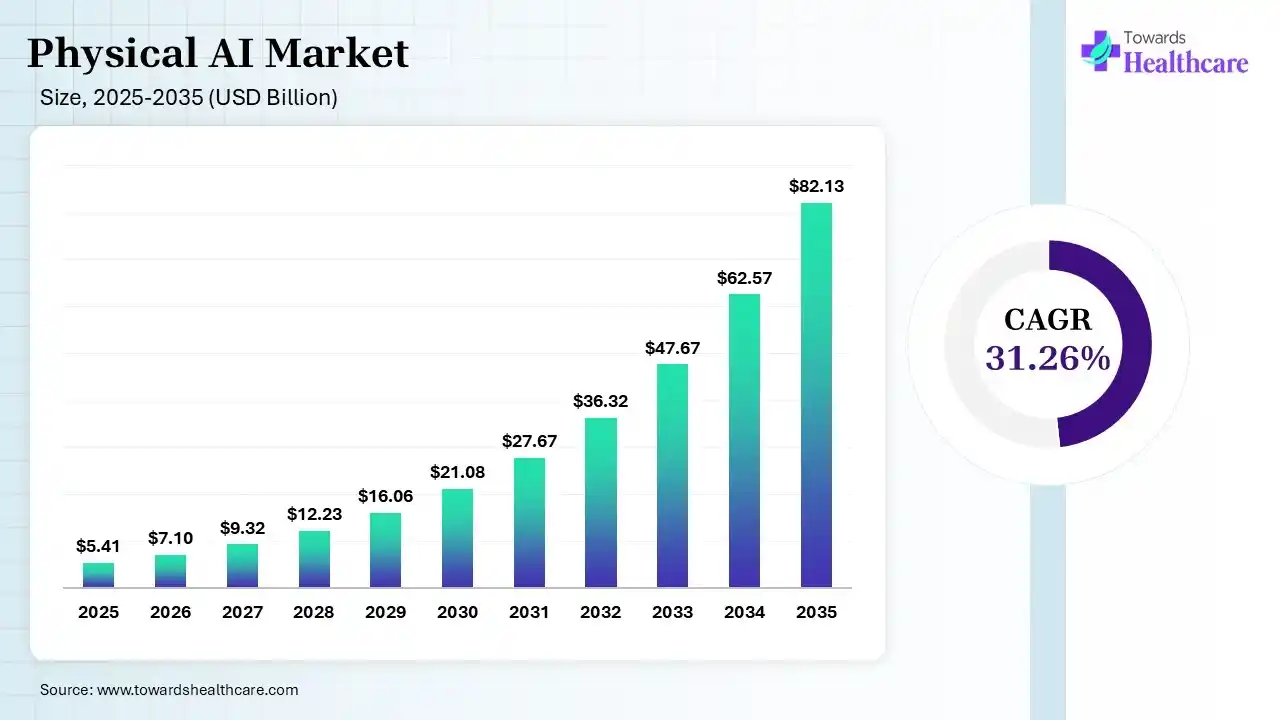
According to Towards Healthcare, the physical AI market is projected to experience significant growth, with estimates suggesting the market size will increase from USD 7.10 billion in 2026 to approximately USD 82.13 billion by 2035. The market is expanding at a CAGR of 31.26% between 2026 and 2035. The AI-based health monitoring application inspires consumer meeting in their health goals by offering AI-based feedback and recommendations, keeping consumers informed and proactive about their health. It improves the abilities of medical care professionals. AI-driven technology plays a significant role in growing hospital effectiveness, reducing physician burnout, and enhancing patient results. AI-based predictive analytics supports identifying patients who are at risk of complications, readmissions, or disease progression. Machine learning algorithms scan patient information to discover early warning signals of illnesses involving sepsis, heart failure, and post-surgical infections, enabling physicians to treat before the symptoms progress.
An Ecosystem Building the Future of Medical Robotics
Medical robotics leaders are already applying simulation-based advancement to solve particular surgical challenges.
CMR Surgical and Cambridge Consultants, part of Capgemini, are applying Cosmos-H-Dreams to implicitly learn interaction physics for soft-tissue surgical technology and generate patient-driven simulations. CMR contributed nearly 500 hours of anonymized clinical information from its Versius Surgical Robotic System to the Open-H Embodiment open dataset, advantages procedures involving cholecystectomy, prostatectomy, hernia repair, and hysterectomy.
“Open source models allow us to build on shared knowledge, accelerating responsible innovation and, ultimately, give us the potential to deliver more consistent care and better outcomes for patients worldwide,” said Chris Fryer, chief technology officer at CMR Surgical.
Johnson & Johnson MedTech is applying Isaac for Healthcare’s Medical Physics Simulation and a Cosmos-driven foundation model to build digital twins of its endoluminal MONARCH stage for urology, modeling complex anatomy and kidney-stone scenarios.
XCath is using the Medical Physics Simulation for endovascular autonomy strategy training. Inner Logic is speeding up the development of healthcare technology with synthetic information, validating tool mechanics and creating in silico evidence to support regulatory pathways with NVIDIA Medical Physics Simulation.
Medtronic Structural Heart is exploring applying Medical Physics Simulation with simulated X-ray sensing to create data for catheter steering research.
A recent report by Towards Healthcare highlights that the physical AI market is growing, as AI-based technology offers major advantages to the sector of medical care, the professionals working within it, and the patients who interact with it each day. Medical care professionals expect reduced operational expenses because of improved decision-making and more effective automated solutions. Providers leverage the technology to project bespoke treatment plans and diagnose conditions more rapidly and precisely than they could alone. Patients expect increased health outcomes and reduced expenses from more effective health solutions. Robotic surgical equipment outfitted with AI-based technology helps surgeons perform surgeries better by decreasing their physical strain and offering updated data during the operation.