



Samsung Launches AI-Powered Health Assistant Beta
Published: 23 Jul 2026
Author: Gautam mahajan



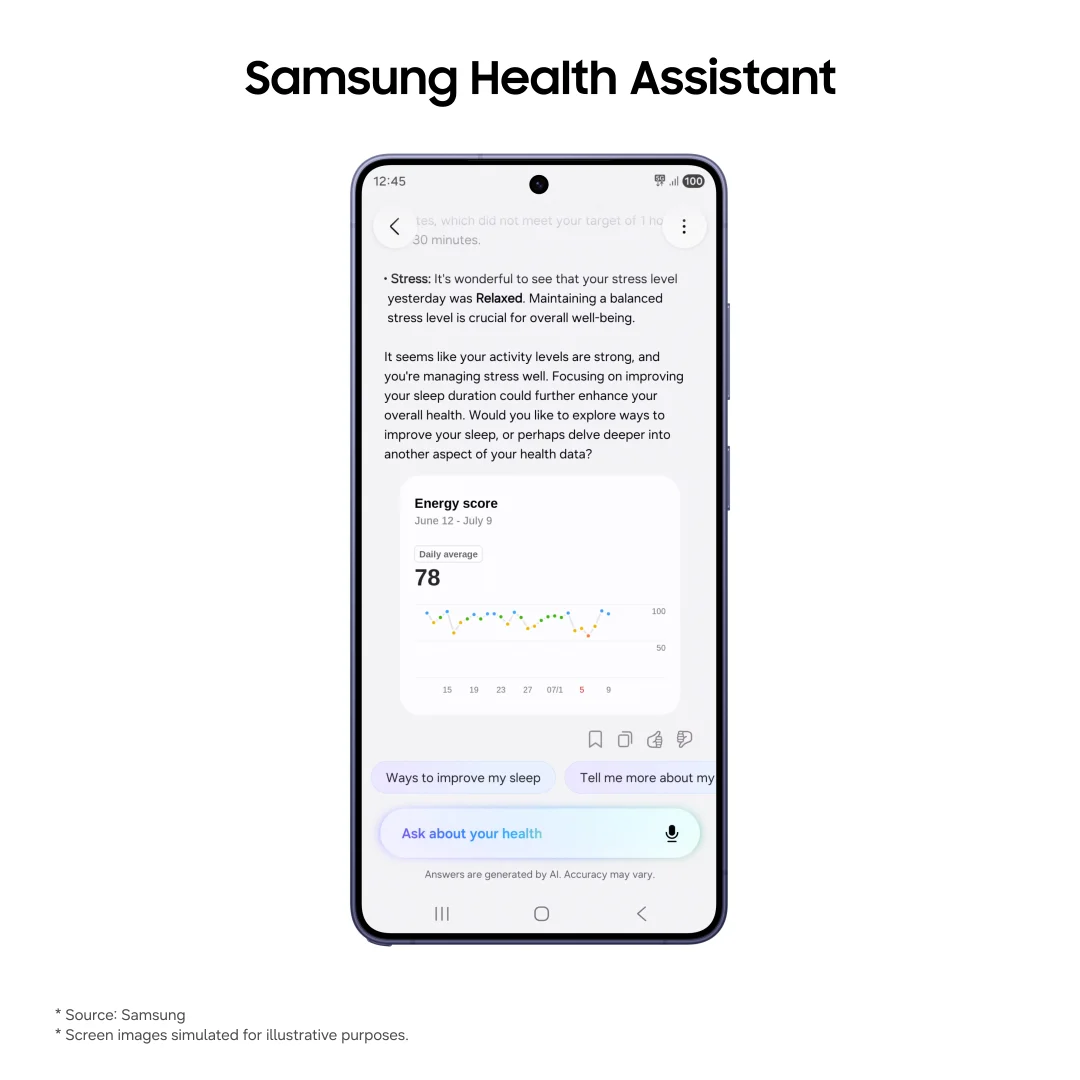
In July 2026, Samsung launched Health Assistant Beta, which is the first fully integrated AI-powered personal health assistant. This health assistant helps users by connecting important health data and empowering them to ask questions about their health and gain access to personalized health guidance and recommendations, thereby achieving their health and wellness goals.
Inside Samsung’s New Health Assistant
Recently, health information has often been scattered across various devices and apps, making it hard for individuals to understand their overall wellness. Samsung Health Assistant is a new AI-powered personal health assistant, currently in beta for eligible U.S. users.
This assistant allows users to view their Energy Score and receive personalized health recommendations by integrating data from Samsung Health’s core wellness fundamentals like sleep, activity, nutrition, mindfulness, and vitals. It also offers actionable insights and helps them to track their health with recommendations validated by health professionals. Future features of Health Assistant will also include coaching for behavior change, weight management services, and highly personalized recommendations based on their schedules and preferences.
Dr. Hon Pak, Senior Vice President of Digital Health at Samsung, remarked that Health Assistant improved users' understanding of their health and supports early detection through daily monitoring. Additionally, Samsung’s acquisition of Xealth improves the connection between health data and clinical care.
Significance and Future Perspective
Instead of analyzing fragmented graphs and charts, users receive clear explanations of how different wellness factors impact their sleep and overall energy score. The assistant operates alongside a knowledge base supported by physician-validated guidance. Meanwhile, it also bridges wellness and clinical care with patient-consented wearable insights directly to healthcare providers between appointments.
Contextual ecosystem integration with Samsung's Personal Data Engine (PDE) will offer tailored suggestions, such as recommending breathing exercises before a busy work meeting. Samsung's active behavior modification and specialized weight management and behavior-modification tools support active and goal-driven coaching. Samsung is shifting user habits from reactive healthcare toward predictive prevention, emphasizing personalized care.
Impact on the Healthcare Industry
Health Assistant Beta impacts the healthcare industry by transforming scattered biometric data into actionable insights, securely sharing consented health metrics with doctors, and evolving healthcare to a proactive and preventive approach.
This bridges the gap between wellness and medicine by allowing care teams to monitor patient vitals remotely between clinic visits. Instead of addressing illnesses after symptoms appear, the AI empowers individuals to manage lifestyle factors like sleep, nutrition, and cardiovascular load, which recognizes warnings. Contextual health guidance also offers highly relevant and personalized health advice.
The healthcare industry often struggles with disconnected data across multiple domains by combating data fragmentation. Generic AI models often provide inaccurate or generic advice regarding health, and Samsung is enhancing AI reliability by validating recommendations with physicians and certified health coaches. Multidimensional health data into actionable this AI system alleviates clinician burnout with personalized guidance.
Impact of the Digital Health Monitoring Devices Market
The global digital health monitoring devices market size is calculated at USD 5.36 billion in 2025 and is predicted to increase from USD 6.39 billion in 2026 to approximately USD 30.86 billion by 2035, expanding at a CAGR of 19.13% from 2026 to 2035.
According to Precedence Research, this health assistant overcomes critical limitations in the digital health monitoring industry by integrating on-device AI with holistic ecosystem data into actionable and validated health guidance.
Instead of treating metrics in isolation, the assistant connects information across Samsung Health's five core fundamentals, including sleep, activity, nutrition, mindfulness, and vitals. It explains how these variables impact one another by securely sharing user-consented wearable data with physicians, providing continuous care between clinic visits. By leveraging Samsung's Personalized Data Engine, the assistant references real-world context to tailor its recommendations for hyper-personalization.
Samsung addresses industry challenges by transforming fragmented data to deliver a holistic understanding of health and drive real action. By leveraging the personal data engine for personalized recommendations and validating insights through collaborations with institutions like the NIH, CDC, and MIT, the platform ensures clinical relevance.
About Samsung
Samsung is a South Korean multinational conglomerate and one of the world's largest technology companies, manufacturing from smartphones and semiconductors to smart home appliances. Its overall aim is to devote its talent and technology to creating superior products and services that contribute to a better global society through hardware excellence, digital convergence, and the integration of AI.
Samsung operates through core divisions like Device eXperience (DX) and Device Solutions (DS). DX delivers consumer hardware like Galaxy smartphones, smart home appliances, and Neo QLED TVs, combined with software ecosystems like SmartThings and Samsung Pay. Concurrently, DS manufactures vital components, producing memory chips, microprocessors, and foundry services for the global tech industry.