



Samsung Launches AI Health Assistant by Bringing AI into Your Daily Health
Published: 29 Jul 2026
Author: Gautam Mahajan



In July 2026, Samsung launches an AI health assistant, indicating a growing trend among tech giants. This fully integrated AI-powered personal health assistant offers cohesive AI-driven insights for its users, combining unstructured and fragmented datasets across apps, devices, and services to improve overall access to consumer healthcare and knowledge.
How Samsung Plans to Unite Your Fragmented Health Data
Over the last decade, consumer use of wearables, particularly for health metrics tracking, has increased exponentially. In fact, some reports indicate that nearly 60% of Americans now own at least one wearable, with over 83% stating that they wear a device more than 5 days a week.
Moreover, with new and different form factors emerging, consumers have even more preferences and options, ranging from rings and bracelets to glasses and watches. This in addition to an incredibly massive health data and tracking software and app market, which has grown actively since the early days of the smartphone. While these tools have been profoundly useful for consumers, little has been done to unite all of these services and the data collected from them into one cohesive arena.
Samsung’s goal is to start iterating on this exact problem, like health information is often fragmented across multiple devices, apps, and services, making it difficult for people to build a complete understanding of their overall wellness. While access to health data has never been greater, many users still struggle to interpret what their data means and understand how they can make meaningful changes in their lifestyle. Therefore, the new Health Assistant platform has been built to collate information across datasets to help users bring these insights together.
Samsung and other tech giants like Nvidia, Google, and Amazon are heavily investing in healthcare innovations, clinical care, and drug development. This trend shows these companies want to use their tools and data to help users understand health information and succeed in a valuable market.
Impact on the Healthcare Industry
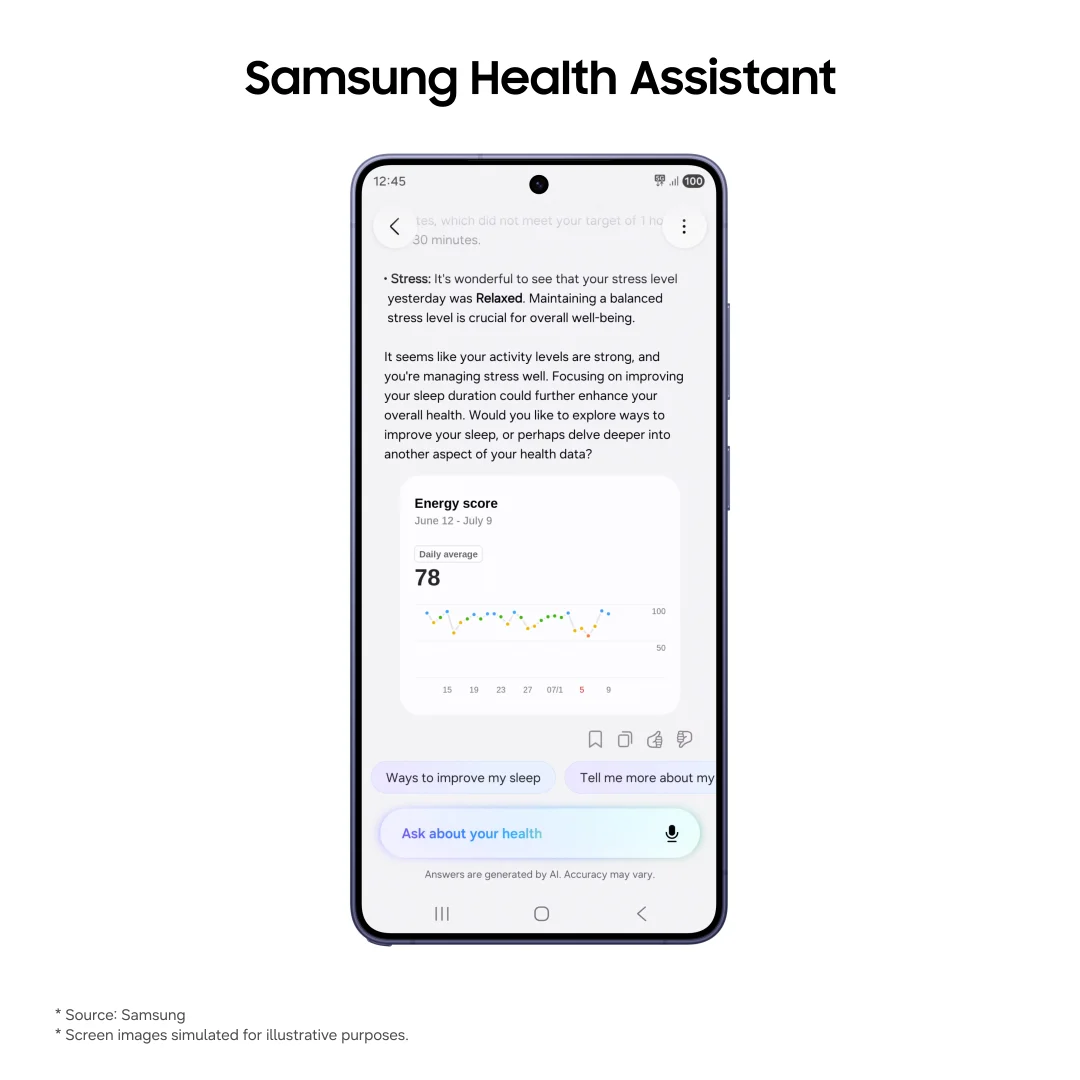
This AI-powered personal health assistant within the Samsung Health ecosystem impacts the healthcare industry by centralizing fragmented biometric data into actionable insights, addressing the challenges of data silos and reactive care by bridging consumer wearables with continuous remote physician monitoring platforms.
This launch connects metrics across sleep, activity, nutrition, mindfulness, and vitals, leaving raw data isolated on a device, as an effective data integration. The shift to preventive care turns daily stats into an Energy Score and custom guidance to stop health issues with early intervention before symptoms escalate, while the clinician-patient bridge uses tools like Xealth integration so doctors can view real-world data from wearables between visits.
This addresses industry challenges by combating data fragmentation through isolated streams and improving response accuracy through medical research partnerships, and navigating regulatory limitations by positioning the assistant as a wellness tool over a diagnostic device. Data integration leverages split streams to connect health variables, research partners like the CDC, NIH, and MIT ensure medical accuracy, and a regulatory wellness label to prevent delays while planning future clinical use.
Impact of the Digital Patient Monitoring Devices Industry
The global digital patient monitoring devices market size was calculated at USD 16.20 billion in 2025 and is predicted to increase from USD 20.29 billion in 2026 to approximately USD 144.16 billion by 2035, expanding at a CAGR of 24.43% from 2026 to 2035.
According to Precedence Research, Samsung’s launch of its AI-powered personal health assistant impacts the digital patient monitoring industry by transforming raw biometric logs into interactive guidance, bridging fragmented data gaps across devices.
The integration of consumer wellness data into a single platform evolves the digital patient monitoring industry by transforming the overall ecosystem and care transformation, developing a unified health platform where ecosystem unification links data from phones and smartwatches into one screen, proactive care leverages AI to talk with you about your wellness, and clinical bridge integration sends your wearable info straight to your doctors.
Concurrently, to resolve the industry challenges, the platform combats data fragmentation by consolidating scattered datasets, resolves interpretation fatigue by turning complex biometric graphs into a simple energy score, reduces AI hallucinations through partnerships with top medical groups to anchor responses in verified research, and efficiently handles regulatory boundaries by classifying as a general wellness assistant.
About Samsung
Samsung is a global South Korean manufacturing company that strongly emphasizes consumer electronics, mobile communications, and device solutions. Its primary goal is to devote its talent and technology to develop superior products and services that further foster a better global society while maintaining market dominance and customer satisfaction.
The company offers diverse mobile and computing devices like Galaxy phones, home entertainment systems including advanced TVs, and connected digital appliances. It also builds crucial semiconductors and components for global tech brands with digital services like Samsung Pay and SmartThings by leveraging its advancements in AI and connected technology to enrich everyday human experiences and foster sustainable prosperity.