



Surgical Science Launches Aeris, Transforming Anybody or Surface into an Interactive Ultrasound Simulator
Published: 31 Aug 2026
Author: Towards Healthcare



Surgical Science, the worldwide leader in simulation products for medical care training, has launched Aeris, a unique technology allowing point-of-care ultrasound (POCUS) training anywhere, on any person, manikin, or surface without hardware attachment, tags, optical tracking, or built-in tools.
"POCUS is used in nearly every specialty in medicine, but training quality has not kept pace," said Tom Englund, CEO of Surgical Science. "Using Aeris, any room becomes a training room, and any body becomes a patient with real clinical scenarios, no tags, cameras, or headsets required. This isn't the next version of ultrasound training. It's the first simulation product to deliver freely moving, full-body ultrasound simulation on any surface."
Aeris was built to meet a significant training gap as the sector grows.
What changes with Aeris:
- Aeris allows full freedom of probe movement in the chest, abdomen, and pelvis with a single correction step.
- Aeris functions anywhere; learning isn't limited to a lab or a classroom.
- Aeris lets instructors simulate particular conditions or pathologies while learners construe in real time.
- Programs are no longer restricted to a single manikin or to practicing on peers with general anatomy.
- The service is a fraction of the expense of a high-fidelity manikin, enabling programs to equip major sites.
Aeris launches with pathology-driven training in the chest, abdomen, and pelvis. Plans include increasing across OBGYN, neonatal, pediatric, and interventional requests.
Surgical Science will accept orders from US consumers in Q4 2026, with initial shipments planned for later in the quarter. Aeris is intended to make high-fidelity ultrasound simulation more accessible, significantly reducing the cost of adoption as compared to traditional high-fidelity simulator platforms.
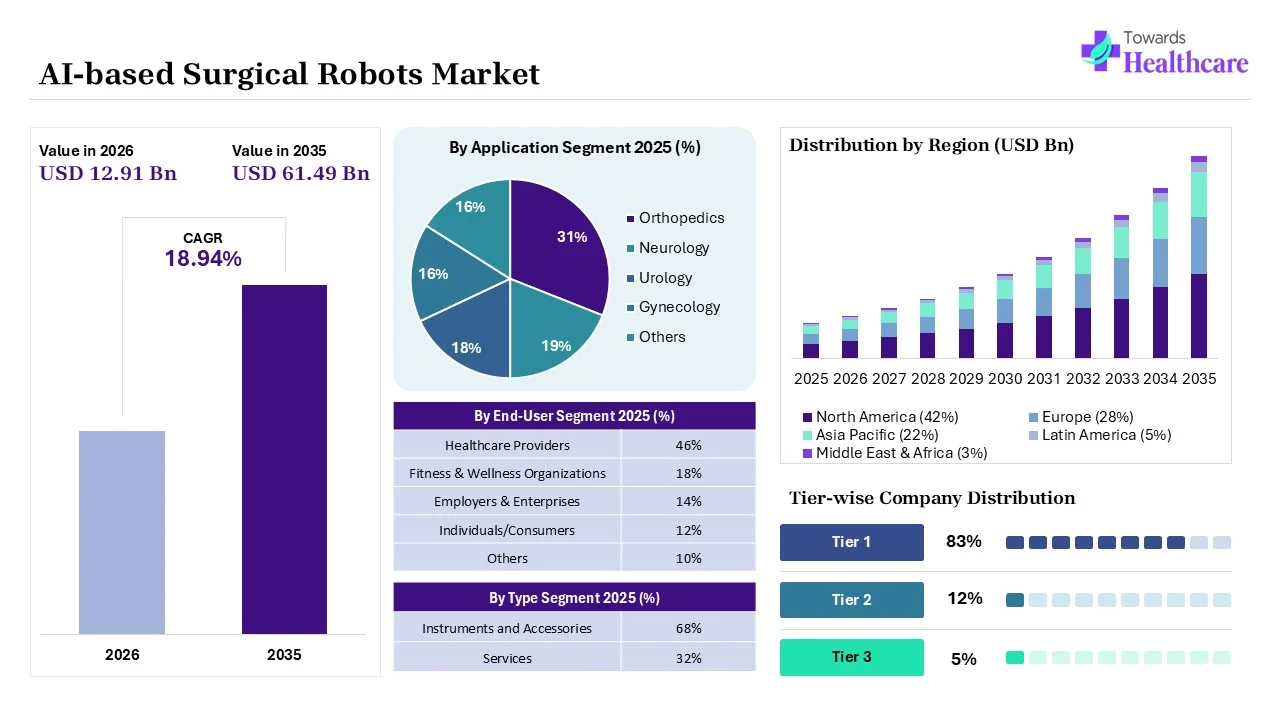
According to Towards Healthcare, the AI-based surgical robots market is projected to grow significantly, with estimates indicating the market size will increase from USD 12.91 billion in 2026 to approximately USD 61.49 billion by 2035, expanding at a CAGR of 18.94% from 2026 to 2035. AI modeling is enabling physicians to have well-developed intraoperative metrics like force and tactile measurements, improved identification of positive healthcare margins, and also allowing for the complete automation of significant steps in healthcare procedures.
Artificial intelligence (AI) is transforming nearly every aspect of modern life. In the healthcare field, robotic surgery is the sector with some of the most groundbreaking and impactful developments. Outline recent contributions of AI to the field of robotic surgery with a specific focus on intraoperative improvement. AI development in robotic surgery is some of the most advanced research happening recently, and the research outlined in this review shows some of the most exciting inventions in recent years. AI-based technology improves surgical planning, intraoperative support, surgical training, patient intensive care, and postoperative care. AI and surgical robots supports analyze scans and surgeries, identify tumors, and facilitate instrument positioning.
About Surgical Science
Surgical Science has around 310 workers. The organization is headquartered in Gothenburg, Sweden, and has processes in Tel Aviv, Israel; Stockholm, Sweden; Cleveland, US; and Cardiff, UK. Surgical Science is a foremost provider of healthcare simulation training and software solutions. Together with healthcare partners and customers worldwide, the company improves patient safety and medical care results using evidence-driven customized simulation to enhance healthcare proficiency and performance. Surgical Science is a medical simulation company at heart, run by humans offering their actions and passions for patients, medicine, and technology. Surgical Science (SS) is a flexibly accessible journal published monthly. The aim of this journal is to offer a platform for researchers and academicians. Surgical Science is a healthcare simulation organization at heart, run by humans indicating their actions and passions for patients, medicine, and technology to improve patient safety and healthcare results globally. Integration with significant healthcare device and robotic surgery organizations to build customized simulation technology directly into healthcare instruments.
A recent report by Towards Healthcare highlights that the AI-based surgical robots market is growing, as robots allow significant patient monitoring, provide consistent performance, lessen infection challenges, and optimize time efficiency for medical care providers. These developments offer a glimpse into healthcare robots of the future, where automation and AI-based technology further improve targeted care and clinical decision-making. In medical care solutions, robots are applied in different settings, delivering both direct and indirect benefits to consumers. They assist elderly and disabled patients with daily actions and also offer conversational engagement to lessen pain, loneliness, and boredom, a significant aspect of patient care. Healthcare robots are transforming modern medical care, with a broad range of types of healthcare robots being deployed in clinical environments. From surgical technology to rehabilitation assistants and telepresence devices, they are increasingly redefining what medical care robots are applied for. Understanding where healthcare robots are applied highlights their adaptability; they are found in operating rooms, diagnostic labs, rehabilitation centers, and even in the in-home care field.