



FDA Approves Revi Extend Implant for Urge Urinary Incontinence
Published: 18 Aug 2026
Author: Towards Healthcare



The US Food and Drug Administration (FDA) granted 510(k) clearance to BlueWind Medical's Revi Extend implant, a next-generation implantable tibial neuromodulation (ITNM) system designed to treat urgency urinary incontinence (UUI).
The Revi Extended Implant by BlueWind Medical has received US FDA 510(k) clearance. It’s a next-generation implantable tibial neuromodulator for urge urinary incontinence that is characterized by an extended life of 15 years, as compared with 10 years for the earlier implant.
The producer plans a limited US launch of Revi Extend in the fourth quarter of 2026.
“FDA clearance of our next-generation implant reflects our continued commitment to meaningful innovation for patients and physicians,” Kerry Nelson, Chief Executive Officer of BlueWind Medical, stated in a news release. “Extending implant durability coupled with our remotely enabled software advancements allows patients to receive the latest therapy innovations for fifteen years into the future.”
Revi Extend is implanted near the ankle under local anesthesia in an outpatient setting. It requires no internal batteries or leads. Rather, patients use an external powered wearable to stimulate the posterior tibial nerve once daily at home.
The recent approval is supported by 3-year efficacy and safety information from the significant OASIS research. Of 90 women with urge urinary incontinence, 71 (79%) had at least a 50% reduction in episodes with the neuromodulator, based on voiding diaries. Symptom improvement was reported by 82%. Device satisfaction was high (95%). Outputs were published in The Journal of Urology.
Data on the Revi System
Clinical evidence helping the Revi platform comes primarily from the multicenter, prospective, single-arm OASIS pivotal study (NCT03596671), which enrolled 151 women with emergency urinary incontinence. The information presented sustained symptom improvement and an acceptable long-term safety profile in women with UUI.
Of the 151 implanted participants, 140 (93%) completed the 12-month study. Among these, 119 enrolled in the extension research, and 90 completed the 36-month assessment.
At 3 years, 79% of evaluable participants achieved at least a 50% reduction in UUI episodes based on 3-day voiding diaries, while 63% experienced at least a 75% reduction in episodes. Medicinal response remained stable over time, with responder rates of 78% at 6 months and 79% at 36 months. Furthermore, 95% of respondents reported satisfaction with therapy, and 82% described themselves as "much better" or "very much better" on the Patient Global Impression of Improvement scale. No device-related or procedure-related severe side effects were reported over 3 years.
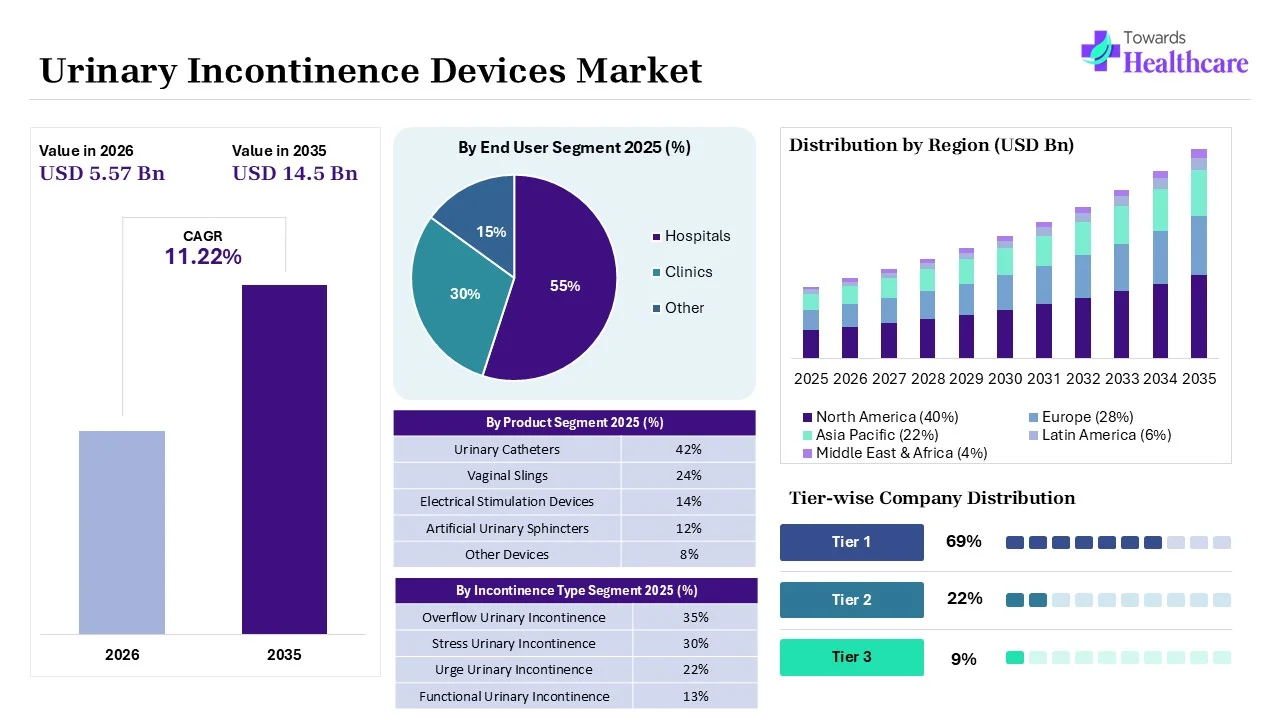
According to Towards Healthcare, the urinary incontinence devices market is projected to grow significantly, with estimates indicating the market size will increase from USD 5.57 billion in 2026 to approximately USD 14.5 billion by 2035, expanding at a CAGR of 11.22% from 2026 to 2035. External urinary devices (EUDs) support treating incontinence in daily life and thus enhance quality of life. EUDs involve absorbent products, female external catheters, male external catheters, and penile compression devices. A broad range of external urinary tools are available for patients with stress urinary incontinence. To confirm the right choice for every patient based on their needs, shared decision-making is essential with guidance from a health care professional with expertise in continence care. These are reusable devices inserted into the vagina to support the bladder and put pressure on the urethra so patients don't leak urine.
About the Revi System
The Revi System consists of a small implant placed adjacent to the posterior tibial nerve near the ankle, with the procedure performed as an outpatient procedure under local anesthesia. Therapy is delivered through an external wearable controller that powers the implant, avoiding the requirement for an implanted battery or lead extensions. Patients self-administer stimulation sessions once a day at home.
A recent report by Towards Healthcare highlights that the urinary incontinence devices market is growing, as incontinence control tools range from non-invasive mechanical supports and external collection technology to well-developed neuromodulation implants. General options include supportive pessaries or urethral implants for women, external compression clamps or condom catheters for men, and implantable sacral nerve stimulators such as the Medtronic InterStim Technology for chronic bladder control. Women choose tools that go inside the vagina, such as tampons or vaginal sponges. They offer temporary control by putting pressure on the tissues of the bladder. This helps keep urine from escaping and is specifically good for stress incontinence, where exercise, laughing, and sneezing cause urine to leak.